
Why Audemars Piguet is Special: 2026 Collector's Guide
Posted by Luxury of Watches on 31st Aug 2026

Why would a stainless steel timepiece, lacking the inherent value of gold or platinum, command a price tag that rivals a luxury vehicle or a home deposit? It's a question that many collectors face when looking at the skyrocketing secondary market premiums and the sheer exclusivity surrounding the brand. You're likely skeptical about whether the technical value justifies the cost or if you're simply paying for a name. Understanding what makes audemars piguet so special requires looking beyond the social media trends to the mechanical mastery and disruptive spirit that defines this independent manufacture.
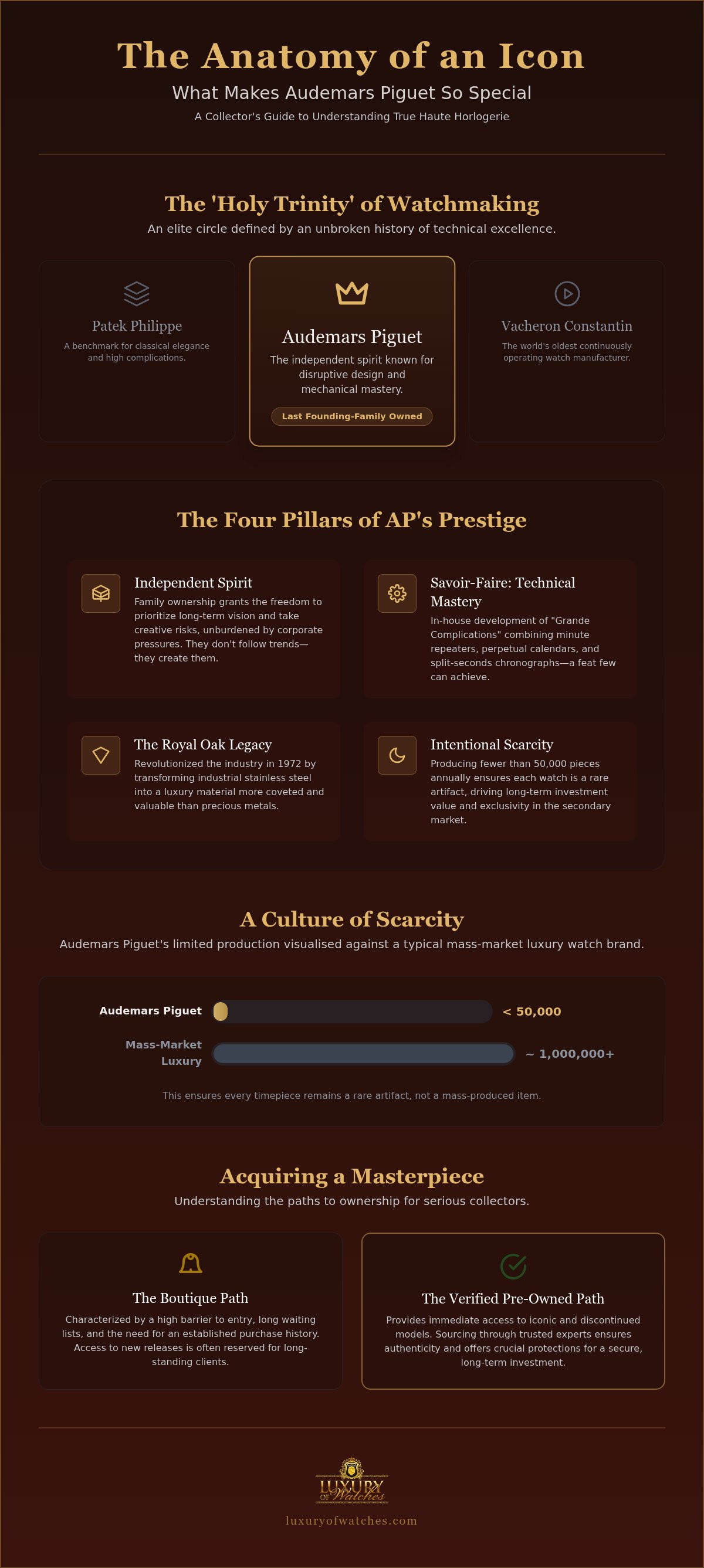
While the Royal Oak often dominates the conversation, the brand's identity is built on a heritage of over 150 years of uncompromising Swiss craftsmanship. Audemars Piguet remains a cornerstone of the prestigious Holy Trinity; a status earned through a relentless commitment to high complications and material innovation. This 2026 collector's guide explores the unique blend of heritage and rebellion that cements their standing in the industry. We'll examine the technical brilliance of the latest releases, identify iconic models beyond the mainstream favorites, and provide the pragmatic insights you need to make a secure investment in a market that values both history and modern efficiency.
Key Takeaways
- Understand why Audemars Piguet remains one of the three most prestigious watchmakers in the world and how its independent spirit distinguishes it from corporate-owned peers.
- Discover what makes audemars piguet so special by exploring their "Savoir-Faire" in high complications, from melodic minute repeaters to the legendary Grande Complication.
- Learn how the Royal Oak revolutionized the industry by transforming stainless steel into a luxury material more coveted than solid gold.
- Gain insight into the brand's limited annual production and why this intentional scarcity creates long-term investment value in the secondary market.
- Develop a clear strategy for bypassing the high barrier to entry at boutiques and learn the benefits of sourcing verified pre-owned icons with expert protections.
The 'Holy Trinity' Status: Why Audemars Piguet Sits at the Pinnacle
The term 'Holy Trinity' of watchmaking is not a mere marketing slogan. It represents an elite circle of three Swiss manufactures that have maintained an unbroken history of technical excellence: Patek Philippe, Vacheron Constantin, and Audemars Piguet. Since its founding in 1875 by Jules Louis Audemars and Edward Auguste Piguet, the brand has operated at the very peak of the industry. These two founders combined their unique talents, with Audemars focusing on complex movements and Piguet overseeing the final quality and financial health of the firm. This partnership established a culture of collaboration that continues to define the manufacture today.
Collectors often ask what makes audemars piguet so special compared to other high-end names. The answer lies in its refusal to compromise on its identity. While many historical brands vanished or were absorbed during industry crises, AP remained steadfast in the Vallée de Joux. It is this geographical and spiritual anchor that allows them to produce fewer than 50,000 pieces annually. This ensures that every watch remains a rare artifact of Swiss culture rather than a mass-produced luxury item.
The Power of Independent Ownership
In the current market, independence is a rare luxury. Most famous watch brands are now owned by massive conglomerates like LVMH or Richemont. Audemars Piguet stands apart as the last member of the Holy Trinity that is still owned by the founding families. This status grants them the freedom to prioritize long-term brand vision over quarterly shareholder profits. They don't have to follow market trends; they create them. This independence is a central component of what makes audemars piguet so special to serious investors. They can invest years into developing a single movement or a revolutionary material without the pressure of corporate bureaucracy.
This autonomy has allowed the brand to preserve ancestral watchmaking techniques that might otherwise have been lost to automation. By studying Audemars Piguet's history, it becomes clear that their independence was the catalyst for their most disruptive designs. They have the agility to take massive creative risks that publicly traded companies simply cannot afford to take.
Defining Haute Horlogerie in 2026
True Haute Horlogerie is distinguished by what happens beneath the dial. In 2026, Audemars Piguet continues to set the standard for hand-finishing and in-house movement architecture. Every component, even those hidden deep within the caliber, undergoes rigorous finishing processes such as anglage, perlage, and Côtes de Genève. This 'Spirit of Le Brassus' ensures that every timepiece is a mechanical masterpiece. While other brands may use the 'luxury' label, AP delivers a level of craftsmanship where the human hand is still the most important tool in the workshop. This dedication to the 'old world' craft, paired with an avant-garde aesthetic, ensures their position at the pinnacle of watchmaking remains unchallenged.
Savoir-Faire: The Technical Mastery Beyond the Design
While the bold silhouette of the Royal Oak often captures the initial interest of a collector, the mechanical heart of the watch provides the most compelling answer to what makes audemars piguet so special. The manufacture has spent over a century mastering the three pillars of horological complications: astronomy, chiming, and chronographs. Unlike brands that rely on outsourced calibers, Audemars Piguet develops its movements in-house, ensuring that the architecture of each piece is as unique as its exterior. This technical independence allows them to maintain the 'Grande Complication' standard, a rare achievement where a single timepiece houses a minute repeater, a perpetual calendar, and a split-seconds chronograph.
The brand's perpetual calendars are widely regarded as the gold standard of the industry. These movements are engineered to account for the varying lengths of months and leap years without requiring manual adjustment until the year 2100. Achieving this level of precision requires a deep understanding of astronomical cycles and a mechanical complexity that few other houses can replicate. For those looking to secure a piece of this horological history, exploring authentic pre-owned Audemars Piguet watches offers a practical path to owning these high-complication masterpieces.
The Art of the Minute Repeater
Chiming watches have a storied history in the Vallée de Joux, where watchmakers once worked in near-silence during long winters. Audemars Piguet has elevated this tradition through its Supersonnerie technology. By treating the watch case like a musical instrument, they've solved the historical problem of muffled sound in water-resistant cases. The result is a chime that is exceptionally clear, loud, and harmonically rich. This pursuit of acoustic perfection is a testament to the brand's refusal to let modern constraints limit traditional artistry.
Finishing Techniques: The Invisible Value
The true mark of Haute Horlogerie is found in the finishing of components that the wearer may never see. Every bridge, screw, and wheel is decorated by hand using techniques that have remained unchanged for generations. Anglage involves hand-filing sharp edges into smooth, 45-degree chamfers, while Perlage creates overlapping circular patterns on the baseplates. Côtes de Genève adds a rhythmic, striped texture to the bridges, catching the light with every movement of the wrist. Black polish is the most demanding technique, where a steel surface is polished so perfectly that it appears either brilliant white or deep black depending on the angle of light. These hundreds of hours of manual labor ensure that every internal component meets the same aesthetic standard as the case itself.
The Royal Oak Legacy: A Disruptive Icon
In 1972, the Swiss watch industry faced an existential threat known as the Quartz Crisis. While other manufactures struggled to compete with cheap electronic movements, Audemars Piguet chose a path of radical defiance. They released a stainless steel sports watch priced higher than many gold timepieces of the era. This audacity is a fundamental part of what makes audemars piguet so special; they didn't just survive the crisis, they redefined the very concept of luxury. The Royal Oak introduced the world to "Luxury Steel," proving that craftsmanship and design could outweigh the intrinsic value of precious metals.
The watch's visual identity remains unmistakable. Its octagonal bezel, inspired by a traditional diver's helmet, is secured by eight visible hexagonal screws. The "Tapisserie" dial, created using a rare engine-turning process, adds a level of depth and texture that has become a brand signature. This design language eventually birthed the more aggressive Royal Oak Offshore in 1993 and the futuristic Royal Oak Concept line in 2002, ensuring the collection remained relevant across generations.
Gerald Genta’s Blueprint
The legendary Gerald Genta reportedly designed the Royal Oak in a single night. His vision was to create a watch where the case and bracelet flowed together as a single, integrated unit. This was a departure from the traditional approach of attaching a leather strap to a watch head. For the modern purist, the "Jumbo" Extra-Thin remains the ultimate expression of this blueprint. It maintains the original 39mm proportions and ultra-slim profile that shocked the world over five decades ago.
Material Innovation in 2026
Audemars Piguet has never been content with just steel and gold. In 2026, the manufacture continues to lead the industry in material science, utilizing advanced substances that provide both durability and unique aesthetics. This commitment to innovation is another layer of what makes audemars piguet so special for contemporary collectors. Key developments include:
- Ceramic: Used in the 2026 "Bleu Nuit, Nuage" Flying Tourbillon, this material is notoriously difficult to finish. AP achieves a level of brushing and polishing on ceramic that matches their steel counterparts.
- Bulk Metallic Glass (BMG): A palladium-based alloy featured in recent models that offers incredible scratch resistance and a unique luster.
- Frosted Gold: A collaboration with jewelry designer Carolina Bucci, using an ancient Florentine technique to create a shimmering, diamond-like finish on the case and bracelet.
- Forged Carbon and Tantalum: Materials originally borrowed from aerospace and medical industries to provide lightweight strength and corrosion resistance.
These innovations ensure that while the silhouette remains iconic, the technical execution is always pushing toward the future.
Exclusivity and Value: The Audemars Piguet Market
The economic allure of Audemars Piguet is built on a foundation of extreme scarcity. While a brand like Rolex produces over one million timepieces annually, Audemars Piguet maintains a strictly limited output of fewer than 50,000 watches per year. This massive disparity in volume creates a "Veblen Good" effect, where the desirability of the product actually increases alongside its price and the difficulty of acquisition. This intentional restriction is a key factor in what makes audemars piguet so special to the modern investor. Every piece is treated as a rare asset, often outperforming traditional financial markets over the long term.
The brand's cultural dominance is further cemented through high-profile collaborations. By partnering with cultural icons like Travis Scott or global franchises like Marvel, AP has successfully bridged the gap between traditional Swiss heritage and contemporary street culture. These limited editions often see immediate appreciation on the secondary market, sometimes trading at significant premiums shortly after release. This ability to remain culturally relevant while maintaining "Holy Trinity" standards ensures that the brand appeals to both traditional horologists and a new generation of high-net-worth collectors.
Scarcity by Design
The "waiting list" is a frequent point of frustration for new collectors, but it reflects the reality of boutique priorities. Direct allocations are typically reserved for clients with long-standing purchase histories, leaving many to wait 12 to 24 months for a standard Royal Oak. This creates a scenario where specific models appreciate the moment they leave the boutique. If you want to bypass these barriers and avoid the uncertainty of boutique allocations, you can browse our collection of Audemars Piguet watches to secure an iconic model today.
Secondary Market Dynamics
In the 2026 market, the stability of Audemars Piguet as an asset class remains strong despite broader economic fluctuations. A pre-owned AP watch is one of the few luxury items that historically retains or exceeds its original retail value over decades. For serious collectors, the presence of original "Box and Papers" is non-negotiable for maximizing resale value. These documents act as the absolute verification of provenance, which is essential when navigating the high-value transactions typical of this sector. While the market can experience short-term volatility, the enduring prestige of the Holy Trinity ensures that these timepieces remain a secure harbor for capital.
Acquiring an Audemars Piguet: Strategy for Collectors
Entering the world of "Holy Trinity" watchmaking requires more than just capital; it requires a strategic approach to acquisition. For many, the initial hurdle is the boutique experience. While the prestige of a flagship store is undeniable, the reality for new collectors in 2026 is a significant barrier to entry. Authorized dealers often prioritize clients with extensive purchase histories, leaving new enthusiasts facing wait times of 12 to 24 months for even the most basic Royal Oak models. This high barrier is part of what makes audemars piguet so special in terms of perceived exclusivity, but it shouldn't prevent you from starting your journey with the brand.
Owning an AP also involves a commitment to meticulous maintenance. The complexity of calibers, particularly those in the Offshore and Perpetual Calendar lines, demands specialized care. Industry standards suggest service intervals of five to seven years to ensure the intricate lubricants and gaskets remain effective. Because these movements are among the most sophisticated in Switzerland, having a comprehensive protection plan is essential when purchasing from the secondary market. A robust warranty acts as a critical safety net for your investment, providing peace of mind that the mechanical integrity of your timepiece is guaranteed.
The Secondary Market Advantage
Choosing a trusted secondary retailer allows you to bypass the traditional waiting list and gain immediate access to the models you desire. This is particularly advantageous for collectors seeking discontinued references or limited editions that are no longer available at retail. Whether you're looking for a vintage "Jumbo" or a modern ceramic Offshore, the secondary market offers a breadth of inventory that boutiques simply cannot match. It's vital to identify dealers with a verified history and a physical presence to ensure a secure transaction. For a deeper look at navigating these choices, consult The Comprehensive Guide to Pre-Owned Luxury Watches.
Securing Your Investment
At Luxury of Watches, we understand that high-value horological investments require absolute verification. Every Audemars Piguet in our collection undergoes a rigorous inspection by master watchmakers to confirm its authenticity and mechanical performance. We bridge the gap between the allure of the manufacturer and the practical needs of the modern buyer by offering a 5-year in-house warranty on all AP watches. This coverage is specifically designed to protect the complex movements that define the brand's "Holy Trinity" status. By removing the traditional retail premiums and providing expert-backed security, we make the pinnacle of watchmaking accessible to serious collectors. To see how AP compares to other leading manufactures, explore our Top 15 Best Luxury Watch Brands Guide.
Securing Your Legacy in the World of High Horology
Audemars Piguet continues to define the boundary between traditional Swiss heritage and modern cultural disruption. By maintaining its independent family ownership and a strictly limited annual production, the manufacture preserves the rarity that serious collectors demand. Understanding what makes audemars piguet so special involves recognizing that every Royal Oak or high-complication masterpiece is a culmination of centuries of "Savoir-Faire" and a commitment to mechanical perfection that few other houses can match. These timepieces aren't just instruments of time; they're enduring assets that bridge the gap between art and engineering.
Navigating this exclusive market requires a partner that prioritizes security and intellectual validation. At Luxury of Watches, we provide a transparent path to ownership with guaranteed authenticity on all timepieces and secure worldwide shipping with expert support. Every acquisition is backed by our 5-year comprehensive in-house warranty, ensuring your investment is protected by the highest standards of technical care. We invite you to explore our curated collection of authentic Audemars Piguet watches and find the piece that resonates with your personal legacy. Your journey into the pinnacle of watchmaking starts with a single, decisive step.
Frequently Asked Questions
Why is Audemars Piguet more expensive than Rolex?
Audemars Piguet commands a higher price because of its limited annual output and the artisanal nature of its production. While Rolex produces over one million watches annually using industrial processes, AP creates fewer than 50,000 timepieces. Every AP movement undergoes extensive hand-finishing by master watchmakers, requiring hundreds of hours of manual labor. This level of Haute Horlogerie elevates the brand into the Holy Trinity, a tier above most mass-produced luxury tool watches.
Is an Audemars Piguet watch a good investment in 2026?
Audemars Piguet remains one of the strongest investment-grade brands in 2026. It's one of only three manufacturers that historically returns more than its retail value on the secondary market. This long-term appreciation is a core part of what makes audemars piguet so special for serious collectors. While market fluctuations occur, the combination of intentional scarcity and high global demand ensures that iconic models like the Royal Oak maintain exceptional value retention over time.
What is the most iconic Audemars Piguet model?
The Royal Oak is undeniably the most iconic model in the brand's history. Introduced in 1972, this Gerald Genta design created the luxury sports watch category and remains the manufacture's most sought-after silhouette. The "Jumbo" Extra-Thin reference is particularly revered for its adherence to the original proportions. Other significant lines include the rugged Royal Oak Offshore and the technically advanced Code 11.59, which showcases the brand's modern movement architecture and commitment to innovation.
How can I tell if an Audemars Piguet is authentic?
Authenticating an Audemars Piguet requires a microscopic inspection of the movement finishing and case architecture. Genuine pieces feature flawless hand-applied decorations like anglage and perlage that counterfeiters can't replicate. You should always verify that the serial numbers on the case match the official documentation provided. At Luxury of Watches, our master watchmakers perform an absolute verification process on every timepiece to ensure its provenance, providing you with total security for your high-value investment.
Why are Audemars Piguet production numbers so low?
Low production numbers are an intentional strategy to maintain exclusivity and ensure the highest standards of quality. The brand produces fewer than 50,000 watches annually because the hand-finishing of their complex movements is incredibly time-consuming. This restriction creates a "Veblen Good" effect, where scarcity drives high desirability and resale value. By refusing to scale production to meet market demand, Audemars Piguet protects the long-term value and prestige of every watch they release.
Does Audemars Piguet make their own movements?
Yes, Audemars Piguet is a true manufacture that develops and produces its own movements in-house. While they historically collaborated with other elite movement makers, they've shifted almost entirely to proprietary calibers over the last two decades. This technical independence allows them to create unique movement architectures that fit their specific case designs. Their mastery is most evident in their perpetual calendars and tourbillons, which are engineered and assembled entirely within their workshops in Le Brassus.
What is the difference between Royal Oak and Royal Oak Offshore?
The Royal Oak is the classic, slim, and elegant original design intended for versatility. In contrast, the Royal Oak Offshore is a more rugged and aggressive evolution introduced in 1993. The Offshore features a larger case, a more prominent rubber gasket under the bezel, and higher water resistance. While the standard Royal Oak is often preferred for formal wear, the Offshore is designed for a sporty, contemporary lifestyle with its bold proportions and oversized aesthetic.
How often should an Audemars Piguet be serviced?
Master watchmakers recommend servicing an Audemars Piguet every five to seven years to maintain its mechanical precision. These complex movements rely on specialized lubricants that can dry out, potentially causing wear on delicate internal components. Regular maintenance ensures the gaskets remain water-resistant and the movement stays accurate. To provide our clients with additional reassurance, Luxury of Watches offers a 5-year in-house warranty that covers the mechanical integrity of your timepiece after purchase.