
What Is a GMT Watch and How Does It Work? A Collector's Guide
Posted by Luxury of Watches on 4th Aug 2026
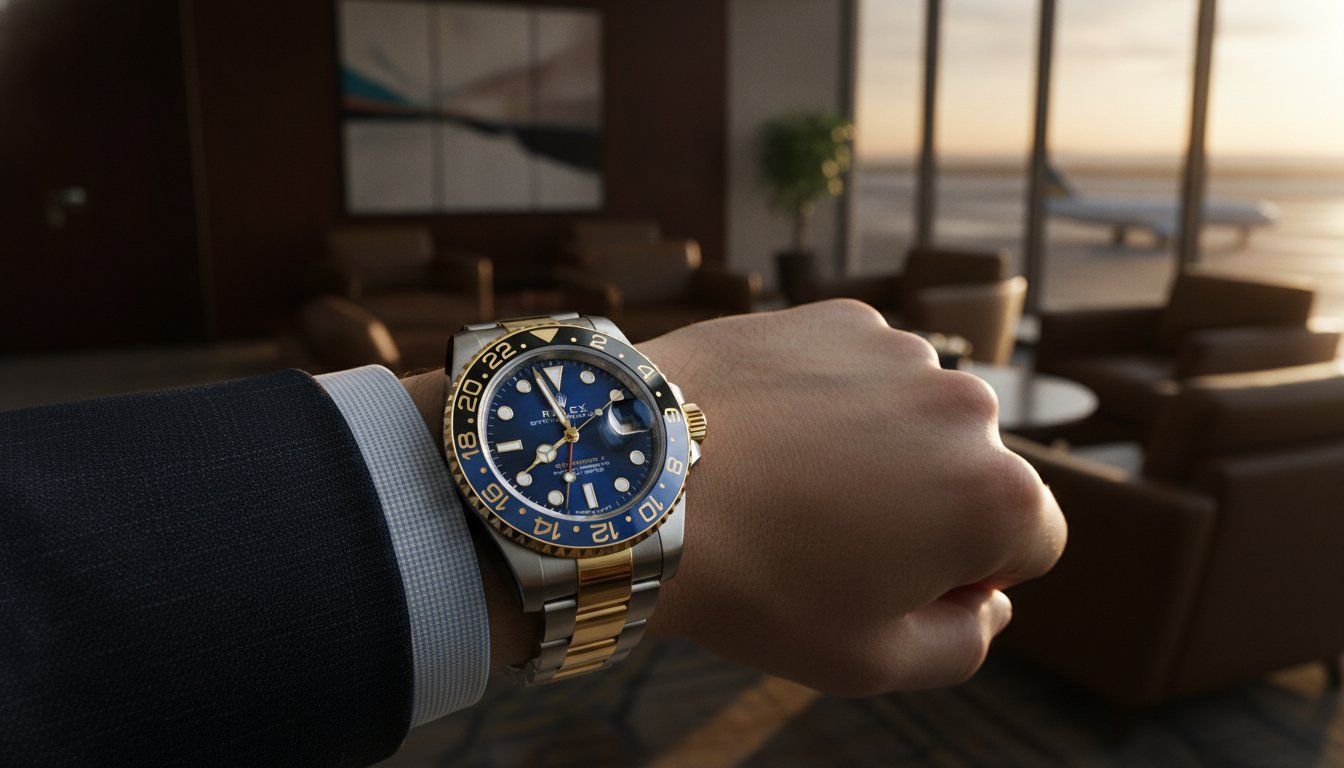
A GMT watch is the only complication that remains as essential in a global boardroom as it does at thirty thousand feet. While many collectors admire the aesthetic of the fourth hand and the iconic two-tone bezel, the true value lies in the mechanical sophistication that allows for seamless travel. If you have ever asked yourself what is a gmt watch and how does it work, you are likely looking for a tool that matches the pace of a modern, international lifestyle.
It's natural to feel hesitant when faced with the technical nuances of different movements or the significant price gap between a standard three-hand model and a dual-time instrument. You want to ensure your investment is both functional and secure. This guide will clarify the mechanical differences between "True" and "Office" GMT types so you can set your watch with total confidence. We will also explore how to utilize a rotating bezel to track a third time zone and identify which prestigious brands, such as Rolex and Breitling, offer the most enduring value for your collection.
Key Takeaways
- Learn how the additional 24-hour hand functions as a navigational tool for tracking multiple time zones without losing home time accuracy.
- Distinguish between 'Flyer' and 'Caller' movements to identify the specific mechanical configuration that best aligns with your travel or professional needs.
- Understand exactly what is a gmt watch and how does it work by mastering the coordination between the local hour hand and the rotating 24-hour bezel.
- Explore the investment landscape of professional GMT models and why timepieces from top manufacturers often retain exceptional value in the secondary market.
- Secure your next acquisition by prioritizing absolute verification and the long term protection of a comprehensive 5-year in-house warranty.
What Is a GMT Watch? Defining the Fourth Hand
A GMT watch is a specialized horological instrument designed to track multiple time zones simultaneously. At its core, the complication is defined by a fourth hand, often distinct in color or shape, that moves independently of the standard hour hand. While the traditional hour hand completes a rotation every 12 hours, the GMT hand takes 24 hours to circle the dial. Understanding what is a gmt watch and how does it work is the first step toward appreciating the engineering required to decouple the hour hands and provide a clear, 24-hour reference.
When collectors ask what is a gmt watch and how does it work, they're often seeking a balance between mechanical complexity and daily utility. This complication differs significantly from a Dual Time watch, which uses sub-dials to show a second zone, or a World Timer, which displays all 24 global time zones at once. The GMT watch remains the preferred choice for enthusiasts who value a clean, legible dial that offers immediate feedback on two or even three distinct locations. By using a 24-hour graduated bezel, the wearer can quickly calculate offsets without resetting the entire movement.
The History: From Pan Am to the Modern Traveler
The origins of this complication are found in the 1950s, a decade defined by the rapid expansion of international flight known as the Jet Age. As transcontinental routes became standard, pilots required a reliable way to manage time across shifting horizons. Rolex famously collaborated with Pan American World Airways to create a watch that could display both local time and the reference time used for flight logs. This partnership birthed a new category of cockpit tools that prioritized legibility and durability in high-stress environments.
Over the decades, these watches transitioned from essential navigational equipment to prestigious status symbols. The shift was driven by the iconic aesthetic of the 24-hour bezel and the sheer mechanical prowess required to maintain accuracy across zones. Today, owning a GMT is a nod to a legacy of exploration. It has become a cornerstone for any serious luxury watch collection, representing a time when the world first began to feel truly connected.
Greenwich Mean Time Explained
To master this complication, one must understand the standard that gives the watch its name. Greenwich Mean Time (GMT) was established as the international baseline for timekeeping in the 19th century. Although the scientific community transitioned to Coordinated Universal Time (UTC) in 1972, the term GMT persists in the world of high-end watchmaking as a tribute to its maritime and aviation heritage. It serves as the "zero point" from which all other zones are calculated.
Greenwich Mean Time acts as the prime meridian of watchmaking, anchoring every other time zone to a single, historical standard. While the mechanics can be intricate, the purpose is simple: providing a constant reference in an ever-moving world. Because these movements involve complex gearing, ensuring the authenticity of a pre-owned GMT is vital. Our process of absolute verification ensures that every component, from the 24-hour wheel to the bezel assembly, meets the exact standards of the original manufacturer, providing the security you need for such a significant acquisition.
Flyer vs. Caller: Understanding the Mechanics of GMT Movements
While the visual layout of GMT watches often looks similar, the mechanical heart dictates how you interact with the time. Understanding the nuances of movement architecture is essential for anyone asking what is a gmt watch and how does it work in a practical sense. Collectors generally categorize these movements into two distinct types: the "Flyer" and the "Caller." Each serves a specific purpose, and the choice between them often depends on whether you're the one sitting on the plane or the one making the international phone call.
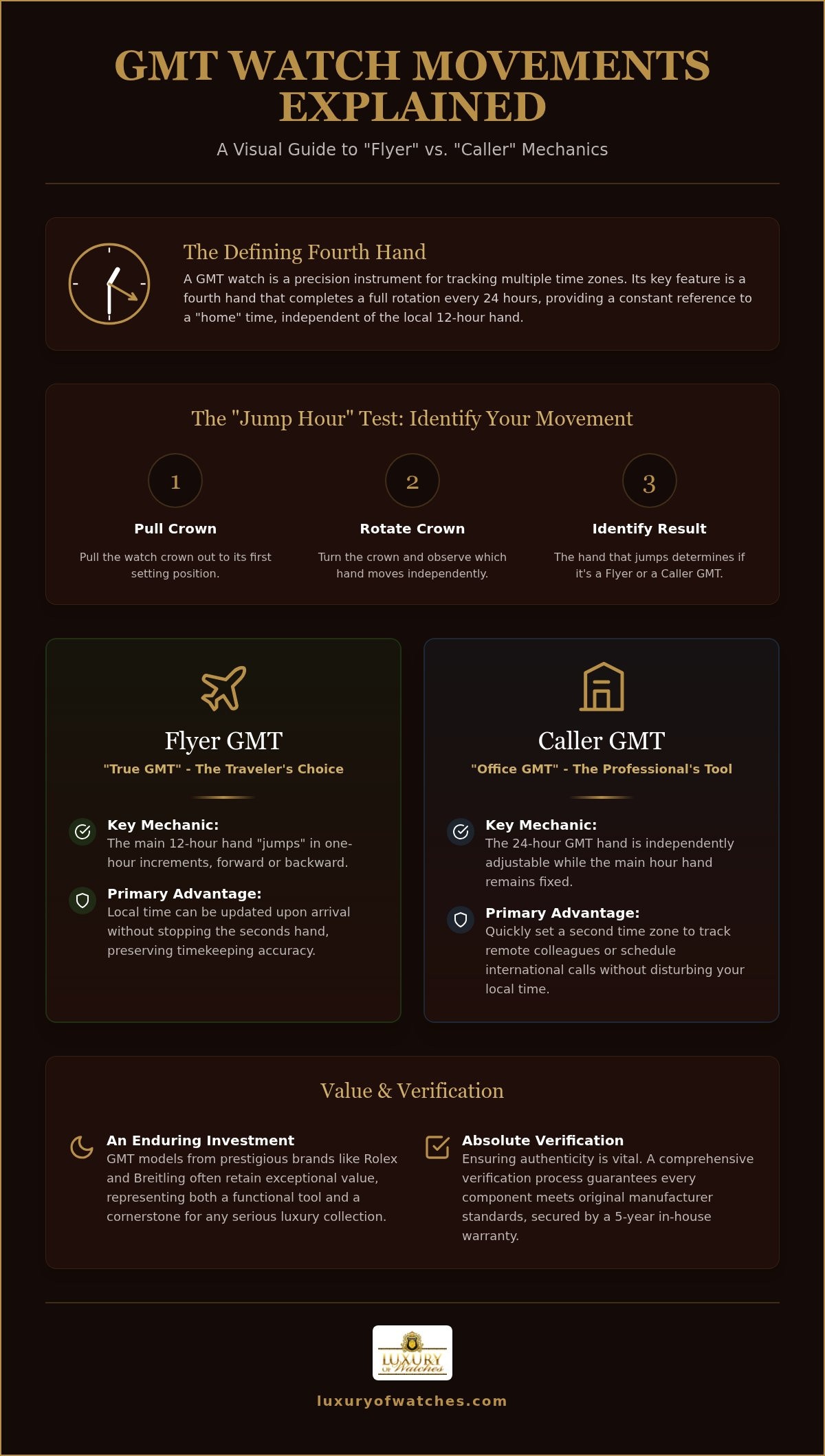
To understand how to tell what kind of GMT you're holding, you must perform the "jump hour" test. Pull the crown to the first setting position and rotate it. If the local hour hand "jumps" forward or backward in one-hour increments while the seconds hand continues to sweep, you're holding a Flyer GMT. If the 24-hour hand moves independently while the main time remains stationary, you have a Caller GMT. This distinction is more than just a technicality; it changes the entire user experience.
The Flyer GMT: The Traveler’s Choice
The Flyer, or "True" GMT, is the gold standard for the frequent traveler. Its primary advantage is the ability to change the local time hand without stopping the movement or losing a single second of accuracy. As you cross a time zone, you simply jump the hour hand to your new local time. The 24-hour hand remains fixed on your home time, acting as a constant reference point. This mechanical sophistication is a hallmark of elite manufacturers, including Rolex and many professional-grade Breitling watches. Because these movements require a more complex gear train, they often command a higher premium and are highly sought after by serious collectors.
The Caller GMT: Perfect for the Home Office
The Caller GMT, often referred to as an "Office" GMT, serves a different but equally valuable purpose. Instead of jumping the local hour hand, the wearer adjusts the 24-hour GMT hand independently. This is ideal for those who stay in one location but need to track a remote office, a client's time zone, or a relative abroad. Many entry-level luxury GMTs utilize this architecture because it's often built upon a reliable, standard three-hand movement with an added complication module. It offers a practical and accessible way to manage global connections from your desk.
The mechanical complexity of a Flyer movement makes it more difficult to manufacture, which often translates to stronger value retention in the secondary market. Whether you prioritize travel utility or professional coordination, choosing the right movement ensures your timepiece functions as a true extension of your lifestyle. If you're ready to find a piece that matches your pace, you can explore our curated selection of pre-owned luxury watches with full confidence in their mechanical integrity and absolute verification.
How to Read and Set a GMT Watch Like a Pro
Mastering the operation of a high-complication timepiece is as much about ritual as it is about utility. Once you understand the fundamental question of what is a gmt watch and how does it work, the next step is perfecting the setup. To set your watch correctly, start by pulling the crown to its furthest position. Align the 24-hour GMT hand and the minute hand with your home time or UTC using the 24-hour scale on the dial or bezel. Only then should you adjust the independent local hour hand to your current location. This sequence ensures that your reference time remains undisturbed while you travel.
Keep in mind the mechanical "danger zone." You should avoid adjusting the date between 9 PM and 3 AM. During these hours, the date-change gears are already engaged; forcing a manual change can cause significant damage to the movement's delicate teeth. Depending on whether you are using Caller vs. Flyer GMTs, the feeling of the crown will differ, but the goal remains the same: total synchronization between your two time zones.
The Three Time Zone Trick
While most enthusiasts use the complication for two zones, the rotating bezel unlocks a third. This is the secret of the professional traveler. To track a third city, you must use the mathematical offset method. If your GMT hand is set to a reference time (like London), and you wish to track a city in a different zone, you rotate the bezel rather than resetting the hands. Follow these steps to read a third zone instantly:
- Identify the offset: Determine how many hours the third city is ahead of or behind your 24-hour hand's reference time.
- Rotate the bezel: Turn the bezel so the GMT hand points to the correct hour on the bezel's 24-hour scale.
- Read the time: Your local time is shown by the 12-hour hand, your home time is on the dial's fixed scale, and the third zone is read where the GMT hand meets the bezel.
Reading the 24-Hour Scale
The iconic bi-color bezels, such as the "Pepsi" or "Batman" configurations, aren't just for flair. They provide an immediate visual distinction between day and night hours. The lighter color typically represents 6 AM to 6 PM, while the darker half covers the evening. This prevents the common disorientation of waking up in a windowless cabin and wondering if it's 4 AM or 4 PM at home. Understanding what is a gmt watch and how does it work visually is just as important as the mechanics; the bold colors and unique hand shapes are designed for split-second legibility under any lighting conditions.
Manufacturers use distinct shapes for the GMT hand, such as triangles or arrows, to ensure it's never confused with the seconds hand. This clarity is a hallmark of the engineering found in the professional models we specialize in. Every timepiece in our collection undergoes a process of absolute verification, ensuring that these intricate functions work exactly as the manufacturer intended. When you invest in a GMT, you're buying a tool that simplifies a complex world, backed by the security of our 5-year in-house warranty.
The Investment Value of Iconic GMT Timepieces
While dive watches have long dominated the luxury landscape, the GMT complication has emerged as a superior performer in the secondary market. The combination of historical significance and daily utility creates a level of demand that often exceeds supply. Understanding what is a gmt watch and how does it work allows collectors to recognize the mechanical value that drives these premiums. Unlike standard three-hand models, a GMT offers a tangible connection to the golden age of travel, making it a highly liquid asset for those seeking to build a robust portfolio of pre-owned luxury watches.
Rolex GMT-Master II: The Gold Standard
The Rolex GMT-Master II is the undisputed sovereign of the category. Since the introduction of the original Ref. 6542 in 1954, the model has evolved through decades of technical refinement. Modern iterations, featuring the Calibre 3285 movement and Cerachrom bezels, represent the pinnacle of durability and precision. This movement provides a 70-hour power reserve and the convenience of a "flyer" hour hand, which remains a primary driver of rolex prices in the current market. The scarcity of these professional models at retail ensures that well-maintained examples retain their value with remarkable consistency.
Other Notable GMT Icons
Beyond the crown, several manufacturers offer compelling alternatives that hold significant weight with enthusiasts. The Breitling Navitimer GMT blends the brand’s aviation slide rule heritage with dual-time functionality, appealing to those who appreciate technical complexity. For collectors seeking a fusion of aquatic durability and travel capability, the TAG Heuer Aquaracer GMT is a formidable choice. Additionally, brands like Panerai offer GMT models that emphasize Italian naval heritage and bold legibility, providing a distinct aesthetic for the global traveler.
Collectibility is often dictated by the bezel's color scheme. The "Pepsi" (blue and red), "Coke" (black and red), and "Root Beer" (brown and gold) variations aren't just design choices; they're cultural touchstones that signal specific eras of horological history. These distinct visual markers help answer what is a gmt watch and how does it work for observers, identifying the timepiece as a professional tool from across a room. This instant recognition is what maintains the high desirability of these models in the global market. If you're ready to secure a piece of this heritage, you can browse our verified selection of Rolex GMT-Master II models, each backed by our 5-year in-house warranty and a legacy of absolute verification.
Acquiring a Luxury GMT Watch: Authenticity and Security
The demand for professional GMT models often creates a significant barrier at authorized dealers. For many collectors, the secondary market is the only viable path to ownership, especially when seeking iconic references that are no longer in production. However, this transition requires a deep understanding of what is a gmt watch and how does it work from a security perspective. High complications are naturally more difficult to verify than standard movements, making the role of a trusted, expert intermediary paramount to a successful transaction.
Since our founding in 1999, we've focused on building a platform where prestige is matched by pragmatic protection. We understand that a luxury purchase is an emotional investment, but it must be anchored in factual validation. Navigating the complexities of the modern GMT market doesn't have to be a risk if you prioritize absolute verification and official documentation.
Verification and Documentation
Expert verification goes beyond a surface level glance; for a GMT, one of the most critical checks is the "hand stacking" order. On a genuine Rolex GMT-Master II, the order of the hands on the center pinion is specific to the movement's architecture. Fraudulent movements often fail to replicate this exact mechanical sequence, which is a primary red flag for our specialists. We scrutinize every detail, from the font on the 24-hour bezel to the tactile feedback of the "jump hour" mechanism.
Serial number verification is equally vital. We cross-reference every timepiece against manufacturer databases to ensure its history is transparent and its origin is legitimate. Peer-to-peer sales carry inherent risks, such as hidden movement damage or counterfeit parts, that a premier digital platform eliminates through rigorous authentication protocols. This level of scrutiny ensures that the timepiece you receive is exactly what the manufacturer intended.
The Luxury of Watches 5-Year Warranty
A primary concern for collectors in the secondary market is the lack of a manufacturer's international warranty. We address this directly by providing a 5-year in-house warranty on every timepiece we sell. This coverage is essential for GMT movements, which contain more moving parts and specialized gearing than standard three-hand watches. If the complex coordination between the 24-hour hand and the local hour hand requires adjustment, our dedicated service protocol ensures your investment is protected.
A GMT watch is more than a luxury; it's a mechanical companion for the global citizen. It represents a bridge between your current location and the places that matter most to you. By understanding what is a gmt watch and how does it work, you can appreciate the craftsmanship on your wrist. When you're ready to add a dual-time instrument to your collection, you can explore our verified selection of pre-owned luxury watches with the security and confidence you deserve.
Elevate Your Collection with a Global Icon
The GMT watch remains a pinnacle of horological utility, bridging the gap between historical aviation heritage and the needs of the modern traveler. By distinguishing between flyer and caller movements, you ensure your timepiece aligns with your specific lifestyle. Whether you're tracking a remote office or crossing time zones, the ability to manage multiple locations from your wrist is a hallmark of the global citizen. Having mastered the fundamentals of what is a gmt watch and how does it work, you can now approach the secondary market with the discernment of a seasoned collector.
Securing an iconic timepiece requires an intermediary that prioritizes your security. At Luxury of Watches, we provide absolute verification and a 5-year in-house warranty to ensure your investment is protected. Our expert customer support team is here to guide you through every technical specification and historical nuance. Explore our collection of authentic Rolex GMT-Master II watches and discover a legacy of precision that stands the test of time. Your next great adventure deserves a companion that's as reliable as it is prestigious.
Frequently Asked Questions
What is the primary difference between a GMT and a Dual Time watch?
A GMT watch utilizes a central 24-hour hand and a corresponding scale, whereas a Dual Time watch typically features a separate sub-dial or a second 12-hour display. The GMT layout is often preferred for its legibility and its ability to provide a clear distinction between AM and PM hours. This makes it a more comprehensive tool for those who need to understand what is a gmt watch and how does it work across vast longitudinal distances.
Can I use a GMT watch to track three different time zones at once?
You can indeed track three time zones simultaneously. This is achieved by setting the 12-hour hand to local time, the 24-hour hand to a second reference zone, and then rotating the bezel to align with a third city's offset. While it requires a simple mathematical calculation, it transforms the watch into a powerful navigational instrument. This versatility is why professional pilots and international business leaders favor the GMT complication above simpler dual-time models.
Is a 'True GMT' movement always better than an 'Office GMT'?
Neither is objectively superior; they simply serve different practical needs. A 'True' or Flyer GMT is designed for the traveler who needs to jump the local hour hand upon landing without stopping the movement. Conversely, an 'Office' or Caller GMT is perfect for the professional who remains stationary but frequently interacts with a remote time zone. Choosing the right one requires you to evaluate how you'll personally use the watch in your daily global operations.
Why are GMT watches typically more expensive than standard automatic watches?
The price premium reflects the mechanical complexity required to add a fourth independent hand. Manufacturers must engineer specialized gearing and often entirely new base movements to ensure the 24-hour hand remains synchronized with the minute hand while allowing for independent adjustment. This level of precision, combined with the high demand for professional models like the Rolex GMT-Master II, naturally elevates the market value above standard three-hand automatic timepieces.
How do I use the rotating bezel on a GMT watch?
To use the bezel, you simply rotate it until the hour of your desired second or third time zone aligns with the 24-hour GMT hand. The bidirectional movement allows for quick adjustments as you communicate with different regions. It essentially functions as a manual computer, providing a visual reference for time offsets without requiring you to stop the movement or reset the internal hands of your timepiece.
Does a GMT watch require more frequent servicing than a regular watch?
A GMT movement doesn't typically require more frequent servicing than a standard automatic watch, but it does require specialized expertise. The additional gears and levers involved in the 24-hour complication mean that a technician must be highly skilled in high-complication horology. We recommend a service interval of five to seven years to ensure the lubrication remains effective and the mechanical synchronization between the multiple hour hands stays perfectly accurate.
What are the most famous GMT watch color combinations and why do they have nicknames?
Nicknames like "Pepsi" for blue and red or "Batman" for blue and black bezels help collectors quickly identify specific references and historical eras. These colors originally served a functional purpose, distinguishing day hours from night hours at a glance. Over time, these aesthetic markers became cultural icons, significantly impacting the collectibility and secondary market value of professional GMT models across different luxury brands.
Is it safe to buy a pre-owned Rolex GMT-Master II online?
Buying online is secure when you partner with a specialist that provides absolute verification and official documentation. We understand the nuances of what is a gmt watch and how does it work mechanically, allowing us to catch inconsistencies that a casual buyer might miss. Every GMT we sell is backed by our 5-year in-house warranty, providing the consumer reassurance required for a high-value transaction in the secondary market.