
Water Resistance in Watches Explained: The Complete Collector’s Guide (2026)
Posted by Luxury of Watches on 6th Aug 2026
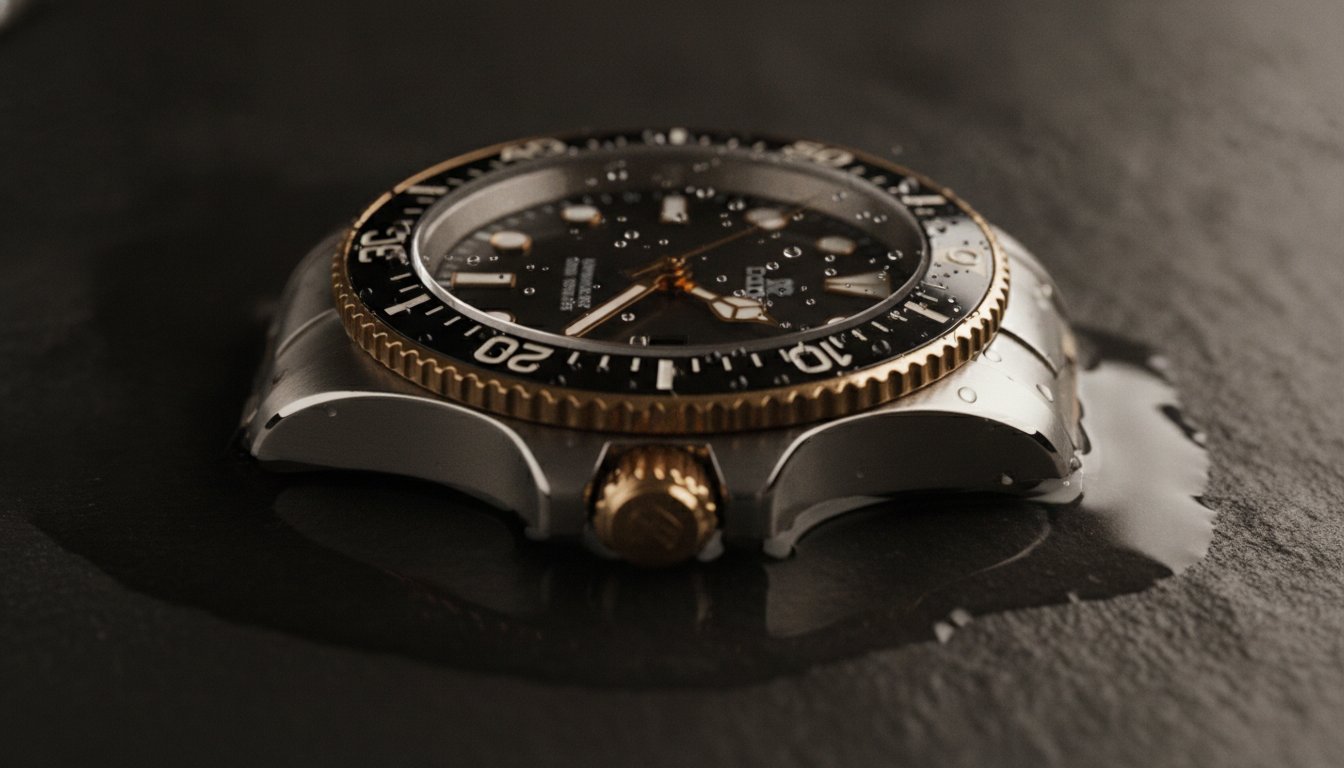
A depth rating of 50 meters on your timepiece doesn't mean you can safely dive 50 meters below the surface. In fact, that elegant dress watch might suffer more damage from the concentrated steam of a morning shower than from a sudden splash of rain. Having the nuances of water resistance in watches explained reveals that these ratings are often based on static laboratory pressure rather than the unpredictable nature of real-world immersion. It's a frequent source of anxiety for collectors who fear that a single misunderstood specification could compromise a delicate, high-value movement.
We recognize the deep respect you have for the craftsmanship of your collection and the desire to protect that investment. You deserve to wear your watch with the assurance that its internal seals are performing exactly as intended. This guide will demystify the complexities of ISO 22810:2010 standards and clarify why water resistance is a temporary state of mechanical pressure handling rather than a permanent attribute. We'll explore the critical differences between static and dynamic pressure, the degradation of gaskets, and the maintenance protocols necessary for long-term security. You will gain the technical knowledge required to navigate any environment with absolute confidence.
Key Takeaways
- Understand why "waterproof" is an obsolete term and how modern ratings represent static laboratory pressure rather than a literal depth limit.
- Discover the nuances of water resistance in watches explained, specifically how to interpret 3ATM through 300m ratings for activities like swimming or snorkeling.
- Learn the critical role of screw-down crowns and O-ring gaskets in maintaining a hermetic seal against moisture, heat, and internal movement damage.
- Identify why professional pressure testing and expert verification are essential when acquiring pre-owned luxury timepieces to ensure their structural integrity.
- Gain peace of mind by understanding how a comprehensive 5-year in-house warranty serves as a vital safety net for properly maintained high-end watches.
The 'Waterproof' Myth: Understanding Water Resistance vs. Waterproofing
Before the late 1960s, it wasn't uncommon to see the word "waterproof" stamped on the casebacks of Swiss timepieces. This terminology suggested an absolute, permanent state of invulnerability to moisture. However, regulatory bodies and the horological industry eventually recognized that no mechanical object can be truly waterproof under all possible conditions. The transition to the term "water-resistant" was a shift toward transparency, acknowledging that protection depends on specific variables like pressure, temperature, and the integrity of rubber gaskets. Having the nuances of water resistance in watches explained helps collectors understand that these ratings are not lifetime guarantees but rather snapshots of a watch's performance under controlled laboratory conditions.
Modern standards are governed by two primary certifications: ISO 22810:2010 for general-use watches and ISO 6425 for professional divers. While the former focuses on resistance to splashes and brief immersion, the latter involves rigorous testing for salt water, thermal shock, and overpressure. When you browse the collections of premier luxury watch brands, you'll notice depth ratings are usually expressed in meters. It's vital to recognize that these "meters" are actually a proxy for atmospheric pressure (ATM) or Bar. In a laboratory, a watch is placed in a chamber where air or water pressure is increased to simulate the weight of water at a specific depth, but this doesn't account for the chaotic movement of a real-world environment.
Static vs. Dynamic Pressure: The Real World Factor
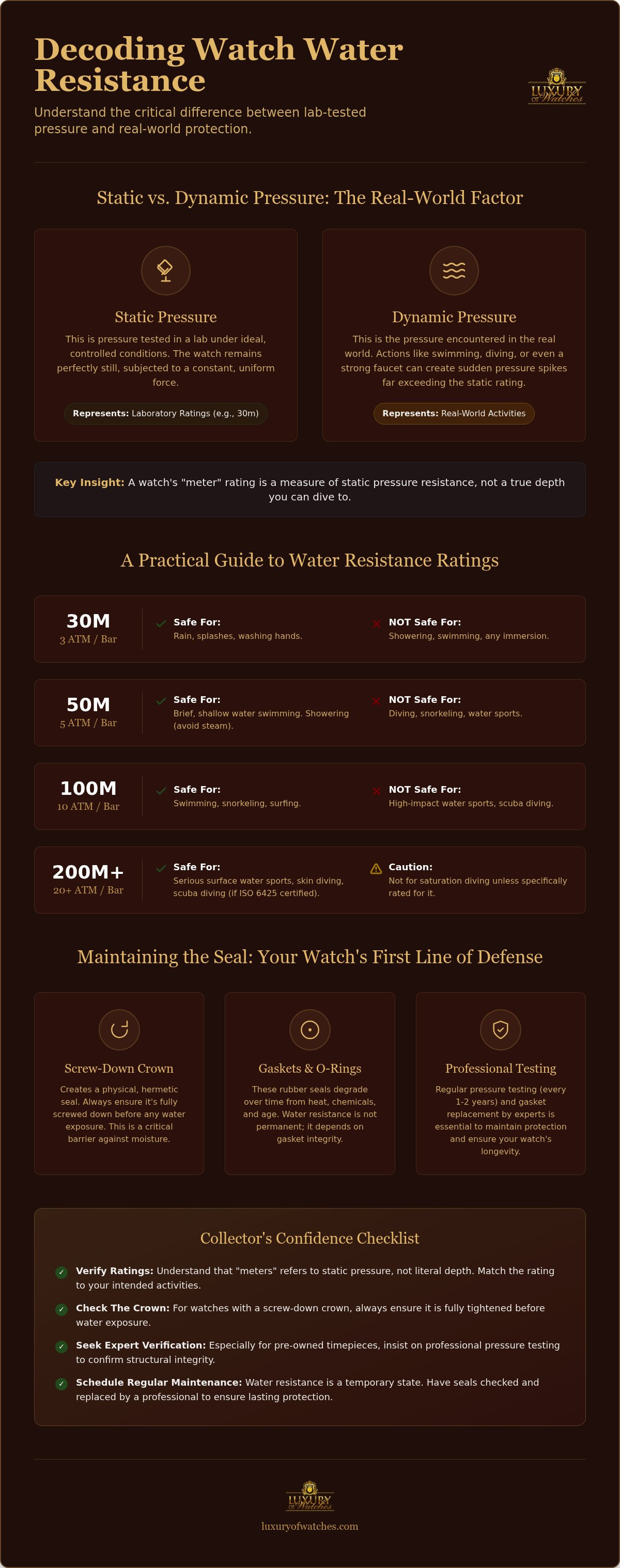
Static pressure is the weight of water at rest. In a testing tank, the watch remains perfectly still, allowing the seals to handle a consistent, uniform load. In the real world, dynamic pressure enters the equation. Moving your arm through the water or jumping into a pool creates localized pressure spikes that can far exceed the static rating of the watch. For instance, the velocity of water from a high-pressure faucet can easily surpass the force of a 30-meter static rating. This is why a 30m rating is designed for peace of mind against rain, not for active aquatic use. At Luxury of Watches, every pre-owned timepiece undergoes rigorous pressure testing during our absolute verification process to ensure the seals are still capable of handling these dynamic forces.
The Role of Atmospheric Pressure (ATM and Bar)
Horology relies on the mathematical relationship between depth and pressure. One atmosphere (1 ATM) is approximately equal to 10 meters of water depth. High-end manufacturers often prefer ATM or Bar ratings because they more accurately describe the mechanical reality of what the case is resisting. The Water Resistant mark on a caseback is a technical certification of the watch's ability to withstand these specific pressure increments. For example, a 10 ATM rating indicates the watch can handle ten times the pressure found at sea level. Because these seals are subject to environmental wear, our 5-year in-house warranty provides a significant safety net, ensuring your timepiece remains protected against moisture ingress as long as regular maintenance is observed.
Decoding Depth Ratings: What 3ATM to 300m Actually Means
Deciphering the engravings on a caseback requires an understanding of how laboratory results translate to the physical world. Having the nuances of water resistance in watches explained allows a collector to move past marketing jargon and into technical reality. While a meter rating suggests a specific depth, these figures are essentially pressure benchmarks. A watch rated to 30 meters isn't designed for a 30-meter dive; it's designed to withstand the pressure equivalent of 30 meters of static water. For the discerning collector, knowing these distinctions is the difference between preserving a masterpiece and facing a costly service bill.
- 30 Meters (3 ATM): This provides protection against the elements, such as rain or accidental splashes while washing hands. It's the standard for delicate dress watches.
- 50 Meters (5 ATM): Suitable for very brief surface immersion. While some brands suggest it's safe for swimming, we recommend avoiding active aquatic use at this level.
- 100 Meters (10 ATM): This is the true threshold for recreational water sports. It's safe for snorkeling, swimming, and poolside diving.
- 200 to 300 Meters (20 to 30 ATM): This is professional territory. The Rolex Submariner, an industry icon, sets the standard here with a build quality designed for serious scuba diving.
- 1000 Meters+: These are specialized instruments for saturation diving, often equipped with a Helium Escape Valve to manage internal pressure during decompression.
The 30m to 50m Trap: Why 'Water Resistant' Isn't for Swimming
Many high-end dress watches from prestigious houses like Cartier prioritize aesthetics and slim profiles, which often results in a 30m or 50m rating. These timepieces aren't built for the dynamic pressure of a swimming stroke. Even if the case itself holds, many of these models are paired with fine leather straps that will degrade instantly upon contact with water. A thorough look at water resistance in watches explained reveals that 100m is the actual baseline for most recreational water sports. If you're looking for a piece that transitions seamlessly from the boardroom to the beach, browsing our selection of pre-owned luxury watches with higher depth ratings is a prudent choice.
Professional Diver Standards (ISO 6425)
There's a significant technical gap between a watch that is "water-resistant" and one certified as a "Diver's Watch." While general-use watches follow the ISO 22810:2010 standard, professional divers must meet ISO 6425. This certification requires more than just pressure resistance; it mandates legibility in total darkness at 25cm, magnetic resistance, and shock resistance. Furthermore, every single ISO 6425 watch is tested to 125% of its rated depth. This rigorous over-pressure testing ensures that a 300m diver's watch can actually handle the unexpected spikes in pressure that occur in the open ocean. At Luxury of Watches, we ensure that every pre-owned diver we sell has been pressure-tested to verify its structural integrity remains intact.
A Practical Activity Guide: When to Wear (and Remove) Your Watch
While technical ratings provide a baseline, the environment dictates the actual risk to your timepiece. Having water resistance in watches explained in a practical context means recognizing that ambient conditions often matter more than depth alone. For most contemporary luxury timepieces, mundane encounters like heavy rain or washing your hands pose no threat. However, as the intensity of the activity increases, so does the demand on your watch's internal architecture. You shouldn't assume that a watch designed for the office can handle the rigors of a weekend at the coast without proper preparation.
A 100m rating is the non-negotiable minimum for swimming or snorkeling. Even with this rating, the crown must be fully engaged or screwed down to prevent a catastrophic breach. Saltwater presents an additional chemical challenge. Sodium chloride is inherently corrosive; it can crystalize around the bezel and gaskets if left to dry. This crystallization can eventually grind away at the seals or the finish of the steel. Always rinse your timepiece in lukewarm freshwater after ocean exposure to preserve the finish and seal integrity. This simple step is vital for maintaining the longevity of high-end materials.
The Hidden Threat: Steam, Soaps, and Chemicals
Many collectors mistakenly believe a high depth rating makes a watch invincible in a hot shower or a sauna. This is a dangerous assumption. High temperatures cause metal components and rubber gaskets to expand at different rates. This thermal expansion can create microscopic gaps, allowing steam to penetrate the case. Steam consists of smaller molecules than liquid water, making it far more invasive. Additionally, the surfactants in soaps and the chlorine in hot tubs act as solvents, gradually drying out synthetic O-rings and making them brittle. Avoid wearing any luxury watch in environments involving high heat or heavy chemical exposure to ensure the movement remains pristine.
Vintage and Pre-Owned Considerations
Acquiring a pre-owned luxury watch requires a shift in perspective regarding its original factory specifications. A vintage piece might have left the manufacturer with a 200m rating decades ago, but rubber gaskets naturally degrade and lose their elasticity over time. Unless the watch has been recently serviced and pressure-tested, you shouldn't treat it as water-resistant. At Luxury of Watches, our absolute verification process includes rigorous pressure testing to ensure pre-owned inventory meets the necessary standards for its intended use. We back this with a 5-year in-house warranty, providing a safety net that factory ratings alone cannot offer for older models.
Maintaining the Seal: Crowns, Gaskets, and Professional Care
The structural integrity of a timepiece relies on a series of specialized mechanical barriers. Having water resistance in watches explained requires looking past the dial and into the architecture of the case. The hermetic seal is maintained by high-performance rubber or synthetic O-rings, known as gaskets, located at the case back, crystal, and crown. These components are the unsung heroes of horology, yet they're also the most vulnerable to time and environmental wear. Whenever a watch is opened for any reason, the case back gasket must be replaced immediately. Reusing an old gasket is a common cause of seal failure because the material takes a permanent set under pressure and cannot reliably reseal once disturbed.
A professional pressure test is the only way to verify these seals without risking the movement. Technicians typically utilize a dry-pressure test first. This involves placing the watch in a chamber and using air pressure to measure microscopic case deformations. If the machine detects a leak, the watch is never exposed to liquid. Only after passing the dry test is a wet-pressure test performed to confirm the results under actual immersion. This dual-layered approach is essential for high-value timepieces where even a single drop of moisture can lead to oxidation and a complete movement overhaul.
Operating the Crown: Best Practices for Safety
Your crown is the most significant point of entry for moisture. The golden rule of watch ownership is absolute: never unscrew or operate the crown or pushers while the watch is submerged or even wet. For watches equipped with a screw-down crown, ensuring it's properly seated is vital. You should feel the threads engage smoothly; never force a crown that feels cross-threaded. Icons like the Rolex Submariner utilize the sophisticated Triplock system, which features multiple gaskets to provide redundant layers of protection. This engineering ensures that even if the crown is slightly unscrewed, secondary seals remain in place to defend the movement from minor splashes. However, this redundancy isn't an excuse for negligence; always verify the crown is fully tightened before any aquatic activity.
Annual Pressure Testing and Maintenance
We recommend an annual water resistance check for any timepiece frequently exposed to the water. While Breitling watches and other aviation-focused pieces are built to handle rapid pressure changes in the cockpit, their seals still require the same scrutiny as a dedicated diver's watch. Over time, the lubricants on the gaskets can dry out, leading to cracks that are invisible to the naked eye. At Luxury of Watches, our absolute verification process includes these rigorous tests to ensure every piece in our inventory meets its technical specifications. If you're ready to add a verified, high-performance timepiece to your collection, you can browse our selection of luxury watches with the confidence provided by our 5-year in-house warranty.
Buying with Confidence: Verification and Warranty Protection
The secondary market offers unparalleled access to horological icons, but it also carries the inherent risk of compromised structural integrity. Having water resistance in watches explained from a procurement perspective means understanding that a timepiece is only as secure as its most recent professional pressure test. Buying from a reputable dealer that performs absolute verification is the only way to ensure the gaskets haven't perished and the case hasn't warped over years of previous ownership. At Luxury of Watches, we don't just verify the authenticity of the dial and movement; we verify the performance of the seals. Every pre-owned timepiece is subjected to rigorous testing to confirm it meets its rated pressure handling before it enters our inventory. This documented history of care not only provides immediate security but also preserves the long-term resale value of your investment.
The Luxury of Watches 5-Year Warranty
Our 5-year in-house warranty serves as a definitive safety net for your collection. While many digital marketplaces offer vague buyer protection, we provide a concrete mechanical guarantee that covers the movement and internal components. This level of support is particularly critical when considering current Rolex prices and the significant investment required for high-depth icons like the Submariner or Sea-Dweller. Our expert-level in-house support ensures that if a properly maintained watch fails to meet its technical specifications, you have a direct line to specialists who understand the nuance of your specific model. It's a commitment to excellence that transforms a high-value transaction into a secure, long-term relationship.
What to Do if You Suspect Water Entry
If you notice "fogging" or persistent condensation under the crystal, your watch has suffered a seal breach. This is a horological emergency. Moisture inside a case acts as a catalyst for rapid oxidation, which can destroy a delicate movement in a matter of days. You should ignore the common myth of placing a watch in a bowl of rice; this does nothing to remove the humidity trapped within the complex gears of the movement. Immediate professional intervention is the only solution. The case must be opened, the moisture removed, and the movement dried and re-lubricated by a specialist. If you suspect a breach, contact our support team immediately for urgent service guidance. Acting within the first 24 hours often makes the difference between a simple gasket replacement and a catastrophic mechanical failure. Understanding water resistance in watches explained means knowing that while these pieces are engineered for the elements, they still require the watchful eye of a dedicated collector.
Protecting Your Horological Investment for the Long Term
Mastering the nuances of water resistance in watches explained allows you to enjoy your collection without the constant anxiety of moisture damage. It's vital to remember that depth ratings are benchmarks for pressure rather than simple measurements of distance. The integrity of your gaskets and seals requires consistent professional oversight to combat the natural degradation of materials over time. By respecting these mechanical limits and avoiding the hidden dangers of steam or chemicals, you effectively safeguard both the movement and the heritage of your timepiece.
When you're ready to acquire your next icon, you can explore our collection of professionally verified luxury watches. At Luxury of Watches, we perform absolute verification on every timepiece and back our inventory with an industry-leading 5-year in-house warranty. Our team brings over 25 years of expert experience to every transaction, providing the technical security required for high-value acquisitions. Wear your collection with the absolute confidence that comes from expert preparation and a sophisticated understanding of horological engineering.
Frequently Asked Questions
Can I wear my 50m water-resistant watch in the shower?
You shouldn't wear a 50m water-resistant watch in the shower. While the rating suggests it can handle immersion, the high temperature of the water and the presence of steam can cause gaskets to expand at different rates than the metal case. Additionally, the chemicals in soaps and shampoos act as surfactants that gradually degrade the synthetic O-rings. It's a risk that could lead to internal fogging or movement damage.
Is any luxury watch truly 100% waterproof?
No luxury watch is technically 100% waterproof. The industry transitioned to the term "water-resistant" decades ago to acknowledge that protection is conditional based on depth, temperature, and maintenance. Even a professional diver's watch has mechanical limits. Having water resistance in watches explained in this way helps collectors understand that seals are defensive barriers rather than absolute, permanent shields against all moisture.
What is the difference between 10 ATM and 100 meters?
In horological terms, there is no difference in the level of protection between a 10 ATM rating and a 100-meter rating. Both indicate that the timepiece can withstand the static pressure equivalent to being 100 meters below the surface. Manufacturers often use ATM, or Atmospheres, because it more accurately describes the laboratory pressure testing process. This rating is generally considered the baseline for safe swimming and snorkeling.
How often should I have my luxury watch pressure tested?
You should have your luxury watch pressure tested at least once a year if you frequently use it for swimming or diving. For watches that remain mostly on land, a check every two to three years is typically sufficient. Because rubber gaskets naturally dry out and lose their elasticity, regular verification is essential to ensure the hermetic seal remains intact. Our 5-year in-house warranty provides an excellent safety net for properly maintained timepieces.
Does salt water damage the water resistance of my watch?
Salt water doesn't inherently destroy water resistance, but it does pose a significant corrosive threat if the watch isn't rinsed properly. Sodium chloride can crystallize around the crown, gaskets, and rotating bezels as it dries. These crystals act as an abrasive that can wear down seals over time. Always rinse your timepiece in lukewarm freshwater after ocean exposure to prevent long-term damage to the high-end materials and structural components.
What should I do if I see condensation inside my watch dial?
You must seek professional service immediately if you see condensation or fogging under the crystal. This is a sign of a compromised seal; the trapped moisture will rapidly oxidize the movement's delicate steel components. Don't waste time with home remedies like rice or hair dryers, as these won't remove humidity from the internal gears. Fast intervention is the only way to prevent a total mechanical failure and a costly overhaul.
Are screw-down crowns better for water resistance than push-pull crowns?
Screw-down crowns are significantly more effective for water resistance than standard push-pull designs. They utilize a threaded tube that creates a mechanical lock, compressing a dedicated gasket to form a watertight seal. This architecture is a hallmark of professional icons like the Rolex Submariner. While a push-pull crown can offer basic protection, it's more susceptible to being accidentally pulled out while submerged, which would lead to an immediate breach.
Does the age of a watch affect its water resistance rating?
The age of a watch significantly impacts its actual water resistance, regardless of the original factory rating. Rubber and synthetic gaskets are perishable components that become brittle or crack over several years. A vintage piece that was once rated for 200 meters might have no resistance at all today. This is why water resistance in watches explained always emphasizes the necessity of modern pressure testing for any pre-owned or vintage acquisition before it touches water.