
Understanding the Rolex Jubilee Bracelet: Design, History, and Fit
Posted by Luxury of Watches on 11th Oct 2026
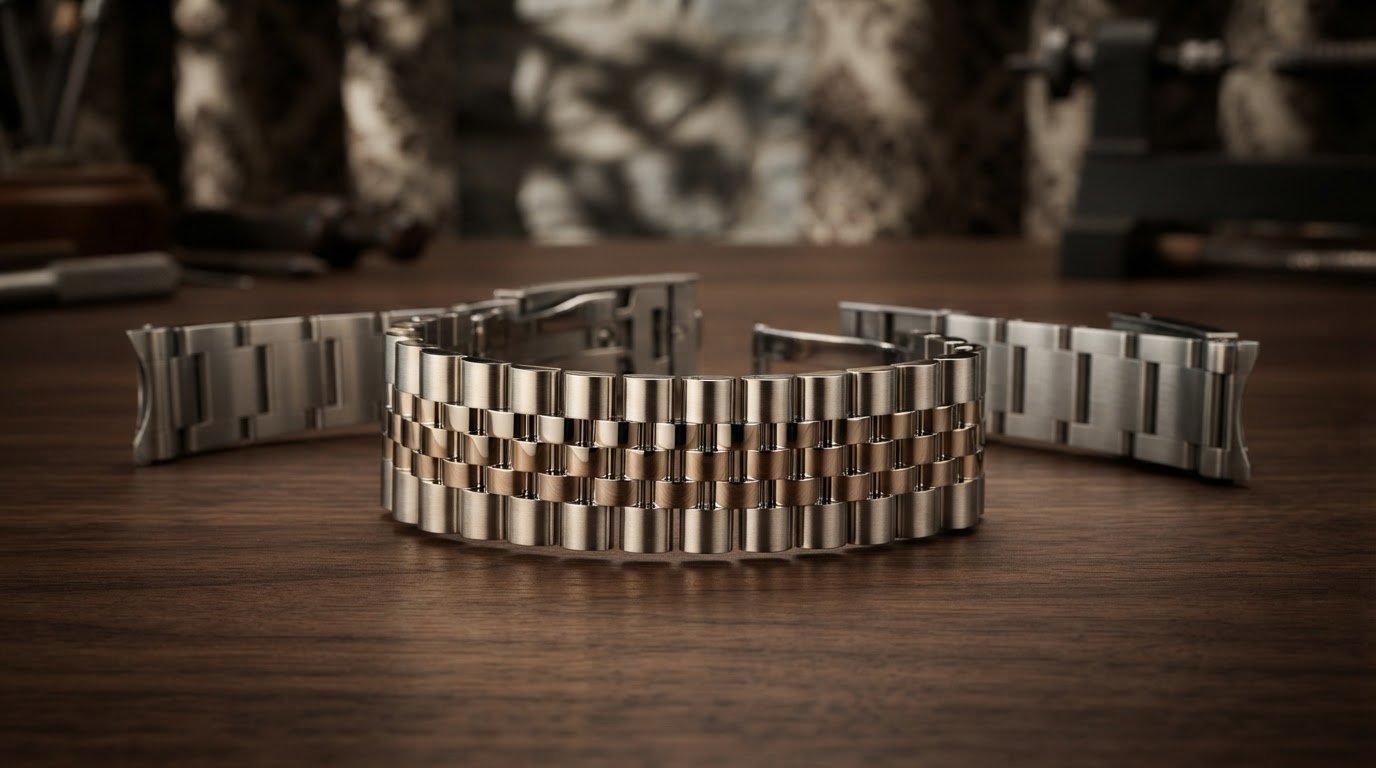
The most elegant-looking Rolex bracelet isn’t automatically the best fit for your wrist or your watch. Understanding the Rolex Jubilee bracelet means looking beyond its refined appearance: its five-piece links create a distinctive, flexible feel, while fit and condition matter just as much when you assess a particular watch.
If you’re weighing the Jubilee against the Oyster, the choice is more than a matter of dressy versus sporty. The Jubilee’s intricate profile catches the light and moves fluidly on the wrist; the Oyster’s broader three-link design has a cleaner, more substantial presence. Neither style suits every wearer or watch.
This guide explains the Jubilee’s design and heritage, compares its feel and appearance with the Oyster, and shows what to observe when checking bracelet condition and fit. You’ll also learn why compatibility depends on the specific watch, not appearance alone.
Key Takeaways
- Understanding the Rolex Jubilee bracelet starts with its five-piece-link design and the heritage behind its distinctive look.
- Compare the Jubilee’s articulated links with the broader, sportier appearance of the Oyster bracelet.
- Check wrist fit, clasp position, and visible link condition when viewing a Rolex.
- Bracelet details can vary by reference and production period, so assess compatibility in the context of the watch.
- Consider bracelet style alongside configuration and overall condition when deciding whether a Rolex suits your preferences.
What Is the Rolex Jubilee Bracelet? Its Design and Origins
The Rolex Jubilee bracelet is a five-piece-link metal bracelet, recognized by three smaller central links framed by two broader outer links. This repeating pattern gives it a more intricate appearance than a bracelet made of a few broad links. The link arrangement is the defining visual feature; materials, finishes, and fastening details can vary between versions.
How the Jubilee bracelet’s links create its signature look
Viewed from above, the bracelet’s links form a repeating row: two outer links, two smaller links beside the center, and one central link. The three narrower links create a fine-grained pattern that catches the eye, especially as the wrist moves. The outer links frame this detail, giving the bracelet a balanced profile rather than one broad surface.
Schematic close-up, viewed from above:
Outer link | Inner link | Center link | Inner link | Outer link
Five links repeat across the bracelet. This diagram shows the arrangement, not the finishing of a specific reference.
Proportions and surface treatments can differ between Jubilee versions. Some have more contrast between polished and satin-finished surfaces than others. When comparing watches, look closely at the specific bracelet rather than assuming every Jubilee reflects light in the same way.
The Jubilee’s Rolex heritage and original context
Rolex introduced the Jubilee bracelet in 1945 for the Datejust, creating an early association between the bracelet and the watch it was designed to accompany. Its detailed link pattern offered an alternative to simpler, broader-link designs. For wider context on the brand’s development, Rolex's history and innovations provides an overview of Rolex’s broader history.
The Jubilee’s identity comes from both its construction and its original Datejust context. It has since appeared in other Rolex configurations, but its presence shouldn’t be assumed from a watch’s general appearance. References and production periods matter: the same bracelet name doesn’t mean every example has identical details or fits every watch. Treat the bracelet as part of a specific configuration, alongside the case and dial, rather than as a universal accessory.
This distinction is especially useful when viewing a vintage or pre-owned watch. The familiar five-link pattern can help you recognize the style, but it doesn’t establish a bracelet’s age, originality, or compatibility by itself. Those questions depend on the individual watch and its reference. The design is a useful starting point; the watch’s context completes the picture.
How the Jubilee Bracelet Feels, Moves, and Fastens
A bracelet’s feel comes from more than its appearance. The Jubilee’s connected links pivot as the wrist changes angle, allowing the bracelet to follow its contours. This articulation gives it a distinctive drape: the links move around the wrist rather than behaving like one rigid strip of metal.
Why link articulation can affect wrist feel
That movement may feel supple to one wearer and simply different to another. Wrist shape, bracelet length, and clasp position all affect how a watch rests. A bracelet that is too tight can feel restrictive; one that shifts excessively may feel unsettled. If possible, try the watch on and notice how it feels as you bend your wrist and move your arm.
Condition matters, too. Examine the bracelet both on your wrist and laid flat. Check that the links move without obvious binding and that the bracelet doesn’t look uneven or sag heavily. Wear can affect how it hangs, so the feel of a particular example depends on more than its link design. This is an important part of assessing an actual watch, not just the Jubilee style in general.
What to know about Jubilee clasps and adjustments
Clasp design and adjustment features vary by reference and production period. Don’t assume every Jubilee has the same clasp, extension system, or adjustment method. For example, Rolex’s official page for this GMT-Master II with Jubilee bracelet identifies that configuration and its features. Use documentation for the exact reference to understand its clasp and adjustments.
When examining a watch in person, close the clasp gently and check that it fastens securely and sits comfortably beneath your wrist. Notice whether its position makes the watch head rotate or pull to one side. Adjustment mechanisms depend on the bracelet’s specification, so don’t assume a feature described for one Rolex applies to another.
Fit can also change during the day. Wrist size can vary, and a setting that feels comfortable while seated may feel different during movement. Check whether the watch stays in a stable position without pinching or sliding excessively. There’s no single fit preference for every wearer, but the bracelet should feel secure during normal wear.
When comparing watches, note the reference and production context, then consult the relevant Rolex documentation for clasp and adjustment details. This helps distinguish general descriptions from model-specific specifications. To compare configurations, browse Rolex watches and review the bracelet and clasp details shown with each watch.
Jubilee vs. Oyster: Which Rolex Bracelet Style Looks and Wears Differently?
The Jubilee and Oyster create noticeably different impressions, but neither is inherently the better choice. The Jubilee’s closely repeated links look more intricate, while the Oyster’s three-link design appears broader and more restrained. The effect depends on the watch as a whole, and the correct bracelet configuration depends on the specific reference.
| Feature | Jubilee | Oyster |
|---|---|---|
| Link appearance | Five-link pattern with smaller, closely repeated links | Three-link pattern with broader links |
| Visual character | Detailed and more visually intricate | Clean, simple, and more substantial in appearance |
| Styling impression | Can lend a watch a more refined or dress-oriented character | Can give a watch a sportier, more utilitarian impression |
How the Jubilee and Oyster differ visually
Look at the bracelet from a short distance, then examine it up close. The Jubilee’s closely spaced links create a finer visual rhythm, with more small transitions across the wrist. The Oyster’s broader links form a simpler sequence that can make it appear more solid. These are broad design impressions, not fixed rules about every example’s finish or dimensions.
Finishing, metal, proportions, and production details can vary. One Jubilee may have a different surface treatment from another, and an Oyster’s appearance also changes with its configuration. Don’t infer the material or precise finish from the style name alone. Compare the actual watch in good light and notice how the bracelet’s surfaces relate to the case.
Choosing a bracelet style by personal preference
Consider whether you prefer a detailed pattern or a quieter, broader-link look. Then assess the complete watch: case size and shape, dial color and markers, and the bracelet’s visual weight all contribute to its overall effect. A bracelet that appeals on its own may feel different when viewed on the watch and wrist together.
If possible, view the watch from above and at an angle, then try it on. Notice whether the bracelet looks balanced with the case and whether its movement and fit suit you. This is a matter of preference, not ranking; the same visual character won’t appeal equally to every wearer.
Compatibility is specific to the reference. Jubilee and Oyster bracelets aren’t interchangeable options for every Rolex simply because both are familiar styles. The watch reference and its intended configuration determine what belongs with it. For sound understanding the rolex jubilee bracelet in context, consider the style alongside the exact reference and complete watch rather than judging by appearance alone.
Jubilee Bracelet Fit and Care: What to Observe
A Jubilee bracelet should feel secure, but the preferred fit varies. Wrist shape, personal preference, and the watch’s balance all affect how it sits. When viewing a Rolex, assess fit and condition in context rather than treating one sign, such as a scratch or a loose-feeling link, as a definitive verdict.
How to assess whether a Jubilee bracelet fits well
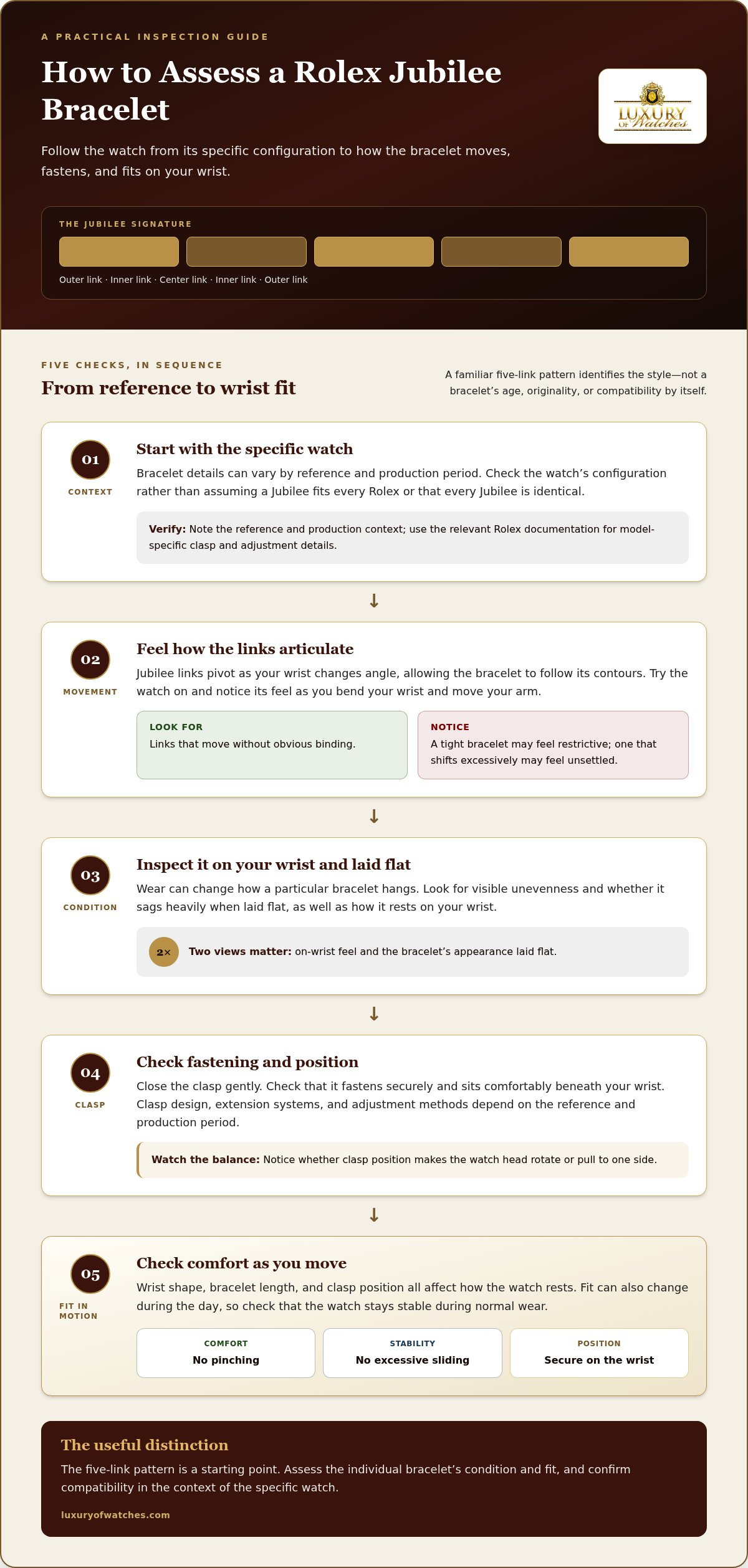
Use this sequence to examine the fit and the watch’s details:
- Check the wrist fit. Wear the watch during ordinary movement. Notice whether it stays comfortably in place without pinching or sliding excessively. Some wearers prefer a little movement; others prefer a closer fit.
- Observe the clasp position. Check whether the clasp rests comfortably beneath the wrist and whether the watch head remains reasonably centered. A clasp that shifts to one side can affect the balance on your wrist.
- Look over the links. Inspect the bracelet in good light for scratches, unevenness, or visible looseness. These are details to consider, not diagnoses of the cause or severity of wear.
- Put the bracelet in reference context. Compare its configuration with the watch’s reference and available documentation. A familiar-looking pattern alone doesn’t establish that the bracelet belongs with a particular watch.
Bracelet sizing can substantially affect comfort, and wrist shape influences which fit feels right. If an adjustment is needed, have it handled by someone qualified to work with the specific watch and bracelet. Avoid improvised adjustments that could mark components or affect the fit.
Everyday care and signs of visible wear
Keep care conservative. Rolex care guidance can depend on the watch, so follow the manufacturer’s instructions for the specific reference instead of applying one general cleaning method to every example. If the documentation doesn’t make a care step clear, don’t assume a product or technique is suitable for the bracelet.
Scratches can be consistent with everyday use, while visible looseness or links that don’t sit evenly may warrant closer assessment. None of these signs alone proves authenticity, identifies a bracelet’s history, or confirms the watch’s overall condition. A clean appearance doesn’t establish originality, either. Consider the bracelet alongside the case, clasp, reference information, and accompanying documentation.
When evaluating a pre-owned Rolex, focus on what you can observe without overinterpreting it. A balanced assessment connects fit, visible wear, and reference context instead of relying on a single detail. To compare examples with these points in mind, browse Rolex watches.
Understanding a Jubilee Bracelet When Exploring Rolex Watches
A bracelet shapes more than the way a Rolex sits on the wrist. Its link pattern, finish, and proportions contribute to the watch’s overall character, so the Jubilee is one part of a broader assessment rather than a feature to judge in isolation. The same bracelet style can look different depending on the case and dial it accompanies.
Reading bracelet details in the context of a complete watch
Start with the reference and configuration, then consider how the bracelet relates to the case, dial, and clasp. A detailed link pattern, for example, may draw attention to the wrist, while the dial and case contribute to the watch’s overall balance. Personal preference matters, but compatibility is reference-specific: a bracelet that looks suitable isn’t automatically appropriate for every Rolex.
Visible condition also needs context. Surface marks, uneven wear, or a bracelet that appears loose are observations, not proof of originality or authenticity. A polished appearance doesn’t confirm that components are original, either. Consider the bracelet alongside the watch’s overall condition and documentation, including reference details where available. For a pre-owned purchase, this broader approach helps separate appearance from claims that require supporting evidence.
For more perspective on evaluating a pre-owned watch beyond its visible details, consult The Comprehensive Guide to Pre-Owned Luxury Watches: Value, Authenticity, and Ownership. The bracelet is one part of the ownership picture; the watch’s configuration, condition, and accompanying documentation also deserve attention.
What a retailer’s warranty does and does not mean
Luxury of Watches provides a five-year in-house warranty on its authentic watch selection. This is the retailer’s in-house warranty, not a Rolex manufacturer international warranty. Keep that distinction clear when reviewing warranty information, and refer to the applicable terms for details about coverage.
Clear warranty language is one part of an informed purchase, but it doesn’t replace examining the watch itself. Review the specific reference, bracelet configuration, fit, visible condition, and documentation together. This gives you a more grounded basis for deciding whether the watch’s design and condition suit your preferences, without relying on bracelet style alone to make assumptions about value or future performance.
Understanding the rolex jubilee bracelet means seeing its design in context. To compare examples and configurations, browse the available Rolex watches with the complete watch in mind, not just the bracelet.
Choose the Rolex That Feels Right on Your Wrist
Move from studying bracelet details to considering what you’ll enjoy wearing. Think about where you expect to wear the watch, the look you’re drawn to, and whether the complete configuration feels balanced to you. Understanding the rolex jubilee bracelet can help you recognize its distinctive character, but your preferences should guide the final choice.
As you compare watches, focus on the individual example rather than choosing by bracelet name alone. Luxury of Watches offers an authentic selection of new and pre-owned luxury watches, including Rolex. For pre-owned purchases, its five-year in-house warranty is separate from a Rolex manufacturer international warranty.
Ready to explore? Explore Rolex watches and compare configurations to find one that suits your style and wrist. The right choice is one you’ll feel confident wearing.
Frequently Asked Questions
Can a Jubilee bracelet be fitted to any Rolex watch?
No. A Jubilee bracelet isn’t a universal fit for every Rolex; compatibility depends on the watch’s reference and configuration. Even if a bracelet appears to fit the case, that alone doesn’t establish that it’s the correct match. Before considering a bracelet for a watch that originally came on another style, identify the exact reference and check its documented configurations. A close visual match isn’t enough to establish suitability.
Does a Rolex Jubilee bracelet stretch over time?
Yes, wear at the joints between links can cause an older bracelet to develop looseness, sometimes called stretch. It’s a gradual condition, not a metal band literally lengthening. Modern Jubilee bracelets produced after 2018 have ceramic tube inserts at link connections, which reduce this common issue. When assessing an older example, consider how the bracelet hangs and moves, and have significant looseness assessed in context rather than judging by age alone.
Is the Jubilee bracelet suitable for everyday wear?
It can be suitable for everyday wear if its fit, condition, and styling work for your routine. Consider where you’ll wear it and whether you’re comfortable wearing a metal bracelet through a typical day. A well-maintained example may suit regular use, but no bracelet is immune to surface marks or wear. Understanding the rolex jubilee bracelet means weighing its character and condition against your habits, not assuming it suits everyone.
Can you resize a Rolex Jubilee bracelet?
Yes, a Jubilee bracelet can generally be resized, but the adjustment method depends on its reference and production period. Link removal or clasp adjustment may be involved, and the available options aren’t identical across all examples. For a valuable watch, have a qualified professional make the adjustment using methods appropriate to that bracelet. Avoid experimenting with tools at home, since a slipped tool can leave marks or damage a component.
Does Rolex make Jubilee bracelets in different materials?
Yes. Jubilee bracelets have been made in stainless steel, two-tone combinations of steel and gold, and full gold. The material depends on the specific watch and its configuration; the bracelet name alone doesn’t identify its metal. A two-tone bracelet, for example, combines contrasting metals and looks different from a steel version. Check the details of the exact watch rather than assuming a particular material is offered with every reference.
How can I tell whether a Jubilee bracelet is original to a specific Rolex?
Start with the watch’s exact reference and production context, then compare the bracelet and its end links with reliable documentation for that configuration. Markings or accompanying papers may provide useful clues, but a bracelet’s appearance or wear pattern can’t prove originality on its own. Assess the whole watch, including the case and bracelet fit, and rely on a qualified authenticity assessment when the original configuration matters to your decision.
What should a Jubilee bracelet feel like on the wrist?
It should feel secure and comfortable for your preferred fit, without pinching or shifting so much that the watch feels unstable. The articulated links can move around the wrist, but the sensation varies with wrist shape, sizing, and condition. Try ordinary movements, such as bending your wrist or reaching forward, and notice whether the watch stays where you expect. There’s no single ideal tightness; personal comfort and a stable fit both matter.