
The Evolution of the Cartier Tank Watch: A Century of Timeless Design
Posted by Luxury of Watches on 1st Aug 2026
Few objects in the history of design have remained this recognizable for this long without changing their fundamental shape. The Cartier Tank, born in 1917 from the angular geometry of First World War combat vehicles, is still immediately identifiable on a wrist in 2026. That's not an accident. It's a masterclass in what could be called static evolution, and understanding it is the key to understanding why the Tank continues to command serious attention from collectors and first-time buyers alike.
If you've found yourself staring at two nearly identical Tank models wondering what actually separates them, or hesitating over a vintage piece because you can't be sure it's genuine, you're not alone. The evolution of the Cartier Tank watch spans more than a century, dozens of sub-references, and a shift from purely mechanical movements to quartz and back again, and it can feel genuinely overwhelming without a reliable guide.
This article cuts through that complexity. You'll walk away with a clear timeline of how the Tank developed, a practical framework for distinguishing the major collections from one another, and the knowledge to approach a pre-owned purchase with real confidence.
Key Takeaways
- The evolution of the Cartier Tank watch spans more than a century, from a WWI battlefield inspiration in 1917 to a continuously refined icon still defining luxury watchmaking in 2026.
- Each major Tank collection — from the Cintrée to the Française — has a distinct silhouette and historical context, and knowing the differences is essential before making any purchase decision.
- The Must de Cartier era of the 1970s and 1980s fundamentally changed who could own a Tank, and understanding this period unlocks some of the most compelling opportunities in today's pre-owned market.
- Secondary market values for the Cartier Tank have demonstrated consistent resilience, positioning it alongside established investment-grade timepieces for collectors seeking both heritage and long-term value.
- Purchasing a pre-owned Tank through a verified specialist — one offering documented provenance and a comprehensive warranty — is often the most financially advantageous route to acquiring one of horology's most enduring designs.
The Genesis of the Tank: From the Battlefield to the Wrist (1917–1919)
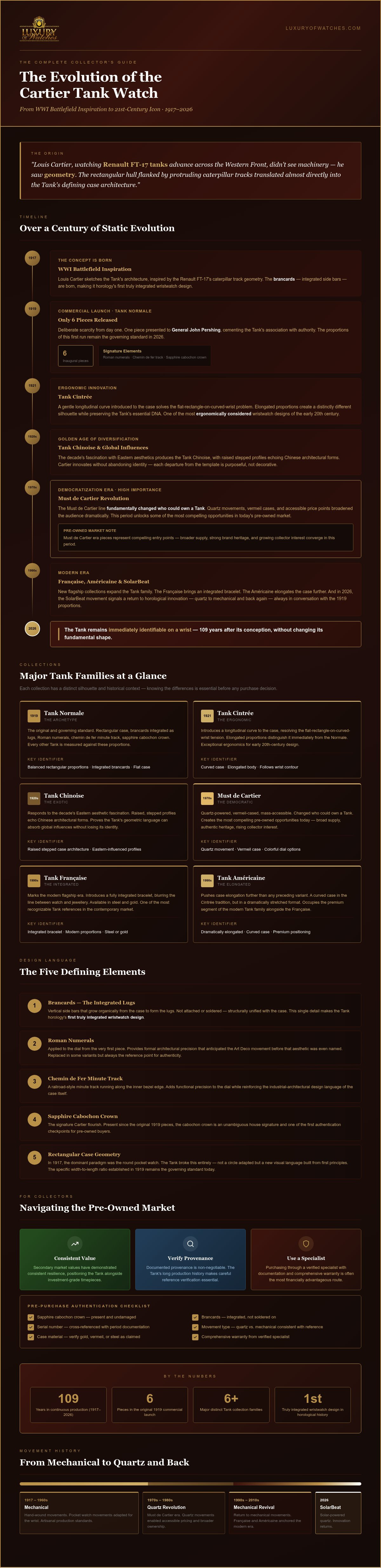
The year 1917 produced one of horology's most consequential moments, and it happened not in a watchmaker's atelier but on a French battlefield. Louis Cartier, watching Renault FT-17 tanks advance across the Western Front, didn't see machinery. He saw geometry. The top-down silhouette of those armored vehicles, with their broad rectangular hull flanked by protruding caterpillar tracks, translated almost directly into what would become the Tank's defining case architecture. That conceptual leap, from combat vehicle to wrist-worn timepiece, is where the evolution of the Cartier Tank watch truly begins.
What made this genuinely radical wasn't just the rectangular shape. In 1917, the dominant paradigm was the round pocket watch, recently migrated to the wrist but not yet reimagined for it. Louis Cartier broke that paradigm entirely. The Tank wasn't a circle adapted; it was a new visual language built from first principles.
The Renault FT-17 Design Philosophy
The FT-17's caterpillar tracks provided the direct inspiration for the Tank's most distinctive structural element: the brancards, the vertical side bars that extend from the case to form integrated lugs. This integration is the detail that separates the Tank from everything that preceded it. Earlier wristwatches attached their straps via soldered rings or afterthought lugs; the Tank's brancards grew organically from the case itself, making the watch and its strap a single unified object. It was, by any reasonable definition, the first truly integrated wristwatch design in horological history.
The early dials reinforced this architectural ambition. Roman numerals, a chemin de fer minute track running along the inner bezel edge, and restrained guilloche detailing gave the Tank a formal precision that anticipated the Art Deco movement before that aesthetic had even been named. The proportions were deliberate and self-contained.
Establishing the 'Tank Normale' Standard
The 1919 commercial launch was deliberately limited: just six pieces, establishing from the outset that this was an object of considered scarcity. One of those original pieces went to General John Pershing, commander of the American Expeditionary Forces, cementing the Tank's association with a particular kind of authority from its very first year of existence. The proportions established in that initial run, the ratio of case width to length, the depth of the brancards, the placement of the sapphire cabochon crown as a signature Cartier flourish, remain the governing standard against which every subsequent Tank reference is still measured in 2026.
Understanding this foundation is essential context for anyone exploring the evolution of the Cartier Tank watch across its many subsequent iterations. Every variation that followed, across more than a century of production, is best understood as a conversation with these original proportions, either honoring them precisely or deliberately departing from them for effect.
The Golden Age of Diversification (1920s–1960s)
Having established its foundational geometry in 1919, Cartier spent the next four decades doing something genuinely difficult: innovating without abandoning the identity it had just created. The 1920s through 1960s represent the most fertile period in the evolution of the Cartier Tank watch, a span during which the maison produced variants that addressed real ergonomic problems, absorbed global aesthetic influences, and solved mechanical challenges that no one had quite confronted before. Each departure from the original template was purposeful, not decorative.
The 1921 Tank Cintrée arrived first, and its logic was immediately apparent. A flat rectangular case sits awkwardly against the curved surface of a human wrist. The Cintrée resolved this by introducing a gentle longitudinal curve to the case itself, elongating the proportions simultaneously to create something that read as distinctly different from the original while sharing its essential DNA. It remains one of the most ergonomically considered wristwatch designs of the early twentieth century.
The 1920s also brought the Tank Chinoise, a reflection of the decade's broader fascination with Eastern aesthetics. Its raised case architecture, with stepped profiles echoing Chinese architectural forms, demonstrated that the Tank's rectangular framework could absorb outside influences without losing structural coherence. It's a historically significant piece precisely because it shows the design's flexibility at its earliest stage.
Then came the Basculante in 1932, which addressed a different problem entirely: protection. Its pivoting inner case could rotate within a fixed outer frame, shielding the crystal and dial during physical activity. This was Cartier's answer to the emerging demand for a more robust dress watch, and it anticipated the sports-luxury category by decades.
The Tank Louis Cartier: The Purist's Choice
The 1922 Tank Louis Cartier, designated by collectors as the "LC," represents the most refined distillation of the original concept. Where the Cintrée elongates and curves, the LC softens the case corners and refines the brancard proportions into something that feels both more sculptural and more resolved. Serious collectors gravitate toward it precisely because it doesn't overcorrect; it simply perfects. Production has historically been confined to gold and platinum, reinforcing its position as a precious-metal-only proposition. Dial details reward close examination: early examples feature intricate guilloché patterns, while later references introduced the famously concealed Cartier signature embedded within the Roman numeral VII, a detail that functions as both authentication marker and design flourish.
Mechanical Mastery in Rectangular Forms
Fitting a reliable movement into a rectangular case is a genuine engineering challenge. Round movements waste space; purpose-built calibres are expensive to develop. Cartier's solution during this era involved close collaboration with Jaeger-LeCoultre, whose ultra-thin rectangular calibres provided the mechanical foundation for many of the finest vintage Tank references. When assessing a pre-owned piece from this period, the movement signature matters considerably. Dials signed "Cartier Paris" typically indicate pieces produced for the French market under stricter quality controls, and they command a premium over "Swiss" signed examples in today's collector market. If you're considering a vintage Tank from this golden era, exploring verified pre-owned Cartier inventory from a specialist who understands these distinctions is the most reliable starting point.
The Revolution of Must de Cartier (1970s–1980s)
The Quartz Crisis of the 1970s didn't just threaten Swiss watchmaking in general; it threatened the very concept of the luxury mechanical timepiece as a desirable object. Cartier's response was neither defensive nor desperate. It was strategic. Rather than retreating into the rarefied air of precious-metal exclusivity, the maison made a calculated decision to broaden its audience without diluting its identity. The result was Must de Cartier, and it represents one of the most consequential pivots in the entire evolution of the Cartier Tank watch.
The defining material innovation was vermeil: gold-plated sterling silver. This wasn't a compromise; it was a reframing. A vermeil Tank case delivered the visual warmth and surface quality of gold at a price point that opened the Tank to an entirely new demographic. Simultaneously, Cartier departed from the classical dial language that had defined the watch since 1917. Lacquered dials in burgundy, cobalt blue, and matte black replaced traditional guilloche finishes, positioning the Tank not just as a horological object but as a fashion statement. The Roman numerals remained on some references, but their absence on others signaled a genuine willingness to evolve.
The cultural alignment was equally deliberate. Andy Warhol wore his Tank Must constantly, photographed with it so frequently that the association became inseparable from his public persona. Jackie Kennedy's longstanding preference for the Tank gave the Must era an additional layer of aspirational credibility. These weren't paid endorsements; they were genuine expressions of preference from figures who understood that an object's meaning extends beyond its materials.
Democratizing the Icon: The 1977 Launch
The Must de Cartier line launched with the explicit philosophy that Cartier ownership should feel like a cultural necessity, not an unattainable luxury. The marketing phrase "Cartier, c'est must" captured this precisely. For collectors examining pre-owned Must examples today, the case back is the primary authentication reference: genuine vermeil pieces carry clear engravings specifying the silver content and gold plating weight, typically alongside a Cartier serial number. The current resurgence in millennial collector interest has driven pre-owned Must prices considerably higher than they sat even five years ago, as younger buyers recognize both the cultural history and the design intelligence embedded in these pieces.
The Introduction of Cartier Quartz
Adopting quartz movements was, for Cartier, a pragmatic concession to market realities rather than an abandonment of values. The movements sourced for Must references were reliable, accurate, and serviceable, and that last quality matters enormously in 2026. A vintage Tank Must with a quartz calibre is genuinely one of the most accessible entry points into pre-owned Cartier ownership: battery replacements are straightforward, and the movements are robust enough that a well-preserved example from the late 1970s or early 1980s typically requires minimal intervention. When evaluating one through a verified specialist like Luxury of Watches, the combination of documented provenance and a comprehensive in-house warranty transforms what might seem like a modest vintage purchase into a genuinely secure acquisition. The competitor narrative that Must pieces are simply "less collectible" than solid gold models misreads the current market entirely. Condition, dial color, and cultural provenance are driving prices in ways that make early Must references increasingly compelling for serious collectors.
The Modern Era: Française, Américaine, and the SolarBeat (1990s–2026)
By the mid-1990s, the evolution of the Cartier Tank watch entered a phase defined less by geometric experimentation and more by material intelligence and market positioning. Two models anchored this shift. The 1996 Tank Française reintroduced something the Tank hadn't seriously explored since its earliest decades: an integrated metal bracelet. Not a strap with a clasp, but a bracelet architecturally continuous with the case, its rectangular links deliberately echoing the caterpillar-track imagery of Louis Cartier's original battlefield inspiration. It was a genuine design callback executed with contemporary manufacturing precision.
Tank Française vs. Tank Américaine
The distinction between these two references matters practically, not just aesthetically. The Française sits lower on the wrist with a broader case footprint; its "tank-track" bracelet creates a horizontal visual weight that reads confidently on medium to larger wrists. The Américaine takes the opposite approach, reviving the longitudinal curve of the 1921 Cintrée in a more elongated, upright case that flatters narrower wrists and carries an inherently dressier character. In 2026, both models are available across steel, yellow gold, and rose gold, with high-jewelry iterations in full diamond pavé that position them firmly within Cartier's haute horlogerie tier. If wrist size is a genuine concern, the Française's small and medium references translate well to wrists under 16cm, while the Américaine's proportions suit those who prefer a watch that reads vertically rather than horizontally.
The 2021 Tank Must Relaunch
The most strategically significant product decision Cartier made in recent memory was retiring the Tank Solo in favor of a relaunched Tank Must in 2021. This wasn't cosmetic. The new Must directly invoked the cultural weight of the 1970s Must de Cartier line while delivering updated movements, refreshed dial colorways, and the SolarBeat calibre as an available complication. For collectors tracking the evolution of the Cartier Tank watch across generations, the relaunch acknowledged something the market had already signaled: the Must name carries genuine heritage equity that the Solo never accumulated.
Sustainability in Horology: The SolarBeat Innovation
The SolarBeat movement is where Cartier made its most technically audacious statement in decades. The engineering challenge was specific: how do you integrate solar cells into a dial whose Roman numeral identity is non-negotiable? Cartier's solution was to perforate the numerals themselves, allowing light to pass through the dial surface and reach the photovoltaic cells beneath. The result is a movement rated for a minimum 16-year lifespan without battery replacement, paired with Cartier's move toward non-animal-derived strap materials that align the watch with contemporary expectations around responsible luxury. The SolarBeat represents the single most consequential technical evolution in the Tank's history, resolving a century-long tension between the watch's formal aesthetic and the practical demands of modern ownership.
For buyers considering a modern Tank Must with SolarBeat technology or a pre-owned Française through the secondary market, working with a verified specialist provides the documentation and warranty coverage that a private sale simply cannot match. Explore authenticated pre-owned Cartier Tank references at Luxury of Watches, where every acquisition is backed by a comprehensive five-year in-house warranty.
Navigating the Cartier Tank Market for Collectors
Secondary market data consistently positions the Cartier Tank among the most resilient luxury timepieces in circulation. Unlike trend-driven pieces that spike and correct sharply, Tank values have demonstrated a measured, sustained appreciation across key references, driven by genuine scarcity in desirable configurations, sustained cultural relevance, and the kind of cross-generational recognition that no marketing budget can manufacture. For collectors approaching the market in 2026, that stability is a meaningful differentiator from more speculative acquisitions.
The financial case for pre-owned over new is straightforward. A new Tank purchased at retail carries an immediate depreciation premium the moment it leaves the boutique. A verified pre-owned example, correctly authenticated and backed by a comprehensive warranty, delivers the same wearing experience at a materially lower acquisition cost, often with the added benefit of discontinued references or dial configurations no longer available through official channels. The caveat is the word "verified." Without rigorous authentication, the pre-owned market's advantages dissolve entirely.
What to Look for in a Pre-Owned Tank
Three specific details separate a genuine Tank from a convincing imitation, and each rewards careful examination.
- The cabochon crown. Cartier's signature sapphire cabochon should display a deep, consistent blue with no surface cloudiness or visible seam where a synthetic stone might be bonded. The setting itself should be cleanly integrated into the crown body, not sitting proud or slightly off-center.
- The secret signature. On dials carrying Roman numerals, Cartier embeds its name within the numeral VII on many references, a detail requiring magnification to confirm. Its presence doesn't guarantee authenticity on its own, but its absence on a piece claiming to be genuine is an immediate red flag.
- Case finish and polish. Among serious collectors, "unpolished" has become a genuine premium descriptor. Original factory surfaces, with their precise brushed and polished zones intact, confirm a case that hasn't been sent through aftermarket refinishing. Heavy polishing rounds edges, removes hallmarks, and erases the crisp brancard geometry that defines the Tank's visual identity. An unpolished example in honest condition is almost always preferable to a heavily refinished piece that reads as new.
The full evolution of the Cartier Tank watch, across more than a century of production, has generated an enormous range of references at varying price points. Knowing which details to examine narrows that field considerably and protects against the most common acquisition errors.
The Luxury of Watches Difference
Founded in 1999, Luxury of Watches has spent more than two decades developing the verification expertise and supplier relationships that pre-owned Cartier acquisition genuinely demands. Every piece undergoes rigorous authentication before it reaches a buyer, covering movement, case, dial, and provenance documentation. That process isn't a formality; it's the foundation on which the entire transaction rests.
The five-year in-house warranty is where the proposition becomes especially compelling. Standard retail warranty terms typically cover two years and exclude pre-owned pieces entirely. Luxury of Watches' five-year coverage extends that protection considerably, transforming a pre-owned acquisition from a calculated risk into a genuinely secure investment. For a high-value timepiece, the difference between two years and five years of comprehensive coverage isn't marginal; it's the difference between confidence and exposure.
Expert customer support is available throughout the acquisition process, covering everything from sizing considerations across Tank references to movement comparisons between quartz and mechanical calibres. That guidance matters, particularly for buyers navigating the Tank's extensive reference history for the first time.
Explore our curated collection of authentic Cartier watches and find the Tank reference that suits both your wrist and your investment horizon, backed by the verification and warranty coverage that serious collectors require.
Your Next Step Into a Century of Design Excellence
The evolution of the Cartier Tank watch is, at its core, a study in disciplined restraint. From Louis Cartier's battlefield inspiration in 1917 through the democratizing Must de Cartier era to the technically ambitious SolarBeat calibre, every significant development has respected the original geometry while finding genuine reasons to depart from it. That continuity is precisely what makes the Tank a compelling acquisition in 2026, not just as a timepiece, but as a long-term holding with demonstrated market resilience.
Two principles should guide any purchase decision: know which reference suits your wrist and your intentions, and buy only from a source that can fully document what you're acquiring. A verified pre-owned Tank, backed by rigorous authentication and comprehensive warranty coverage, is a fundamentally different proposition from a private sale with no paper trail.
Luxury of Watches has been serving serious collectors since 1999, with an A+ authentication standard and a five-year in-house warranty that retail simply can't match. Global shipping means the right reference is genuinely within reach.
Shop our verified collection of authentic Cartier Tank watches with a 5-year warranty and acquire yours with complete confidence.
Frequently Asked Questions
Is the Cartier Tank considered a good investment watch in 2026?
Yes, the Cartier Tank has demonstrated consistent secondary market resilience that positions it among the more reliable investment-grade timepieces available. Unlike trend-driven watches that spike and correct sharply, Tank values have shown measured, sustained appreciation across desirable references. Solid gold vintage examples and early Must de Cartier pieces with sought-after dial colorways have attracted particularly strong collector demand in recent years.
That said, investment potential varies significantly by reference, condition, and provenance. Unpolished cases with original documentation command meaningful premiums over refinished examples. Buying through a verified specialist who can fully authenticate what you're acquiring is the foundation of any sound purchase decision in this category.
What is the difference between a Tank Solo and a Tank Must?
The Tank Solo was Cartier's entry-level steel Tank reference, positioned primarily as an accessible introduction to the collection. Cartier retired it in 2021 in favor of a relaunched Tank Must, a decision that reflected the Must name's stronger heritage equity and cultural resonance. The Tank Must carries the direct lineage of the 1970s Must de Cartier era, and its relaunch introduced updated movements, refreshed dial colorways, and the SolarBeat calibre as an option.
For collectors, the practical difference is meaningful. The Must name connects to a documented cultural history that the Solo never accumulated, which matters both for long-term value and for the wearing experience. Pre-owned Tank Solo references remain available through the secondary market and can represent solid value, but the Must carries the stronger collector narrative.
How can I tell if a pre-owned Cartier Tank is authentic?
Three details warrant close examination on any pre-owned Tank. First, the sapphire cabochon crown should display consistent, deep blue coloring with no cloudiness or visible bonding seam. Second, on dials with Roman numerals, Cartier embeds its signature within the numeral VII on many references; its absence on a piece claiming to be genuine is a significant red flag. Third, examine the case finish carefully, as original factory surfaces with precise brushed and polished zones intact confirm the piece hasn't been through aftermarket refinishing.
Beyond these physical checks, documented provenance matters enormously. A purchase backed by rigorous authentication from a verified specialist, covering movement, case, dial, and serial records, provides a level of confidence that no private sale can replicate. That documentation also protects resale value if you decide to sell later.
Should I buy a quartz or mechanical Cartier Tank?
The honest answer depends on your priorities. Mechanical Tanks, particularly vintage references housing Jaeger-LeCoultre-derived rectangular calibres, carry stronger collector appeal and often command higher secondary market values. They reward engagement with horology as a craft. Quartz Tanks, especially Must de Cartier examples from the late 1970s and 1980s, offer genuine practicality: battery replacements are straightforward, and well-preserved examples typically require minimal intervention.
For a first acquisition, a quartz Must in excellent condition is often the more financially accessible entry point, and the current collector market has recognized their cultural significance in ways that have driven prices higher than they sat even five years ago. The SolarBeat calibre in the current Tank Must represents a third option, resolving the battery question entirely with a movement rated for a minimum 16-year lifespan.
Why is the Cartier Tank so popular among celebrities and icons?
The Tank's appeal to cultural figures has never been manufactured through paid partnerships. Andy Warhol wore his Tank Must because it aligned with his visual sensibility; Jackie Kennedy's preference for the Tank was a genuine expression of taste. The watch communicates a particular kind of authority that doesn't announce itself aggressively, which suits figures who understand that restraint is its own form of statement.
The geometry itself is part of the explanation. The rectangular case reads differently from every angle, projecting architectural precision rather than the round-watch conformity that dominated before 1917. That distinctiveness, combined with over a century of cultural association, makes the Tank recognizable to people who couldn't name another watch reference. That cross-audience recognition is genuinely rare in horology.
Does Luxury of Watches provide a warranty for pre-owned Cartier watches?
Yes. Every pre-owned Cartier watch acquired through Luxury of Watches is backed by a comprehensive five-year in-house warranty. This significantly exceeds the two-year coverage that standard retail terms typically offer, and it applies specifically to pre-owned pieces, a category that manufacturer warranties exclude entirely. For a high-value timepiece, that three-year difference in coverage represents meaningful protection.
The warranty is supported by rigorous pre-purchase authentication covering movement, case, dial, and provenance documentation. Founded in 1999, Luxury of Watches has spent more than two decades developing the verification expertise that makes this level of coverage credible rather than merely promotional. Expert customer support is available throughout the acquisition process and beyond.
What is the best Cartier Tank model for a first-time buyer?
The Tank Must is the most natural starting point for most first-time buyers. It sits at a more accessible price point than solid gold references, carries genuine heritage through its connection to the 1970s Must de Cartier line, and is available in both current production and pre-owned form across a range of dial configurations. Steel references offer the lowest barrier to entry while still delivering the full Tank design experience.
Wrist size should also factor into the decision. The Tank Française suits medium to larger wrists with its horizontal visual weight, while the Tank Américaine's elongated, upright proportions work particularly well on narrower wrists. If you're uncertain which reference suits your proportions, working with a specialist who can guide you through the sizing distinctions across the Tank family is worth the conversation before committing.
Is the Cartier Tank Must SolarBeat still available and how does it work?
The Tank Must SolarBeat remains part of Cartier's current collection as of 2026. The movement addresses a genuine engineering challenge: integrating photovoltaic cells beneath a dial whose Roman numeral identity is non-negotiable. Cartier's solution was to perforate the numerals themselves, allowing ambient light to pass through the dial surface and reach the solar cells beneath. The calibre is rated for a minimum 16-year lifespan without battery replacement under normal wearing conditions.
Beyond the technical specifications, the SolarBeat represents Cartier's most significant movement innovation in the Tank's history, resolving the practical inconvenience of battery changes while aligning with contemporary expectations around responsible luxury. Pre-owned SolarBeat references are beginning to appear through the secondary market; when considering one, verified authentication and warranty coverage from a specialist like Luxury of Watches ensures the movement's condition has been properly assessed before purchase.