
The Breitling Navitimer History: From Pilot’s Tool to Horological Icon
Posted by Luxury of Watches on 8th Jul 2026
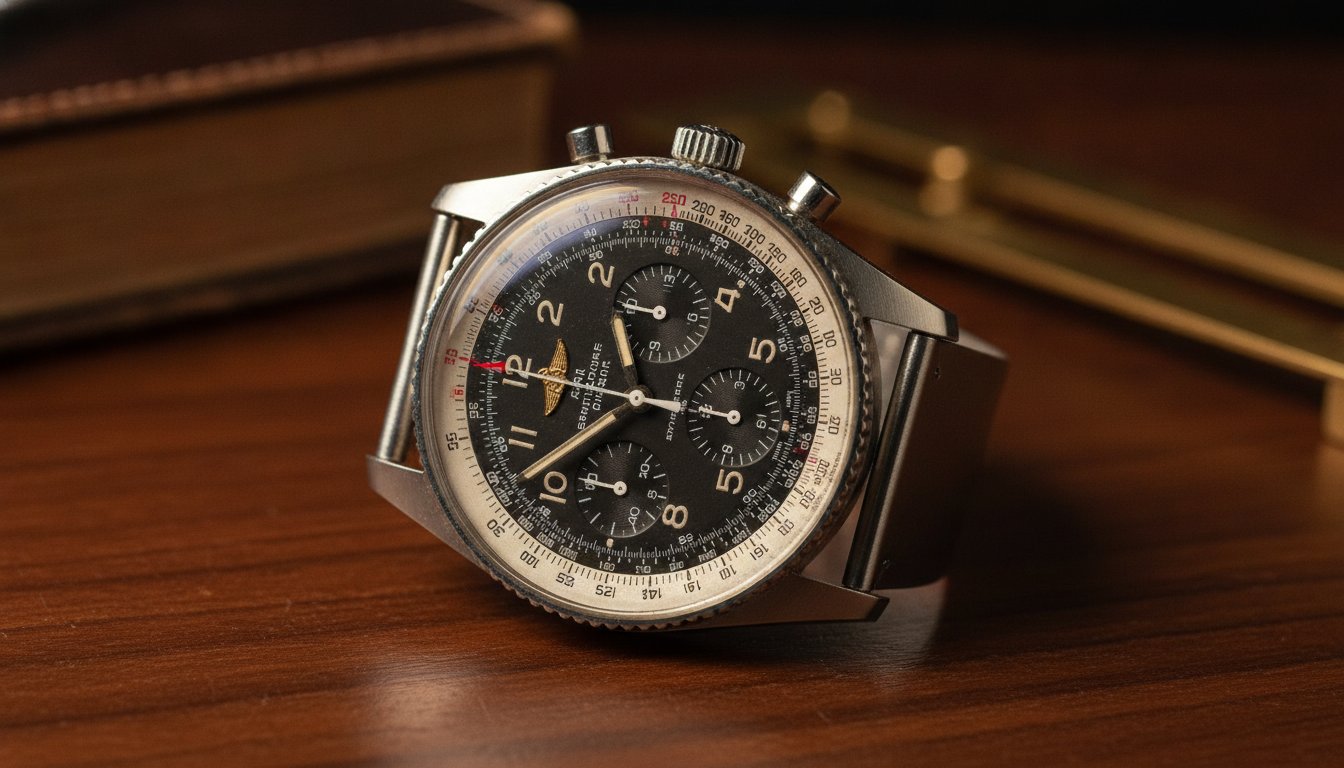
Long before digital cockpits and satellite GPS, a pilot's life depended on the mechanical computer strapped to their wrist. The Breitling Navitimer wasn't merely a luxury accessory; it was a functional instrument designed to calculate fuel consumption and climb rates at high altitudes. You likely recognize its signature slide rule bezel, yet the complex web of logos and references within the Breitling Navitimer history can often feel overwhelming when you're looking to invest. It's natural to feel uncertain about whether a vintage "Twin-Jet" model or a modern B01 Chronograph represents the best value for your specific collection.
We've designed this guide to provide the technical clarity you need to select a timepiece with lasting significance. You'll discover the seventy-year evolution of this horological icon, from its 1952 debut as the official watch of the Aircraft Owners and Pilots Association to its current status as a premier manufacture movement. We'll outline how to identify key historical eras and explain the technical milestones that define the Navitimer's worth in today's market. This knowledge ensures you can approach the pre-owned market with the same precision and confidence that pilots once used to navigate the skies.
Key Takeaways
- Trace the origins of the circular slide rule and understand why the AOPA adopted this timepiece as its official flight instrument in 1952.
- Navigate the Breitling Navitimer history by identifying the visual markers of the "Twin-Jet" era and other significant design shifts that impact collectability.
- Explore the technical revolution of the Caliber 11, a secret collaboration that brought automatic winding to the world of professional pilot chronographs.
- Learn to distinguish between authentic vintage references and "Franken-watches" to ensure your investment maintains its long-term horological value.
- Understand how the brand’s survival during the Quartz Crisis shaped the modern Navitimer’s status as a global symbol of prestige and engineering excellence.
The Origins of the Navitimer: A Flight Computer for the Wrist
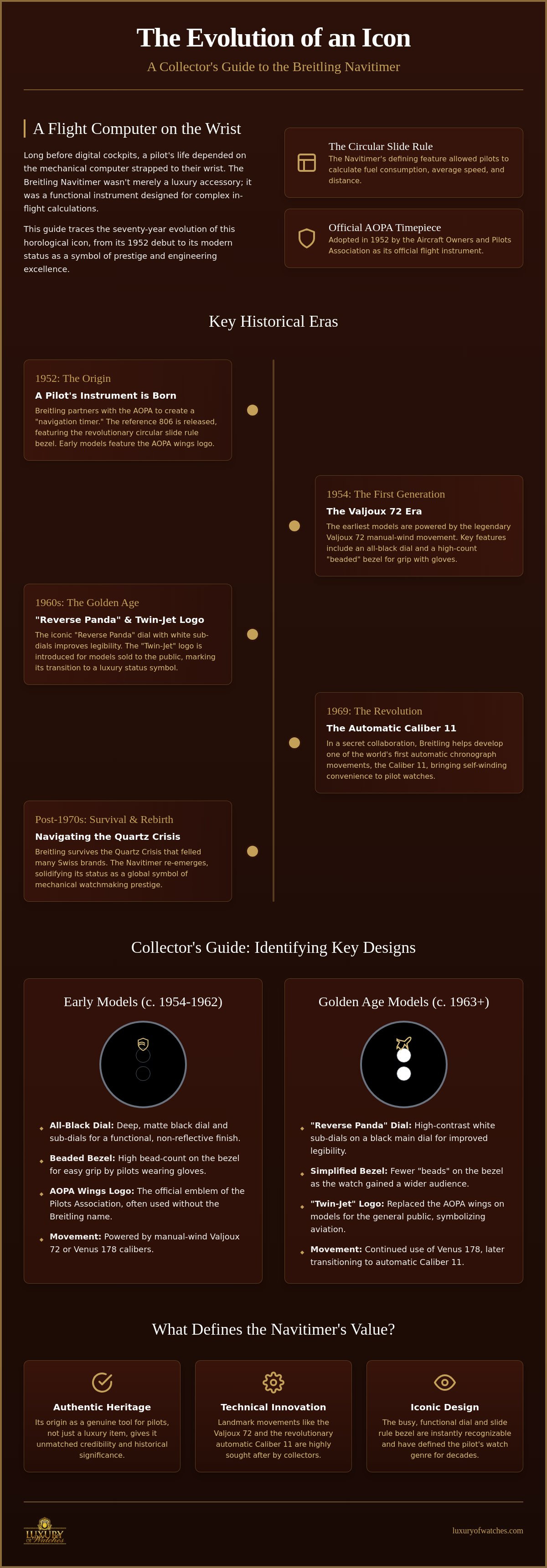
The term "Navitimer" serves as a portmanteau of "navigation" and "timer," a name that perfectly encapsulates the watch's intended utility upon its 1952 release. While many high-end timepieces of the era focused on elegance, Willy Breitling sought to create a specialized tool that functioned as a wearable flight computer. This ambition led to a historic partnership with the Aircraft Owners and Pilots Association (AOPA). The association was so impressed by the design that they adopted it as their official timepiece, often featuring the AOPA wings at the 12 o'clock position instead of the Breitling brand name. For more technical details on these early specifications, the Breitling Navitimer Wikipedia page offers an extensive breakdown of the model's lineage.
The early reference 806 established a design language that remains virtually unchanged today. It introduced the black dial with three sub-dials and the revolutionary circular slide rule bezel. This layout wasn't just for show; it provided pilots with the ability to perform complex calculations directly on their wrists. By integrating these features, Breitling secured the Navitimer's place as a vital piece of cockpit equipment before the advent of electronic avionics. Understanding this functional foundation is essential to appreciating the full Breitling Navitimer history.
The Slide Rule Explained: Calculations at 30,000 Feet
The Navitimer's most defining feature is its logarithmic slide rule, an evolution of the system first seen on the 1940s Chronomat. In a period where a single mathematical error could be catastrophic, this bezel allowed aviators to calculate fuel consumption, average speed, and distance during flight. The dial's dense, technical appearance became a badge of honor. It signaled that the wearer wasn't just a watch enthusiast, but a professional capable of managing the intricate physics of flight. This functional complexity is a cornerstone of the Breitling Navitimer history, separating it from more decorative chronographs of the mid-century.
The First Generation: The All-Black Valjoux 72 Era
Serious collectors often focus on the earliest iterations of the reference 806. The very first models from 1954 featured the Valjoux 72 manual-wind movement, a legendary caliber also found in other high-value vintage chronographs. These "pre-AOPA" and early AOPA models are exceptionally rare today. Shortly after, Breitling transitioned to the Venus 178 movement, which powered the Navitimer for much of its golden age. You can identify these early pieces by specific design cues:
- Beaded Bezels: Early models featured a bezel with a high count of small "beads" to provide grip for gloved hands.
- Small AOPA Wings: The logo was often applied or printed without the Breitling script, emphasizing its role as a professional tool.
- All-Black Dials: Before the "reverse panda" look became standard, the entire dial was a deep, matte black.
These technical specifications weren't aesthetic choices; they were pragmatic solutions for men working in high-pressure environments. This commitment to utility is why the Navitimer remains a staple for those who value authentic tool-watch heritage.
Evolution of an Icon: The Twin-Jet and Big Case Eras
The 1960s marked a pivotal chapter in the Breitling Navitimer history. During this decade, the watch transitioned from a niche aviation instrument into a broader luxury status symbol. This era introduced the "Reverse Panda" dial, featuring high-contrast white sub-dials against a deep black background. This design choice significantly improved legibility, but it also defined the aesthetic that modern collectors still covet today. If you're looking to start your own collection, exploring our selection of Breitling Watches provides a gateway to these iconic designs.
As the watch's popularity grew outside professional pilot circles, Breitling introduced the "Twin-Jet" logo. This emblem, featuring two stylized aircraft flying in formation, replaced the exclusive AOPA wings on models intended for the general public. For those studying Breitling Watches: The Ultimate Collector’s Guide to Heritage and Performance, identifying these logo variations is a primary step in verifying a piece's era. Expansion continued with the Reference 809 Cosmonaute. Launched in 1962, it modified the Navitimer for space travel by incorporating a 24-hour dial. This allowed Scott Carpenter to distinguish between day and night while orbiting the Earth, further cementing the brand's reputation for extreme technical reliability.
The Branding Shift: From AOPA Wings to Twin-Jets
Breitling moved away from the exclusive AOPA branding to capture a global market that admired aviation but didn't necessarily hold a pilot's license. The Twin-Jet logo became the face of this expansion, appearing on the dial alongside the Breitling name. When inspecting these vintage pieces, it's vital to look for original tritium lume and sharp printing. Service replacements often lack the nuanced texture of 1960s dials. The Twin-Jet era represents the absolute peak of vintage Navitimer collectibility for serious horological enthusiasts.
The 1970s and the "Big Case" Navitimer 1806
By the late 1960s and early 70s, consumer tastes shifted toward bolder, more substantial wrist presence. Breitling responded with the Reference 1806, affectionately known by collectors as the "Pizza" Navitimer due to its massive 48mm case. This model was a radical departure from the traditional 40mm proportions. It utilized the pioneering Chrono-Matic automatic movement, which required a larger housing. These "Big Case" models represent a fascinating pivot in the Breitling Navitimer history, proving that the brand was willing to push technical and aesthetic boundaries to remain at the forefront of the industry. Their influence is still visible in the oversized dimensions often seen in modern Breitling collections.
The 1969 Revolution: The Caliber 11 and Automatic Flight
The year 1969 stands as arguably the most transformative period in Breitling Navitimer history. While the watch had already secured its legacy as a manual-wind tool for aviators, the industry was racing toward a new frontier: the automatic chronograph. To achieve this, Breitling entered a clandestine partnership known as Project 99. This collaboration included Heuer, Buren, and the chronograph specialist Dubois-Dépraz. Together, they developed the Caliber 11, also known as the Chrono-Matic, which effectively redefined the capabilities of a pilot's watch.
The release of the Chrono-Matic was a direct response to the Zenith El Primero. While Zenith pursued an integrated high-frequency movement, the Project 99 team opted for a modular construction. This engineering choice resulted in one of the most distinctive visual quirks in horology. Because the chronograph module was mated to a micro-rotor base, the winding crown had to be moved to the left side of the case. This "lefty" configuration remains a hallmark of authenticity for collectors seeking pieces from this specific two-year window. It's a design that wasn't just a stylistic choice but a necessity of the movement's architecture.
The Technical Brilliance of the Chrono-Matic
The Caliber 11's modular design was a feat of micro-engineering. By utilizing a Buren micro-rotor, the movement remained relatively slim despite its mechanical complexity. This era also introduced a practical addition to the Navitimer's busy dial: the date window. Positioned at the 6 o'clock mark, it offered a balanced symmetry that earlier manual models lacked. Collectors often refer to these as "transitional" icons because they represent the bridge between the purely mechanical tool era and the modern age of automated convenience.
Market Impact: The Navitimer in the Late 60s
The late 1960s coincided with the height of the "Jet Age," where international travel became more accessible and prestigious. The automatic Navitimer aligned perfectly with this cultural shift toward modern efficiency. It wasn't just a slide rule for calculating flight paths anymore; it was a symbol of cutting-edge technology. This period in Breitling Navitimer history proved the brand could innovate under pressure, maintaining its relevance even as the industry faced the looming threat of electronic timekeeping.
The left-hand crown serves as the primary identifier for 1969 and 1970 models, signaling a watch that was designed to be worn by a pilot who would operate the chronograph pushers with their right hand while the crown remained protected against the wrist. This era's models are highly sought after in the pre-owned luxury market for their unique silhouette and historical significance.
Survival and Rebirth: Navigating the Quartz Crisis
While the 1960s were a golden age for mechanical chronographs, the late 1970s brought the Swiss watch industry to its knees. The "Quartz Crisis" nearly erased decades of innovation as battery-powered movements from Asia flooded the market. In 1979, the Breitling family was forced to sell the company, a moment that many official brand histories often gloss over. This was a critical juncture in Breitling Navitimer history, as production actually halted briefly before a new visionary stepped in to preserve the legacy of the slide rule bezel.
Ernest Schneider, a pilot and microelectronics specialist, purchased the brand and moved operations to Grenchen. He recognized that while quartz technology was the present, the mechanical soul of the Navitimer was the brand's true future. Schneider didn't just maintain the status quo; he revitalized the collection by introducing the "Old Navitimer" in the 1990s. These models typically utilized the Valjoux 7750 movement, a robust workhorse that allowed Breitling to offer mechanical precision at a time when many competitors were still struggling to find their footing. This period proved that the Navitimer could adapt to the modern era without losing its core identity.
The Schneider Era: A Pilot at the Helm
Schneider’s leadership was defined by a return to aviation roots. He understood that a pilot's watch must be both functional and legible, leading to the introduction of the Navitimer Airborne. This model favored smaller, more wearable case sizes that appealed to a new generation of enthusiasts who appreciated the technical heritage of the 1950s. This era is particularly interesting for those exploring The Comprehensive Guide to Pre-Owned Luxury Watches, as these 1990s models represent a perfect bridge between vintage aesthetics and modern manufacturing standards.
The B01 Movement: Modern Engineering Meets Heritage
The most significant modern milestone in Breitling Navitimer history occurred in 2009. This was the year Breitling transitioned from utilizing sourced movements to becoming a true "manufacture" with the launch of the Caliber 01. This in-house movement features a robust 70-hour power reserve, meaning you can set the watch down on a Friday evening and it will still be ticking accurately on Monday morning. Coupled with COSC chronometer certification, these technical specifications make modern Breitling watches powered by the B01 the gold standard for contemporary collectors who demand both heritage and high-performance engineering.
If you are ready to add a piece of this resilient legacy to your wrist, browse our curated collection of Pre-Owned Luxury Watches to find a model that fits your personal style and investment goals.
Collecting the Navitimer: Verification and Market Value
Understanding the Breitling Navitimer history is the first step toward building a collection that holds its value. Unlike many fashion-forward watches that fluctuate with trends, the Navitimer's core design has remained remarkably consistent since 1952. This aesthetic stability makes it one of the more reliable assets in the luxury market. However, this seven-decade longevity creates a specific challenge for the secondary market: the "Franken-watch." Because so many parts are interchangeable across different references, it's common to find vintage pieces with mismatched hands, service dials from the wrong era, or incorrect bezels. For a serious collector, these inconsistencies can significantly diminish the watch's resale potential and historical integrity.
Absolute verification is the only way to navigate these risks. A genuine Navitimer isn't just a collection of parts; it's a documented piece of aviation history. Statistics from the pre-owned market show that having the original box and papers can add approximately 20% to 30% to a watch's resale value. This documentation serves as a bridge between the watch's past and its future worth, providing the transparency required for high-value horological transactions. We prioritize this level of verification to ensure that every piece in our collection meets the scrutiny of the most demanding enthusiasts.
Navitimer Investment: Vintage vs. Modern
When you're deciding where to allocate your capital, you must weigh the historical prestige of vintage references against the daily-wear reliability of modern engineering. A vintage Reference 806 from the 1960s offers immense "cool factor" and potential appreciation, but it requires careful maintenance. In contrast, the modern B01 series provides the security of a 70-hour power reserve and superior water resistance. The 2022 redesign, which saw the return of the AOPA wings to the dial, has also shifted the market. Pre-2022 models featuring the "B" or "Anchor" logos now represent a distinct era in the Breitling Navitimer history, while limited editions like the TWA or Pan Am series hold specific value for those who appreciate the "Jet Age" aesthetic. Buying pre-owned typically allows you to secure these icons at 15% to 30% below original retail prices.
The Luxury of Watches Promise: Security in Heritage
We believe that acquiring a piece of history shouldn't feel like a gamble. Our 5-year in-house warranty is designed to protect your investment, ensuring that the mechanical heart of your Navitimer performs to the manufacturer's original standards. Every pre-owned watch we feature undergoes a rigorous verification process conducted by experts who understand the nuances of caliber movements and period-correct components. This commitment to absolute verification, combined with our secure transaction protocols and expert customer support, provides the peace of mind you need when making a significant addition to your collection. We bridge the gap between the prestige of the past and the security of modern commerce, allowing you to focus on the craftsmanship and heritage of your timepiece.
Investing in a Legacy of Aviation Precision
The journey from a specialized 1950s flight computer to a global horological icon demonstrates the enduring power of functional design. You've seen how the Breitling Navitimer history is defined by technical milestones, from the early AOPA partnerships to the revolutionary automatic Caliber 11. This timeline isn't just a record of the past; it's a roadmap for collectors seeking timepieces that offer both historical depth and long-term market stability.
Finding a model that aligns with your collection requires an intermediary who values authenticity as much as you do. Since 1999, our team has acted as trusted experts in luxury horology, providing the absolute verification needed for high-value acquisitions. We invite you to explore our curated collection of authentic Breitling Navitimer watches. Every pre-owned timepiece we sell comes with guaranteed authenticity and our 5-Year Comprehensive In-House Warranty for your total peace of mind. Own a piece of the sky today and invest in a legacy that remains as precise as the day it was first engineered.
Frequently Asked Questions
Is the Breitling Navitimer a good investment piece?
The Breitling Navitimer is widely considered a stable investment because its core aesthetic hasn't changed significantly since 1952. While retail prices for flagship models often exceed $10,000, the pre-owned market typically sees values remain between 15% and 30% below retail, providing a more accessible entry point for collectors. Authentic vintage models, particularly those with rare movements like the Valjoux 72, have historically shown strong appreciation over several decades.
What is the difference between a Navitimer and a Chronomat?
The primary difference lies in the specialized function of the slide rule bezel. While the Navitimer features a logarithmic scale specifically calibrated for flight calculations like fuel consumption and rate of climb, the original 1940s Chronomat was designed for mathematical and engineering tasks. Modern Chronomats have evolved into versatile luxury sports watches with "rider tabs" on the bezel, whereas the Navitimer remains dedicated to its aviation heritage.
How can I tell if a vintage Breitling Navitimer 806 is authentic?
Authenticating a vintage Reference 806 requires a close inspection of the movement and dial details. You should verify that the caliber is a period-correct Venus 178 or the rarer Valjoux 72, as many "Franken-watches" utilize incorrect movements. Additionally, the number of beads on the bezel and the specific alignment of the AOPA or Twin-Jet logos are critical markers that our experts analyze during our rigorous verification process.
Why do some Navitimers have the AOPA logo and others have the Twin-Jet?
These variations represent different chapters in the Breitling Navitimer history and target audiences. The AOPA wings logo was used for models commissioned by the Aircraft Owners and Pilots Association, while the Twin-Jet logo was introduced in the 1960s to market the watch to the general public. Collectors often seek specific logos depending on whether they value the watch's professional origins or its transition into a global luxury icon.
Does the Navitimer slide rule actually work for modern pilots?
The slide rule remains a fully functional mechanical computer that can perform the same calculations today as it did in 1952. While modern pilots rely on digital avionics and GPS, the Navitimer serves as a reliable analog backup for calculating ground speed or fuel endurance. It's one of the few luxury instruments that retains its original utility despite the advancement of electronic flight technology.
What movement is inside the modern Breitling Navitimer?
Most modern flagship Navitimer models are powered by the in-house Manufacture Caliber B01, a self-winding mechanical movement. This caliber is COSC-certified and features a substantial 70-hour power reserve, allowing for high precision and reliability. Other variations in the current collection, such as the Automatic 41 or GMT models, utilize specialized automatic movements tailored to their specific complications and case sizes.
How do I maintain the water resistance on a Navitimer?
Maintaining water resistance on a Navitimer requires an understanding of its 30-meter (3 ATM) rating. This watch is designed to withstand splashes or rain but isn't intended for swimming or diving. To protect the movement, you should have the gaskets inspected annually by a professional and ensure the crown is always pushed in fully before any contact with moisture.
Why is the Navitimer called the 'Ultimate Pilot Instrument'?
The Navitimer earned this title because it was the first timepiece to successfully integrate a complex circular slide rule into a wrist-worn chronograph. This innovation allowed pilots to perform all essential flight calculations without needing a separate handheld computer. This unique combination of mechanical timing and mathematical utility is the defining hallmark of the Breitling Navitimer history and its status as a professional tool.