
Sapphire vs. Mineral Crystal: Watch Collector's Guide
Posted by Luxury of Watches on 5th Aug 2026
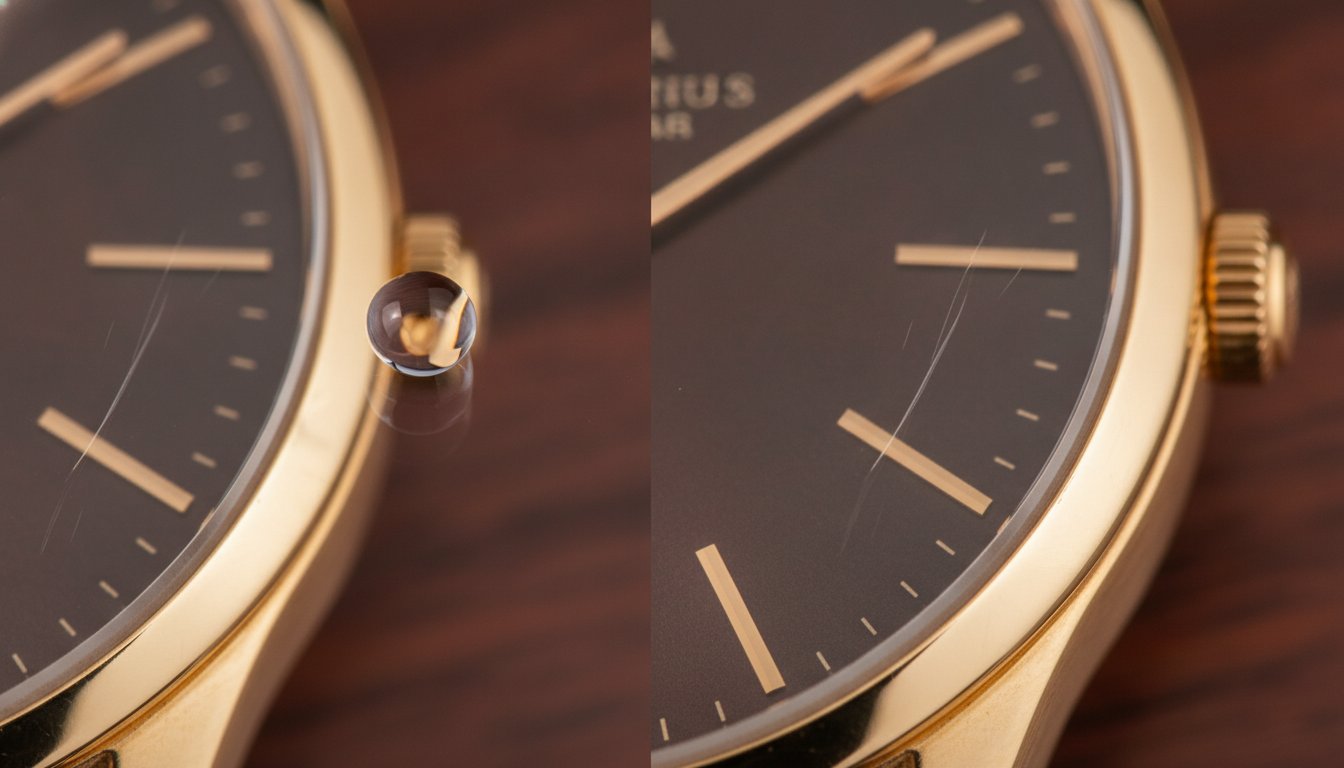
A single hairline scratch across a pristine watch face can instantly diminish the emotional and financial value of a high-end timepiece. When you're investing in a luxury asset, the protective barrier over the dial shouldn't be a source of anxiety or technical confusion. Many collectors find themselves caught in the sapphire crystal vs mineral crystal in watches debate, wondering if the visible difference justifies the price gap or if "hardened" glass can truly withstand the rigors of a modern lifestyle.
It's understandable to feel overwhelmed by industry jargon like the Mohs scale or the trade-offs between brittleness and hardness. You deserve to feel confident that your watch will remain as flawless as the day you acquired it. This guide clarifies the critical distinctions between these materials, ensuring your next acquisition is both beautiful and resilient.
We'll examine the specific physics of scratch resistance versus impact durability, provide a clear comparison of manufacturing costs, and highlight why the world's most prestigious manufacturers insist on sapphire. By the end, you'll have the expert knowledge required to choose a crystal that aligns with your standards for craftsmanship and long-term security.
Key Takeaways
- Learn why the crystal is a precision-engineered component essential for shielding your investment's dial and movement from external damage.
- Understand the technical properties of mineral crystals, which offer a practical balance of impact resistance and cost-effectiveness for casual wear.
- Discover why the sapphire crystal vs mineral crystal in watches comparison is a defining factor in luxury horology, particularly regarding scratch resistance and long-term value.
- Master the "Water Drop Test" and other expert techniques to verify crystal authenticity and assess optical clarity at home.
- Gain confidence in your next acquisition by identifying the standards of excellence maintained by prestigious brands like Rolex, Cartier, and Breitling.
What is a Watch Crystal and Why Does Material Matter?
The watch crystal is the transparent cover protecting the dial, usually made of acrylic, mineral, or sapphire. It functions as the primary barrier between the delicate mechanical movement and the environmental hazards of daily life. In the sphere of luxury horology, this component is far more than mere glass. It is a precision-engineered lens that ensures clarity and structural integrity. The specific material chosen for this watch glass dictates whether a timepiece will maintain its showroom luster after decades of wear or succumb to unsightly abrasions.
When evaluating sapphire crystal vs mineral crystal in watches, collectors must consider the long-term aesthetic impact. A high-quality crystal preserves the intricate details of a hand-finished dial. Because we specialize in pre-owned luxury, we often observe how different materials age over fifty years. While a vintage acrylic crystal might develop a charming patina of fine scratches, a modern sapphire crystal remains remarkably clear, acting as a permanent window into the artistry of the manufacturer. This clarity is essential for brands like Rolex, Cartier, or Patek Philippe, where the dial's texture and finish are central to the watch's value.
The Evolution of Watch Protection
Early horology relied on fragile pocket watch glass that offered minimal protection against moisture or impact. As timepieces migrated to the wrist, manufacturers adopted acrylic, often known as Hesalite. This material was shatterproof but prone to heavy scratching. The industry eventually transitioned toward mineral and sapphire standards to satisfy the modern collector's demand for durability. Today, scratch resistance is a priority for serious investors. They want the assurance that an accidental brush against a granite countertop won't result in a permanent scar on their investment. This shift reflects a broader commitment to longevity in the secondary market.
Key Factors: Hardness vs. Toughness
Understanding the technical performance of a crystal requires a distinction between hardness and toughness. Hardness refers to the material's ability to resist surface scratches and abrasions from external objects. Toughness represents the ability to resist fracturing or shattering under a direct impact. Finding a perfect balance between these two properties is the "Holy Grail" of watchmaking. While sapphire offers unparalleled hardness, mineral glass provides a degree of flexibility that can be advantageous in specific tool-watch applications. Understanding the nuances of sapphire crystal vs mineral crystal in watches allows you to select a timepiece that matches your specific lifestyle needs, whether you're a desk diver or a weekend adventurer.
Mineral Crystal: The Versatile Standard for Tool Watches
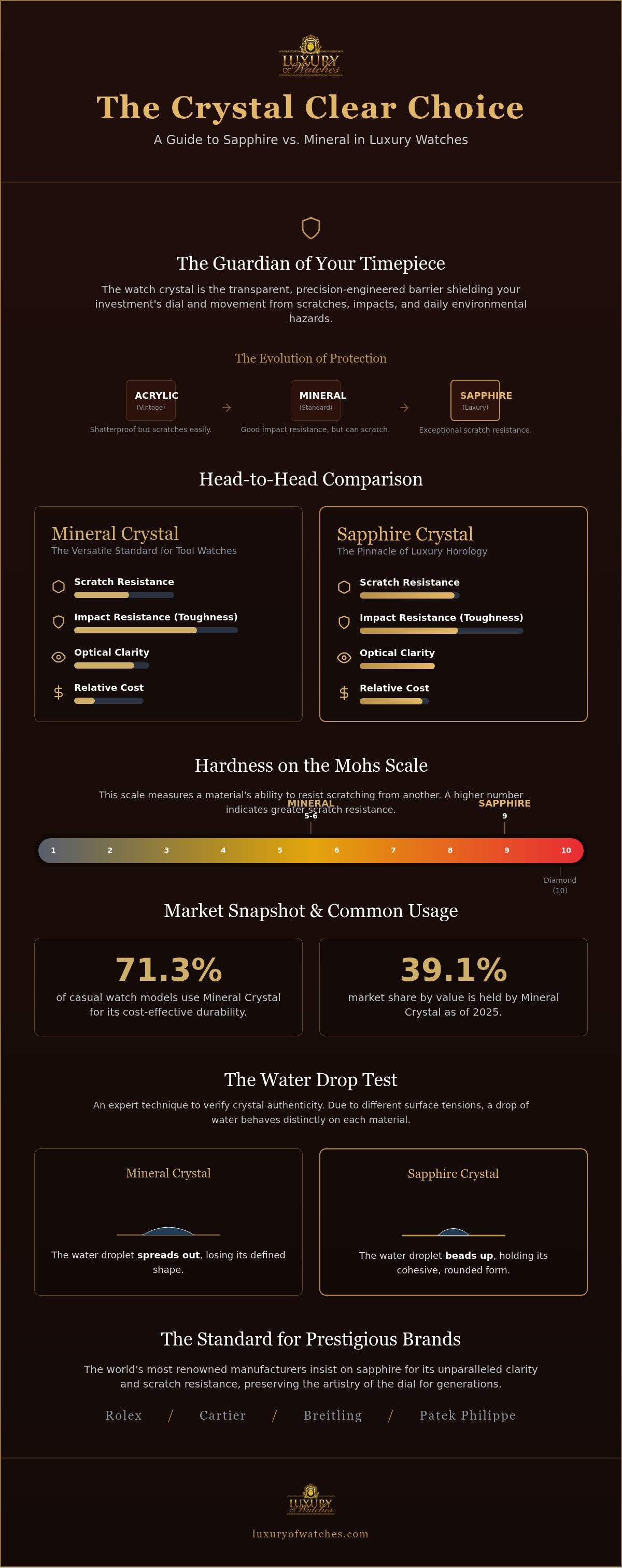
Mineral crystal is essentially tempered glass that has been treated with heat or chemicals to increase its surface hardness. It ranks approximately 5 to 6 on the Mohs scale of hardness, placing it significantly above standard glass but below the extreme resilience of synthetic sapphire. This material remains a dominant force in the industry, holding a 39.1% market share by value as of 2025. You'll commonly find it in entry-level luxury pieces and professional dive watches where the risk of heavy impact is a primary concern. The fundamental advantage of mineral glass is its relative flexibility; it's less likely to shatter than sapphire when subjected to a sharp blow, though it's considerably more prone to surface scratches.
For collectors, the choice between materials often comes down to the intended environment of the timepiece. Mineral glass is the standard for approximately 71.3% of casual watch models because it provides a reliable, cost-effective barrier for daily use. However, when evaluating the long-term investment potential of sapphire crystal vs mineral crystal in watches, the limitations of tempered glass become more apparent. While it serves the needs of a tool watch, it lacks the permanent clarity that characterizes the highest tiers of horology.
The Hardening Process Explained
The manufacturing of mineral crystal involves a thermal tempering process where the glass is heated to near-melting points and then cooled rapidly. This technique creates a compressed surface layer that enhances impact resistance. Some manufacturers utilize proprietary variants, such as Seiko's "Hardlex" or the "K1" crystal found in many boutique brands, which offer slightly improved scratch resistance over standard mineral glass. These materials are preferred for military-spec or extreme sports timepieces where a shattered crystal could compromise the movement in the field. For those seeking a more technical breakdown of these manufacturing standards, this Comprehensive Guide to Watch Crystals provides an excellent historical and material analysis.
Limitations for the Luxury Collector
The primary drawback for the serious collector is the "scratch magnet" reality of mineral glass. Unlike acrylic, which can be buffed with specialized pastes, or sapphire, which resists almost all contact, mineral crystal is difficult to polish once it's damaged. Surface scratches don't just affect the look of the watch; they actively diminish the legibility of high-end complications and intricate dial textures. Over time, these abrasions can make a once-stunning timepiece look neglected. This is why brands like Rolex and Cartier have moved away from mineral glass entirely. If you're prioritizing a pristine aesthetic that lasts for decades, we invite you to browse our curated selection of pre-owned luxury watches, where every model is verified for material integrity and lasting value.
Sapphire Crystal: The Pinnacle of Luxury Horology
Sapphire crystal stands as the definitive standard for high-end horology, offering a level of clarity and protection that mineral glass simply cannot match. Unlike the colored gemstones found in fine jewelry, these crystals are composed of lab-grown synthetic corundum. Synthetic sapphire is created by melting aluminum oxide at 2,040°C to form a crystal lattice identical to natural sapphire. This rigorous thermal process results in a material of extraordinary purity and structural integrity. Ranking 9 on the Mohs scale, it's surpassed only by diamond in terms of absolute hardness, making it one of the toughest transparent substances on Earth.
To produce these resilient shields, manufacturers typically utilize the Verneuil process or the Czochralski method. These sophisticated techniques grow large, cylindrical crystals known as "boules." Because of the material's extreme hardness, these boules must be sliced into thin discs using diamond-tipped saws. This complexity is a major factor when weighing sapphire crystal vs mineral crystal in watches, as the energy and precision required for production are significantly higher than those for tempered glass. For the serious collector, this investment pays dividends in the form of a crystal that remains impervious to the hazards of daily wear.
Why Sapphire is Virtually Scratch-Proof
The primary allure of sapphire is its near-immunity to surface damage. While everyday materials like stainless steel, coarse sand, or even concrete can easily mar mineral glass, they're incapable of scratching a sapphire surface. This provides a profound sense of peace of mind for the owner. You can wear your timepiece with the confidence that the face will look as pristine in twenty years as it does today. This uncompromising durability is why sapphire is the non-negotiable standard for prestigious houses like Rolex and Cartier. Every modern model we feature is selected for these high-grade specifications, ensuring the dial's artistry is never obscured by unsightly abrasions.
The Manufacturing Challenge
The very hardness that makes sapphire desirable also presents significant manufacturing hurdles. Shaping and polishing the material requires specialized equipment and labor-intensive finishing stages. The high energy costs associated with the melting process, combined with the difficulty of cutting the crystal lattice, naturally lead to a higher retail price point. There's also a specific technical trade-off: brittleness. While sapphire is nearly impossible to scratch, its rigid structure makes it more prone to shattering if it suffers a severe, direct impact against a hard surface. However, in the context of luxury wear, the benefit of a permanently clear, scratch-free surface far outweighs the rare risk of impact failure.
Sapphire vs. Mineral Crystal: Head-to-Head Comparison
Evaluating the sapphire crystal vs mineral crystal in watches requires a look at the specific trade-offs between surface resilience and structural flexibility. While sapphire dominates the Mohs scale with a rating of 9, mineral glass sits between 5 and 6. This technical gap translates to a significant difference in daily wear. A sapphire crystal will shrug off contact with steel or stone, whereas mineral glass will gradually accumulate a "cloud" of micro-scratches. However, mineral glass provides superior impact resistance for those in extreme outdoor environments where a sharp blow might shatter a more brittle sapphire face. For the average collector, the scratch resistance of sapphire is usually the more practical priority.
You can identify these materials at home using the "Water Drop Test." Because sapphire is smoother and more dense, a drop of water will bead into a tight sphere and roll across the surface without leaving a trail. On mineral glass, the water tends to spread and smear because of the material's lower surface tension. This simple verification is often the first step we take when assessing pre-owned pieces. It's also important to consider replacement costs. While a mineral crystal unit costs approximately $2 to $4, a sapphire crystal ranges from $18 to $22. When you factor in professional labor, swapping a damaged sapphire crystal can cost five to ten times more than a mineral equivalent.
Optical Performance and AR Coatings
Sapphire has a higher refractive index than mineral glass, which can lead to increased glare under direct light. To counter this, elite luxury watch brands apply multiple layers of Anti-Reflective (AR) coating to both sides of the crystal. These chemical treatments reduce light bounce, sometimes creating an "invisible crystal" effect where the dial appears completely exposed. Without these coatings, the superior clarity of sapphire would be hindered by its own reflectivity. High-end manufacturers prioritize this optical perfection to ensure that every detail of a hand-painted or textured dial remains visible from any angle.
Long-Term Value and Resale Impact
Resale value is heavily influenced by crystal condition. A single deep scratch on a mineral crystal can necessitate a full replacement to restore the watch's "Excellent" rating. While mineral replacements are relatively inexpensive, the frequency of damage creates a hidden maintenance cost. In contrast, a sapphire crystal is a one-time investment that protects the watch's secondary market value for decades. Serious collectors rarely tolerate chipped or heavily scratched crystals, often viewing them as signs of poor overall maintenance. If you're looking for a timepiece that holds its integrity and aesthetic appeal, we invite you to explore our authenticated luxury watch collection where sapphire standards are the norm.
Making the Choice: Which Crystal is Right for Your Collection?
The choice between sapphire and mineral is ultimately a choice between temporary utility and permanent excellence. For the serious collector, the debate over sapphire crystal vs mineral crystal in watches has a clear winner. Sapphire remains the definitive choice for those who view their timepiece as a legacy asset. While mineral glass serves a purpose in the entry-level market or for specific utilitarian tool watches, it cannot provide the enduring clarity and scratch-immunity required by the world's most prestigious manufacturers. It's a matter of ensuring that the face of your investment remains as impeccable as its internal mechanics.
At Luxury of Watches, we maintain a rigorous standard of verification for every piece we offer. Every timepiece in our inventory undergoes a thorough inspection to ensure the crystal meets the original manufacturer's specifications. This is particularly vital in the secondary market, where a crystal's integrity is a primary indicator of the watch's overall history and care. We prioritize sapphire because it aligns with our commitment to providing high-tier products that retain their value over generations. Our role as a knowledgeable expert intermediary is to ensure you never have to guess about the quality of the materials on your wrist.
Inspecting Pre-Owned Crystals
When acquiring a pre-owned luxury watch, the crystal is often one of the most overlooked components during the initial viewing. A savvy collector should look beyond simple surface scratches. It's essential to check for "service crystals" or aftermarket replacements that might not offer the same optical quality or hardness as the original factory-fitted sapphire. These non-original parts can subtly alter the watch's silhouette or even compromise its water resistance if not seated perfectly. Our specialists use advanced diagnostic tools to verify that every crystal is authentic and correctly installed. To provide further reassurance, we back our timepieces with a 5-year in-house warranty, which covers the integrity of the watch and ensures your investment is protected against unforeseen defects.
Conclusion: The Luxury Standard
The industry's most iconic houses, from Rolex to Patek Philippe, have long since settled the sapphire crystal vs mineral crystal in watches discussion. They recognize that a luxury watch is an investment in craftsmanship, and that craftsmanship deserves the best possible protection. Choosing sapphire isn't just about avoiding scratches; it's about honoring the heritage of the movement beneath the glass. It's the standard of excellence that distinguishes a fine timepiece from a mere accessory. If you're ready to add a timepiece of uncompromising quality to your collection, we invite you to explore our collection of authentic sapphire-equipped luxury watches. From professional chronographs to elegant dress pieces, we provide the security, verification, and value that modern collectors demand.
Investing in Lasting Horological Excellence
Selecting the right protective barrier for your timepiece is a decision that impacts its beauty and value for decades. While mineral glass offers practical impact flexibility, it cannot match the near-diamond hardness of synthetic sapphire. Understanding the technical divide in sapphire crystal vs mineral crystal in watches allows you to prioritize the scratch resistance that defines true luxury. A clear, unmarred face is essential for appreciating the intricate dial work of a prestigious manufacturer. It ensures your investment remains a pristine reflection of your personal style.
Luxury of Watches has provided expert horological support since 1999, acting as a specialist intermediary for those who value craftsmanship and security. We provide guaranteed authenticity and a comprehensive 5-year in-house warranty to ensure your purchase is protected by industry leading standards. Our verification process ensures that every sapphire crystal in our inventory meets the rigorous demands of elite watchmaking.
Secure Your Investment: Shop Our Sapphire-Crystal Luxury Collection
Your journey toward a world class collection begins with the confidence that every component of your watch is built to endure. We invite you to discover the difference that professional expertise and premium materials make in your next acquisition.
Frequently Asked Questions
Can you scratch sapphire crystal with a metal key?
You cannot scratch a sapphire crystal with a standard metal key because the key's steel is significantly softer on the Mohs scale. While a key might leave a metal deposit that looks like a scratch, this mark can usually be wiped away with a clean cloth. Only materials as hard as diamonds or specific silicon carbides possess the hardness required to permanently mar the surface.
Is sapphire crystal more likely to shatter than mineral glass?
Sapphire crystal is more prone to shattering than mineral glass because of its rigid, crystalline structure. While it excels at resisting surface abrasions, it lacks the molecular flexibility to absorb sharp, direct impacts. Mineral glass is often preferred for extreme tactical or construction environments where a cracked crystal is safer than one that shatters into shards.
How can I tell if my watch has sapphire or mineral crystal?
You can often distinguish the materials by observing the crystal's color and temperature. Sapphire typically feels colder to the touch than mineral glass and may exhibit a faint blue or violet hue if it features an anti-reflective coating. Many luxury manufacturers also engrave the material type directly onto the case back for absolute verification of the watch's specifications.
Does Rolex use sapphire crystal on all their watches?
Rolex utilizes high-grade sapphire for all modern models produced since the late 1980s and early 1990s. Prior to this transition, the brand relied on acrylic crystals for its various tool and dress watches. Today, the presence of a sapphire crystal is a hallmark of the brand's commitment to enduring quality and the long-term protection of the timepiece's value.
Can a scratched mineral crystal be repaired or polished?
A scratched mineral crystal cannot be effectively repaired or polished back to its original state. Unlike acrylic, which is soft enough to be buffed with simple compounds, the tempering process of mineral glass makes it resistant to most polishing techniques. Most horological professionals recommend a full replacement to restore the timepiece's aesthetic integrity and ensure the dial remains legible.
Why is sapphire crystal so much more expensive to manufacture?
The high cost of sapphire stems from the intense energy required to melt aluminum oxide at temperatures exceeding 2,040°C. Additionally, the material is so hard that it requires specialized diamond-tipped machinery and labor-intensive polishing stages to achieve a clear finish. These factors contribute to a manufacturing cost that is significantly higher than that of standard tempered glass.
What does 'AR coating' mean on a sapphire crystal?
AR coating stands for anti-reflective coating, which is a microscopic chemical layer applied to the crystal to minimize light bounce and glare. Because of the high refractive index found in the sapphire crystal vs mineral crystal in watches comparison, sapphire can be quite reflective without this treatment. Multiple layers of AR coating ensure the dial remains visible even in bright, direct sunlight.
Is it worth upgrading a mineral crystal to sapphire?
Upgrading to sapphire is a worthwhile investment if you plan to wear the watch frequently and value a pristine, scratch-free appearance. It eliminates the ongoing accumulation of micro-scratches and enhances the overall clarity of the dial. This upgrade is a practical step for collectors who want their timepieces to maintain a luxury standard throughout years of daily use.