
Luxury Watch Value Retention: The 2026 Investor’s Guide to Timeless Assets
Posted by Luxury of Watches on 7th Jul 2026
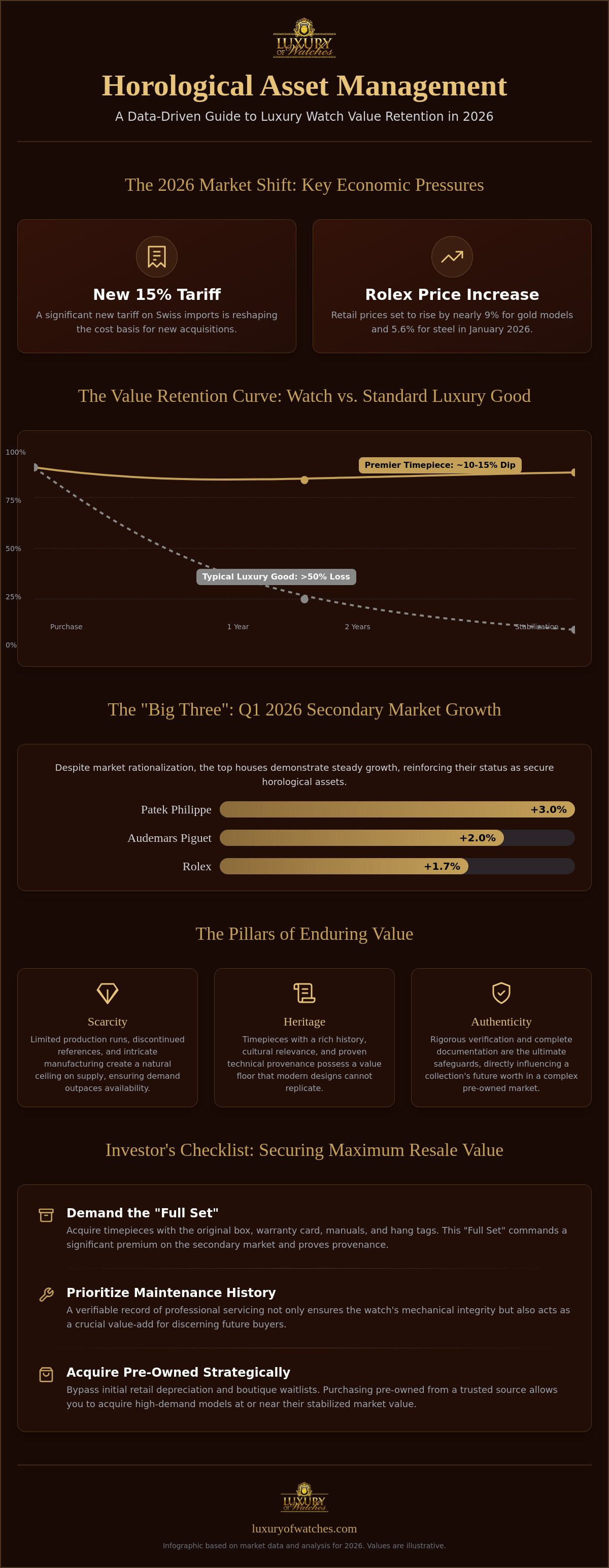
With a new 15% tariff on Swiss imports and Rolex increasing retail prices by nearly 9% for gold models in January 2026, the landscape of luxury watch value retention has evolved into a disciplined field of asset management. You might feel the pressure of market volatility or find yourself confused by the widening gap between retail MSRP and secondary market premiums. It is natural to seek clarity when the stakes involve both significant capital and horological heritage. Authenticity concerns in the pre-owned space only add to the complexity of a high-value acquisition.
This guide provides the technical insight and market data you need to invest with absolute certainty. You will discover the specific drivers behind current resale prices and which prestigious brands offer the most secure long-term value in today's rationalized market. We will analyze the enduring dominance of the "Big Three," evaluate the impact of 2026 price adjustments, and explain why meticulous documentation is the ultimate safeguard for your collection's future worth.
Key Takeaways
- Identify why prestigious models from Rolex, Patek Philippe, and Audemars Piguet transcend typical depreciation to function as liquid assets.
- Learn to recognize specific designs from Cartier, IWC, and Breitling that maintain enduring demand through timeless aesthetics and technical utility.
- Discover how the "Full Set" premium and rigorous verification protocols directly influence long-term luxury watch value retention in the 2026 market.
- Master the strategy of acquiring pre-owned models to bypass traditional boutique markups and lock in value from the moment of purchase.
- Understand the critical role of original documentation and maintenance history in securing a significant premium on your timepiece's resale price.
The Mechanics of Luxury Watch Value Retention
Luxury watch value retention isn't merely a byproduct of a brand's popularity. It is a calculated metric of stability that separates a strategic acquisition from a typical retail purchase. Most luxury goods, from high-end electronics to designer apparel, lose a significant portion of their value the moment they leave the boutique. A premier timepiece behaves more like a hard currency. In the 2026 market, this distinction has become even more pronounced. Collectors now prioritize the security of established heritage over the volatile "hype" associated with newer micro-brands. This shift toward stability ensures that your capital is preserved in a tangible, liquid asset.
The "Depreciation Curve" for a high-tier watch is unique. While a standard luxury item might lose 50% of its value within two years, a "safe" watch reference typically experiences a shallow dip of 10% to 15% before stabilizing or even appreciating. If the model is a high-demand professional reference, it may never drop below its original MSRP. The secondary market premium exists because collectors value immediate availability. In an era where authorized dealer waitlists can span years, the ability to own a piece today commands a financial premium that often exceeds the retail price. This dynamic is a fundamental pillar of luxury watch value retention for the modern investor.
The Scarcity Principle in Horology
Horological Scarcity is the gap between global demand and annual production output. It's a physical limitation of high-end manufacturing that dictates market prices. A master watchmaker can only produce a limited number of intricate movements each year, creating a natural ceiling on supply. When a manufacturer places a production cap on a model or moves a specific reference to "discontinued" status, the secondary market value often surges. Finite supply turns a functional tool into a rare collectible, ensuring that demand always outpaces the number of available pieces in the wild.
Heritage and Cultural Relevance
A watch's history provides a psychological and financial floor for its price. Timepieces that conquered the deepest trenches of the ocean or served as essential equipment for early aviators possess a cultural weight that modern designs cannot replicate. The science of timekeeping provides the technical legitimacy that serious collectors demand. While a celebrity association can cause a temporary price spike, it's the long-term technical excellence and historical provenance that ensure a watch remains an icon. First editions and original design references almost always outperform modern updates because they represent the purest expression of the manufacturer's heritage.
The Big Three: Rolex, Patek Philippe, and Audemars Piguet
While many manufacturers produce exquisite timepieces, three houses consistently define the ceiling for luxury watch value retention. Rolex, Patek Philippe, and Audemars Piguet aren't just brands; they're the primary architects of the secondary market economy. In the first quarter of 2026, these brands saw modest secondary market price increases. Patek Philippe led with a 3.0% rise, followed by Audemars Piguet at 2.0% and Rolex at 1.7%. This steady growth, even after the market corrections of previous years, reinforces their status as the most secure harbors for horological capital. Choosing between them requires an understanding of how they balance production volume with global desire.
Rolex: The Most Liquid Asset in Watches
Rolex operates on a principle of scale scarcity. They produce approximately one million watches annually, yet demand for professional models remains insatiable. The Submariner, GMT-Master II, and Daytona are the gold standards for liquidity. You can convert a "Pepsi" GMT-Master II into cash almost anywhere in the world within hours. Interestingly, stainless steel models often retain a higher percentage of their value than precious metal versions. In January 2026, Rolex increased retail prices for steel models by approximately 5.6% in the US, while gold models saw a steeper 8.9% hike. Understanding these Rolex prices 2026 is essential for calculating your potential exit value. For instance, a 2022 model of the GMT-Master II 126710BLRO was listed for roughly $23,995 in July 2026, demonstrating remarkable resilience against retail price shifts.
The Holy Trinity and the Waitlist Economy
Patek Philippe and Audemars Piguet utilize a different strategy centered on extreme exclusivity. Their distribution is tightly controlled through boutique-only models and limited production runs. Patek's "Generational Asset" marketing isn't just a slogan; it's a market reality. For example, the Nautilus 5811/1G currently commands a secondary market price of roughly $150,000, which is a 1.7x premium over its retail price. Audemars Piguet’s Royal Oak remains the undisputed king of the integrated-bracelet category, dominating the market through its bold aesthetic and technical pedigree. These models often appear on lists of the Top 10 most investable luxury watches due to their consistent performance across major auction houses.
It's vital to distinguish between "hype" and heritage. While the Nautilus and Royal Oak are currently dominant, steady performers like the Rolex Explorer or Patek Calatrava offer more predictable, if less explosive, retention. If you're looking to secure one of these timeless assets without the indefinite waitlist of an authorized dealer, you might browse our selection of pre-owned luxury watches to find a model with a verified history and immediate availability. By opting for a pre-owned model, you often bypass the initial retail premium, effectively locking in your value from day one.
Selective Value Retention: Cartier, Breitling, and IWC
While the "Big Three" dominate the headlines, savvy investors often look toward the "Heritage Tier" for stability and growth. Brands like Cartier, Breitling, and IWC offer a unique proposition in luxury watch value retention. They provide a bridge between high-volume retail and ultra-exclusive horology. These manufacturers don't rely on the volatile hype cycles that plague micro-brands. Instead, they lean on decades of design continuity and professional utility. This makes them far safer than fashion-house timepieces that lack mechanical depth and horological history.
The 2026 market has seen a distinct shift toward these established houses. As buyers become more analytical, the "tool watch" heritage of IWC and the naval history of Panerai provide a psychological floor for resale prices. These brands serve a dedicated niche of collectors who value function as much as form. This loyalty ensures that even during market corrections, demand for iconic references remains steady, preventing the sharp price drops seen in more speculative categories.
Cartier: The Power of Aesthetic Continuity
Cartier’s Santos and Tank models are masterclasses in aesthetic permanence. Because these designs transcend fashion trends, they don't suffer the steep depreciation seen in brands that prioritize "current" styles. Cartier’s refusal to radically alter their core silhouettes protects the value of older references. In 2026, the market has seen a sharp increase in demand for "Neo-Vintage" Cartier. This trend has stabilized pre-owned prices for models from the late 20th century. Stainless steel references often show the most resilience for entry-level collectors, while precious metal pieces remain sought-after for their intrinsic material value and classic prestige. To determine the current market value of your precious metal assets, you can visit Houston Empire Gold Buyers.
Breitling and IWC: The Tool Watch Advantage
Breitling and IWC maintain their position through technical specialization. The Navitimer and the IWC Big Pilot are not just watches; they are recognized flight instruments. This professional appeal creates a dedicated buyer base that remains active regardless of broader market fluctuations. When you analyze Breitling watches, you'll notice that models featuring in-house calibers consistently outperform those with third-party movements on the secondary market. Collectors in 2026 are more analytical than ever. They value mechanical integrity and historical provenance over mere brand recognition.
Identifying which limited editions will actually contribute to luxury watch value retention is an art. Pieces that celebrate a specific technical milestone or a genuine historical anniversary typically hold their worth. Conversely, models that simply offer a new dial color without a significant narrative often fail to appreciate. IWC and Panerai have successfully navigated this by focusing on their naval and aviation roots, ensuring their niche resale value remains protected by a loyal community of enthusiasts who prioritize heritage over marketing gimmicks.
This appreciation for heritage and community often extends to other areas of life; for readers who value the preservation of noble traditions beyond horology, check out We LOVE Arabian Horses to discover their work in equine welfare.
Protecting Value: Maintenance, Verification, and Documentation
Acquiring a premier timepiece is only the first step in a successful investment strategy. To ensure optimal luxury watch value retention, you must prioritize the preservation of the "Full Set." In the 2026 market, a watch accompanied by its original box, manuals, and warranty cards can command a premium of 10% to 20% over a "naked" watch. These components act as a physical biography of the piece, providing future buyers with the psychological and financial security they require. Without this documentation, even the rarest reference loses a portion of its liquid potential.
The debate between originality and functionality is a constant point of scrutiny for serious collectors. While regular maintenance is essential, the use of "Service Parts," such as replacement dials or hands, can significantly impact vintage value. Modern buyers often prefer a watch with honest wear and original components over a piece that has been over-polished or fitted with non-original parts. Condition grading plays a decisive role here. A "Mint" watch, showing no visible signs of wear, naturally sits at the top of the pricing hierarchy. An "Excellent" grade indicates a well-cared-for piece that remains highly desirable for daily wear.
The Role of the 5-Year Warranty
We believe that security shouldn't end at the point of sale. Our in-house 5-year warranty functions as value insurance for pre-owned buyers, offering a layer of protection that traditional retail often lacks. Regular servicing at a specialist facility is not just about mechanical health; it's about preventing catastrophic failures that could lead to a permanent loss in value. By maintaining a clear paper trail of all professional interventions, you provide the transparency that the secondary market demands. This meticulous record-keeping ensures your asset remains as prestigious as the day you acquired it, directly supporting long-term luxury watch value retention.
Authentication as Value Protection
The rise of "Super-Clones" has made expert verification more critical than ever before. These sophisticated counterfeits can deceive even experienced enthusiasts, making professional scrutiny the only way to secure your capital. A watch without a verifiable origin is a liability, not an asset. Every timepiece we offer undergoes a rigorous inspection process to ensure it is 100% authentic. For a deeper understanding of what to look for, you can consult our guide to pre-owned luxury watches which outlines essential verification checklists. If you are ready to add a secure, high-tier reference to your portfolio, we invite you to shop our verified pre-owned luxury watches and invest with absolute confidence.
Buying for Retention: The Luxury of Watches Advantage
Choosing a premier timepiece is an emotional journey, but the final acquisition should be a pragmatic financial decision. Our "Accessible Prestige" model allows you to secure world-class horology without the traditional boutique premiums that often inflate initial costs. By focusing on digital efficiency and expert curation, we bridge the gap between high-tier status and competitive pricing. This approach ensures that a larger portion of your capital remains in the asset itself rather than being lost to retail overhead, which is a fundamental component of luxury watch value retention.
Buying pre-owned is the most effective strategy to lock in value from day one. When a timepiece is purchased new, the first owner absorbs the initial retail depreciation. By the time a watch reaches the secondary market, its price has often reached a point of equilibrium. This allows you to enter the market at a price point that is much closer to the watch's long-term resale value. It transforms a luxury purchase into a strategic asset allocation, providing you with a piece that is as fiscally responsible as it is aesthetically pleasing.
Pre-Owned as a Value Play
The most effective way to maximize luxury watch value retention is to let the first owner absorb the initial retail depreciation. When you acquire a timepiece that is 3 to 5 years old, you are entering the market at a point of price stabilization. A pre-owned Rolex or Cartier from this era often represents a significantly more resilient allocation of capital than a brand-new entry-level model from a lesser manufacturer. You gain the prestige of a legacy brand with the financial security of a stabilized asset that has already moved past its steepest depreciation curve.
Secure Transactions and Long-Term Support
We mitigate the "Risk Premium" often associated with online high-value transactions through a rigorous process of absolute verification and official documentation. Our US-based expert support team understands the nuances of technical movements and manufacturer heritage, providing the reassurance necessary for significant horological acquisitions. This level of professional intermediary service ensures that your investment is protected from the moment of purchase. Every piece in our inventory is a testament to our commitment to quality, transparency, and the long-term satisfaction of our clients.
Our commitment to providing a clear paper trail acts as a signature of our brand promise. When you browse our inventory, you aren't just looking at watches; you are viewing curated assets that have been vetted for their authenticity and condition. This meticulous attention to detail is what defines our advantage in the secondary market. We provide the highest tier of products without the traditional retail premiums, ensuring that luxury remains accessible to the serious collector and the prudent investor alike.
If you are ready to secure a timepiece that balances historical significance with financial stability, we invite you to explore our collection of value-retaining luxury watches. Every model is selected for its potential to stand the test of time, both on the wrist and in your portfolio.
Securing Your Horological Future
The 2026 market has transitioned into a period of rational growth, where savvy buyers prioritize technical integrity and historical provenance over fleeting trends. You now understand that luxury watch value retention is not a matter of chance; it's the result of selecting models that balance global demand with finite production. From the enduring dominance of the "Big Three" to the specialized tool watches of IWC and Breitling, the most successful collectors are those who value the security of a verified history. By choosing to buy pre-owned, you effectively lock in value by bypassing the steepest part of the depreciation curve from day one.
We are dedicated to acting as your expert intermediary in this high-stakes environment. Our Guaranteed Authentic Pre-Owned Timepieces undergo rigorous verification to ensure your absolute peace of mind. Every purchase is reinforced by our 5-Year In-House Warranty and our A+ BBB Rating, providing a level of protection that matches the prestige of the brands we feature. Your path to a sophisticated and secure collection begins with a partner who values craftsmanship and documentation as much as you do. Secure your capital in an asset that offers both aesthetic pleasure and financial resilience.
Browse Our Selection of Investment-Grade Rolex Watches and invest in a legacy that will stand the test of time.
Frequently Asked Questions
Do luxury watches actually hold their value better than stocks?
Luxury watches serve as a tangible hedge against inflation but typically offer different growth patterns than aggressive equity portfolios. While the global luxury watch market is projected to grow at a compound annual rate of 4.7% to 6.14% by 2030, stocks generally provide higher long-term yields. However, timepieces offer a physical store of value that doesn't fluctuate with the daily volatility of the stock market, providing stability during economic uncertainty.
Which Rolex model has the highest resale value in 2026?
The stainless steel Rolex Cosmograph Daytona continues to command the highest resale premiums in 2026, often trading significantly above its retail MSRP. Other professional models, such as the GMT-Master II "Pepsi" and the Submariner, also demonstrate exceptional luxury watch value retention. These specific references benefit from a permanent supply deficit, as global demand consistently outpaces the limited annual production output from the Geneva manufacturer.
Is it better to buy a new or pre-owned watch for investment purposes?
Buying pre-owned is almost always the more effective strategy for investment because the first owner has already absorbed the initial retail depreciation. When you purchase a used timepiece, your entry price is much closer to the actual secondary market value. This allows you to lock in your capital and avoid the immediate 15% to 25% dip that often occurs when a new watch leaves the boutique.
Does a watch lose value if I wear it every day?
Daily wear has a minimal impact on value as long as the watch is professionally maintained and not subjected to severe damage. Collectors in 2026 prioritize mechanical health and the presence of original parts over a flawless, unpolished exterior. While a mint-condition piece commands a slight premium, a well-cared-for watch with honest signs of use remains a highly liquid and desirable asset on the secondary market.
How much does missing "Box and Papers" affect a watch’s value?
A missing original box and documentation can reduce a timepiece's resale value by 10% to 20% depending on the model's rarity. These components serve as a physical biography and a vital layer of authentication for future buyers. While the watch itself remains a high-value item, having the "Full Set" ensures you can command the maximum possible price when you decide to exit your position.
What is the best entry-level luxury watch for value retention?
The Cartier Santos and the Tudor Black Bay are the premier entry-level choices for those prioritizing value stability in today's market. Both brands have seen steady price adjustments in 2026, with Tudor increasing retail prices by an average of 5.6% in the US. These models offer significant horological heritage and iconic designs that tend to stabilize quickly on the secondary market, making them safe starting points for new investors.
Why do some brands like Omega or TAG Heuer have lower retention than Rolex?
The difference in retention is primarily driven by production volume and the gap between supply and global demand. Rolex maintains a more restricted distribution and lower production relative to its massive global following, which keeps secondary prices high. While Omega and TAG Heuer produce technically superior instruments, their greater retail availability means they don't benefit from the same level of forced scarcity that drives immediate appreciation in other brands.
Can I sell my watch back to Luxury of Watches in the future?
We offer a secure and transparent process for clients who wish to sell or trade their timepieces as part of their long-term investment strategy. Because we specialize in verified, high-tier references, we are always looking to acquire well-maintained models with complete documentation. This provides you with a reliable exit strategy and the flexibility to upgrade your collection as your personal tastes and market dynamics shift.