
Is an In-House Warranty Transferable? What Watch Buyers Should Know
Posted by Luxury of Watches on 9th Oct 2026
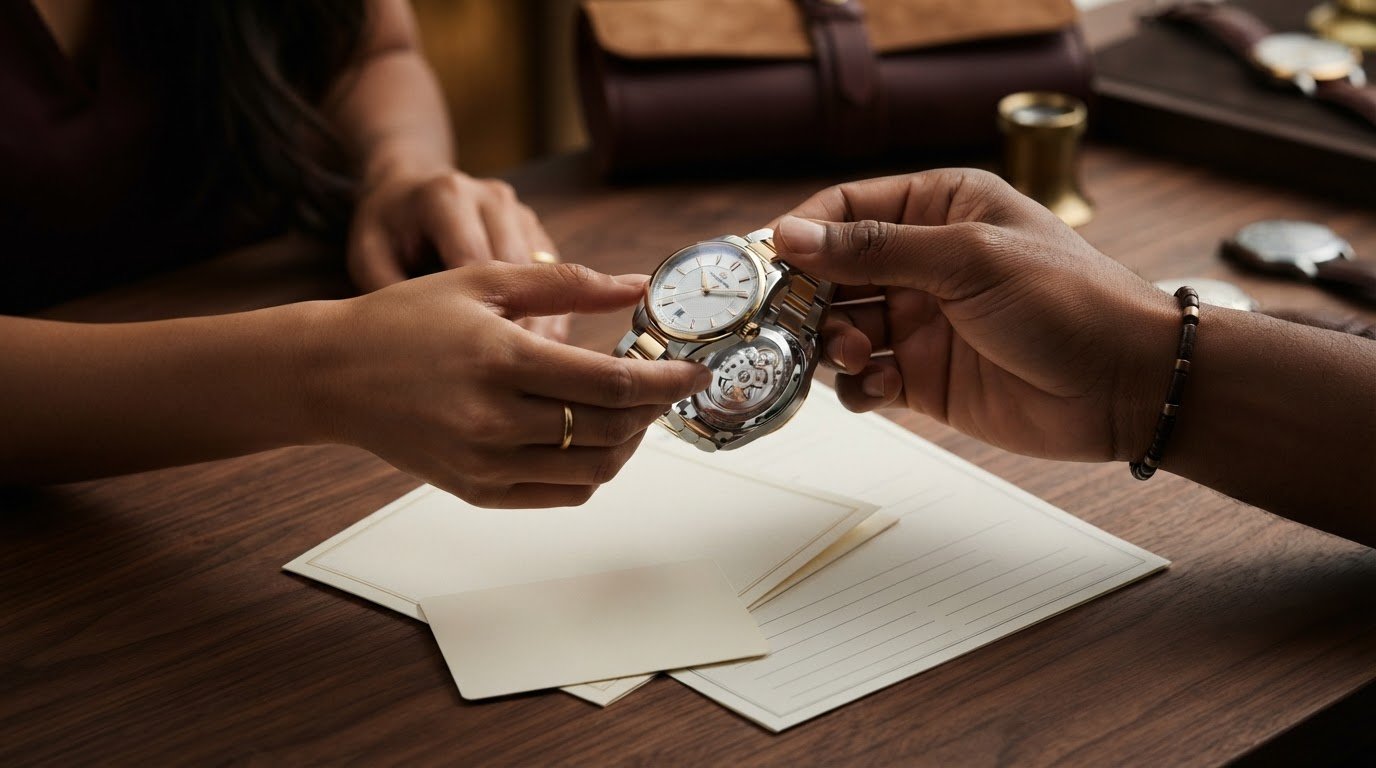
A warranty can stay with a watch, or end with its first owner. If you’re buying or selling a pre-owned timepiece, the key question is: is an in-house warranty transferable? The answer depends on the written terms, not simply on the fact that coverage comes from a retailer.
A multi-year warranty can add reassurance, especially when a watch changes hands. But retailer-provided coverage and a manufacturer’s warranty are separate protections, and their transfer rules can differ. Luxury of Watches provides a five-year in-house warranty with its watch selection. That coverage is non-transferable and valid only for the original purchaser.
In this guide, you’ll learn what “in-house warranty” means, which wording to look for when ownership changes, and how retailer coverage compares with manufacturer protection. You’ll also see why warranty documents matter when assessing a purchase or resale, and how to distinguish the time remaining from the right to make a claim.
Key Takeaways
- Whether is an in-house warranty transferable depends on the warranty’s written terms, not just its coverage period.
- Look for language about transfers, assignments, the original purchaser, and subsequent owners to understand who may qualify.
- A remaining warranty term doesn’t automatically mean a new owner is eligible to make a claim.
- Retailer in-house coverage comes from the seller; manufacturer coverage comes from the watch brand. Their transfer rules may differ.
- Luxury of Watches provides a five-year in-house warranty with its watch selection. Its coverage is non-transferable and valid only for the original purchaser. Keep warranty records with the watch’s transaction documents.
Is an In-House Watch Warranty Transferable? Start With the Written Terms
It depends on the specific written warranty terms. To answer is an in-house warranty transferable, look beyond the coverage period and the label “in-house” to see who is entitled to make a claim. Some terms limit eligibility to the original purchaser; others may describe coverage that can pass to a subsequent owner. The wording, rather than the watch changing hands, determines which arrangement applies.
An in-house watch warranty is coverage provided by the retailer that sold the watch, rather than by its manufacturer. The retailer sets out the terms and administers coverage according to those terms. This is distinct from an assurance about a watch’s history or authenticity: each describes a different part of a purchase. For a general overview of how warranties function in consumer sales, see this legal definition of a warranty.
What does “in-house warranty” mean for a watch?
“In-house” identifies the source of the warranty: the selling retailer. It doesn’t describe one standard industry-wide policy. Retailers can set different coverage periods, exclusions, claim procedures, and eligibility rules, so don’t assume one seller’s terms apply to another’s. Manufacturer coverage is separate, with its own issuer and conditions. Read the document for the specific watch rather than relying on a general description of either type.
The issuer tells you who stands behind the coverage; the eligibility clause tells you who can use it. Those are related, but not interchangeable, questions. A retailer may issue a warranty for a particular watch while limiting claims to the person who bought it. The fact that coverage is documented with a sale doesn’t, on its own, establish that a later owner can make a claim.
Does ownership automatically transfer warranty coverage?
No. Selling, gifting, or inheriting a watch changes its owner, but doesn’t by itself determine who remains eligible under the warranty. Search the document for terms such as “original purchaser,” “subsequent owner,” “transfer,” “assignment,” and “claimant.” Read these terms in context: a policy may permit ownership changes while restricting who can submit a claim, or it may expressly allow coverage to follow the watch.
Check whether the terms identify the protected person, the specific watch, or both. A clause that names the original buyer points to person-specific eligibility; wording that covers the watch and expressly includes later owners may indicate a different arrangement. If the warranty is silent or unclear, don’t treat silence as permission to transfer coverage. A warranty that follows the watch may protect an eligible new owner, while a buyer-only warranty remains with the original purchaser.
- Find the complete written warranty, not only a listing description or summary.
- Locate the language that defines the covered owner and eligible claimant.
- Separate the time remaining on the warranty from the right to make a claim.
These checks establish the right starting point before considering claim procedures or paperwork. A warranty’s duration tells you how long coverage may run; the eligibility terms tell you whose claim may be considered during that period.
How Warranty Terms Determine Whether Coverage Follows the Watch
Once you have the warranty document, read it as a set of conditions rather than relying on a headline such as “five-year coverage.” To determine is an in-house warranty transferable, find the clauses that define the covered party and any steps required when ownership changes. A long coverage period can still apply only to the original purchaser.
Only the written terms establish who may claim under a warranty. Start with the full certificate or policy, including any definitions and conditions referenced elsewhere. A product listing or seller’s short description may summarize coverage, but it may not include the details that govern an eventual claim.
Which warranty clauses should buyers read closely?
Search for “original purchaser,” “current owner,” “subsequent owner,” “transfer,” and “assignment.” Note whether the warranty identifies a person, a specific watch, or both. If it allows a transfer, look for any stated procedure, deadline, registration requirement, or fee. Don’t assume those steps apply unless the terms say so, and don’t assume a transfer changes the original coverage conditions.
Review exclusions and claim requirements at the same time. A warranty may require particular records or set conditions for submitting a claim; these requirements can remain relevant after a permitted transfer. For example, if a policy requires proof of purchase, a new owner may need the original receipt even if the warranty allows coverage to pass. The document determines which records matter.
What documents can help establish continuing coverage?
Keep the warranty certificate or complete terms with the purchase receipt and any registration records. If ownership changes, preserve the sale or gift paperwork and pass along the documents that identify the watch and describe its coverage. These records help connect the timepiece to its warranty history, but they don’t override an owner-eligibility clause or create transfer rights that the terms don’t provide.
Separate two questions: how much time remains, and who is eligible to claim. A warranty could have time left while limiting claims to the original buyer. Conversely, a policy might permit a new owner to claim subject to its stated conditions. The calendar alone can’t answer the eligibility question.
- Match the watch’s identifying details on the warranty documents to the timepiece.
- Check whether a transfer must be recorded or completed within a stated period.
- Keep claim-related records with the warranty, even when the watch is resold.
When a clause is ambiguous, treat that uncertainty as unresolved rather than assuming the most favorable interpretation. Buyers can account for warranty eligibility as one part of evaluating a pre-owned watch; sellers can make the relevant paperwork available so a prospective buyer can review the terms. For context while considering a timepiece, explore pre-owned luxury watches alongside its accompanying documentation.
In-House vs. Manufacturer Watch Warranties: What Changes for a New Owner?
A watch can be associated with more than one warranty, and each has its own issuer and conditions. An in-house warranty comes from the retailer that sold the watch. A manufacturer warranty comes from the brand. Their transfer rules, claim processes, and coverage details may differ, so assess each document separately rather than treating “the warranty” as one package.
| Coverage type | Issuer and terms | Potential eligibility after resale |
|---|---|---|
| In-house warranty | The selling retailer; the retailer’s written policy applies. | Depends on whether the terms include subsequent owners or restrict claims to the original purchaser. |
| Manufacturer warranty | The watch brand; the manufacturer’s warranty terms apply. | Depends on that brand’s policy and any stated conditions for a new owner. |
Who is responsible for each type of warranty?
The retailer administers its own in-house coverage according to its written terms. The manufacturer issues and administers its warranty under a separate set of conditions. A watch may have both types of coverage, or only one that is currently relevant. Having one does not automatically extend, replace, or change the rules of the other.
Manufacturer policies also vary. For example, Rolex’s five-year international warranty is transferable to subsequent owners when its stated conditions are met, while Patek Philippe’s two-year warranty is officially non-transferable to a second owner. These distinct policies show why the brand name alone isn’t enough to establish eligibility. Read the applicable manufacturer document and confirm which warranty, if any, remains in force for the specific watch.
How should buyers compare coverage beyond transferability?
Transferability is only one part of the comparison. Review what each warranty covers, its exclusions, remaining duration, and the process for submitting a claim. Check whether the terms require a warranty card, proof of purchase, registration record, or other documentation. Also note which party handles the claim: retailer in-house coverage is administered by the retailer, while manufacturer coverage is governed by the brand’s process.
Consider a pre-owned watch with a longer retailer warranty and a shorter manufacturer warranty. The longer period doesn’t necessarily mean broader protection; the policies may cover different matters or impose different conditions. Nor does the presence of manufacturer coverage prove a later owner can claim under it. The written terms answer those questions.
- Compare each warranty document separately, including exclusions and claim requirements.
- Keep the relevant purchase and warranty records together with the watch’s documentation.
- Assess the scope and owner eligibility, not just the number of years remaining.
For a considered purchase, clarity about who issued each warranty helps set realistic expectations about protection after resale. The answer to is an in-house warranty transferable comes from the retailer’s written terms, while a manufacturer warranty must be evaluated under the brand’s own policy.
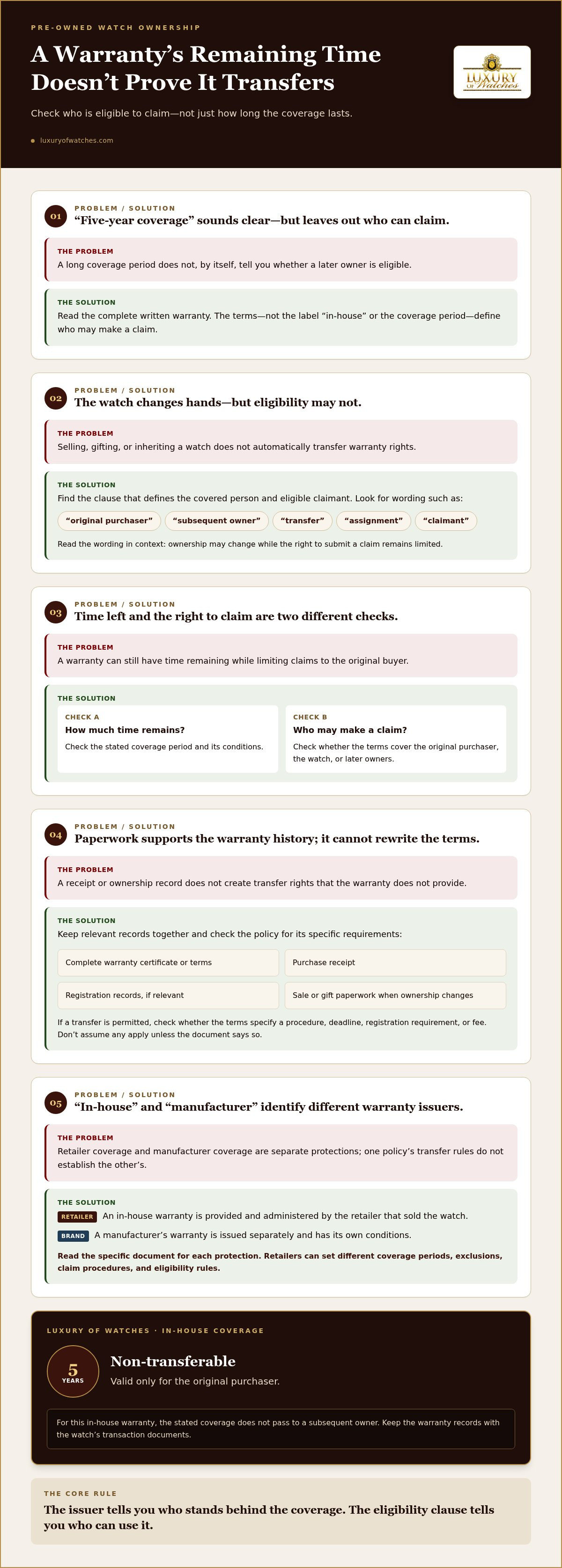
A Practical Checklist for Checking Warranty Transfer Before a Watch Changes Hands
A careful document review can clarify what protection may accompany a pre-owned watch and what remains tied to its first buyer. Use this sequence before completing a purchase, sale, or gift. It keeps the warranty question grounded in the paperwork, not assumptions based on a seller’s description or the time left on the coverage.
- Find the current written terms. Read the warranty document or certificate supplied with the watch, including any referenced conditions. Don’t rely on a verbal summary alone.
- Identify who may claim. Look for language naming the original purchaser, current owner, subsequent owner, or covered watch. Check whether the document describes a transfer process.
- Confirm required records. Note any stated proof-of-purchase, registration, or claim-document requirements, and identify whether the retailer or manufacturer administers that specific coverage.
- Preserve the paperwork. Keep the warranty terms, receipt, registration confirmation, and transaction documents together with the watch’s ownership records.
What should a buyer review before completing a purchase?
Compare the watch’s identifying information on its case or accompanying records with the details shown in its warranty paperwork. A mismatch can make it harder to establish which timepiece the document concerns. Then read the eligibility and claim sections closely. If the terms specify the original purchaser, don’t assume a seller’s remaining coverage can be used by you. The question “is an in-house warranty transferable” is answered by the written policy, not by the watch’s age or sale price.
Keep retailer and manufacturer documents distinct. Each warranty has its own issuer, conditions, and claim administrator. For a broader review of provenance, authenticity, and ownership considerations, see this pre-owned luxury watch ownership guide. Warranty paperwork is one important part of a considered purchase, not a substitute for reviewing the watch’s other records.
What records should accompany a later resale or gift?
Owners can make a future handover clearer by keeping the original warranty document, proof of purchase, and any registration confirmation in one organized file. If the watch is sold or gifted, include the available warranty paperwork with the transaction records so the next owner can read the actual terms. Preserve copies for your own records as well.
Be precise in any listing or sale discussion. You can state that documents accompany the watch, but don’t represent coverage as transferred unless the written terms support that claim. If a transfer procedure is specified, retain the records showing it was completed. Passing on paperwork is useful; it doesn’t independently change eligibility.
Use the same care when selecting a timepiece: review the available watch and its accompanying documentation together. Explore pre-owned luxury watches as part of your search.
How Luxury of Watches' In-House Warranty Fits Into a Considered Purchase
A warranty is one part of a watch purchase, alongside the timepiece and the records that document its identity and ownership. Luxury of Watches provides a five-year in-house warranty with its watch selection. This retailer-provided coverage is non-transferable and valid only for the original purchaser. It is separate from a manufacturer international warranty, which is governed by the brand’s own terms.
What does an in-house warranty add to a watch purchase?
Knowing which retailer provides the stated coverage gives you a clear starting point for understanding where its terms come from. It also helps distinguish retailer coverage from a manufacturer’s warranty, which may have different eligibility rules, exclusions, and claim requirements. The five-year period describes the duration of Luxury of Watches’ in-house warranty; it doesn’t change who may make a claim or what conditions apply. The coverage is for the original purchaser and does not transfer to a later owner.
That’s why the written document matters. Read it alongside the watch’s accompanying ownership and authenticity records, and consider how those records identify the timepiece and its purchase. A warranty is useful information when evaluating a watch, but it shouldn’t be treated as a promise of a particular claim outcome, a standalone repair service, or a transfer right. Those details depend on the applicable written terms.
How can buyers make a confident next decision?
For a current or prospective owner, the practical question, is an in-house warranty transferable, can only be answered by the current written warranty terms. Use that document to understand eligibility and any claim requirements rather than relying on a general description of in-house coverage. For Luxury of Watches’ five-year in-house warranty, the answer is clear: coverage is non-transferable and valid only for the original purchaser. Keep the warranty information with the watch’s identifying and ownership documents.
A considered decision brings several details into view together:
- The watch and its identifying information.
- Available authenticity and ownership documentation.
- The written terms for the retailer’s in-house warranty.
- Any separate manufacturer warranty documents and their conditions.
This approach keeps expectations clear without assuming one type of coverage replaces another. Luxury of Watches’ five-year in-house warranty is a distinct retailer-provided benefit for the original purchaser. Its coverage period does not create a transfer right, and a separate manufacturer document does not change the retailer warranty’s terms.
As you compare timepieces, include written coverage information in your review of each watch and its documentation. Explore the Luxury of Watches luxury-watch selection and review the coverage information provided with its watches as part of your decision.
Make Your Next Watch Purchase With Clear Expectations
Before a watch changes hands, distinguish the value of the timepiece from the protection that may accompany it. Ask yourself, is an in-house warranty transferable, and let the current written terms guide the answer. Clear documentation helps you understand what coverage means for you, rather than relying on assumptions about the watch’s history or the time remaining.
That same care can shape your next purchase. Consider the watch, its ownership records, and its written coverage together, so the details support the confidence you feel when choosing a piece. Luxury of Watches offers new and pre-owned luxury timepieces with a five-year in-house warranty. The warranty is non-transferable and valid only for the original purchaser. Review the coverage information as you explore options suited to your collection or personal style.
Explore the luxury-watch selection at Luxury of Watches and take the next step with clarity and confidence.
Frequently Asked Questions
Is an in-house warranty transferable to a new watch owner?
Sometimes, but the warranty’s written terms decide whether a new owner can make a claim. The answer to “is an in-house warranty transferable” isn’t determined by the word “in-house” or by how much time remains. For instance, a policy might cover a watch for a stated period but name only the original buyer as eligible. Check the owner-eligibility clause before counting the warranty as a benefit of ownership. Luxury of Watches’ five-year in-house warranty is non-transferable and valid only for the original purchaser.
Can a watch warranty transfer when the watch is sold or gifted?
A sale or gift doesn’t automatically transfer warranty rights. The result depends on the policy, which may allow an ownership change, require a formal transfer, or limit claims to the first purchaser. If you’re giving a watch to a family member, for example, don’t assume the recipient inherits claim eligibility along with the timepiece. Treat any transfer process specified in the terms as a separate part of the handover.
How can I tell whether a retailer's watch warranty is transferable?
Read the full policy and search for terms such as “transfer,” “assignment,” “original purchaser,” and “subsequent owner.” Then check whether a transfer requires registration, written notice, or other steps. A listing that says “warranty included” may not explain who qualifies. If a clause is unclear, don’t count the coverage as transferable unless the written terms support that conclusion.
Does an in-house watch warranty differ from a manufacturer warranty?
Yes. An in-house warranty is issued by the retailer, while a manufacturer warranty is issued by the watch’s brand. Their terms may differ in covered components, exclusions, claim procedures, and owner eligibility. A watch could have both, with different expiration dates or requirements. Read each document separately, and don’t assume that an active retailer warranty extends or replaces the manufacturer’s coverage.
What documents should accompany a watch with remaining warranty coverage?
Keep the warranty document, proof of purchase, and any registration confirmation with the watch’s transaction records. Include available paperwork when selling or gifting the timepiece, and retain secure copies for your own records. If documents identify a serial or other watch details, compare them with the timepiece before the handover. Having a complete file supports review of the coverage, though it doesn’t by itself establish eligibility.
Can a pre-owned watch still have an active in-house warranty?
Yes, a pre-owned watch may still fall within the stated warranty period. But an unexpired term and an eligible claimant are separate matters: coverage may remain on the calendar while the policy limits claims to the original buyer. Before valuing that coverage as part of a resale, establish both the relevant start or expiration date and whether the current owner qualifies under the written terms. Luxury of Watches’ in-house warranty is valid only for the original purchaser, so it does not transfer with a resale.
What happens if a warranty document does not explain transferability?
If the document is silent, don’t assume the warranty transfers or that it automatically ends on resale. Another section or accompanying policy may address ownership changes. Review the complete warranty package and treat transferability as unresolved unless the terms clearly establish it. Until the wording is clear, assess the watch on the basis of coverage you can verify.