
How to Spot a Fake Rolex: The Expert Verification Guide (2026 Edition)
Posted by Luxury of Watches on 12th Aug 2026
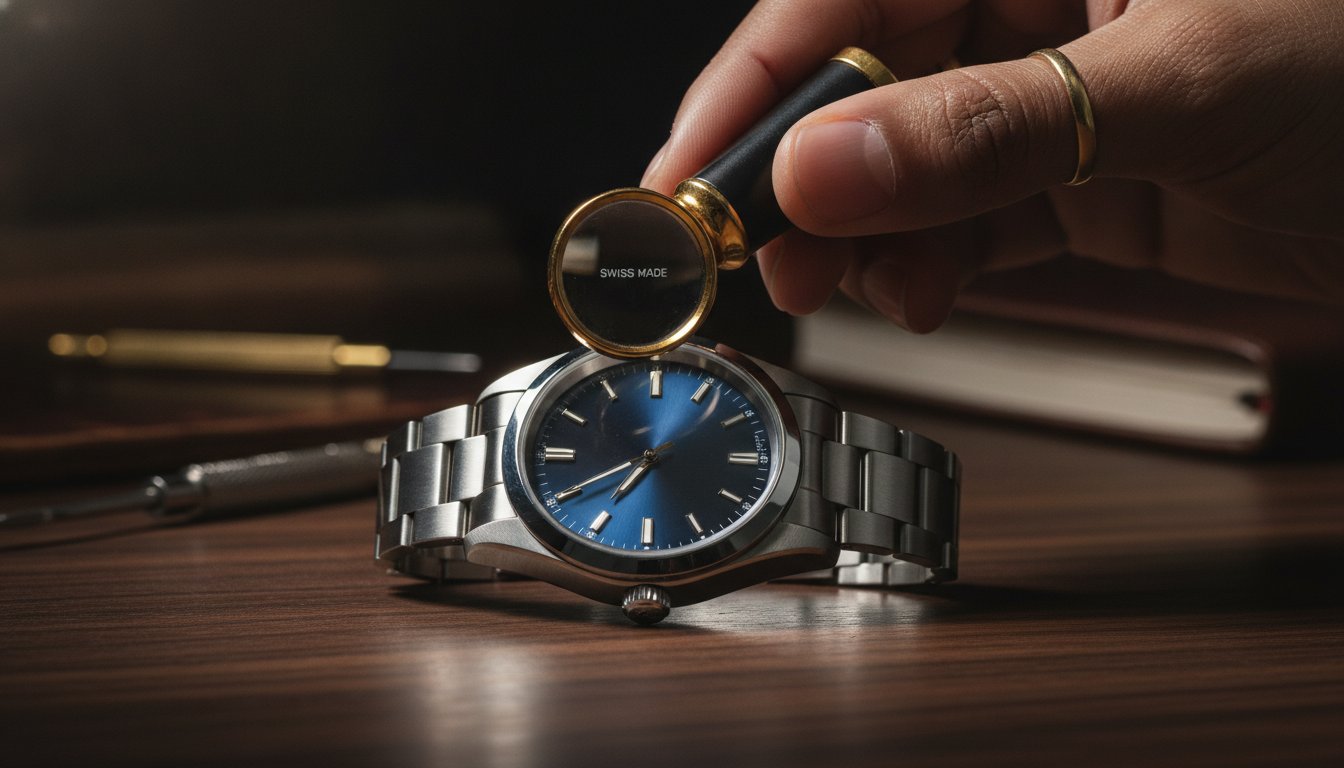
The most dangerous counterfeit Rolex isn't the one that looks like a toy; it's the one that looks, feels, and even ticks like a masterpiece. As 'Super Clones' reach a level of precision that can deceive even seasoned enthusiasts, the stakes for collectors have never been higher. You've likely felt that familiar anxiety when browsing the secondary market, wondering if a subtle flaw is hiding in plain sight. Learning how to spot a fake rolex is no longer just a hobbyist's skill. It's a necessary safeguard for your capital and your peace of mind.
We understand that conflicting online advice often creates more confusion than clarity. This guide promises to cut through the noise, offering you the technical nuances and microscopic details required to distinguish a genuine masterpiece from a sophisticated counterfeit. You'll gain the mastery needed to inspect movements, serial engravings, and dial finishing with professional scrutiny. We'll provide a definitive verification checklist to ensure you move forward with absolute certainty. From the specific weight of the 904L steel to the silent glide of the second hand, you're about to become your own best advocate in the world of luxury horology.
Key Takeaways
- Identify the specific visual properties of 904L Oystersteel and understand why modern replicas now require horological expertise to uncover.
- Master how to spot a fake rolex by evaluating the silent, fluid movement of the second hand and the microscopic perfection of dial printing.
- Learn to locate the elusive laser-etched crown on the sapphire crystal and verify the precise alignment of rehaut serial engravings.
- Understand the tactile differences in weight and balance that distinguish a genuine masterpiece from a high-end counterfeit.
- Gain confidence by learning why the integrity of the source and a robust in-house warranty are your most reliable safeguards in the secondary market.
The Evolution of the Counterfeit: Understanding "Super Clones" in 2026
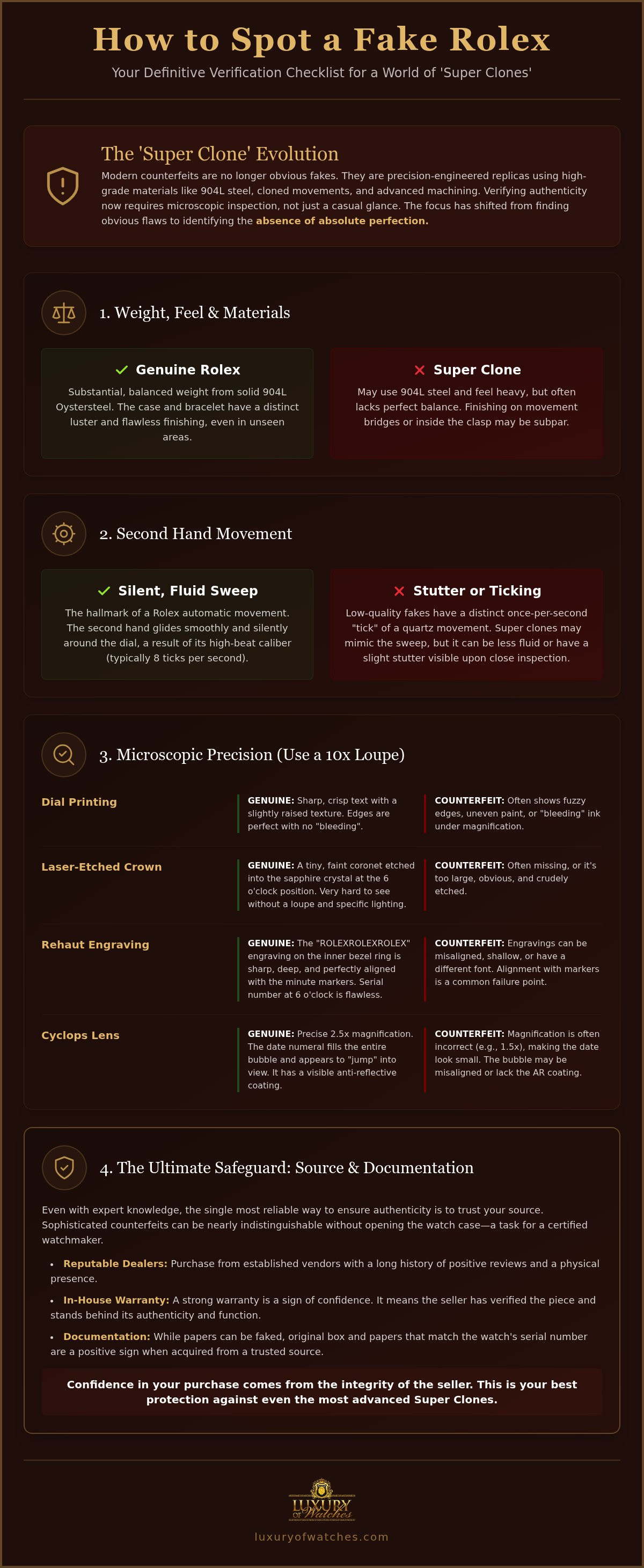
The horological landscape has moved far beyond the era of "Canal Street" specials characterized by mismatched fonts and lightweight cases. In 2026, the primary challenge for collectors is the "Super Clone." These are not mere imitations; they are precision-engineered replicas that utilize genuine 904L Oystersteel, the same corrosion-resistant alloy Rolex uses for its cases and bracelets. Because these counterfeits mimic the exact density and luster of the original, traditional "weight tests" no longer suffice. Understanding how to spot a fake rolex now requires a shift in perspective. You must move from looking for obvious errors to identifying the absence of perfection.
Authenticity is found in the cumulative harmony of microscopic details. A Super Clone might feature a cloned movement that looks identical to a Rolex caliber at a glance, even to some watchmakers. This technical evolution means that price is no longer the definitive red flag. Counterfeiters often price their high-end replicas just below market value to avoid immediate suspicion while still reaping massive profits. A holistic approach is the only way to protect your investment. You shouldn't look for a single "tell," but rather verify the integrity of every component in unison.
The Rise of High-End Replicas
Modern counterfeiters employ advanced CNC machining and laser-etching technology to replicate the exact proportions of iconic models. This technical sophistication creates a dangerous psychological trap. When the metal feels cold to the touch and the bracelet links move with a familiar heft, the brain wants to believe the piece is genuine. However, these manufacturers often cut corners in areas invisible to the naked eye, such as the finishing on the underside of movement bridges or the exact composition of the luminous material. Relying on a "gut feeling" is a recipe for financial loss when dealing with replicas that cost thousands to produce.
Why Micro-Inspection is Mandatory
The margin for error has shrunk to microns. To truly master how to spot a fake rolex, you must employ a 10x jeweler's loupe or high-resolution macro photography. Professional verification protocols, such as those used by the specialists at Luxury of Watches, rely on these tools to scrutinize the laser-etched crown and the sharpness of the dial typography. While a replica might look flawless from six inches away, magnification reveals the "bleeding" of paint or the jagged edges of a stamped hand. Transitioning from a casual observer to a disciplined investigator means accepting that if a detail isn't perfect under 10x power, it isn't a Rolex.
Microscopic Precision: Examining the Dial, Cyclops, and Crystal
While the case material provides the first clue, the true soul of the watch lies beneath the sapphire crystal. A mastery of how to spot a fake rolex requires a disciplined eye for microscopic finishing. Rolex dials are produced in-house with a level of precision that remains the industry benchmark. Every element, from the depth of the ink to the alignment of the indices, serves as a signature of authenticity. Replicas often stumble here, as the cost of perfect dial production is prohibitively high for counterfeiters.
The text on an authentic dial isn't just printed; it's often applied with a specific raised texture that catches the light. Under a loupe, the edges of every letter must be sharp and distinct. Counterfeits frequently show "fuzzy" edges or uneven paint application where the ink has bled into the dial's texture. Chromalight, the brand's proprietary photoluminescent material, should appear as a uniform, clean blue in the dark. If the glow is patchy, grainy, or fades too quickly, the watch is likely a fake. For those seeking absolute peace of mind, choosing pre-owned Rolex watches from a verified expert ensures these microscopic standards are met.
The Rolex Dial: A Study in Perfection
Modern Rolex dials utilize a sophisticated construction where each hour marker is a solid gold component, whether white, yellow, or Everose. These markers are perfectly centered within their designated spaces. Most importantly, the coronet logo at 12 o'clock must align exactly with the center of the crown on the rehaut and the center of the 12 o'clock marker. Any deviation, however slight, is a sign of a replica. Learning how to spot a fake rolex involves checking that the "sandwich" effect of the applied markers shows no visible glue or gaps between the marker and the dial surface.
Crystal and Magnification Nuances
The Cyclops lens is a hallmark of Rolex design, providing exactly 2.5x magnification. On a genuine piece, the date should fill the entire bubble. Many fakes only manage 1.5x or 2x magnification, leaving the date looking small and centered. Authentic crystals also feature a clear anti-reflective coating on the Cyclops itself. If you see a "halo" or a blueish tint around the date bubble, it's likely a counterfeit crystal. Furthermore, the date should flip "instantly" at midnight rather than slowly rolling over a period of hours.
Finally, the "LEC" or Laser Etched Crown is a vital security feature. Located at 6 o'clock, this tiny crown is etched into the underside of the sapphire. It's designed to be nearly invisible to the naked eye. If it's too easy to see, it's probably a fake. It should consist of thousands of tiny dots at different depths, creating a transparent, ghostly image rather than a solid white line. This level of detail is why professional verification remains the gold standard for serious collectors.
The Weight of Excellence: Metal Composition and Movement Mechanics
Rolex isn't just a name; it's a tangible experience of density and precision. While modern "Super Clones" attempt to mimic the weight of Oystersteel, they often fail to capture the specific visual depth of 904L steel. This proprietary alloy is exceptionally resistant to corrosion and takes a polish that standard 316L steel cannot match. When you're learning how to spot a fake rolex, pay close attention to the metal's luster. 904L has a whiter, more brilliant finish. If the watch appears slightly grey or dull under direct light, it's a significant indicator of lower-grade steel used in counterfeits.
Weight distribution is equally telling. A genuine Rolex feels balanced on the wrist. The bracelet's weight should complement the case rather than feeling like an afterthought. This is especially true for precious metal models. A solid gold Submariner or a platinum Day-Date carries a distinct heft that is nearly impossible to replicate with gold plating or tungsten cores. If a gold watch feels as light as a steel one, it's an immediate red flag. Additionally, remember the caseback rule. With very few exceptions in the modern catalog, Rolex does not use clear display casebacks. If you see the movement through a glass window, you're likely looking at a counterfeit.
The Haptics of a Masterpiece
The tactile feedback of a Rolex is unmatched. When you unscrew the winding crown, the action should feel buttery and consistent. There shouldn't be a gritty or loose sensation as you move through the positions to set the time or date. Similarly, the bezel clicks on a GMT-Master II or a Submariner are engineered for a crisp, auditory snap with zero back-play. The Oyster bracelet links should move freely. They shouldn't kink or feel stiff when you drape the watch over your hand. This fluid movement is a result of tight manufacturing tolerances that counterfeiters don't prioritize.
Acoustics and Internal Workings
A genuine Rolex doesn't "tick" in the traditional sense. Because the movement operates at a high frequency of 28,800 beats per hour, the second hand appears to glide smoothly across the dial. If you hold the watch to your ear, you'll hear a rapid, melodic heartbeat rather than a slow, clunky "tick-tock" associated with quartz or lower-grade mechanical movements. This acoustic signature is a direct result of the movement's engineering. Rolex Calibre movements represent the gold standard of chronometric precision. If the second hand jumps or stutters, it's a clear sign of an inferior movement hidden within the case. Mastering how to spot a fake rolex requires listening as much as looking.
Beyond the Watch: Verifying Serial Numbers and Documentation
Every Rolex carries a unique identity encoded into its metal. Understanding how to spot a fake rolex requires looking at the technical execution of these serial and model numbers. Since the mid-2000s, Rolex has engraved the serial number on the inner bezel ring, known as the rehaut. In a genuine piece, the serial number at the 6 o'clock position must align perfectly with the hour marker. The repeating "ROLEX" text around the rest of the rehaut should also line up precisely with the minute markers. If the letters are slightly off-center or the engraving looks shallow, you're likely holding a counterfeit.
The typography itself is a signature of the brand's manufacturing prowess. Authentic engravings are diamond-cut into the metal. This process results in clean, sharp lines that reflect light with a subtle metallic sheen. Replicas often utilize acid-etching or laser-burning. These inferior methods leave a sandy, grey, or "burned" texture that lacks the crisp definition of a diamond-cut edge. If you are curious about how these details and production years affect market worth, consult our Rolex Prices 2026: The Comprehensive Market Value & Buying Guide.
Inspecting the Rehaut and Lugs
On older models produced before the rehaut engraving became standard, the model and serial numbers are located between the lugs. You'll need to remove the bracelet to see them. The model number sits at 12 o'clock, while the serial number is at 6 o'clock. These engravings should be deep and possess the same sharp, fine lines as the dial printing. Counterfeiters often use a "dot matrix" style of engraving that appears blurry or pixelated under a loupe. Always cross-reference the model number with the actual watch configuration. A mismatch between a "Submariner" case and a "Datejust" model number is an immediate disqualifier.
Paperwork and Provenance
In 2020, Rolex transitioned to a new generation of warranty cards equipped with NFC technology. These modern cards don't feature a visible serial number on the front. Instead, the data is stored digitally and printed on the back. Mastering how to spot a fake rolex involves verifying that the documentation isn't just present, but accurate to the specific production year. A sophisticated "Super Clone" might come with a forged card, but it often lacks the correct authorized dealer stamp or includes a font that deviates from the official Rolex typography.
The presence of the "Green Tag" and "White Tag" also adds a layer of security. The green seal signifies the Superlative Chronometer certification, while the white tag should display the matching serial and model numbers. To ensure your timepiece is accompanied by legitimate documentation and expert verification, you should only buy Rolex watches from established specialists who provide their own rigorous authentication protocols and service backing.
Securing Your Investment: Why the Source Defines Authenticity
While mastering the technical nuances of how to spot a fake rolex empowers you as a collector, your most significant defense against fraud is the reputation of your chosen dealer. The "Buy the Seller" axiom remains the cornerstone of luxury horology for a reason. In an era where high-end replicas can mimic 904L steel and cloned movements, the integrity of the source provides the final, insurmountable layer of security. Private marketplaces like eBay and Craigslist often lack the specialized oversight required to identify sophisticated counterfeits, leaving buyers vulnerable to significant financial loss and emotional frustration.
The danger of the grey market isn't just limited to obvious replicas. It's the subtle deception that requires a professional eye to uncover. When you purchase from an unverified individual, you're assuming all the risk of a high-value transaction without any of the legal or technical safeguards that a premier digital commerce platform provides. Authenticity isn't a single feature; it's the cumulative perfection of every microscopic detail and the integrity of the business standing behind the product.
The Risks of the Private Market
The private market is rife with "Frankenwatches," where genuine Rolex parts are combined with counterfeit components to create a deceptive hybrid. These pieces are notoriously difficult to detect because a cursory inspection of the dial or bezel might reveal authentic markings, while the movement or bracelet remains a replica. Unscrupulous sellers also employ "bait and switch" tactics, showcasing a genuine timepiece in digital listings only to ship a high-tier replica once the payment is secured. To understand the broader landscape of safe acquisition, explore The Comprehensive Guide to Pre-Owned Luxury Watches: Value, Authenticity, and Ownership.
A Legacy of Trust at Luxury of Watches
Luxury of Watches has operated as a specialist intermediary since 1999, building a legacy on absolute verification and consumer protection. Our team understands that a high-value transaction requires more than just a visual check. We subject every timepiece to a rigorous multi-point inspection process that validates every component, from the hairspring to the clasp. This expertise allows us to offer a 5-year in-house warranty on all timepieces, a commitment that far exceeds the standard protections found in the secondary market. This warranty acts as the ultimate proof of our confidence in every watch we sell.
By choosing a partner that values craftsmanship and history as much as you do, you ensure that your investment remains as timeless as the watch itself. We invite you to browse our verified collection of authentic Rolex watches and experience the security of professional horological expertise. When you buy from us, you aren't just buying a watch; you're securing peace of mind through a proven verification protocol and a dedicated support team.
Mastering the Art of Confident Collection
Authenticity in the modern market requires more than a casual glance. You've learned that identifying a genuine timepiece involves a disciplined examination of microscopic details, from the laser-etched crown to the specific luster of 904L Oystersteel. While understanding how to spot a fake rolex is an essential skill for any serious collector, technical knowledge is most powerful when paired with a trusted source. True security comes from knowing that every gear, hand, and engraving has been validated by professionals who understand the heritage of these manufacturers.
Since 1999, Luxury of Watches has served as a specialist intermediary, providing the peace of mind that private sales simply cannot offer. Our expert verification process and A+ rated customer support ensure that your investment is protected from the moment of purchase. Every timepiece is backed by our signature 5-year in-house warranty, allowing you to enjoy the prestige of your model without the anxiety of the grey market. Secure Your Authentic Masterpiece at Luxury of Watches today. Your journey toward owning a true icon of engineering deserves the security of a partner you can trust.
Frequently Asked Questions
Do all authentic Rolex watches have a serial number?
Yes, every genuine Rolex is assigned a unique serial number that acts as its individual identity. On vintage models and those produced before the mid-2000s, this number is engraved between the lugs at the 6 o'clock position. Modern references feature the serial number laser-engraved on the inner rehaut. If you're investigating how to spot a fake rolex, verifying the depth and alignment of this engraving is a vital first step.
Can a fake Rolex have a genuine movement inside?
While rare, some "Frankenwatches" utilize a genuine Rolex movement housed within a counterfeit case to deceive collectors. Most high-end replicas, however, use "Super Clone" movements that mimic the architecture of a Rolex caliber but lack the chronometric precision and high-grade finishing of the original. Professional watchmakers can usually identify these imitations by scrutinizing the hairspring and the bridge engravings under high magnification.
Why doesn’t my Rolex have a clear caseback?
Rolex prioritizes the structural integrity and water resistance provided by their signature Oyster case, which traditionally requires a solid metal screw-down caseback. Aside from very few exceptions, such as the 1908 or specific platinum Daytona models, Rolex does not produce watches with sapphire display backs. If a standard Submariner or Datejust features a clear window into the movement, it's a definitive sign that the timepiece is not authentic.
How much does it cost to have a Rolex professionally authenticated?
The cost for professional authentication varies based on the watchmaker's expertise and the level of technical teardown required. Many specialists include this service as part of a standard maintenance check or appraisal. Rather than paying for standalone verification, many collectors find better value in purchasing through established dealers like Luxury of Watches. Our process includes expert verification and a 5-year in-house warranty to ensure your investment is secure from day one.
Is the "ticking" sound a definitive sign of a fake Rolex?
A slow, audible "tick-tock" sound is an immediate red flag. Genuine Rolex movements operate at a high frequency of 28,800 beats per hour, which creates a rapid, melodic heartbeat rather than a clunky cadence. This high-frequency movement causes the second hand to glide smoothly across the dial. If you see a second hand that jumps once per second or hear a slow mechanical rhythm, you've successfully learned how to spot a fake rolex.
What is a "Frankenwatch" and how do I avoid one?
A "Frankenwatch" is a deceptive timepiece constructed from a mixture of genuine and counterfeit components. For example, a seller might pair an authentic dial with a replica bracelet and movement. These are the most difficult fakes to detect because certain parts will pass a cursory inspection. You can avoid these hybrids by insisting on a multi-point inspection from a reputable dealer who verifies the serial number's history and the integrity of every internal component.
Does a Rolex always come with a certificate of authenticity?
Rolex does not issue a specific "Certificate of Authenticity" document. Instead, new watches are accompanied by an official warranty card that includes the model and serial numbers. In the secondary market, "box and papers" add value but aren't a guarantee of the watch's current state. A professional dealer's in-house warranty and verification record are often more reliable indicators of a watch's legitimacy than potentially forged paper documentation.
How do I verify a Rolex warranty card from 2026?
Modern Rolex warranty cards utilize embedded NFC technology that authorized dealers can scan to verify the watch's data. For a private buyer, verification involves checking the card's specific typography and the presence of the gold-flecked texture on the surface. The serial number should be printed on the back and must match the engraving on the watch's rehaut. Always ensure the authorized dealer stamp and date of purchase appear legitimate and unaltered.