
How to Adjust a Rolex Glidelock Clasp: The Definitive Owner’s Guide (2026)
Posted by Luxury of Watches on 8th Sep 2026
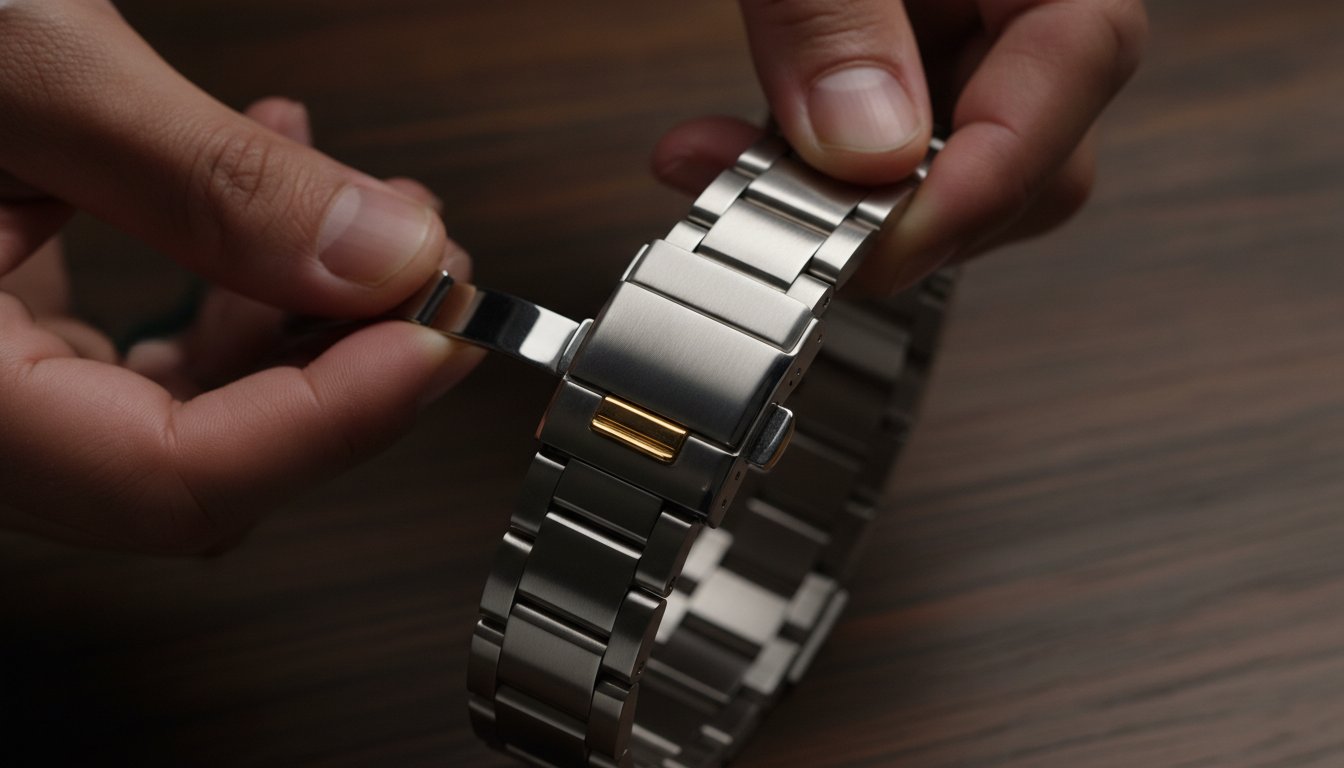
You are halfway through a humid afternoon when your Submariner suddenly feels restrictive, yet you are miles away from a jeweler's toolkit. It's a common frustration for collectors who demand both precision and comfort from their horological investments. We recognize that the fear of accidentally forcing the delicate ceramic-beaded mechanism often prevents owners from enjoying the full utility of their timepiece. You shouldn't have to worry about damaging your bracelet just to achieve a breathable fit.
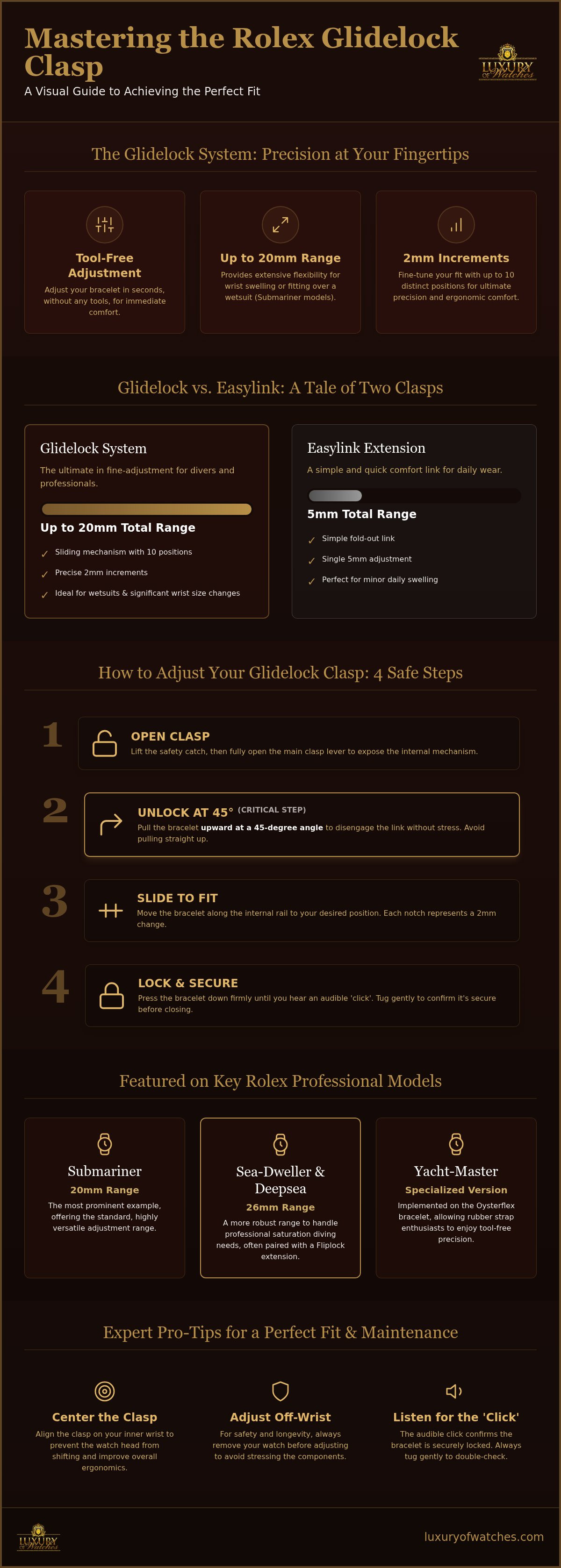
This guide will show you exactly how to adjust a rolex glidelock clasp to master the art of the perfect fit. We will demystify the tool-free system, explain the 2mm increments that provide up to 20mm of range on modern Submariners, and clarify how this patented engineering differs from the simpler Easylink extension. Our expertise ensures you'll gain the confidence to secure a perfectly centered, comfortable fit on your wrist. Whether you're navigating a deep dive or a summer gala, your Rolex will remain as secure as it is sophisticated.
Key Takeaways
- Learn exactly how to adjust a rolex glidelock clasp using the intuitive, tool-free sliding mechanism to achieve a custom fit in seconds.
- Understand the technical precision of the system, which allows for 2mm increments over a total range of up to 20mm on current Submariner models.
- Distinguish between the comprehensive Glidelock sliding scale and the simpler 5mm Easylink extension to better manage wrist swelling and comfort.
- Master the secret to centering your clasp on the inner wrist, which prevents the watch head from shifting and improves overall ergonomics.
- Ensure the longevity of your timepiece's moving parts with our five-year in-house warranty that covers the functional integrity of every verified Rolex clasp.
What is the Rolex Glidelock System and How Does it Work?
Rolex engineered the Glidelock system as a sophisticated solution for divers who needed to accommodate wrist expansion or fit their timepiece over a wetsuit. Unlike standard clasps that rely on fixed positions, the Glidelock is a patented fine-adjustment mechanism that offers 20mm of total extension. It functions through a series of internal notches and a sliding carriage integrated directly into the clasp. This design allows for adjustments in precise 2mm increments, providing a level of customization that traditional micro-adjustments simply cannot match. For those learning how to adjust a rolex glidelock clasp, the genius lies in the ceramic beads located within the mechanism. These beads ensure the glide remains smooth and reduces friction, preventing the metal-on-metal wear common in lesser designs. The result is a tactile, secure experience that reflects the brand's commitment to functional excellence.
The History and Evolution of Rolex Clasp Technology
The journey to the modern Glidelock represents a significant shift from utility to luxury engineering. Early Rolex models featured hollow, stamped steel clasps that, while functional, lacked the substantial feel of modern horology. The evolution culminated in 2008 with the launch of the Deepsea Sea-Dweller. This model introduced the world to the milled 904L Oystersteel Glidelock, effectively replacing the older pin-and-hole systems that required specialized tools. This transition transformed the watch strap from a simple fastener into a sophisticated component of the watch's overall movement. By utilizing solid 904L steel, Rolex ensured that the clasp would be as durable as the case itself, maintaining its structural integrity over decades of use.
Which Rolex Models Feature the Glidelock Clasp?
While initially reserved for the most extreme dive watches, Rolex has expanded the Glidelock to several key Professional models. The Submariner, including references 124060 and 126610, is the most prominent example, offering the standard 20mm adjustment range. In contrast, the Sea-Dweller and Deepsea models provide a more robust 26mm range to handle professional saturation diving needs. These larger models often pair the Glidelock with a Fliplock extension for even greater versatility. You'll also find a specialized implementation of the Glidelock on Yacht-Master models equipped with the Oysterflex bracelet. This allows rubber-strap enthusiasts to enjoy the same tool-free precision as those wearing traditional metal bracelets. This versatility ensures that whether you're in a boardroom or 300 meters underwater, your fit remains perfect.
Step-by-Step: How to Adjust Your Rolex Glidelock Clasp Safely
Mastering the physical movement of the clasp is essential for maintaining the longevity of your bracelet. Before you begin, ensure you're working over a soft surface like a microfiber cloth or a valet tray. To start the process of how to adjust a rolex glidelock clasp, first lift the safety catch—the small rectangular flap—and then fully open the main clasp lever. This exposes the internal mechanism where the adjustable side of the bracelet meets the clasp body. Understanding how to adjust a rolex glidelock clasp properly is the difference between a lifetime of comfort and an expensive repair bill.
Once open, you'll enter the 'Unlock' phase. Grasp the adjustable side of the bracelet and pull it upward at a 45-degree angle. This specific angle is crucial; it disengages the link from the internal notches without stressing the components. During the 'Slide' phase, move the bracelet along the internal rail to your desired position. Each notch represents a 2mm change. Finally, perform the 'Lock' phase by pressing the bracelet back down into the clasp until you hear an audible 'click'. A final check is mandatory: tug gently to ensure the link is seated firmly before closing the safety catch.
The 45-Degree Rule: Avoiding Unnecessary Stress
Many owners make the mistake of pulling the bracelet straight up. This creates a lever effect that puts unnecessary pressure on the spring bars and the ceramic beads. Visualize the pivot point inside the clasp body as a hinge rather than a pull-tab. By following this geometric approach, you protect the Rolex Glidelock Clasp from premature wear. If you notice any resistance, don't force it. A well-maintained mechanism should glide with effortless precision. This tactile feedback is a hallmark of the quality you'll find in our collection of pre-owned luxury watches.
Adjusting Your Watch While on the Wrist
While it's tempting to make a quick fix during a humid afternoon, we strongly recommend taking the watch off first. Take it off. Adjusting while wearing the piece increases the risk of dropping it or over-extending the link carriage beyond its rail. For those in humid environments, a quick adjustment is best done by resting your arm on a stable surface. This ensures the watch is secure throughout the process. The risks of a slip far outweigh the convenience of a mid-wear adjustment, especially when dealing with high-value professional models.
Glidelock vs. Easylink: Understanding the Differences
Rolex offers two primary solutions for bracelet adjustment, yet they serve distinct purposes for the wearer. The Easylink is a comfort extension link found on everyday icons like the GMT-Master II, Daytona, and Datejust. It operates as a binary system; it is either on or off. By folding or unfolding a single link, you gain or lose exactly 5mm of length. While this is helpful for a quick fix, it lacks the surgical precision of the Glidelock. The Glidelock system, standard on professional divers, provides a sliding scale of up to 20mm. Because it moves in 2mm increments, it allows you to counteract the subtle effects of thermal expansion with far more accuracy. Knowing how to adjust a rolex glidelock clasp effectively means you can find a sweet spot that a fixed 5mm jump might over-correct.
Can You Retrofit a Glidelock Clasp to Other Models?
Collectors often ask if they can upgrade their GMT or Daytona by swapping the clasp. Technically, this is difficult. Rolex designs bracelets and clasps as matched sets with specific tapering and link widths. Swapping parts between different references can lead to fitment issues or unsightly gaps at the connection points. Beyond the mechanical hurdles, mixing components can raise authenticity concerns during a future resale. Luxury of Watches recommends maintaining factory configurations to preserve the watch's long-term value and structural integrity. A mismatched bracelet can compromise the secure feel that defines the Rolex experience.
When to Use the Easylink if Your Watch Has Both
Some professional models, specifically the Sea-Dweller and Deepsea, incorporate a hybrid approach. These watches feature both the Glidelock rail and a Fliplock extension link. The Fliplock is a large, fold-out link designed to fit the watch over a thick neoprene sleeve instantly. It isn't meant for daily comfort. If you are researching how to adjust a rolex glidelock clasp for a specific model like the Sea-Dweller, remember that the Fliplock is for the dive, while the Glidelock is for the day. For your standard routine, you'll rely on the Glidelock to manage small 2mm shifts. Understanding these nuances helps you decide which system best fits your lifestyle. If you prefer a set and forget approach with high precision, the Glidelock remains the superior choice for ergonomic perfection.
Expert Pro-Tips for a Perfect Rolex Fit and Maintenance
Achieving a master-level fit involves more than just total bracelet length. It's about balance. Many owners learn how to adjust a rolex glidelock clasp but forget that the clasp itself must sit perfectly centered on the underside of the wrist. If the clasp is offset, the watch head will naturally "flop" toward the outer edge of your arm. This is particularly noticeable with heavier professional models. For owners of the Deepsea, remember that your watch features a Fliplock extension in addition to the Glidelock. While the Fliplock offers a massive jump for thick diving suits, the Glidelock remains your primary tool for neutralizing that top-heavy rotation during daily wear. Using the sliding carriage to snug the fit by just 2mm can keep a heavy Sea-Dweller stable without sacrificing comfort.
Centering the Clasp: Link Count Strategy
A common mistake is leaving too many links on the 6 o'clock side of the bracelet. For the majority of wrists, a shorter 6 o'clock side pulls the clasp into the center of the wrist's flat surface. You should adjust your permanent links to get as close to your ideal size as possible first. Think of the Glidelock as your finishing tool, not a replacement for proper sizing. Ideally, you want the sliding carriage to sit near the middle of the internal rail. This gives you ample room to expand or contract the bracelet as your body temperature fluctuates throughout the day. If the clasp is already at its maximum extension just to fit your wrist, you've lost the functional benefit of the system.
Maintenance: Keeping the Slide Smooth
The secret to that signature "Rolex glide" is a set of tiny ceramic beads hidden inside the mechanism. These beads are incredibly hard and smooth, but they can't do their job if the track is filled with salt, skin oils, or grit. We recommend cleaning the internal clasp rail every few weeks with lukewarm water and a very soft brush. Never use lubricants, oils, or spray cleaners. These substances actually attract more debris and will eventually gum up the precision notches. If the slide feels gritty or sticks even after a thorough rinse, it's a sign that the mechanism needs professional attention. You can find expertly maintained models with fully functional, verified clasps in our selection of Rolex watches.
The ceramic beads are designed to minimize friction, ensuring the metal components don't grind against each other. This engineering allows the clasp to feel as smooth today as it will in twenty years. When you find that "goldilocks zone" where the watch stays put but your skin can still breathe, you'll truly appreciate the technical mastery behind the design. Proper maintenance ensures that every 2mm click remains crisp and secure for the life of the timepiece.
Finding Your Perfect Rolex with Glidelock at Luxury of Watches
Knowing how to adjust a rolex glidelock clasp is a vital skill for any owner, but the foundation of that experience is a timepiece that functions exactly as the manufacturer intended. When you acquire a professional model from Luxury of Watches, you aren't just buying a watch. You're investing in a piece of engineering that has been verified for absolute performance. Every sliding carriage and ceramic bead in our inventory must meet rigorous standards before it reaches your wrist. We understand that for a serious collector, the tactile response of a 2mm adjustment is just as important as the accuracy of the movement itself.
Our commitment to your investment extends far beyond the point of sale. We provide a comprehensive five-year in-house warranty that specifically covers the functional integrity of mechanisms like the Glidelock clasp. This ensures that your knowledge of how to adjust a rolex glidelock clasp is always supported by a mechanism that glides with effortless precision. Since 1999, we've acted as a knowledgeable expert intermediary, bridging the gap between high-end elegance and pragmatic consumer security. This steady, reassuring approach guides you through a significant decision without the pressure of traditional retail environments.
Why the Submariner Remains the Glidelock Standard
The Rolex Submariner remains the definitive benchmark for this technology. Whether you choose the date-equipped 126610LN or the symmetrical 124060, you're gaining 20mm of on-the-fly versatility. These models are engineered to handle the demands of daily wear while maintaining a profile that fits under a dress cuff. They represent the peak of clasp engineering, offering a balance of utility and prestige that few other models can match. For those tracking the current market, our Rolex Prices 2026 Guide provides the necessary data to help you navigate market values with intellectual security.
Secure Your Next Investment with Confidence
Choosing pre-owned luxury watches requires a partner that values verification as much as you do. Our US-based team subjects every timepiece to a 30-point inspection process, paying close attention to the bracelet tension and clasp rails. We eliminate the traditional retail premiums while maintaining the highest tier of product quality. This juxtaposition of high-tier status and competitive pricing is our signature brand promise. Don't settle for a mechanism that feels gritty or unsecure. Browse our curated Rolex collection today to find a timepiece that offers the perfect fit, guaranteed by our horological expertise.
Mastering Your Rolex Fit for a Lifetime of Comfort
You now possess the technical knowledge to handle one of the most advanced clasp systems in horology. By mastering the 45-degree pivot and understanding the importance of centering your bracelet links, you can ensure your timepiece remains both secure and ergonomic. This tool-free system is more than a convenience; it's a testament to the functional art that defines the Rolex Professional range. Whether you're managing wrist expansion in humidity or preparing for a dive, knowing how to adjust a rolex glidelock clasp allows you to maintain the perfect fit in any environment.
At Luxury of Watches, we have specialized in authentic, high-value timepieces since 1999. Our collection features meticulously inspected models, each backed by our comprehensive 5-year in-house warranty and delivered with free insured shipping for your total peace of mind. We invite you to explore our selection to find a model that pairs iconic design with this pinnacle of clasp engineering. Enjoy the confidence that comes with a perfectly adjusted investment on your wrist.
Shop Authentic Rolex Watches with Glidelock Clasps
Frequently Asked Questions
Can I adjust the Rolex Glidelock while wearing the watch?
No, you should always remove the watch before making any adjustments. While the system is designed for speed, attempting to manipulate the sliding carriage while it's on your wrist significantly increases the risk of dropping the timepiece or over-extending the link. By taking it off, you can clearly see the 45-degree angle required to safely unlock the mechanism. This ensures that you don't put unnecessary leverage on the spring bars or ceramic beads.
Which Rolex models have the Glidelock clasp instead of Easylink?
The Glidelock clasp is primarily featured on Rolex Professional dive watches, including the Submariner, Sea-Dweller, and Deepsea models. It's also found on the Yacht-Master when equipped with the Oysterflex bracelet. In contrast, the Easylink is standard on sport and dress models like the GMT-Master II and Daytona. Understanding how to adjust a rolex glidelock clasp is essential for diver owners, as it offers a much broader 20mm to 26mm range compared to the 5mm Easylink.
Do I need any tools to adjust the Glidelock mechanism?
No tools are required to use this system. Rolex designed the Glidelock specifically as a tool-free solution for divers who need to make immediate adjustments in the field. You simply lift the safety catch, open the main lever, and pull the bracelet at a 45-degree angle to unlock the slide. This allows you to find a precise fit in seconds without needing a jeweler's screwdriver or spring bar tool, making it ideal for managing wrist swelling.
How many millimeters can the Rolex Glidelock adjust in total?
The Submariner models allow for a total adjustment of 20mm, while the Sea-Dweller and Deepsea variations offer up to 26mm of extension. Both systems operate in precise 2mm increments. This granular control is what sets the Glidelock apart from other extension systems. It allows you to fine-tune the bracelet length across ten different positions on a Submariner, ensuring that the watch head remains stable and the clasp stays perfectly centered on your inner wrist.
What should I do if my Glidelock clasp feels gritty or stuck?
If the mechanism feels gritty, you should first rinse it with lukewarm water and use a soft-bristled brush to clear away salt or debris. Never apply oils or lubricants, as these attract grit that can damage the internal rail. If the stiffness continues, it may indicate a deeper issue with the ceramic beads. At Luxury of Watches, our 5-year in-house warranty covers the functional integrity of your clasp, ensuring that every adjustment remains smooth and secure.
Is the Glidelock clasp available on the Rolex Jubilee bracelet?
No, the Glidelock clasp is not currently available on the Jubilee bracelet. Rolex reserves this specific sliding mechanism for the Oyster bracelet and the Oysterflex rubber strap. The Jubilee bracelet typically utilizes either a concealed Crownclasp or an Oysterclasp featuring the 5mm Easylink extension. If you require the extreme precision of the Glidelock system, you should focus your search on professional models like the Submariner that are factory-fitted with the Oyster bracelet.
What is the difference between Glidelock and Fliplock?
Glidelock is a sliding fine-adjustment system, whereas Fliplock is a single, large fold-out link. The Glidelock allows you to move the bracelet in 2mm steps for daily comfort. The Fliplock extension, found on the Sea-Dweller and Deepsea, is a binary link that adds a large amount of length instantly to fit over a thick diving suit. While they work together on extreme dive watches, they serve very different ergonomic purposes for the wearer.
Does adjusting the Glidelock frequently wear out the bracelet?
Frequent use of the Glidelock mechanism does not wear out the bracelet when performed correctly. Rolex utilizes microscopic ceramic beads within the sliding carriage to eliminate metal-on-metal friction. These beads are harder than the Oystersteel itself, ensuring the "glide" remains consistent over decades of use. As long as you follow the 45-degree rule and keep the track free of abrasive grit, the system is engineered to handle daily adjustments without compromising its structural integrity.