
Financial planning for a grail watch: Set a budget that fits
Posted by Luxury of Watches on 22nd Oct 2026
The right grail-watch budget starts with what you can afford, not what you hope the watch will be worth later. One collector’s guideline is to cap the purchase at no more than two monthly salaries, while postponing it if buying would mean taking on debt or relying on unstable employment. Sound financial planning for a grail watch puts personal affordability first and resale potential second.
A coveted reference can bring together craftsmanship, history, and personal meaning, so it is natural to wonder whether it might hold or gain value. Start by defining your goal, setting a realistic budget, and mapping out a savings timeline. When comparing new and pre-owned watches, consider condition, originality, and documentation. These practical checks help you make a considered decision without relying on hoped-for resale value.
Key Takeaways
- Compare the full ownership cost, including applicable taxes and fees, rather than judging a watch by its purchase price alone.
- For a pre-owned watch, learn how originality, condition, service history and accompanying documentation can shape its appeal and resale prospects.
- Market growth can offer context, but it doesn’t establish what an individual watch will be worth later. Consider the model’s characteristics and your reasons for buying before treating it as an investment.
- Build a savings timeline around a consistent contribution you can maintain, then revisit it as your priorities and finances change.
- Explore the factors that can help a fine timepiece retain value, while keeping your purchase decision grounded in personal affordability.
Setting objectives for a luxury watch purchase
Set a maximum budget that fits your finances, then choose the reference and ownership purpose that make the watch meaningful to you. Build a dedicated fund through regular contributions, keeping it separate from money for essentials and other priorities. A realistic savings plan is more dependable than expecting the watch to appreciate.
Setting a Savings Goal
Your savings goal is the amount you plan to set aside for the watch, based on your budget and chosen reference. Setting a firm ceiling helps distinguish an appealing purchase from one that would strain your finances.
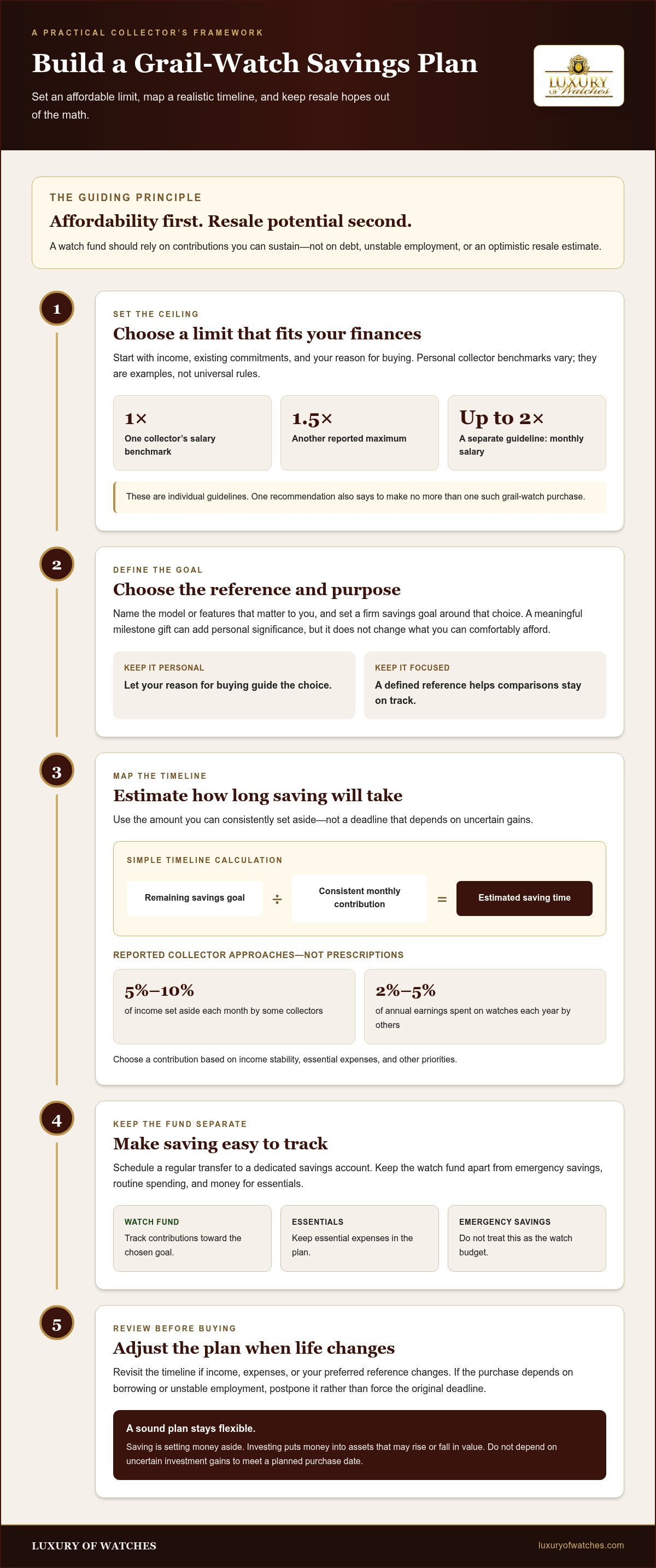
Collectors use different personal benchmarks: some have limited a watch to one month’s salary, while another reported a maximum of 1.5 times monthly salary. A separate recommendation was to cap a grail purchase at up to two monthly salaries and make no more than one such purchase. These are individual guidelines, not universal rules.
Choose a limit that reflects your own income, existing commitments, and reason for buying. A milestone gift, such as a watch to mark turning 40, may carry personal meaning, but the occasion doesn’t change what you can comfortably afford. Include the specific model or features you value so your goal guides comparisons rather than shifting with every appealing listing.
Planning the Savings Timeline
A savings timeline estimates how long regular contributions will take to reach your goal. It turns a large purchase into a manageable plan without relying on debt or an optimistic resale estimate.
Some collectors set aside 5% to 10% of income each month for watches; others aim to spend 2% to 5% of annual earnings on watches each year. Treat these figures as reported approaches, not prescriptions. Your contribution depends on income stability, essential expenses, and other financial priorities.
For a simple estimate, divide the remaining savings goal by the amount you can consistently set aside each month. Revisit the timeline if your income, expenses, or preferred reference changes. If buying depends on unstable employment or borrowing, postpone the purchase rather than force the original deadline.
Saving and Investing for the Purchase
Saving means setting money aside for the purchase. Investing means putting money into assets that may rise or fall in value. Keep the distinction clear: your watch fund should not depend on uncertain investment gains to meet a planned purchase date.
Schedule a regular transfer to a dedicated savings account, and adjust it when your budget changes. Keeping the watch fund separate from emergency savings and routine spending makes it easier to track progress. Don’t treat the watch as a substitute for an investment plan.
Some enthusiasts consider spending around one or two months of current gross compensation on a grail watch. That is a personal benchmark, not a financial target. Sound financial planning for a grail watch starts with an affordable limit, a realistic timeline, and a clear reason to buy.
Buying the grail watch
A sound purchase decision accounts for the payment method, total ownership cost, and evidence about the specific watch. In the United States, tax treatment and consumer protections can vary by location and transaction.
Comparing Purchase Financing Options
Compare paying from savings with borrowing through credit, a card, or a watch-secured loan. Financing can increase the total amount paid and affect your monthly budget, so consider the repayment terms before choosing.
Paying from savings avoids creating a debt balance or interest charge. Financing and credit cards spread payments, but compare the annual rate, fees, repayment period, and consequences of missed payments before committing. A watch-secured loan uses the timepiece as collateral, so missed payments can put it at risk. If you cannot comfortably repay a loan, wait and save instead.
Calculating the Total Purchase Cost
The total purchase cost includes the agreed price, transaction charges, and the ownership expenses that follow. Calculating the full commitment matters because the listed price alone may not tell you what the purchase will cost.
For a purchase in the United States, state and local sales-tax treatment depends on the location and transaction. Shipping, payment charges, and import costs can also affect the total. Consumer protections vary too, so review the written terms for returns, disputes, and payment security before completing a purchase.
Budget for servicing and insurance as separate ownership costs. Service needs depend on the watch’s condition, use, and service history. Insurance terms depend on coverage limits, exclusions, and how you wear or store the watch. A standard homeowners policy may not adequately cover a high-value watch, especially during frequent wear or international travel.
Private sellers and online marketplaces can involve added uncertainty if the buyer has limited recourse over an inaccurate description, condition, or provenance. Before paying, compare the reference and parts with the listing, and review any box, papers, service history, and parts originality. These details help assess a pre-owned watch, but paperwork alone does not establish its current condition.
Keep the original purchase paperwork with the watch’s records. It can support authentication, future resale, and tax-basis tracking. Save the transaction terms and seller correspondence, then compare them with the watch and its service records.
For a pre-owned purchase, pre-owned luxury watches offer a way to compare individual timepieces while considering condition and documentation alongside the reference.
The author's view of watches as investments
A luxury watch can be both a personal object and a marketable asset, but those roles aren’t equivalent. The luxury watch market climbed 5% in 2025, while the second-hand watch market grew 11% since July 2025. Those figures describe broad market movement, not the future value of a particular reference.
A rising market does not mean every individual watch will gain value. Model popularity, condition, originality, completeness, and buyer demand all influence resale interest. A market-wide percentage cannot predict what a specific Rolex, Cartier, or Patek Philippe will sell for later.
Consider a watch an investment only after separating the emotional appeal from the financial case. Ask what could support future demand for the exact reference and what could weaken it. A distinctive design or strong collector interest may attract buyers, while visible wear, replaced parts, or missing documentation can narrow its appeal.
Pay particular attention to originality. Replacing key external components during service without the owner’s consent can diminish value in some cases. For a collectible watch, retaining original parts and service records helps establish its history. The effect depends on the watch and components involved, so broad market figures cannot account for every example.
Use a conservative test: would you still want the watch if its resale value never increased? Treat possible resale as an uncertain benefit, not a reason the purchase is affordable. If the decision only makes sense after a future price rise, your budget is exposed to changing market conditions and demand.
Documentation helps create a clearer ownership record. Keep the original purchase paperwork, reference details, and service history together. These records can support authentication, resale, and tax-basis tracking. An appraisal may also help with insurance coverage, estate planning, and gifting decisions as circumstances change.
Finally, compare market performance with the costs and time involved in owning a watch. A headline increase doesn’t equal personal profit: the amount received at resale depends on the watch’s condition, the transaction, and buyer interest at that time. Treat the 5% market rise in 2025 and 11% second-hand growth since July 2025 as context, not a promised return. A sound financial plan should work even if the watch’s value doesn’t rise.
How much does the grail watch cost, including taxes and fees?
The full purchase total is the amount required to acquire the watch, not just its advertised price. Estimate it using the specific reference, transaction charges, applicable taxes, and any delivery or payment costs.
Start with the exact watch you are considering. A Rolex reference and a pre-owned example of that reference may have different asking prices because of condition, originality, documentation, or service history. Compare like with like: align the reference, production details, condition, and included accessories before treating listings as comparable.
Next, identify each charge shown at checkout or in the seller’s written terms. Separate the watch price from shipping, payment charges, and other transaction costs. If the seller provides a total, use an itemized breakdown in the transaction documents to distinguish the watch price from purchase-related charges.
Sales tax can affect the amount due in the United States, and state and local treatment varies by location and transaction. Use the tax amount shown for your specific purchase when calculating the total. A price shown before checkout may not be the final amount payable.
Delivery details also matter. Shipping arrangements, insurance during transit, and any import-related charges can change the amount required to complete an international purchase. The relevant costs depend on how the watch is shipped and the transaction’s circumstances. Include any stated delivery charges before comparing offers, rather than treating them as an afterthought.
Use a simple worksheet to keep the calculation clear. List the watch price, sales tax, shipping, payment charges, and other stated costs separately, then add them to find the amount due. A second column can track recurring ownership expenses, such as insurance and future servicing, without mixing them into the one-time purchase total.
To compare two examples of the same reference, record each asking price and its disclosed transaction charges. If one listing includes shipping and the other adds it later, the displayed prices alone will not show which costs less overall. Compare the final totals and the documentation accompanying each watch.
Keep the listing, invoice, payment record, and original purchase paperwork together. These documents provide a clear purchase record and can support future resale or tax-basis tracking. A complete cost estimate helps you decide whether the acquisition fits your budget before you commit.
State and local sales-tax treatment varies by location and transaction. Include the tax amount shown for your specific purchase when calculating the total.
What is a realistic savings timeline for buying a luxury grail watch?
A realistic timeline depends on how much you can consistently save, not on an assumed future rise in watch value. Calculate it from your savings target and regular contribution, then adjust the target if your priorities or preferred reference change.
Some enthusiasts report setting aside 5% to 10% of their income each month for watches. Others are comfortable spending 2% to 5% of annual earnings on watches each year. These are personal budgeting approaches, not universal targets. Choose a contribution that fits your income and obligations without drawing from money reserved for essential expenses.
To estimate your timeline, subtract any savings already set aside for the watch from your target. Divide the amount left by what you can save each month. A larger contribution shortens the timeline, while a higher target or added purchase costs lengthens it. Recalculate whenever either figure changes.
Build consistency into your plan. Schedule an automatic transfer after each payday, and keep the watch fund separate from everyday spending. If your income varies, choose a regular contribution your budget can sustain in a quieter month. Add extra savings when cash flow allows, rather than relying on them to meet a fixed purchase date.
A timeline gives you room to refine your goal. As you save, compare references and decide which details matter most, such as condition, originality, or documentation. If your preferred watch changes, update the target before deciding to buy. This keeps your plan aligned with the watch you genuinely want.
Protect the plan from competing priorities. Review essential expenses, debt obligations, and other savings goals before increasing your watch contribution. If saving requires borrowing or depends on unstable employment, postponing the purchase protects the rest of your financial plan. A longer timeline is better than a purchase that disrupts your budget.
Some collectors use one or two months of current gross compensation as a grail-watch budget benchmark; others set a different limit. Treat this as one way to consider affordability, not as a deadline or savings formula. Your sustainable contribution and full purchase target determine the timeline.
Once your target and timeline are clear, explore luxury watches and compare references that fit the objective you’ve set.
Luxury of Watches: Rolex Watches
Once your budget and buying criteria are clear, Luxury of Watches can help you compare timepieces. Its selection includes Rolex watches, used Rolex watches, and pre-owned luxury watches, offering options to consider alongside your preferred reference and condition.
As you assess a specific watch, weigh authenticity, documentation, and condition against your purchase objective. Luxury of Watches states that its authentic watch selection includes a five-year in-house warranty, a practical detail to factor into ownership planning. The right choice still depends on the reference and your priorities, including whether you value a new or pre-owned piece.
Explore the selection or contact Luxury of Watches to continue your search.
Make your next decision with intention
A grail watch should feel like a considered choice long after the excitement of buying has passed. Let financial planning for a grail watch guide your next step: refine your preferred reference, decide which condition and documentation matter most, and set a purchase limit that supports your wider financial priorities.
When you are ready to compare options, Luxury of Watches offers Rolex watches, used Rolex watches, and pre-owned luxury watches. Assess each piece as an individual purchase rather than letting a striking listing or expected resale value set the direction. A thoughtful shortlist keeps the focus on the timepiece you will value wearing.
Contact Luxury of Watches to continue your search with your priorities in mind. The right grail watch is one you can appreciate with confidence, both for its craftsmanship and for the care you took in choosing it.
Frequently Asked Questions
What factors contribute to jewelry and watches holding or increasing value over time?
Rarity, condition, craftsmanship, provenance, and buyer demand influence how watches and jewelry are valued. For jewelry, material quality and gemstone characteristics matter; for watches, the exact reference, originality, and service records help distinguish one example from another. Strong demand may support resale interest, but value depends on the individual piece and market conditions. Clear documentation helps establish what an item is and how it has been maintained.
Where Do I Go From Here?
Start with a written buying objective and create a shortlist of references that fit your intended use and budget. Compare each candidate’s condition, originality, documentation, and ownership costs. Then revisit your savings plan before deciding whether to proceed or keep saving. If your priorities have changed, refine the shortlist first. A deliberate next step is more useful than rushing to buy a watch simply because it is available.
How should I budget for a grail watch without sacrificing emergency savings or retirement goals?
Keep emergency reserves and retirement contributions separate from your watch fund. Build your purchase plan from money left after essential commitments, and set a regular contribution your budget can sustain. Pause or reduce it if income falls or expenses rise. Financial planning for a grail watch should treat the purchase as a discretionary goal, not a reason to borrow or interrupt long-term savings.
Is it better to buy a grail watch new, pre-owned, or at auction?
The right route depends on whether you prioritize unworn condition, selection, or access to particular examples. A new watch offers an unworn piece; pre-owned gives you a chance to compare condition, originality, and service history. For auction listings, review the catalogue description, buyer terms, and added charges carefully. Compare the full transaction and documentation, not just the headline estimate or listing.
How do watch values and resale prices vary by brand, model, and condition?
Resale prices vary between brands and between references from the same maker because buyer demand, production details, and condition differ. Compare the exact reference and configuration rather than relying on broad brand averages. Two watches with the same model name may differ in dial, materials, originality, and documentation. Asking prices show what sellers hope to receive; completed transactions offer a more useful indication of market interest.