
Exploring Different Rolex Dial Colors: The Ultimate Collector’s Guide
Posted by Luxury of Watches on 6th Sep 2026
Can a subtle shift in saturation really dictate a five-figure price difference? You likely understand that a Rolex is a masterpiece of engineering, yet the sheer variety of dial options often feels overwhelming. Distinguishing between a Bright Blue and a Z-Blue, or identifying the long-term value of a 2026 green ombré, requires more than just a keen eye for aesthetics. It's about recognizing how rarity and material science converge on the wrist.
This guide simplifies the process of exploring different rolex dial colors, textures, and materials. You'll gain the clarity needed to select a timepiece that aligns with your personal style while securing your investment goals. We will break down the current taxonomy of Rolex colors, examine the investment potential of exotic materials like pink opal and aventurine, and provide the authentication markers every serious collector must know. With our focus on absolute verification and our signature five-year in-house warranty, you'll feel confident choosing a dial that offers both visual prestige and enduring market value.
Key Takeaways
- Gain insight into the specialized in-house production at the Chêne-Bourg facility, where Rolex crafts the "face" of each timepiece with surgical precision.
- Master the nuances of the iconic "Big Four" palette while exploring different rolex dial colors to identify which shades define the brand's professional tool watch heritage.
- Understand the allure of exotic materials like meteorite and precious stones, which ensure that no two dials in your collection are ever truly identical.
- Evaluate how market demand and the discontinuation of specific references can lead to immediate appreciation in the secondary market.
- Discover how to safely acquire discontinued or boutique-exclusive dial colors through our expert authentication process and five-year in-house warranty.
The Art and Science of Rolex Dial Manufacturing
The dial serves as the face of the timepiece, defining its character and horological identity. It's the primary point of interaction between the wearer and the movement, acting as a canvas where Rolex demonstrates its mastery of aesthetics and engineering. Rolex centralizes its dial production at the Chêne-Bourg facility, one of the most advanced sites in the Rolex company history. Here, traditional craftsmanship meets cutting-edge technology to ensure every dial meets the brand's rigorous standards for legibility and beauty.
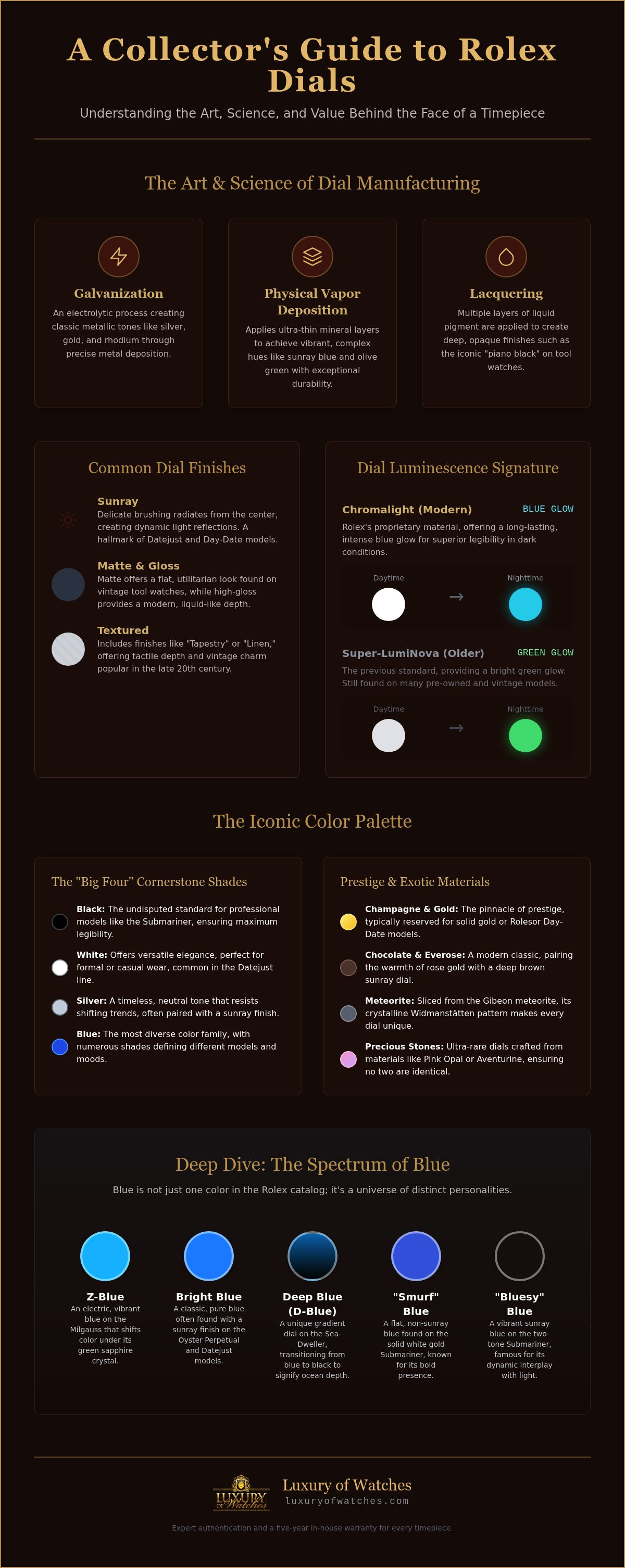
When exploring different rolex dial colors, you'll encounter three primary coloring techniques that define the watch's appearance. Galvanization uses electrolytic baths to create classic metallic tones like silver, gold, and rhodium. For more complex hues, Rolex employs Physical Vapor Deposition (PVD), which allows for the precise application of thin mineral layers to achieve vibrant shades like the iconic sunray blue or olive green. Finally, lacquering involves applying multiple layers of liquid pigment to create deep, opaque finishes like the "piano black" found on the Submariner. Absolute consistency in font, spacing, and color depth across these processes remains a primary indicator of authenticity.
Common Rolex Dial Finishes
The finish of a dial dictates how it interacts with light. The sunray finish is a hallmark of the Datejust and Day-Date lines, created through delicate brushing that radiates from the center to create shifting highlights. Modern collectors often contrast these with the flat, utilitarian matte finishes found on vintage tool watches, which eventually evolved into the high-gloss dials seen on current professional models. For those seeking vintage charm, textured options like tapestry or linen offer a tactile depth that defined the elegance of the late 20th century.
The Role of Luminescence
Luminescence isn't just a functional tool for divers; it changes the dial's daytime personality and nighttime signature. Chromalight is Rolex's proprietary blue-glow luminescent material. While older models used Super-LumiNova for a green glow, modern "Maxi" dials feature larger markers that maximize the surface area for this blue emission. This shift improves legibility in low light and provides a distinct aesthetic signature for contemporary references. The interaction between the lume's white daytime color and the dial's base shade is a critical consideration for any collector focused on visual harmony.
Exploring the Iconic Rolex Color Palette
Exploring different rolex dial colors often begins with what collectors call the "Big Four." These cornerstone shades (black, white, silver, and blue) anchor the majority of the catalog. Black remains the undisputed standard for professional tool watches like the Submariner and GMT-Master II. It provides the high-contrast backdrop necessary for professional divers and pilots who require instant legibility under pressure. While black is functional, white and silver offer a versatile elegance that transitions perfectly from boardroom to social engagements. These neutral tones serve as the foundation for the Datejust line, providing a timeless aesthetic that resists shifting fashion trends.
In the more formal Day-Date collection, champagne and gold dials represent the pinnacle of prestige. These colors are typically reserved for solid gold or Rolesor (two-tone) models, creating a monochromatic look that exudes luxury. For those seeking the ultimate in status, the brand offers Rolex Serti dials, which integrate factory-set diamonds and sapphires directly into these classic gold foundations. Modern tastes have also embraced "Everose" and chocolate tones. The warmth of rose gold paired with a deep sunray chocolate dial creates a sophisticated, contemporary aesthetic that has become a modern classic. If you are searching for a specific discontinued shade, you can browse our collection of Used Rolex watches to find the perfect match.
The Spectrum of Rolex Blue
Blue is perhaps the most diverse category in the Rolex archive. The Milgauss "Z-Blue" is a cult favorite, featuring an electric hue that appears to change under its green sapphire crystal. This is distinct from the "Bright Blue" found on the Oyster Perpetual or the "Deep Blue" (D-Blue) gradient dial of the Sea-Dweller. In the Submariner line, blue defines two heavy hitters: the "Smurf," a solid white gold model with a flat blue dial, and the "Bluesy," a two-tone model with a vibrant sunray finish. Each shade offers a completely different wrist presence despite sharing a primary color name.
Green: The Signature Color of the Crown
Green is the official color of Rolex, and its application on dials has created some of the market's most sought-after pieces. The "Hulk" Submariner, with its green sunray dial and matching ceramic bezel, famously shifted the market's perception of colorful tool watches. More recently, olive green has become the sophisticated choice for Everose Day-Dates, providing a muted yet distinct contrast. In 2026, Rolex expanded this family with mint green and green ombré options for the Datejust 41. These modern releases, alongside experimental "Palm" and "Motif" patterns, prove that the brand continues to innovate while respecting its heritage.
Exotic and Rare Dial Materials
For the most discerning collectors, the pursuit of horological excellence often leads beyond standard pigments and into the territory of natural earth and space resources. While the majority of Rolex dials rely on sophisticated chemical treatments, the brand’s "Exotic" category utilizes organic minerals, precious stones, and extraterrestrial metal. Exploring different rolex dial colors in this context moves from choosing a simple shade to selecting a unique geological fingerprint. Because these materials are harvested from nature, no two dials are ever exactly alike, providing an unparalleled level of exclusivity for the wearer.
Manufacturing these dials presents a significant technical challenge. Crafting a functional watch face requires slicing brittle materials like malachite or meteorite into paper-thin discs that must remain structurally sound under the pressure of hand-setting. A single microscopic fissure can result in the entire dial shattering during production, which contributes to their limited availability and higher market value. On the secondary market, these "natural" dials often command significant premiums, particularly when the material’s pattern is exceptionally vivid or symmetrical.
Meteorite Dials: From Space to the Wrist
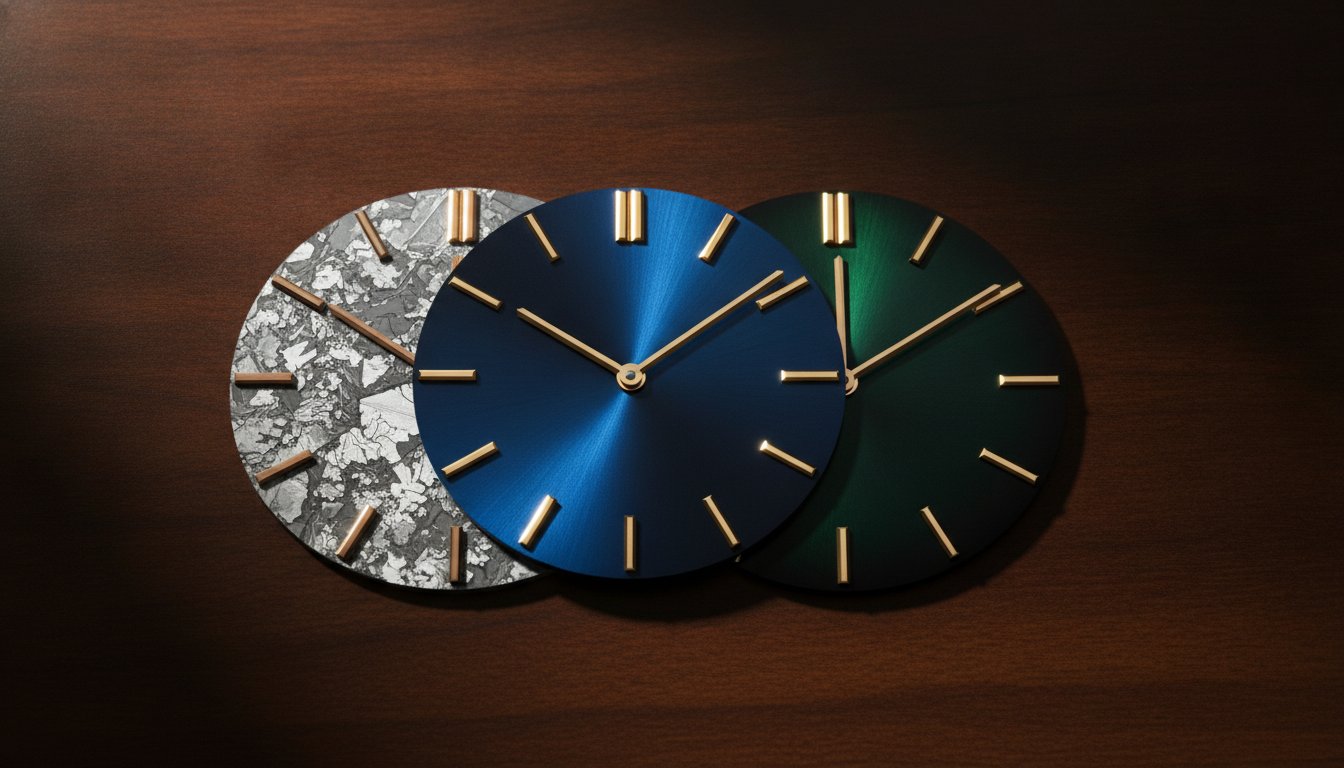
Rolex famously sources its meteorite from the Gibeon meteorite, which crashed in Namibia during prehistoric times. This material is prized for its Widmanstätten pattern, a unique crystalline structure formed as the iron-nickel alloy cooled over millions of years in space. This pattern only becomes visible after the slice is treated with an acid wash, revealing a metallic geometry that cannot be replicated in a lab. It's a bold alternative to traditional metals, found primarily in the GMT-Master II, Daytona, and Day-Date collections.
Stone and Mineral Dials
During the 1970s and 80s, Rolex experimented heavily with vibrant semi-precious stones. Lapis Lazuli offered a deep, speckled blue, while Malachite provided a lush, banded green that remains highly sought after today. For a more understated luxury, Onyx dials provide a jet-black void that lacks any markers, emphasizing the watch's silhouette. Mother of Pearl remains a staple for feminine models, while 2026 releases have introduced Aventurine and pink opal to the Day-Date line, offering an iridescent play of light that changes with every movement of the wrist. Collectors also prize rare "Wood" dials, featuring Birch or African Mahogany, which brought a warm, mid-century aesthetic to the vintage Day-Date line.
The Investment Perspective: How Dial Color Drives Value
In the secondary market, a watch's value is often determined by the scarcity of its specific configuration. While the movement and case architecture might remain constant across a reference, the dial color acts as a primary lever for price volatility. Exploring different rolex dial colors reveals that "standard" shades like black or white offer stable, predictable value, whereas trending or discontinued colors can see returns that exceed the original MSRP by several hundred percent. This phenomenon is most visible when a popular color is abruptly retired, creating an immediate supply vacuum that drives prices upward on the secondary market.
Understanding the intersection of rarity and demand is essential when exploring different rolex dial colors for investment. While Serti dials are objectively rarer than many standard professional models, they often remain a niche preference compared to the universal appeal of "Hulk" green or "Pepsi" blue. Investors should focus on colors that maintain high liquidity across different market cycles. To ensure your selection is both authentic and secure, you can browse our verified Rolex collection, which includes our five-year in-house warranty for peace of mind.
The 'Tiffany' Blue Phenomenon
The 2020 release of the Oyster Perpetual featured a turquoise blue that ignited a global frenzy. Within months, market data showed that a turquoise OP could trade for double or triple the price of its black-dial counterpart. Collectors adopted the 'Tiffany' nickname due to the color's striking resemblance to the famous jewelry brand's signature hue, even though no official partnership exists between the two companies. This surge proves that emotional demand for a specific aesthetic can outweigh technical specifications in the investment market, especially when the color is eventually discontinued in certain case sizes.
Vintage Patina and 'Tropical' Dials
Some value drivers are the result of age rather than intent. "Tropical" dials are highly prized accidents where prolonged UV exposure has turned a once-black dial into a rich chocolate brown. Collectors pay a significant premium for this specific type of aging because it represents a unique historical fingerprint that cannot be replicated. However, the rise of "fake" patina in the secondary market makes expert verification essential. When assessing pre-owned luxury watches, the condition of the dial remains the most critical factor in determining its long-term potential. Any signs of aftermarket refinishing or moisture damage can drastically reduce the value of even the rarest colors.
Finding Your Ideal Rolex Dial at Luxury of Watches
Exploring different rolex dial colors is a journey that often leads collectors beyond the current retail catalog. At Luxury of Watches, we curate an extensive selection of both new and pre-owned timepieces, providing access to the full spectrum of Rolex's horological history. While current models offer modern innovation, our pre-owned inventory is the premier destination for finding discontinued or "boutique-only" shades that are no longer in production. This allows you to acquire iconic pieces like the "Hulk" or the "Z-Blue" Milgauss that have already established their place in the secondary market.
Security is paramount when acquiring high-value references, especially those featuring fragile stone or rare meteorite dials. Every timepiece in our collection undergoes a rigorous expert authentication process to ensure the dial and all components are 100% original. To provide a definitive safety net, we accompany every Rolex watch with our signature five-year in-house warranty. This commitment to absolute verification allows you to focus on the aesthetic allure of the piece while we handle the technical validation and long-term protection of your investment.
Choosing a Dial for Your Lifestyle
Selecting the right dial involves balancing personal taste with daily utility. Neutral tones like silver or white offer maximum versatility for professional environments, whereas vibrant greens or blues serve as powerful statement pieces. The interaction between dial color and case material is equally vital. For instance, the warmth of Everose gold perfectly complements chocolate sunray finishes, while stainless steel provides a crisp, modern backdrop for "Bright Blue" variants. Our specialists are available to help you navigate these nuances and identify specific reference numbers that suit your lifestyle needs.
Secure Your Next Investment
Buying a luxury timepiece should be a steady, reassuring experience. As a trusted US-based retailer, we provide the modern efficiency of a digital platform paired with the expertise of a traditional boutique. Before making your selection, it's helpful to understand the broader market context by reviewing our guide on Rolex prices 2026. This transparency ensures you feel intellectually secure in your decision. Once you're ready to proceed, you can browse our current Rolex inventory and find your perfect dial color today.
Mastering the Spectrum of Your Rolex Collection
Choosing a dial is more than a simple color preference; it's a strategic decision that balances history, material science, and market demand. From the precision-engineered sunray finishes of the Datejust to the extraterrestrial beauty of Gibeon meteorite, the dial remains the definitive soul of the watch. Exploring different rolex dial colors allows you to build a collection that is as diverse as it is valuable, ensuring your investment remains as timeless as the craftsmanship behind it.
Your journey doesn't have to be navigated alone. At Luxury of Watches, we provide the expertise and security required for high-value transactions. Every timepiece in our inventory comes with an industry-leading 5-year in-house warranty and a guarantee of absolute authenticity on all new and pre-owned models. With expert US-based customer support at your disposal, you can proceed with the confidence that your next acquisition is protected and verified. Explore the Full Rolex Collection at Luxury of Watches and secure a timepiece that reflects your unique legacy. Your next masterpiece is only a click away.
Frequently Asked Questions
What is the most popular Rolex dial color?
Black remains the most popular Rolex dial color due to its presence in the professional tool watch collections. It offers a classic aesthetic and high contrast for models like the Submariner and GMT-Master II. While blue and silver are top contenders in the Datejust line, black's versatility ensures it stays the most sought after choice for daily wear. When exploring different rolex dial colors, many collectors start with black because it holds its value consistently across all market conditions.
Do Rolex dial colors affect the resale value?
Yes, dial color is one of the most significant factors influencing a watch's secondary market value. While standard colors like silver or white maintain steady pricing, trending colors or discontinued shades can double or triple a watch's price. For example, the green "Hulk" dial commands a massive premium over standard black Submariners. Collectors often prioritize these unique configurations to maximize their investment potential while enjoying the prestige of a rare aesthetic.
Can I change the dial color on my Rolex later?
You can technically have a dial swapped by a watchmaker, but it's generally discouraged for serious collectors. Altering the original factory configuration can negatively impact the resale value and complicate the authentication process. It's much safer to purchase the specific reference you desire from a reputable source. At Luxury of Watches, we offer a vast selection of configurations, allowing you to find your ideal piece without compromising the watch's original integrity.
What is a 'Serti' dial on a Rolex?
A 'Serti' dial is a factory-produced dial that features precious gemstones, such as diamonds, sapphires, or rubies, set into the hour markers. The term comes from the French word "sertissage," which means "gem setting." These dials were traditionally found on luxury tier professional models like the Submariner and GMT-Master. They represent a high end fusion of tool watch functionality and jewelry grade elegance, making them a niche but highly prized choice for luxury enthusiasts.
Why are some Rolex dials called 'Tropical'?
Rolex dials are called 'Tropical' when a manufacturing defect causes the original black paint to fade into a rich chocolate brown over time. This transformation is usually triggered by prolonged exposure to UV light or humidity. While technically a flaw, collectors view this specific type of aging as a desirable patina. These unique, naturally occurring color shifts are rare, often making 'Tropical' vintage pieces significantly more expensive than those with perfectly preserved black dials.
Is the 'Tiffany Blue' Rolex dial official?
The 'Tiffany Blue' designation is an unofficial nickname used by collectors to describe the turquoise blue dial found on the Oyster Perpetual. While the shade is remarkably similar to the jewelry brand's signature color, there's no official partnership between Rolex and Tiffany & Co. for this modern release. Despite the lack of an official tie-in, the nickname stuck, fueling a massive surge in demand that has kept market prices for this color exceptionally high.
How can I tell if a Rolex dial is original or refinished?
You can identify a refinished dial by examining the sharpness of the printing and the consistency of the lume application under magnification. Original Rolex dials feature razor sharp font edges, perfect spacing, and luminous material centered within its housing. Refinished dials often show fuzzy text or inconsistent paint depth. Because exploring different rolex dial colors involves high stakes, every watch we sell undergoes a rigorous authentication process, backed by our signature five year in-house warranty.
What is the rarest Rolex dial material?
Meteorite and rare semi-precious stones like lapis lazuli or malachite are considered the rarest dial materials. Rolex sources its meteorite from the Gibeon meteorite, which offers a unique crystalline structure that cannot be replicated. Vintage wood dials, crafted from materials like African Mahogany or Birch, are also incredibly scarce. These natural resources ensure that no two dials are identical, providing an ultimate level of exclusivity that standard painted or galvanized dials simply cannot match.