
Cartier or Rolex: Which Watch Offers Better Resale Value
Posted by Luxury of Watches on 27th Oct 2026
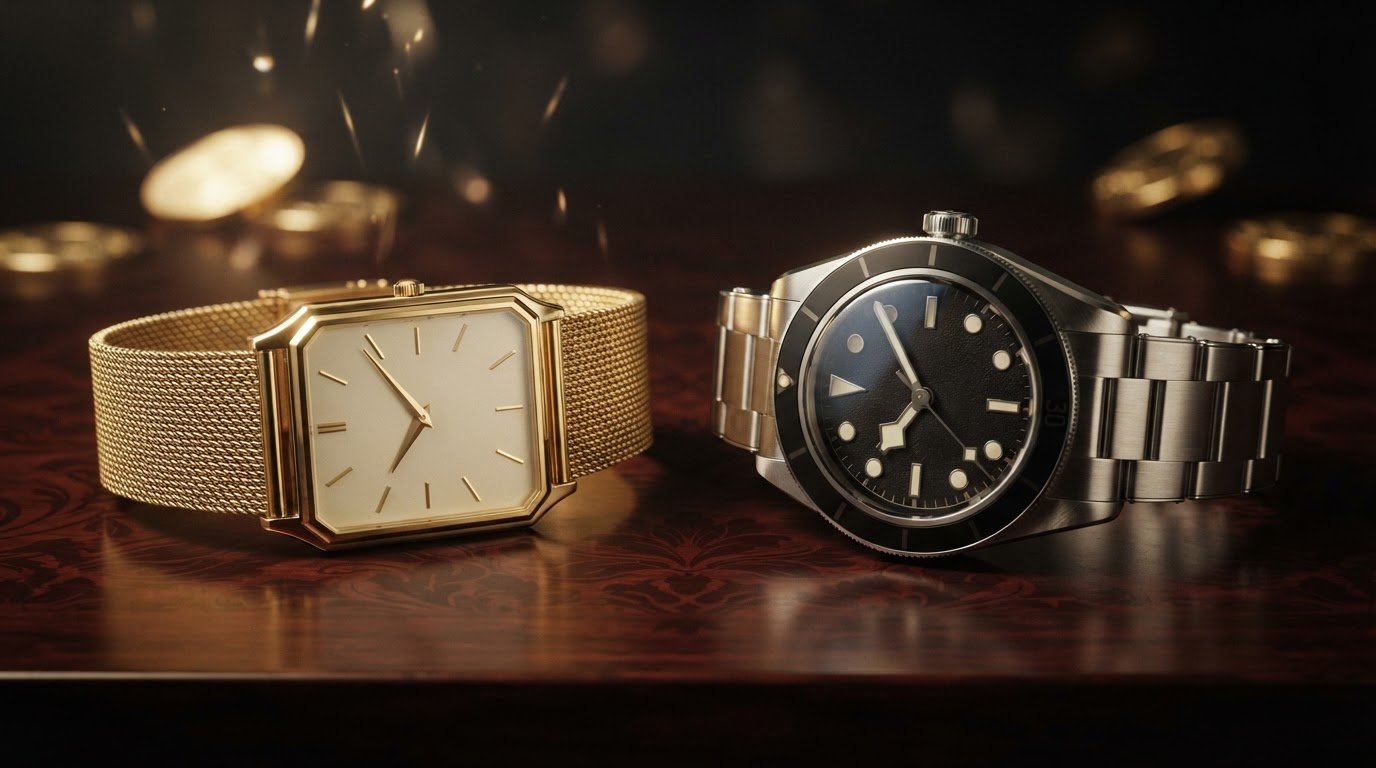
The stronger resale name isn’t always the watch with the biggest gains. Resale outcomes vary by model, and neither brand is consistently the better investment for every buyer. Still, select Cartier models have appreciated sharply, making the choice more nuanced than brand names alone suggest.
Cartier has a distinctive design heritage and a strong market presence. Its appeal can extend beyond resale performance, while Rolex is often the more familiar choice for buyers focused on value retention. Neither brand guarantees a return: the model, condition, demand, and purchase price all shape resale prospects.
This comparison covers resale potential, price positioning, design, and market standing to help you decide which brand suits your priorities. See why Rolex tends to lead on resale, where Cartier can surprise, and how to balance investment-minded buying with personal style.
Key Takeaways
- Rolex generally has the stronger reputation for resale-value retention, but individual Cartier models can perform differently from the broader brand pattern.
- Compare the specific model’s demand, condition, and purchase price rather than treating either brand name as a guarantee of future value.
- Cartier and Rolex occupy different price positions, so weigh the model you want against your budget before comparing resale prospects.
- Use each brand’s design identity and market position to decide whether resale potential or personal style matters more to you.
Resale value and investment potential
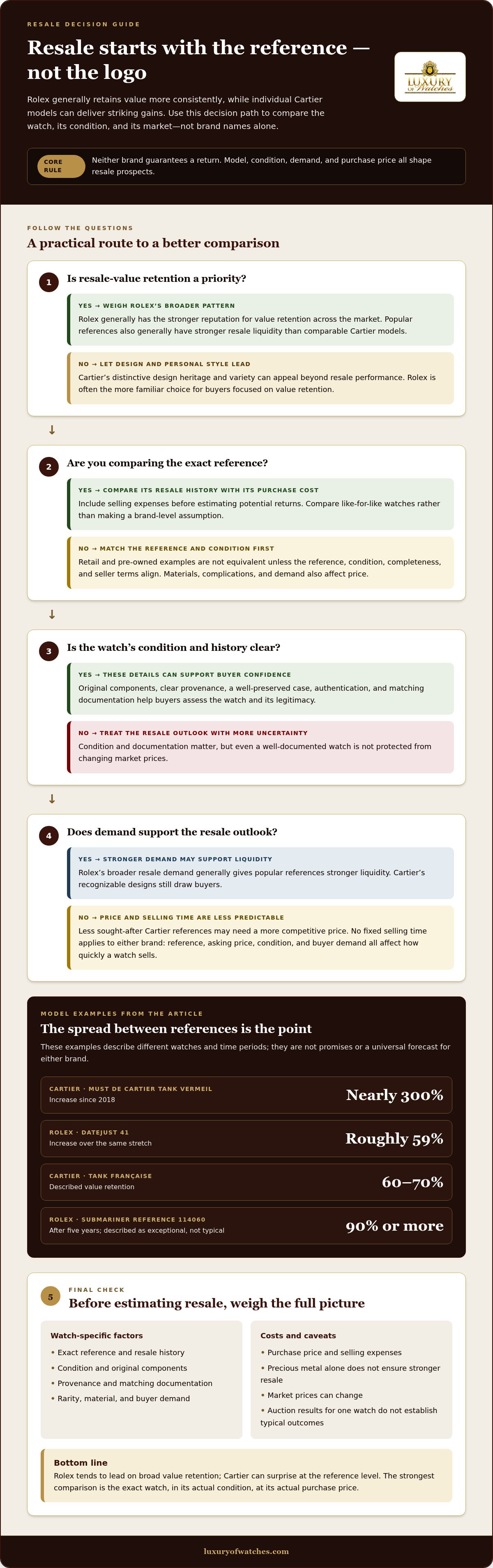
Rolex generally retains value more consistently, while individual Cartier references can deliver striking gains. The most useful comparison is model against model, not brand against brand.
Cartier Resale Value
Cartier’s resale performance varies sharply by reference. The Must de Cartier Tank Vermeil rose nearly 300% since 2018, while the Tank Française is described as retaining 60-70% of its value. Those examples show why the question of whether Cartier is a better investment than Rolex has no single model-independent answer. A profitable U.S. sale may have tax implications, depending on the seller’s cost basis and circumstances.
Rolex Resale Value
Rolex watches generally show stronger value retention across the market. A Rolex Datejust 41 rose roughly 59% over the same stretch as the Tank Vermeil’s increase, while the Submariner reference 114060 retains 90% or more of its original value after five years. That result is exceptional, not a typical resale benchmark.
Liquidity and Time to Sell
Rolex’s broader resale demand generally gives popular references stronger liquidity than comparable Cartier models. However, no fixed selling time applies across either brand: reference, asking price, condition, and buyer demand all affect how quickly a watch sells. Cartier’s recognizable designs still draw buyers, but less sought-after references may need a more competitive price. Auction results differ by individual watch, so the 2025 Daytona sale cannot establish typical outcomes for either brand.
Investment Value Factors
Start with the reference and condition: original components, clear provenance, and a well-preserved case can support buyer confidence. Rarity and material also influence demand, but precious metal alone doesn’t ensure stronger resale. Authentication and matching documentation help buyers assess a watch’s legitimacy, though market prices can still change. Compare the exact reference’s resale history with its purchase cost, and account for selling expenses before estimating potential returns. For collectors looking to liquidate luxury timepieces or precious metal assets, professional purchasing firms like ctgoldandsilver.com can offer guidance on secondary-market valuations.
| Option | Value retention | Resale outlook |
|---|---|---|
| Cartier | Varies by reference | Selective gains |
| Rolex | Generally stronger | Broader demand |
Compare the exact reference, condition, and demand rather than choosing by logo alone.
Entry-level and high-end prices
Cartier generally offers a lower entry point into luxury watchmaking, while Rolex’s entry-level options tend to cost more. That difference may let buyers choose Cartier’s fashion-led design at a more accessible starting point, or pay more for a Rolex reference. Compare specific watches, not just brands: materials, complications, and demand all affect price.
For a U.S. retail-versus-pre-owned comparison, match the exact reference and condition. A new Rolex Submariner Date 126610LN and a pre-owned example are not equivalent price comparisons unless condition, completeness, and seller terms align. The same applies to Cartier’s Tank Must and Santos de Cartier. Pre-owned asking prices reflect the individual watch and market demand, so they can differ from retail positioning.
Cartier’s entry-level range includes the Tank Must, while the Oyster Perpetual is a starting point for Rolex. Their designs also shape the decision: the Tank Must has a more formal profile, while the Oyster Perpetual has a versatile, classic look. Consider whether a lower initial outlay or a particular design matters more to your budget.
At the high end, compare specific configurations rather than assuming every model follows the same pricing ladder. Cartier’s Pasha with a diamond bezel represents a high-jewelry direction; Rolex Daytona and Day-Date references hold prominent positions in Rolex’s upper range. Precious-metal cases, gem-setting, complications, and scarcity can place a model well above its brand’s entry-level category.
- Compare retail and pre-owned examples of the same reference, with condition and completeness matched.
- Separate a watch’s purchase price from its resale appeal; they answer different questions.
- Choose a budget first, then weigh a Cartier design against a Rolex model with comparable materials.
For a practical comparison, identify the reference, decide between new and pre-owned, then compare like-for-like examples. This makes the price gap between Cartier and Rolex more meaningful than a broad brand-level comparison.
Rolex and Cartier brand identities and design
Cartier and Rolex signal luxury through different design languages. Cartier’s watch heritage includes the Santos, designed in 1904 for aviator Alberto Santos-Dumont and placed into general production in 1911. The Tank followed in 1917, bringing a geometric case that remains a distinctive signature. Rolex built its identity around practical watchmaking, introducing the Oyster case in 1926.
These histories shape brand recognition today. A Cartier Tank’s rectangular profile and Roman numerals can feel like refined jewelry, while a Rolex Oyster case often suggests a robust, versatile wristwatch. These recognizable details help buyers distinguish the brands beyond their dial logos. They also frame the choice between dress-led elegance and an adaptable everyday style.
Cartier’s strength is design variety, from the clean lines of the Tank to the aviation-inspired Santos. That range can appeal to buyers looking for a watch with a strong fashion presence and a less conventional silhouette. The trade-off is that distinctive shapes may feel more suited to particular occasions than a round, broadly styled watch. Consider how a case shape fits your wardrobe and daily routine.
Rolex’s advantage is a consistent visual identity across familiar models, including Oyster-based designs. That continuity can make a Rolex easy to wear in both formal and casual settings. The look may be less jewelry-like, though, for someone seeking ornament or unusual proportions. Cartier may suit that preference, particularly if you’re drawn to sculptural cases and jewelry craftsmanship.
- Choose Cartier if a Tank’s rectangular case or Santos heritage matches your personal style.
- Choose Rolex if you prefer the Oyster identity and a versatile, classic wristwatch profile.
Try each brand’s signature shape with your usual clothing and consider wrist comfort. The better design is the one you’ll enjoy wearing regularly, not simply the one with the more familiar name.
Cartier and Rolex sales and market position
Market position adds context to resale prospects, but brand scale alone doesn’t determine a watch’s future value. Cartier’s estimated watch revenue grew around 95% over four years, and the brand became the second-largest watch brand by sales after overtaking Omega. That growth signals broader commercial reach, while individual reference demand still shapes resale.
Rolex remains a major force in luxury watches, yet its market performance can shift. WatchCharts’ June 2026 update described Rolex as one of the softer performers in recent months. Rolex also implemented a round of retail price increases on June 1, 2026. Retail pricing and secondary-market demand can move differently, so neither development alone predicts what a specific watch will resell for.
Cartier’s sales momentum matters because a growing market presence can broaden awareness of its designs. Rolex’s established recognition supports familiarity, but short-term market movement shows that even a prominent name doesn’t prevent fluctuations. Compare the specific reference’s resale demand, condition, and asking price instead of treating either brand’s overall sales position as a forecast.
Ownership costs also affect the net result. Servicing depends on the model, movement, and condition; insurance reflects the watch’s insured value and coverage; and selling fees depend on the sales channel. Include these factors alongside purchase and resale prices when comparing the economics of Cartier and Rolex.
The practical takeaway is to distinguish brand momentum from investment performance. Cartier’s sales growth indicates expanding market presence, while Rolex’s recent softer performance shows that even a highly recognized brand can see shifts. Neither sales rank nor a change in retail price guarantees resale gains.
- Use sales growth as market context, not as a substitute for reference-level resale comparison.
- Factor servicing, insurance, and selling expenses into the net ownership calculation.
- Compare the specific model’s demand and condition before drawing conclusions from brand headlines.
To put the comparison into practice, compare current watch selections by brand and reference.
Luxury of Watches: Rolex Watches
Luxury of Watches helps buyers compare Rolex Watches and Used Rolex watches when resale potential, condition, and personal style shape the decision. The collection also includes Cartier Watches and Pre-Owned Luxury Watches, offering options across the brands discussed above.
When considering a pre-owned watch, weigh its specific reference, condition, and documentation alongside the brand’s general market position. Luxury of Watches offers a five-year in-house warranty on select brand watches. This can factor into your ownership comparison, separately from resale expectations and a manufacturer’s international warranty.
If Rolex’s value-retention profile suits your priorities, explore the available watches and compare individual references. If Cartier’s design matters more, weigh that preference alongside your resale goals. Contact Luxury of Watches to discuss your preferences and next steps.
Choose a Watch That Fits Your Next Chapter
Before choosing, decide what you want the watch to do for you over time. A watch bought primarily for personal style calls for different priorities than one you may eventually resell. Consider how often you’ll wear it, which design feels lasting, and whether you’re comfortable with resale values changing as market demand shifts.
The question of whether Cartier is a better investment than Rolex is more useful when you consider what matters beyond potential resale. Luxury of Watches offers Rolex Watches, Used Rolex watches, and Pre-Owned Luxury Watches for buyers comparing established brands and pre-owned options. Focus on the individual watch and how it fits your plans, rather than deciding on reputation alone.
When you’re ready to explore your options, contact Luxury of Watches to discuss the watches you’re considering. Take your time, compare thoughtfully, and choose a timepiece you’ll be glad to wear.
Frequently Asked Questions
How have Cartier watch resale values changed compared with Rolex over the past 5-10 years?
Cartier’s gains have varied considerably by model, while Rolex generally shows stronger value retention across its range. Over the past eight years, the two-tone Cartier Panthère reference 1057917 rose 208%, and the yellow-gold reference 1070 rose 218%. Those results show that select Cartier watches can outperform broad expectations, but they don’t establish a brand-wide trend or guarantee similar future resale performance.
Which Cartier and Rolex models have the strongest resale value and demand?
Demand is model-specific, but notable Cartier examples include the Crash and Panthère, while Rolex standouts include Daytona and Submariner references. The Cartier Crash is described as appreciating 15-20% annually, an exceptional pattern rather than a dependable forecast. For Rolex, some pre-owned Daytona models have sold for multiples of retail, while the Submariner reference 114060 is known for strong value retention. Condition and purchase price still affect the comparison.
What is the average resale value retention for Cartier versus Rolex watches?
There isn’t one useful average that applies to every Cartier or Rolex watch, because references perform differently. As examples, the Cartier Tank Française is described as retaining 60-70% of its value, while the Rolex Submariner reference 114060 retains 90% or more after five years. Treat these as model-specific comparisons, not brand-wide averages; purchase price, condition, and demand influence an individual watch’s resale result.
What are current retail prices versus pre-owned prices for comparable Cartier and Rolex watches in the US?
U.S. Pre-owned asking prices vary by reference, condition, completeness, and seller terms, so compare like-for-like examples.