
Avoiding Customs Issues When Buying Watches Abroad: The 2026 Collector's Guide
Posted by Luxury of Watches on 16th Sep 2026
That vintage Rolex you found in a boutique in Geneva might look like a bargain until you reach the U.S. Customs and Border Protection checkpoint. For many collectors, the dream of acquiring a rare timepiece during an international journey is often overshadowed by the fear of unexpected seizures or steep financial penalties. If you're concerned about avoiding customs issues when buying watches abroad, you aren't alone. The technical nuances of declaring luxury goods can be as intricate as the movements within the watches themselves.
It's understandable to feel overwhelmed by the ambiguity of Harmonized Tariff Schedule codes and the potential for duties to erase any initial savings. You deserve to focus on the heritage of a Patek Philippe or the precision of an Audemars Piguet without the anxiety of a legal misstep. This 2026 guide promises to simplify these complexities by providing a clear framework for legal compliance and total cost calculation. We'll examine the specific requirements for official documentation, explain how to navigate the declaration process with confidence, and compare the risks of international transit against the security of domestic acquisition.
Key Takeaways
- Learn how to calculate the true landed cost of an international purchase by accounting for currency fluctuations and mandatory import taxes.
- Navigate the Harmonized Tariff Schedule by understanding the three-part duty calculation applied to the movement, case, and bracelet of luxury timepieces.
- Master professional strategies for avoiding customs issues when buying watches abroad, ensuring you approach CBP officers with the correct documentation and forms.
- Identify hidden risks such as CITES regulations on exotic straps and trademark protections that can lead to unexpected seizures at the border.
- Discover why domestic acquisition from a US-based expert eliminates customs anxiety while providing the security of a five-year in-house warranty.
The Reality of International Watch Sourcing in 2026
Many collectors view an international journey as the perfect opportunity to acquire a legendary timepiece. The romanticism of purchasing a "vacation watch" in its country of origin is a powerful draw for enthusiasts of brands like Rolex or Audemars Piguet. However, the modern horological landscape requires a distinct shift from simple deal hunting to sophisticated risk management. Successfully avoiding customs issues when buying watches abroad starts with acknowledging that the sticker price you see in a foreign boutique is rarely the final price you'll pay.
It's vital to recognize that the allure of a favorable exchange rate can be deceptive. While the price might look attractive on the tag, the logistical and legal hurdles of bringing that piece home can quickly erode any perceived savings. Collectors often find themselves caught between the excitement of the find and the pragmatic reality of international trade regulations. To protect your investment, you must move beyond the emotional appeal of the purchase and focus on the technicalities of legal importation.
The Saving Trap: MSRP vs. Total Landed Cost
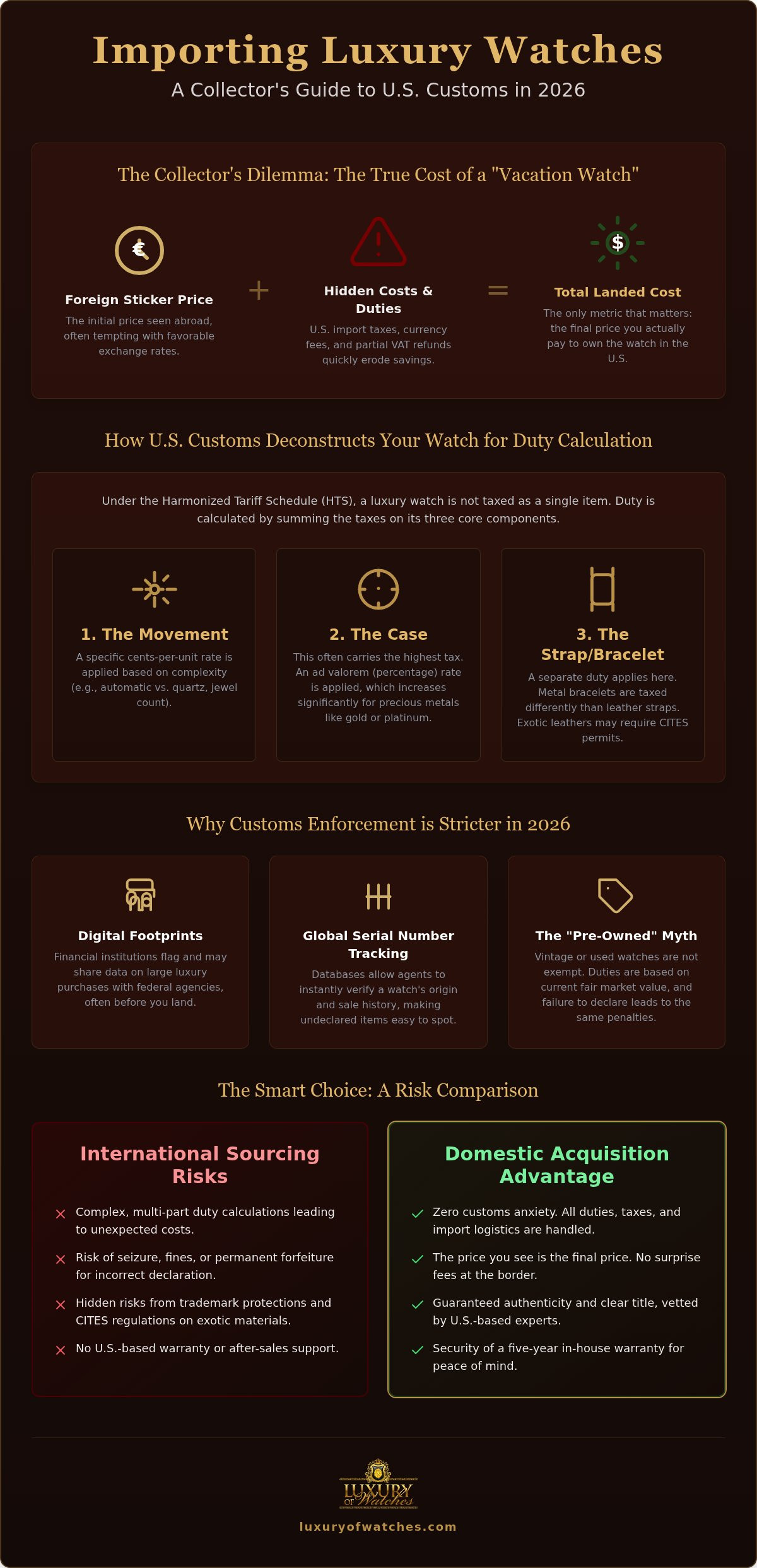
Currency volatility is a silent predator in international transactions. A favorable exchange rate in the morning can shift by the time you reach the boutique; potentially erasing your anticipated margins. While VAT (Value Added Tax) refunds in regions like the European Union or Japan are enticing, they're rarely a full return of the tax paid due to significant administrative fees from third-party refund agencies. You must account for the reality that the U.S. Customs and Border Protection (CBP) will assess duty based on the watch's value regardless of the tax you recovered elsewhere. Total Landed Cost is the only metric that matters for collectors as it encompasses the purchase price, currency fees, and all applicable import duties.
Why Customs Enforcement is Stricter in 2026
Technology has transformed how borders are managed. In 2026, digital tracking of high-value luxury transactions has become standard, and understanding the technicalities of avoiding customs issues when buying watches abroad is essential because authorities now utilize sophisticated digital tools. Customs agents often have access to financial data and merchant records that flag significant overseas purchases before your flight even touches down. Additionally, global serial number databases allow authorities to verify the origin and sale history of a timepiece instantly.
- Digital Footprints: Financial institutions often share data on large luxury purchases with federal agencies.
- Serial Number Tracking: Modern databases make it easier for agents to identify watches that haven't been properly declared.
- The Pre-owned Myth: Don't assume that a "vintage" Cartier or a used Breitling is exempt from scrutiny; CBP regulations apply to the current fair market value of the item.
Failing to declare a used piece can lead to the same seizures and fines as a brand-new model. Authenticity and official documentation are your primary shields, but they don't replace the legal obligation to declare your acquisition upon arrival.
Understanding Customs Duties and Import VAT
Successfully avoiding customs issues when buying watches abroad requires a technical understanding of how U.S. Customs and Border Protection (CBP) evaluates luxury timepieces. Many travelers mistakenly believe that a single, flat percentage applies to the entire purchase price. In reality, the CBP treats a watch as a composite item. Under the Harmonized Tariff Schedule (HTS), the duty is calculated by aggregating the individual values of three distinct components: the movement, the case, and the strap or bracelet. This granular approach ensures that the specific materials and complexities of the watch are taxed accurately.
The Harmonized Tariff Schedule (HTS) Decoded
When an agent inspects your Cartier or Patek Philippe, they reference specific HTS codes that differentiate between automatic and quartz movements. The technical specifications of the caliber, including the jewel count, can influence the specific cents-per-unit rate applied to the movement. While mechanical movements are subject to specific rates based on their complexity, the exterior materials often carry the heaviest tax burden. Duty rates are often 'de minimis' on movements but high on gold cases. If your timepiece features a solid 18k gold or platinum case, the ad valorem rate increases significantly compared to a standard stainless steel model.
Flat Rates vs. Ad Valorem Duties
For U.S. residents returning from an international trip, the first $800 of your acquisition is typically covered by a personal exemption. For the next $1,000 of value, the CBP generally applies a flat 3% duty rate. However, luxury timepieces almost always exceed these thresholds, triggering ad valorem duties, which are a percentage of the item's total value. This transition is where many collectors encounter unexpected financial penalties. Precise documentation is your most effective tool for managing these costs. You should always request a commercial invoice from the seller that provides a clear value breakdown of the movement, case, and strap. Without this documentation, customs officers may apply the highest possible duty rate to the entire transaction value.
The complexity of these calculations often leads collectors to reconsider the merits of international sourcing. You can eliminate the stress of these administrative hurdles by choosing to buy pre-owned luxury watches from a domestic specialist. By working with a U.S.-based provider, you ensure that all import technicalities and duties have already been professionally managed, providing a transparent and secure acquisition process. This approach allows you to invest in the heritage of the manufacturer without the lingering anxiety of a customs inspection.
Common Pitfalls: Seizures, Fines, and Paperwork
Many collectors assume that paying the required duty is the final step in avoiding customs issues when buying watches abroad. This is a dangerous misconception. Legal compliance extends far beyond financial declarations; it involves the physical composition of the timepiece and the intellectual property rights of the manufacturer. Overlooking these technical details can lead to constructive seizure, where the item is legally impounded even if it remains in your possession during an investigation.
The consequences of a botched declaration are often permanent. Beyond the immediate financial penalties, which can reach the full market value of the timepiece, you risk the immediate and permanent revocation of your Global Entry or TSA PreCheck status. Customs agents view any failure to declare as a significant breach of trust, and the resulting "red flag" on your passport can lead to secondary inspections for every international flight you take for years to come.
CITES and Exotic Materials
The Convention on International Trade in Endangered Species (CITES) is a global treaty that most watch enthusiasts overlook until it's too late. This regulation primarily affects straps made from alligator, crocodile, lizard, or ostrich skins. Prestigious houses like Cartier and Patek Philippe frequently utilize these exotic materials for their high-tier models. Without a specific CITES export permit from the country of purchase, customs agents have the authority to seize the strap or the entire watch. It's a devastating loss that duty payments won't rectify. To stay safe, ask the dealer to swap the exotic leather for a synthetic or calfskin strap before you head to the airport.
Trademark and 'Grey Market' Legalities
Trademark laws provide another layer of complexity that can catch travelers off guard. Brands like Rolex use these protections to strictly control the "parallel import" of their products into the United States. If an agent suspects a watch is part of an unauthorized commercial flow, they may flag it for inspection, even if you bought it for personal use. This risk is particularly high with "grey market" goods that lack regional provenance. To understand how to navigate these challenges through proper sourcing, consult The Comprehensive Guide to Pre-Owned Luxury Watches, which explains the importance of absolute verification and official documentation.
Purchasing abroad also introduces the risk of warranty disputes. Many international boutiques provide warranties that aren't recognized by U.S. service centers, leaving you with a high-value asset that lacks local protection. By prioritizing domestic acquisition, you bypass these international legal traps and ensure your investment is backed by verifiable paperwork and accessible service coverage.
How to Legally Import Your Watch: A Step-by-Step Checklist
One of the most persistent myths in the horological community is the "wear it home" strategy. Many travelers believe that by simply placing a new timepiece on their wrist and mailing the box separately, they've successfully bypassed federal scrutiny. This is a significant legal gamble. Customs agents are highly trained to identify luxury watch packaging during routine luggage scans, and they often notice the contrast between a traveler's declared items and a high-value timepiece. Transparency is the only sustainable strategy for avoiding customs issues when buying watches abroad. Attempting to obscure a purchase can lead to immediate seizure and the permanent loss of your investment.
Pre-Travel Preparation
Your legal defense begins before you even board your international flight. If you plan to travel with high-value pieces from your existing collection, such as a Rolex or Patek Philippe, you should register them with the CBP using Form 4457. This "Certificate of Registration for Personal Effects Taken Abroad" acts as definitive proof that you owned the watch before leaving the country, preventing you from being taxed on your own property upon return. Additionally, ensure you have digital and physical copies of your purchase documents. For new acquisitions, request a "Pro Forma" invoice from the dealer that provides the specific value breakdown of the movement, case, and strap required for HTS classification.
The Declaration Process at the Airport
When you arrive at the U.S. border, you'll need to complete CBP Form 6059B. Accuracy is paramount here. You must declare the full price paid, even if you anticipate that the value of a pre-owned watch is lower than its original MSRP. If you're declaring a vintage piece, present a formal appraisal to help the agent understand its current market value. Always choose the "Goods to Declare" lane. This proactive approach demonstrates your intent to comply with federal law, which often makes the inspection process smoother and faster.
- Form 6059B: List the watch and its total value clearly in the provided section.
- The Duty Receipt: Once you've paid the required fees, keep the official duty receipt. It's an essential document for future international travel to prove the watch was legally imported.
- Agent Interaction: Be prepared to explain the technical specifications of the movement if asked, as this directly impacts the HTS code used.
If you prefer to bypass these complex logistical hurdles and the stress of the declaration lane entirely, you can shop our collection of authentic luxury watches domestically. By purchasing from a U.S.-based specialist, you ensure that every timepiece has already been professionally cleared through customs, allowing you to focus on the craftsmanship of your new acquisition rather than the complexities of international trade law.
The Domestic Advantage: Why US-Based Retailers Mitigate Risk
While the logistical hurdles of HTS codes and CITES permits are manageable for the seasoned traveler, the most reliable method for avoiding customs issues when buying watches abroad is to source your timepiece within the United States. Choosing a domestic specialist like Luxury of Watches transforms a high-stakes international gamble into a secure, transparent transaction. You bypass the physical and legal risks of airport checkpoints while gaining access to a level of consumer protection that international boutiques simply cannot replicate. For the modern collector, the peace of mind that comes from a domestic transaction is often more valuable than a slight price variance found in a foreign market.
The technical movement of a high-end timepiece deserves a purchase process that is just as precise. When you eliminate the border, you eliminate the possibility of constructive seizure, permanent loss of Global Entry status, and the anxiety of a secondary inspection. This strategic choice allows you to focus on the heritage and craftsmanship of the watch rather than the ever-changing landscape of federal import regulations. It's a pragmatic approach that prioritizes the safety of your investment and the long-term health of your collection.
Eliminating the 'Landed Cost' Guesswork
When you purchase from a US-based expert, the price you see is the final price you pay. There is no need to calculate fluctuating exchange rates or anticipate surprise ad valorem duties upon arrival. Domestic acquisition removes the threat of a weeks-long customs hold, ensuring your timepiece arrives securely at your door without federal intervention. As outlined in our guide on Rolex Prices 2026, domestic market values are often more competitive than international landed costs once all taxes, currency fees, and duties are factored in. We handle the absolute verification and official documentation in-house, providing you with the technical validation serious collectors require.
Long-Term Security and Support
The value of a luxury watch extends far beyond the initial transaction. International purchases often come with warranties that are functionally void or difficult to use in the United States, leaving you without local recourse for mechanical issues. Luxury of Watches provides a comprehensive five-year in-house warranty, backed by our expert US-based support team. This ensures that your investment in a Cartier, Breitling, or Patek Philippe is protected by specialists who understand the intricate technical movements of your specific model. By building a relationship with a domestic intermediary founded in 1999, you secure a partner for the long-term growth of your collection. You don't have to navigate the complexities of global trade alone. Skip the customs headache and browse our fully authenticated Rolex collection to find your next masterpiece with absolute confidence.
Securing Your Horological Legacy with Absolute Confidence
Acquiring a world-class timepiece should be a moment of triumph, not a source of legal anxiety. By mastering the technicalities of HTS codes and CITES permits, you ensure that your collection grows on a foundation of absolute compliance. Successfully avoiding customs issues when buying watches abroad requires moving beyond the sticker price to account for the total landed cost and the long-term security of your investment.
While international travel offers the allure of discovery, the domestic market provides the ultimate sanctuary for serious collectors. Luxury of Watches offers a secure environment where every piece undergoes an A+ rated verification process. You don't have to worry about border inspections or "void" international warranties. Instead, you benefit from a comprehensive five-year in-house warranty and expert, US-based support that understands the nuances of technical movements.
Secure Your Next Timepiece Without Customs Hassle at Luxury of Watches
Your next masterpiece is waiting; enjoy the journey of collecting with the absolute confidence you deserve.
Frequently Asked Questions
Is it illegal to wear a new luxury watch through customs without declaring it?
Yes, wearing a new timepiece through a checkpoint without declaring it is a direct violation of federal law. Customs and Border Protection (CBP) requires you to report all acquisitions made abroad, regardless of whether you're wearing the item. Failure to do so can result in immediate seizure and heavy financial penalties. This is a critical step in avoiding customs issues when buying watches abroad and protecting your legal status for future travel.
How much is the duty on a Rolex watch imported to the US?
Duty on a Rolex is not a single percentage; it's a composite calculation based on the individual values of the movement, the case, and the bracelet. While the first $800 of your trip is typically exempt, values exceeding this are subject to specific HTS rates. Timepieces featuring precious metals like gold or platinum often carry higher ad valorem percentages than stainless steel models. Always request a detailed value breakdown from the boutique to ensure accurate reporting.
What happens if customs seizes my watch for a CITES violation?
If a watch is seized for a CITES violation, typically involving exotic skins like alligator or crocodile, the item is legally impounded. In many cases, this results in the permanent loss of the strap or the entire timepiece if a valid export permit wasn't obtained. You may also face substantial fines and administrative hurdles. To avoid this risk, many collectors choose to purchase through domestic specialists like Luxury of Watches, where all components are pre-verified for compliance.
Do I have to pay duty on a used or vintage watch bought abroad?
Yes, used and vintage watches are subject to the same declaration requirements and duty calculations as new models. The CBP assesses duty based on the fair market value of the item at the time of purchase. Even if a piece is decades old, you must declare it on Form 6059B. Having a formal appraisal or a detailed receipt is essential to prove the value and ensure you aren't overtaxed during the inspection process.
Can I get a VAT refund and still avoid US import duty?
Receiving a VAT refund in Europe or Japan doesn't exempt you from U.S. import duties. These are two distinct tax systems. While a VAT refund returns the local sales tax paid in the country of origin, the CBP requires duty payments for bringing luxury goods into the United States. Attempting to hide a purchase because you received a tax refund is a common mistake that often leads to seizures and the loss of travel privileges.
How do I prove I owned my watch before I left the country?
The most effective way to prove prior ownership is to register your timepiece with the CBP using Form 4457 before your departure. This certificate acts as an official record of your property, including the serial number and manufacturer. You should also keep digital copies of your original purchase receipt or a certified appraisal. This documentation is vital for avoiding customs issues when buying watches abroad by demonstrating that your existing collection isn't a new acquisition.
Why do customs agents look for watch boxes in checked luggage?
Customs agents look for watch boxes because they are primary indicators of a new, high-value purchase made during your trip. Large, branded boxes are easily identified during routine luggage scans and often trigger a more thorough inspection of your belongings. If agents find a box but no corresponding declaration, they'll likely search for the watch itself. This discovery often leads to immediate seizure and a permanent red flag on your passport for future international flights.
Is it cheaper to buy a luxury watch in Europe or the US in 2026?
While the MSRP in Europe might appear lower, the total landed cost often makes domestic buying more economical. Once you account for currency conversion fees, travel expenses, and mandatory U.S. import duties, the perceived savings frequently vanish. Domestic retailers like Luxury of Watches offer competitive pricing structures and the security of a five-year in-house warranty. This eliminates the financial uncertainty of international trade and ensures you receive a fully authenticated timepiece without the risk of surprise penalties.