
Authentic Watches for Pre-Owned Luxury Buyers
Posted by Luxury of Watches on 1st Nov 2026
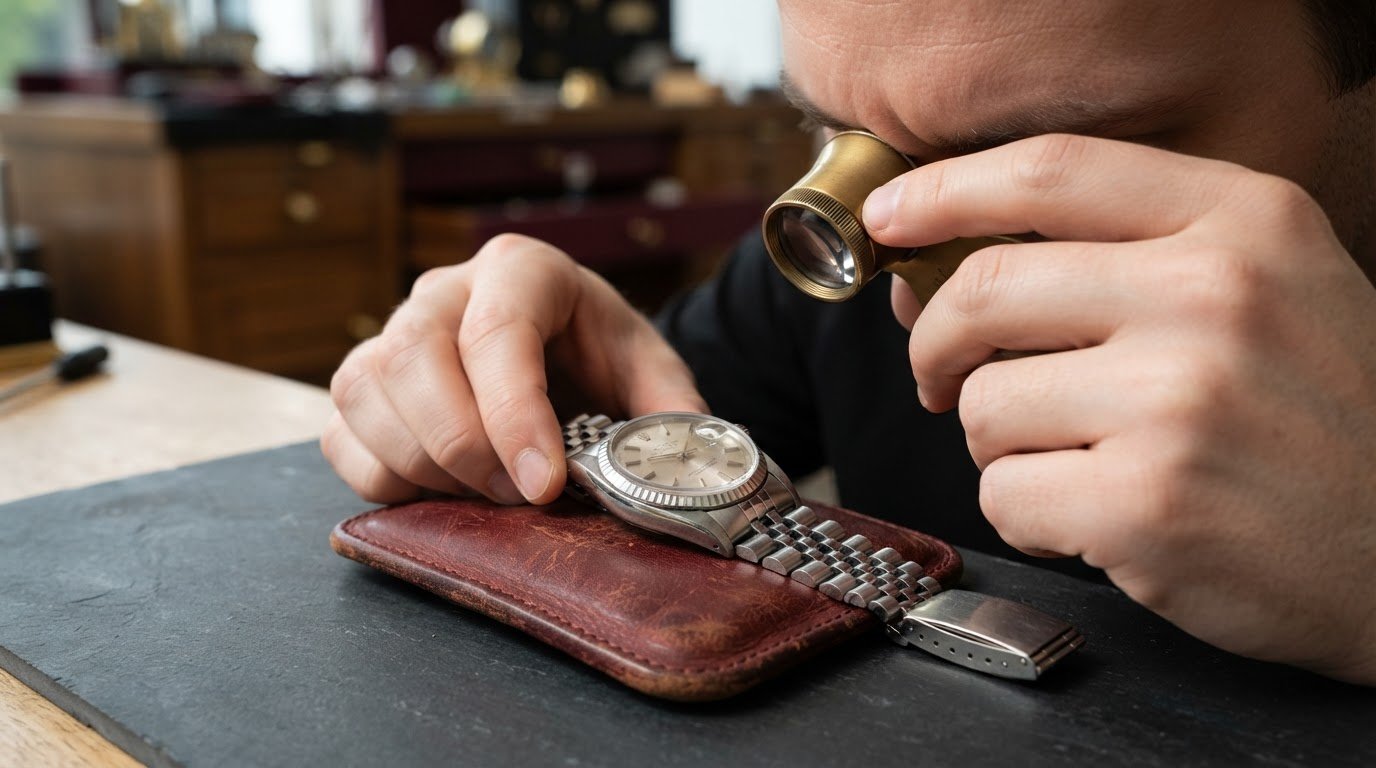
A certificate and original packaging can support a purchase, but neither replaces a careful inspection. To assess authentic watches, look at the timepiece itself, including its serial, case, and manufacturer numbers, then compare its condition and documentation with the stated model. No single detail tells the whole story.
It’s reasonable to want clear evidence before buying a pre-owned luxury watch. Weigh the physical inspection alongside the paperwork, packaging, warranty terms, and seller information instead of relying on appearance alone.
This guide explains what to examine, how documents and seller status fit into the assessment, and what an inspection can reveal. Use it to judge the details and make a more informed purchase.
Key Takeaways
- Compare the watch’s visible details with the exact model, and look for consistency across its components and condition.
- Review certificates for matching model and ownership details, while treating original packaging as supporting evidence rather than a verdict.
- Separate manufacturer coverage from a seller’s own warranty, and understand what the stated coverage applies to.
- Use dealer status as one part of your assessment, then weigh it alongside a hands-on inspection and clear documentation.
Pre-owned luxury watch authenticity
A sound assessment of authentic watches starts with the exact brand and model, not a general impression of quality. Identify the reference in the listing, then compare the dial, case shape, hands, bezel, bracelet, and markings with that model’s configuration. Rolex and Patek Philippe have distinct design languages, and models from the same maker can also differ substantially across production periods.
Inspect the whole watch as a coordinated object. Look for consistent finishing, cleanly applied dial details, and components appropriate for the stated model. Wear may explain scratches or softened case edges, but it does not establish authenticity. Ask how replaced parts or restoration are described: originality and authenticity are related, but separate questions. A genuine watch may have service parts, while an attractive presentation alone proves little.
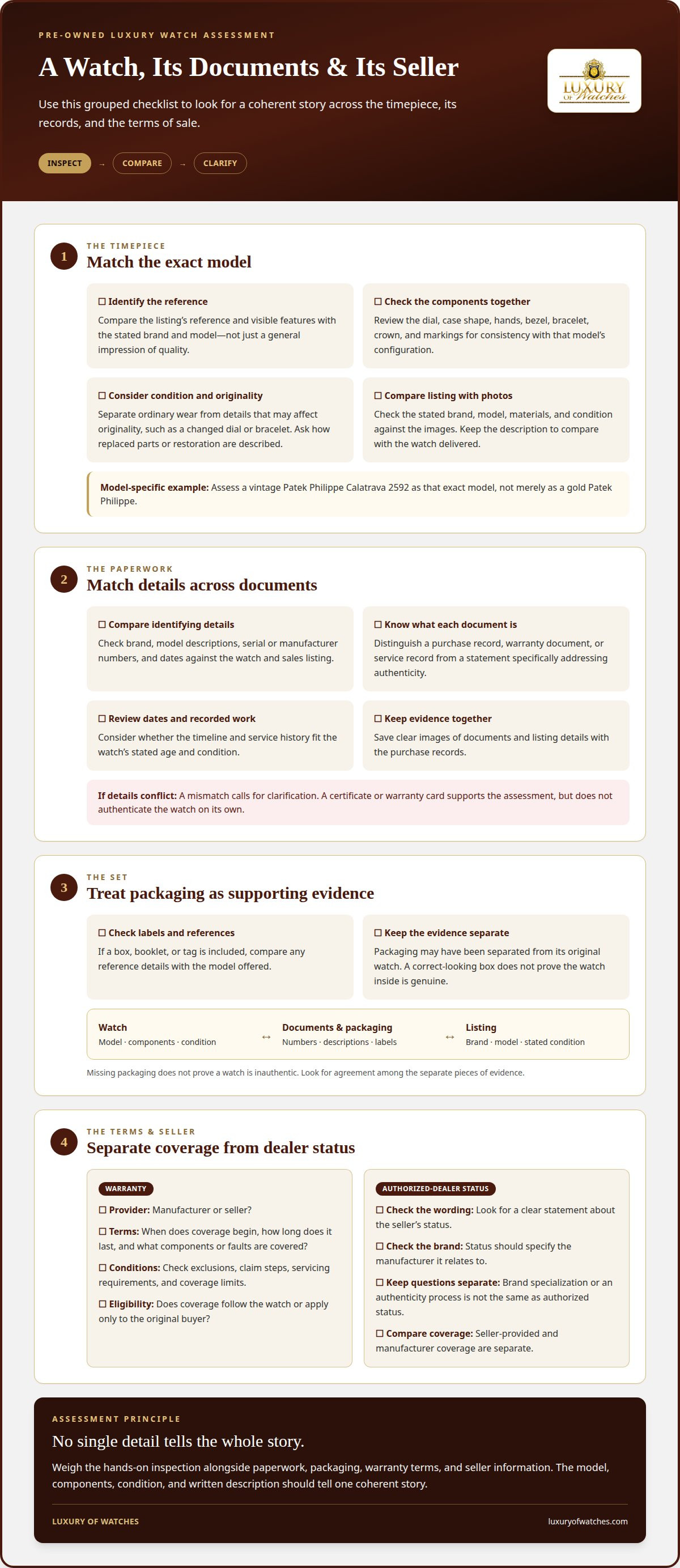
- Match the model: Compare the listing’s reference and visible features. For example, a vintage Patek Philippe Calatrava 2592 should be assessed as that specific model, not merely as a gold Patek Philippe.
- Review the components: Examine the dial, case, crown, hands, and bracelet together. Note any mismatch between the listing description and the watch shown.
- Consider condition: Separate ordinary wear from details that could affect originality, such as a changed dial or bracelet. Ask for clear descriptions of alterations.
- Read the listing closely: Compare its stated brand, model, materials, and condition with the photographs. Save the description so you can evaluate the delivered watch against it.
These steps apply across luxury brands, including Rolex, Cartier, Breitling, and Audemars Piguet. They can also help distinguish a pre-owned watch with disclosed restoration from one presented as untouched. Treat the certificate, packaging, and seller information as supporting evidence, not substitutes for inspecting the watch. The model, components, condition, and written description should tell one coherent story.
Authenticity certificates and original packaging
A certificate or warranty card can connect paperwork to a watch, but it does not authenticate the timepiece on its own. Read each document closely and compare the brand, model details, serial or manufacturer number, and dates with the watch and listing. A mismatch calls for an explanation, not an assumption that the paperwork settles the question.
Documents vary by brand, model, age, and ownership history. A pre-owned Rolex may come with a warranty card or service records, while another watch may have incomplete paperwork. Look for legible details that agree across the documents. If a document names a model or number, compare it with the corresponding watch marking. Treat alterations, missing details, or conflicting information as reasons to look more closely.
- Match identifying details: Compare numbers and model descriptions on the documents with the watch and sales listing.
- Read the document type: Distinguish a purchase record, warranty document, or service record from a statement specifically addressing authenticity.
- Review the timeline: Check whether dates and recorded work make sense alongside the watch’s stated age and condition.
- Keep the evidence together: Save clear images of documents and listing details with your purchase records.
Original packaging can provide useful context. A branded box, booklet, or tag may indicate a complete set, but packaging can be separated from its original watch. Check that any labels or reference details match the model offered. A correct-looking box does not prove the watch inside is genuine, and missing packaging does not prove otherwise.
Assess the watch, paperwork, and packaging as separate pieces of evidence, then look for agreement among them. For example, if a card’s number differs from the watch’s marking, the set needs clarification before its documents can support your assessment. Buyers comparing pre-owned luxury watch listings can use this same document-by-document approach, rather than treating “box and papers” as a verdict.
Warranty coverage and authorized-dealer status
Warranty terms and dealer status answer different questions: what support applies after purchase, and how the seller relates to the manufacturer. Review each separately for the specific watch and transaction.
Warranty Coverage
Start with the written warranty terms, not a general promise in a listing. Identify who provides coverage, when it begins, how long it lasts, and which components or faults it addresses. Read the exclusions and claim conditions, too. A seller’s in-house warranty is separate from manufacturer coverage; do not treat one as a substitute for the other.
Check whether the warranty follows the watch or applies only to the original buyer. Note the stated claim steps, servicing requirements, and coverage limits. A card or certificate may support the watch’s history, but its presence alone does not explain which repairs are covered. Keep the written terms with the listing and purchase records.
Authorized-Dealer Status
Authorized status describes a seller’s relationship with a specific watch manufacturer. It is different from experience with pre-owned watches or a seller’s own authenticity process. Read the wording carefully: a seller can specialize in a brand without being identified as its authorized dealer.
Look for a clear statement about the seller’s status and the brand it covers. A claim involving Rolex, for example, should apply specifically to Rolex, not imply authorization across several luxury brands. Compare that status with the seller’s warranty terms, since manufacturer and seller-provided coverage are separate.
Use these questions to assess the documents before deciding:
- Coverage: Who provides the warranty, and what does it cover?
- Duration: What start date and coverage period appear in writing?
- Eligibility: Who can make a claim, and what steps apply?
- Dealer status: Which manufacturer and brand does the stated authorization cover?
For a pre-owned purchase, these details clarify what support comes with the watch. Tie the answers to the exact listing and written terms rather than assuming every watch from one seller has identical coverage or dealer status.
Watch inspection and authentication
A watch that differs from its description can leave a buyer with an unwelcome surprise. Warning signs include mismatched serial, case, or manufacturer numbers, inconsistent details, and listing photos that obscure key features.
A careful inspection compares identifying marks, visible components, condition, and the seller’s description. Each detail should support the same model and account of the watch.
Watch Authentication Checks
Start with the serial, case, and manufacturer numbers, which can help identify an authentic watch. Compare each visible marking with the listing and accompanying records, noting any mismatch. Then examine the case, dial, hands, and bracelet together. Their appearance should make sense for the stated model, rather than looking like unrelated parts assembled into one watch.
For an online listing, request clear images of the dial, case sides, case back, and clasp. Check that the photographs show the same watch from different angles. Compare the condition description with the images, including any stated alterations or replacement components. A thorough review connects the physical details with the seller’s written claims.
Counterfeit Risks and Warning Signs
A mismatch between a number on the watch and its documents is a concrete warning sign. Other concerns include model details that conflict with the photographs, unclear images around identifying marks, or a description that avoids explaining visible changes. A polished appearance does not resolve these concerns.
Keep a record of the listing and its images while reviewing the watch. If the delivered item differs from the photographs or stated condition, that comparison gives you a precise basis for describing the discrepancy. Focus on observable facts, such as a different marking, dial, or bracelet, rather than a general impression.
Use a consistent sequence: match identifying numbers, compare the model’s visible features, inspect condition, and reconcile the findings with the listing. This disciplined process makes the evidence easier to assess. To explore pre-owned luxury watches with these inspection points in mind, review the details shown for each timepiece.
Luxury of Watches: Rolex Watches
Luxury of Watches offers a focused selection for buyers comparing pre-owned Rolex watches. Its collection includes Rolex Watches, Used Rolex watches, Pre-Owned Luxury Watches, and Breitling Watches. Compare the options by model and condition, using the details discussed above.
For eligible authentic watches, Luxury of Watches provides a five-year in-house warranty. This is seller-provided coverage, not a manufacturer’s international warranty, so consider its written terms separately from your authenticity assessment. Review each listing’s photographs and description against the model features that matter to you, then weigh the watch’s documentation and stated condition together.
Explore the available watches at Luxury of Watches, or contact the company with questions about a listing.
Make your next watch decision with clarity
Let your priorities guide the final choice. Consider which design you’ll enjoy wearing, how the watch fits your collection, and whether the listing gives you a clear basis for deciding. Compare the details at your own pace rather than choosing under pressure.
Keep your decision grounded in the specific timepiece, not its prestige alone. Confidence in authentic watches comes from evidence that holds together, while the right choice should also reflect your taste and intended use. Compare the details and decide what matters most before moving forward.
Luxury of Watches can be your next step as you explore pre-owned luxury timepieces. If you’re ready to discuss your options, contact Luxury of Watches. Make your choice with care, and enjoy the craftsmanship and character your next watch brings to your collection.
Frequently Asked Questions
What makes a watch authentic versus counterfeit?
An authentic watch is made by its stated manufacturer, with an identity and construction consistent with the specific model. A counterfeit imitates a brand or model without being made by that manufacturer. A familiar logo alone proves little. Assess a Rolex, for example, by its model-specific details and identifying marks, while considering condition, replacement parts, and ownership history separately.
How can I verify a watch is genuine using its serial and model numbers?
Use the serial, case, or manufacturer number alongside the model reference rather than treating any single marking as proof. To assess authentic watches, compare visible numbers with the listing and available records, and check that the model description matches the timepiece. If a number is unreadable in online photographs, request a clearer view. Keep a record of the numbers and listing details you reviewed.
How do I authenticate a luxury watch before buying it online or in person?
For an online purchase, compare the description with clear, current photographs from several angles. In person, inspect the watch shown in the listing and note any differences in condition or components. Buyers evaluating authentic watches should check the model identification and written description, then record the item’s condition at handover. A consistent record helps distinguish a genuine discrepancy from a later misunderstanding about condition.
What documents and packaging should come with an authentic watch?
Documents and packaging vary with a watch’s age, brand, and purchase history. They may include a warranty card, sales paperwork, service records, branded box, and manuals. Match identifying details on those items with the watch and listing. Keep the invoice and included-item description after purchase. A complete set can support the watch’s history, but packaging alone does not establish its origin.
Where can I buy from authorized dealers in the United States?
Buy from a brand boutique or a retailer the specific manufacturer recognizes as authorized, and confirm the relationship for that brand before checkout. Luxury of Watches is a United States-based online retailer offering Rolex watches, used Rolex watches, and pre-owned luxury watches. If authorized-dealer status matters to your purchase, verify it against the manufacturer’s dealer information.
How do authorized dealers, brand boutiques, and gray-market sellers compare?
A brand boutique sells directly under the manufacturer’s retail identity, while an authorized dealer is designated by that manufacturer. A gray-market seller offers genuine goods through channels outside the manufacturer’s authorized network. These labels describe different selling relationships, not an automatic judgment about an individual watch. Compare the seller’s stated status, warranty provider, and purchase terms for the specific listing.