
Are Watch Prices Going Down in 2026? What Buyers Should Know
Posted by Luxury of Watches on 14th Oct 2026
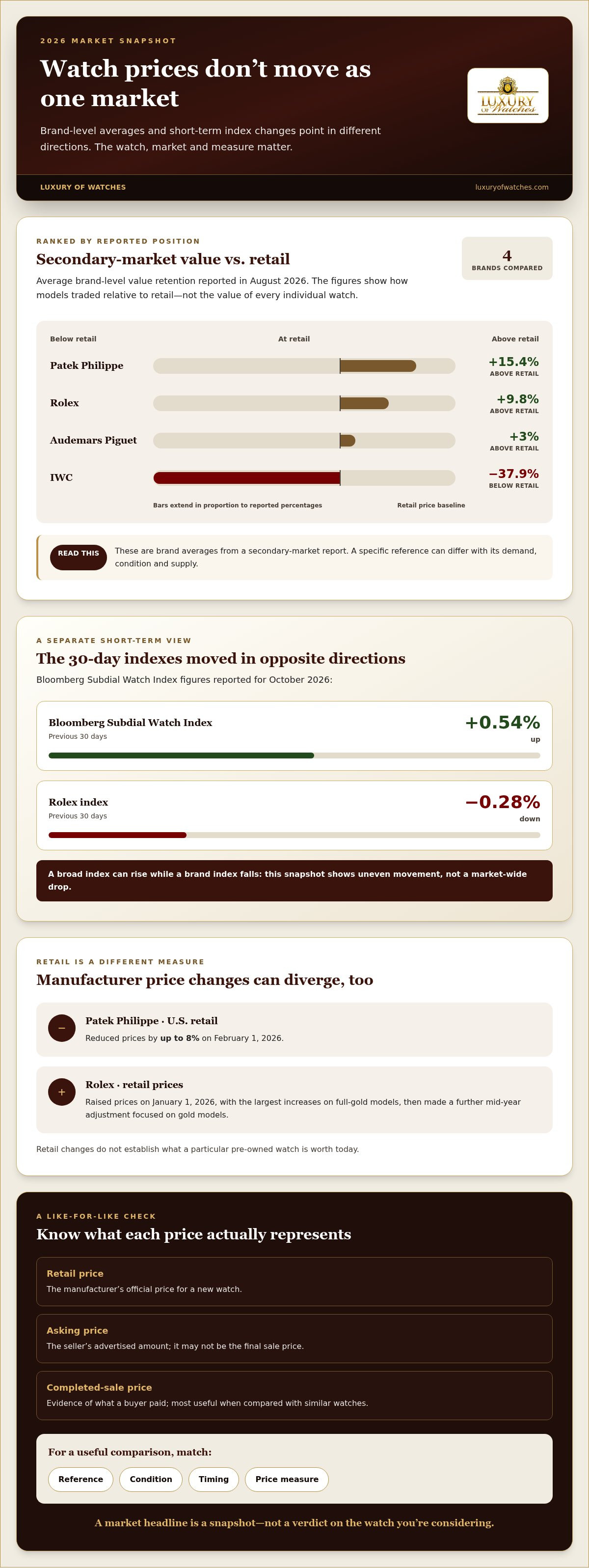
A market correction doesn’t mean every watch is getting cheaper. So, are watch prices going down in 2026? The answer depends on the brand, model and whether you mean a manufacturer’s retail price or a pre-owned market value. In October 2026, the Bloomberg Subdial Watch Index was up 0.54% over the previous 30 days, while its Rolex index slipped 0.28%. Those figures point to uneven movement, not a market-wide drop.
If headlines have left you unsure whether to buy now or wait, that’s understandable. Retail prices and secondary-market values can move in opposite directions: Rolex raised retail prices in 2026, while Patek Philippe reduced U.S. retail prices by up to 8% in February. Neither change tells you what a specific watch is worth today.
This article explains how to assess a particular listing, compare new and pre-owned options, and weigh buying now against waiting. Focus on the watch you want, its price and condition, and your budget rather than relying on a broad market headline.
Key Takeaways
- Are watch prices going down in 2026? It depends on the brand, model and market, so broad headlines may not reflect the watch you’re considering.
- Distinguish manufacturer retail prices from pre-owned asking prices and completed sales before deciding whether a watch has become more affordable.
- Compare dated, like-for-like evidence to see which segments may soften, hold value or rise.
- Use your intended wear, target model and timing to decide whether buying now or waiting makes sense.
- Assess a listing by comparing its stated MSRP with its current price, then consider whether it’s new or pre-owned, its condition and its documentation.
Are Watch Prices Going Down in 2026? The Short Answer
There is no single price direction for every watch in 2026. Some manufacturer retail prices have risen, while secondary-market values vary by brand and model. Whether a particular watch is becoming less expensive depends on its reference, condition, availability and the period being measured. A correction from earlier speculative highs is not the same as a universal price drop.
Morgan Stanley’s August 2026 report on secondary-market value retention found that Patek Philippe models traded at an average of 15.4% above retail, Rolex at 9.8% above, and Audemars Piguet at 3% above. IWC models, by comparison, averaged 37.9% below retail. These brand-level averages describe different market positions, not the value of every watch. A specific reference can differ because of demand, condition and supply.
Retail prices and secondary-market prices are different measures
A manufacturer’s retail price is the official price for a new watch. Secondary-market prices relate to watches previously sold and may refer to either a seller’s asking price or a completed transaction. These measures can move in opposite directions: a brand may raise its list price while pre-owned sellers lower their asking prices to attract buyers. Economic conditions and consumer behavior also help explain why pricing varies across categories.
A headline about rising retail prices doesn’t prove pre-owned values are climbing. Likewise, a lower resale asking price doesn’t mean the manufacturer has reduced its price. Check what each figure measures before drawing a conclusion.
What “going down” can mean to a watch buyer
A lower listing is not proof of a lower transaction value. Asking prices show what sellers hope to receive; completed sales show what buyers paid, although comparisons are most useful when the watches match in reference, condition and timing. A discounted retail listing is a different measure again: it compares a seller’s offer with an official MSRP, not with a completed pre-owned sale.
Check whether a reported change is nominal or inflation-adjusted. A nominal figure compares currency amounts recorded at different times. An inflation-adjusted figure accounts for changes in purchasing power. The two can tell different stories, so don’t compare them as if they were interchangeable.
- Retail price: the manufacturer’s official price for a new watch.
- Asking price: the amount a seller advertises, which may not be the final sale price.
- Completed-sale price: evidence of a transaction, best compared with similar watches.
So, are watch prices going down in 2026? Some may soften while others hold or rise. Treat short-term movements as a snapshot, not a promise about the full year. For a specific listing, compare its current price with its stated MSRP and like-for-like market evidence. A transparent MSRP and current-price display can help you assess that offer, but it doesn’t establish a market-wide trend.
What Is Driving Watch Prices in 2026?
Watch pricing reflects several forces, and they don’t affect every brand or model in the same way. Manufacturers set retail prices in response to production costs, materials and pricing strategy. Pre-owned asking and transaction prices respond more directly to available supply, buyer demand and comparable sales. A retail increase doesn’t automatically lift resale values, and a softer pre-owned market doesn’t require a brand to cut its official price.
The main price drivers are brand pricing decisions, material and currency costs, supply, demand and buyer expectations. Rolex increased retail prices on January 1, 2026, with the largest increases on full-gold models, then made a further mid-year adjustment focused on gold models. Those retail changes don’t show that every Rolex reference rose by the same amount on the secondary market.
Brand pricing, materials, and currency
Gold costs can influence the production economics of precious-metal watches, while currency movements may affect brands operating across markets. The effect depends on a watch’s materials, where it’s sold and how its manufacturer sets prices. Patek Philippe, for example, reduced U.S. retail prices by up to 8% on February 1, 2026. Brand pricing decisions can therefore move in different directions within the same year.
Tariff claims need particular care. Headlines may cite changing rates as a reason for price movement, but check a claim against a dated, authoritative source and the specific market it concerns. Don’t treat a tariff figure, forecast or industry commentary as proof of an individual watch’s current value. The broader Global Watches Market Analysis 2026 offers context on market forces, but it doesn’t replace model-level pricing evidence.
Demand, supply, and market transparency
Availability and collector interest can push individual models in different directions. A sought-after reference with limited supply may attract firmer asking prices, while weaker demand can lead sellers to adjust listings. These are possible market mechanisms, not guarantees. An advertised price shows what a seller is asking, not what a buyer ultimately paid.
Online listings make it easier to compare offers, which can shape buyer expectations and prompt sellers to revise prices. But listings, forum comments and forecasts are not completed-sale data. For a useful comparison, look for the same reference and similar condition, and note when the evidence was published. A current listing can help you assess one offer; it cannot establish a market-wide trend.
- Retail evidence: dated manufacturer price changes show official list-price movement.
- Pre-owned evidence: comparable completed sales can indicate transaction movement more clearly than asking prices alone.
- Context: material, currency, supply and demand may affect models differently.
To see how these forces translate into individual offers, compare the displayed MSRP and current price for new and pre-owned luxury watches. Transparent listing information can help you assess a specific purchase without suggesting that the entire market is moving in one direction.
Which Watch Prices May Fall, Hold, or Rise? Compare the Evidence
There isn’t enough comparable evidence to label every luxury brand or model as falling, stable or rising. Separate official retail pricing from secondary-market indicators, then check the dates and methodology behind each figure. A brand index, a value-retention estimate and a seller’s listing describe different things; they aren’t interchangeable evidence.
| Brand or segment | Retail-price evidence | Secondary-market evidence | What the evidence supports |
|---|---|---|---|
| Patek Philippe | A U.S. retail decrease was reported in February 2026. | The brand index rose 1.30% in the 30 days leading into October 2026. | Retail and secondary indicators moved in different directions over their respective periods. This doesn’t establish a trend for every model. |
| Audemars Piguet | No comparable dated retail-price change is included here. | The brand index gained 0.22% in the 30 days leading into October 2026. | The short-term index reading was slightly positive; it doesn’t establish longer-term or model-level direction. |
| Rolex | Retail increases were reported in 2026. | The Morgan Stanley report found models averaging above retail in August 2026. | The average doesn’t describe every reference, condition or transaction. |
| Cartier and Breitling | No like-for-like dated retail comparison is provided here. | No comparable brand-level completed-sale evidence is provided here. | There isn’t enough evidence in this snapshot to classify either brand as falling, holding or rising. |
The index movements are short-term readings from the Bloomberg Subdial indices, while the Rolex value-retention comparison comes from Morgan Stanley’s August 2026 report. They have different scopes and timeframes. A small index gain doesn’t prove a watch is appreciating, and an average above retail doesn’t predict a future sale price.
New watches versus pre-owned watches
For a new watch, compare the current offer with the manufacturer’s stated retail price and note the date of each. For a pre-owned watch, compare like with like: reference, model year, condition and completeness, including whether original documentation or accessories are present. A polished, serviced watch and an unworn example aren’t automatically equivalent. The pre-owned luxury watch guide offers further context for weighing condition and ownership details.
Brand and model differences matter
Brand averages can conceal substantial differences between references. A broad index may combine watches with distinct demand and availability, while a single listing reflects one seller’s asking price. Before deciding whether prices are falling, compare dated evidence for the exact model and distinguish asking prices from completed sales. For Rolex-specific context, consult this Rolex prices market guide. The question “are watch prices going down in 2026” is best answered at the model level, not with one brand-wide label.
Should You Buy a Watch Now or Wait for Prices to Fall?
Your choice doesn’t have to depend on guessing the market’s next move. Start with why you want the watch, then assess the model and the available evidence. If you’re buying a timepiece to wear and have found the right example at a price that suits your budget, waiting for an uncertain market bottom may not improve your decision. If you’re buying mainly to resell at a profit, remember that future prices and resale outcomes aren’t guaranteed.
A practical buy-now-or-wait checklist
Use this sequence to turn a broad market question into a decision about the watch in front of you:
- Define your purpose. Decide whether this is a personal purchase, a planned addition to a collection or a speculative bet on future appreciation. The more your decision depends on resale profit, the more carefully you should consider uncertainty.
- Choose the exact model. Compare the same reference rather than relying on broad brand averages. Note whether each example is new or pre-owned, and account for condition, model year and included documentation.
- Record comparable prices and dates. Track current listings alongside available completed-sale evidence. Keep asking prices separate from confirmed transactions, and avoid comparing listings that differ substantially in condition or completeness.
- Set your decision point. Establish a budget and a date to reassess. If the watch still suits your needs and the evidence supports the price, you can proceed. If not, keep waiting or reconsider the model. This is more useful than waiting indefinitely for a price floor no forecast can pinpoint.
When a price prediction should not drive the decision
An annual forecast describes a broad outlook, not the future price of every reference. Even within one brand, models can attract different levels of demand and availability. A short-term index movement or a seller’s revised asking price can’t promise what a particular watch will be worth later.
Keep investment risk in view. A luxury watch may hold personal meaning and lasting appeal, but that doesn’t make appreciation or an eventual resale price certain. Give greater weight to whether the watch fits your lifestyle, whether its condition and provenance information meet your expectations, and whether you feel comfortable with the purchase independent of hype.
Waiting can make sense if you’re still comparing examples, need time to reach your budget or don’t feel confident about the listing. Buying now can make sense if you’ve found the model you want, assessed comparable evidence and are comfortable with the price without relying on a predicted gain. Set a clear review point so the decision stays deliberate rather than being driven by every new headline.
Once you’ve set your criteria, explore current luxury watch selections and compare new and pre-owned options against the same priorities.
How to Evaluate a 2026 Watch Listing with Confidence
A market headline can’t tell you whether a particular listing is fairly priced. Focus on the watch itself: its exact reference, whether it’s new or pre-owned, its condition, and how the listed price compares with the stated manufacturer’s suggested retail price (MSRP). This helps you assess an individual offer without treating it as evidence that the entire market is rising or falling.
Compare the listing, not just the headline price
Start with the model reference and price basis. Confirm that the listed watch matches the reference you’re researching, then compare its current price with the stated MSRP. Treat that comparison as context for the offer, not as a forecast or proof of broader market direction. Two watches from the same brand may differ in reference, condition and completeness, making a simple price comparison misleading.
Next, read the description carefully. Is the watch new and unworn, or pre-owned? Luxury of Watches’ pre-owned Rolex watches are polished and serviced, and presented in mint showroom condition. Compare like with like, and review the condition details and documentation stated for the specific watch. Papers or other documentation may vary by listing, so use the details provided rather than assuming every watch includes identical items.
- Match the reference: Compare the same model and reference, not just the same brand.
- Account for condition: Keep new, unworn watches separate from pre-owned examples.
- Read the price context: Compare the displayed current price with the stated MSRP, without treating either figure as a market forecast.
- Review listing details: Use the described condition and included documentation to assess the individual watch.
Use authenticity and warranty information as trust signals
Price matters, but confidence in what you’re buying matters just as much. Luxury of Watches guarantees that the watches it sells are 100% authentic. The company also offers a 5-year Luxury of Watches warranty on select brand watches. It covers the movement, functionality and manufacturing defects, but not the battery. Review the terms for the specific watch to understand the stated coverage rather than assuming every watch or component is covered in the same way.
Asking whether are watch prices going down in 2026 is useful for market context, but your purchase decision should come down to the exact listing. A clear reference, transparent MSRP and current-price display, accurate condition description and stated trust information give you practical points to assess. They won’t predict future resale value, but they can help you make a more informed choice today. For international orders, shipping is $95 for orders under $1,499 and $195 for orders of $1,500 and above, with insurance included; customs and duties are the buyer’s responsibility. Sales tax is charged only on shipments to California.
Ready to compare individual listings? Browse Luxury of Watches to explore current luxury watch selections, including new and pre-owned options.
Choose the Watch That Fits Your Next Chapter
The most useful next step isn’t predicting every market turn. Decide what you want from a watch, then choose a specific piece you’ll feel confident wearing and owning. If you’re still weighing are watch prices going down in 2026, keep the question in perspective: market direction can inform your timing, but it can’t replace your priorities or guarantee future value.
Luxury of Watches has more than 25 years in the industry and has served over 15,000 customers. Compare current listings at your own pace, keeping your preferred model, condition and budget in view. A considered choice today is more dependable than one based on a prediction coming true.
Explore authentic luxury watches and current listings to find a timepiece that fits your priorities.
Frequently Asked Questions
Are luxury watch prices going down in 2026?
Not across the board. The answer to “are watch prices going down in 2026” depends on whether you mean official retail prices or pre-owned values, and on the specific watch. Identify the reference you’re considering and follow comparable prices over time. A general luxury-watch index can provide context, but it can’t tell you whether that exact model or condition is becoming less expensive.
Which luxury watch brands are seeing prices fall in 2026?
Available evidence points to mixed movement, not a definitive list of brands whose watches are all falling. The Rolex secondary-market index was down 0.28% in the 30 days leading into October 2026, while IWC’s average trading value was reported below retail in Morgan Stanley’s August 2026 report. A below-retail average isn’t proof of a recent decline. Comparable dated transaction data for Cartier and Breitling isn’t provided here, so avoid classifying either brand based on guesswork.
Are pre-owned watch prices dropping faster than retail prices?
There’s no consistent, comparable evidence here to establish that pre-owned prices are dropping faster overall. Retail list prices and pre-owned transactions track different things, and comparisons need matching periods, currencies and watch references. For a practical check, record the same model’s current retail price and comparable pre-owned completed sales, then revisit those figures later. Don’t use a changing listing alone as proof that the pre-owned market has declined.
Should I wait until the end of 2026 to buy a luxury watch?
Wait only if doing so serves a clear purpose, such as saving toward your budget or comparing additional examples. Since the end of 2026 is approaching, delaying for a few weeks won’t guarantee a lower price, and an appealing listing may change or sell. Decide what price and condition work for you, then set a date to reassess. If the watch is for regular wear, include the value of enjoying it now in your decision.
Can a watch’s retail price rise while its resale value falls?
Yes. A manufacturer can raise the official price of a new watch while buyers in the pre-owned market become less willing to pay as much for a particular reference. Retail pricing reflects the brand’s pricing decision; resale value reflects demand for that watch and the terms of individual transactions. A higher MSRP doesn’t ensure a pre-owned seller can achieve the same increase. Assess each price measure separately.
How can I tell whether a watch price has actually declined?
Look for dated completed sales of the same reference, not just older and newer asking prices. Compare watches with similar condition, model year and included documentation, and keep the currency and measurement period consistent. A single sale may be an outlier, so look for a pattern across comparable transactions. Also distinguish nominal prices from inflation-adjusted figures; they answer different questions about how the watch’s price has changed.
Are luxury watches a reliable investment when prices are changing?
No watch should be treated as a reliable investment or a guaranteed source of appreciation. Demand can shift by reference, and broad brand averages don’t predict an individual watch’s future resale price. If you’re considering a purchase mainly for potential returns, ask whether you’d still be comfortable owning it if its value fell or stayed flat. For a personal purchase, prioritize the watch’s fit, condition and appeal over a forecast.