Are Luxury Watches a Good Investment? A 2026 Market Analysis
Posted by Luxury of Watches on 18th Aug 2026

In 2026, Rolex accounts for nearly one in every three luxury watches sold globally, a statistic that underscores the enduring allure of blue chip horology. You've likely watched the secondary market with a mix of fascination and caution, wondering if the recent stabilization following the 2022 surge makes this the ideal moment to acquire your next piece. It's natural to feel a sense of hesitation when the line between a passionate hobby and a high-value asset class becomes this thin. You want to know: are luxury watches a good investment, or will your capital evaporate the moment you strap the piece to your wrist?
This analysis provides the financial clarity you need to move beyond speculation. We'll explore the reality of current market trends, from the continued appreciation of discontinued icons like the Rolex Submariner 116610LV to the steady performance of Patek Philippe's most coveted references. You'll discover a practical framework for identifying models that offer both mechanical prestige and long term value retention. By the end of this guide, you'll understand the total cost of ownership and how our rigorous verification processes and five year in-house warranty transform a high-end purchase into a secure, enduring legacy.
Key Takeaways
- Learn how blue-chip brands like Rolex and Patek Philippe function as resilient alternative assets within a diversified 2026 portfolio.
- Identify the specific "Big Three" manufacturers and stainless steel references that historically outperform traditional market indices.
- Gain a clear framework to evaluate the secondary market and decide for yourself: are luxury watches a good investment for your financial goals?
- Understand why professional verification and a 5-year in-house warranty are essential to maintaining the pristine condition required for maximum ROI.
- Discover the strategic advantage of entering the market through pre-owned models to bypass initial retail depreciation and secure immediate value.
Understanding Luxury Watches as Alternative Assets in 2026
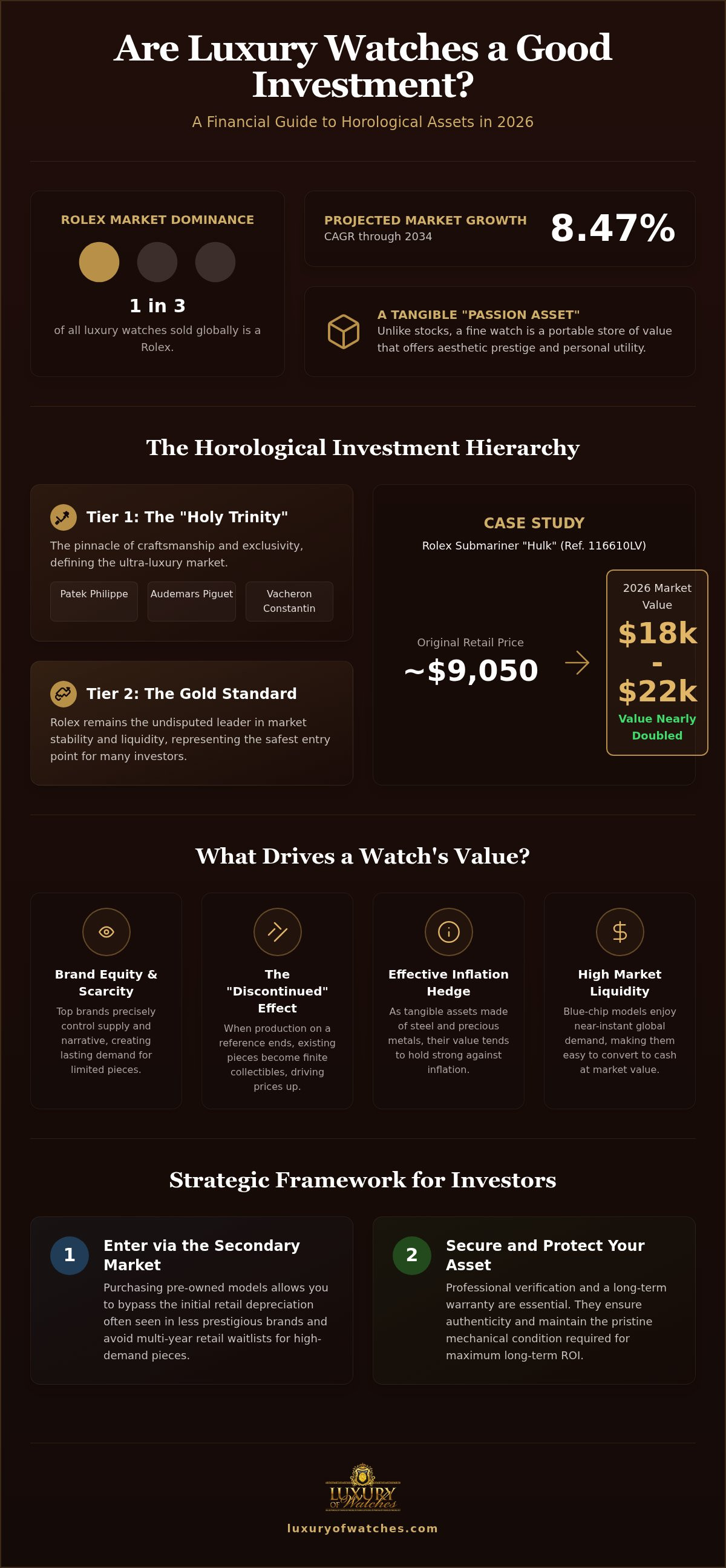
A luxury timepiece is far more than a tool for tracking minutes; it's a sophisticated store of value. Unlike standard consumer electronics or vehicles that lose significant equity upon purchase, certain horological references act as portable repositories of wealth. When discerning collectors ask are luxury watches a good investment, they're looking at a market projected to grow at a CAGR of 8.47% through 2034. This growth isn't driven by speculative hype but by a fundamental imbalance between global demand and the strictly limited production capacities of houses like Patek Philippe and Audemars Piguet.
Owning a "passion asset" provides a unique utility that traditional stocks or gold bars cannot match. You can't wear a share of the S&P 500 to a board meeting, yet a Rolex Submariner offers both aesthetic prestige and a history of price resilience. While gold remains a classic hedge, the historical performance of the most expensive watches sold at auction demonstrates that rarity and provenance can drive returns far beyond the spot price of precious metals. The secondary market has become the smarter entry point for investors, allowing them to bypass the initial retail depreciation often found in less prestigious brands.
The Mechanics of Watch Value Appreciation
True appreciation is rooted in brand equity and technical heritage. A Rolex maintains its value because the manufacturer controls its supply chain and brand narrative with absolute precision. These pieces serve as effective inflation hedges because they're tangible assets composed of high-grade steel and precious metals. Value often spikes during the "discontinued" effect. When production ends for a specific reference, the sudden cap on supply turns existing pieces into finite collectibles. This scarcity drives secondary market premiums, often significantly exceeding the original retail price over a decade.
Market Liquidity: How Quickly Can You Exit?
Liquidity varies significantly depending on the brand and model. Blue chip references from Rolex or Cartier enjoy near-instantaneous global demand, making them easier to liquidate than niche, independent brands. Horological liquidity is the ease with which a timepiece can be converted to cash at market value. Selling a high-demand reference like a stainless steel Submariner is a straightforward process in the secondary market. By sourcing through established platforms that provide a 5-year in-house warranty, you ensure the watch remains in the peak mechanical condition required for a swift and profitable exit. This protection is a critical factor in maintaining investment value over the long term.
The Investment Hierarchy: Which Brands and Models Hold Value?
The hierarchy of horological value is remarkably consistent, topped by the "Holy Trinity" of watchmaking: Patek Philippe, Audemars Piguet, and Vacheron Constantin. These houses represent the pinnacle of craftsmanship, yet they aren't the only path for those asking are luxury watches a good investment. In 2026, the market has bifurcated between high-complication pieces and the "blue chip" sports models that dominate the secondary market. Successful collectors often focus on models with a clear lineage and a history of price resilience.
Rolex: The Gold Standard of Watch Investing
Rolex remains the undisputed leader in market stability, currently capturing approximately one in every three luxury watch sales globally. For many, the Rolex Submariner represents the safest entry point. Its iconic design and utilitarian heritage ensure it remains highly liquid. For example, the discontinued "Hulk" (Ref. 116610LV) now trades between $18,000 and $22,000, nearly doubling its original retail price of approximately $9,050.
The 2026 discontinuation of the GMT-Master II "Pepsi" in both stainless steel and white gold has further solidified the secondary market's importance. References like the Daytona and GMT-Master II command significant premiums because they bypass the multi-year waitlists found at traditional retail. Understanding how Rolex prices have evolved over the last five years is essential for timing your entry to avoid speculative peaks.
Ultra-Luxury: Patek Philippe and Audemars Piguet
In the ultra-luxury tier, the Patek Philippe Nautilus and Audemars Piguet Royal Oak define the "Luxury Sport" category. These are not merely watches; they are financial instruments. The discontinued Nautilus 5711/1A remains a powerhouse, with the rare green dial version reaching prices near $267,016 on the secondary market. Audemars Piguet's Royal Oak "Jumbo" Ref. 15202ST follows a similar trajectory, often priced between $85,000 and $95,500 depending on condition.
While these brands offer impressive potential ROI, "waitlist culture" has pushed many collectors toward the secondary market for immediate access. When evaluating these pieces, remember that complication doesn't always equal value retention. Often, the simplest stainless steel models from these houses offer the most reliable long-term outlook. To ensure your acquisition retains its maximum value, consider browsing our curated selection of investment-grade Rolex watches that come with our signature verification.
Emerging Classics and the Hype Trap
Beyond the giants, brands like Cartier and Breitling are gaining significant ground in 2026. Cartier's focus on timeless design and Breitling's technical precision offer stable alternatives for those seeking diversification. However, you should avoid the "hype trap" of brands that rely on celebrity endorsements rather than mechanical substance. Authentic value is found in heritage and verified condition. A watch must stand on its own horological merits to survive market corrections.
The Financial Reality: Pros and Cons of Horological Investing
Protecting your capital involves more than just a secure safe. Specialized jewelry insurance is mandatory for an investment-grade portfolio, as standard homeowners' policies often have low coverage limits for individual items. Mechanical maintenance is another critical factor. To remain "investment grade," a movement must be kept in pristine condition. We address this concern directly by providing a 5-year in-house warranty on every timepiece we sell. This protection ensures that unexpected mechanical issues don't erode your potential ROI, keeping the watch in the peak condition required for the secondary market.
The Utility Factor: The "Dividend" of Joy
Watches offer a "dividend of joy" that traditional stocks cannot provide. When you calculate the cost per wear, a piece that you enjoy daily provides a psychological return on investment. If you don't appreciate the technical movement of a Breitling or the design language of a Cartier, the purchase is rarely a wise one. A watch you hate is never a good investment, regardless of the brand name on the dial. The most successful collectors are enthusiasts first, choosing pieces that they are proud to wear today and pass down as heirlooms to the next generation tomorrow. This blend of emotional utility and value retention is what defines the modern passion asset.
A Strategic Framework for Purchasing Your First Investment Piece
Entering the horological market requires more than just capital; it demands a disciplined methodology. When you ask are luxury watches a good investment, the answer often hinges on your ability to distinguish between a common reference and a rare variant. Your research should begin with the specific reference number. For instance, a Rolex Submariner 116610 features the 3135 movement and a 40mm case, while the 126610 houses the upgraded 3235 caliber and a 41mm profile. These technical nuances dictate long term desirability and price trajectory in the secondary market.
Condition is the primary arbiter of value. A "polished" case might appear pristine to a novice, but serious collectors pay a significant premium for original factory chamfers and sharp, unrounded lugs. Preservation is everything. Similarly, a "Full Set" that includes the original box and papers typically commands a 15% to 20% premium over a "naked" watch. Finally, you must source from a trusted intermediary to avoid the "Frankenwatch" trap, where authentic but non-period-correct parts are combined to create a deceptive and less valuable piece.
The Grey Market Advantage
For most serious collectors, the pre-owned luxury watch market is the most viable venue for investment. Buying pre-owned allows you to bypass the immediate depreciation often associated with purchasing less-desirable brands at full MSRP. It also provides immediate access to discontinued models that are no longer available at authorized dealers. When you're choosing a dealer, prioritize longevity and a proven track record. Our presence in the industry since 1999 offers the security required for these high value transactions.
Verification and Authentication Protocols
Absolute verification is the cornerstone of any high-tier acquisition. Expert watchmakers must scrutinize every component, from the escapement to the dial printing, to ensure every part is period-correct and authentic. A counterfeit-detection process is the first line of defense for any capital investment in horology. This level of scrutiny, combined with our 5-year in-house warranty, ensures your piece remains a viable asset. You can browse our collection of verified timepieces to find your next investment with complete confidence.
Securing Your Investment with Luxury of Watches
Choosing where to acquire your timepiece is just as critical as the model itself. At Luxury of Watches, we've provided authentic luxury since 1999, building a legacy of trust that underpins every transaction. When you're determining if are luxury watches a good investment, the reputation of the intermediary is the variable that determines your peace of mind. We specialize in blue chip brands like Rolex, Cartier, and Breitling, ensuring every piece in our curated selection meets the rigorous standards required for long term value retention. Our platform offers a bridge to pragmatic luxury, providing immediate access to the world's finest manufacturers without the traditional retail friction of multi-year waitlists or opaque pricing.
Why Our Warranty Matters for Investors
Resale value is inextricably linked to mechanical integrity. A watch that requires an expensive overhaul shortly after purchase is a liability, not an asset. Our 5-year in-house warranty acts as a significant value-multiplier, ensuring your investment stays in the peak condition required for the secondary market. This coverage is a hallmark of our commitment to your ownership journey, protecting your capital from the costs of mechanical failure. Beyond the warranty, our expert customer support team assists you through every stage, providing the technical validation and documentation that serious collectors demand.
The security of your transaction is our highest priority. We maintain an A+ rating for secure transactions, utilizing absolute verification protocols to ensure every timepiece is 100% authentic. This rigorous scrutiny allows you to focus on the horological prestige of your acquisition while we handle the complexities of verification. By sourcing through a stable, long term market presence, you gain the confidence to build a portfolio that is both emotionally rewarding and financially sound.
Your Next Steps in Horological Investing
Building a horological portfolio is a journey that rewards patience and expert guidance. Your next steps should involve identifying the references that align with both your personal taste and your financial objectives. Our specialists are available to help you analyze current market trends and find the specific model that offers the best outlook for your collection. Whether you're a seasoned collector or a first time buyer, we provide the tools and transparency needed to make an informed decision.
- Review our current inventory of investment-grade references from leading manufacturers.
- Consult with our experts to understand the nuances of specific reference numbers and their historical performance.
- Ensure your piece is protected by our signature 5-year in-house warranty and absolute verification.
Your portfolio deserves the scrutiny of specialists who understand the heritage of fine watchmaking. We invite you to explore our Rolex Collection to start your investment journey today. Our secure environment and commitment to quality ensure that your next acquisition is a source of pride and a resilient store of value for years to come.
Curating Your Horological Legacy
Building a portfolio that balances horological prestige with financial security requires a move from emotion to evidence. The 2026 market rewards those who prioritize "Blue Chip" references and absolute mechanical integrity. You now have the framework to determine for yourself: are luxury watches a good investment for your long-term goals? Success in this space isn't about chasing short-term hype; it's about the disciplined acquisition of verified, high-condition pieces from intermediaries with a proven legacy.
Since 1999, we've anchored our brand on the principles of absolute verification and consumer security. Every timepiece we offer undergoes rigorous expert scrutiny to ensure its authenticity and period-correct status. By pairing these iconic models with our signature 5-year in-house warranty, we provide the protection needed to maintain the value of your assets. We invite you to Browse our Investment-Grade Rolex Collection today to secure a piece that offers both aesthetic excellence and enduring value. Your journey into fine watchmaking is a path toward a tangible, wearable legacy.
Frequently Asked Questions
Do luxury watches actually increase in value over time?
Yes, certain references from prestigious manufacturers have a documented history of appreciation. While most consumer goods depreciate, limited production pieces from houses like Patek Philippe or Rolex benefit from a global supply and demand imbalance. In 2026, the market continues to recognize these as resilient alternative assets. However, determining if are luxury watches a good investment depends on buying at the right entry point and selecting models with long term horological significance.
Which watch brand holds its value the best?
Rolex remains the undisputed leader for resale value and market liquidity. Currently, one in every three luxury watches sold is a Rolex, ensuring a deep and active secondary market. Patek Philippe and Audemars Piguet also command massive premiums, particularly for their iconic sports models. While other brands like Cartier and Breitling are gaining ground in 2026, the "Big Three" and Rolex continue to offer the most predictable stability for serious collectors.
Is it better to buy a new or pre-owned watch for investment?
Buying pre-owned is generally the superior strategy for investors. This approach allows you to bypass the immediate depreciation that occurs when a new watch leaves the boutique. It also grants access to discontinued references that often see price spikes once production ceases. Since we provide a 5-year in-house warranty and absolute verification, you gain the security of a new purchase with the financial advantages of the secondary market.
How much should I spend on my first investment watch?
Your budget should prioritize quality and condition over a specific dollar amount. Many investors begin with "blue chip" stainless steel sports models, which offer the highest liquidity and historical resilience. It's often wiser to allocate your capital toward a single, high condition piece with its original box and papers rather than multiple lower tier watches. This strategy ensures your first acquisition remains a viable component of a diversified investment portfolio.
What are the risks of investing in luxury watches?
The primary risks include market volatility and the potential for mechanical failure or damage. While the market has stabilized in 2026, prices can still fluctuate based on global economic conditions. Authenticity is another significant risk; "Frankenwatches" with non-original parts can devastate your ROI. We mitigate these risks through our rigorous verification protocols and long standing industry presence, ensuring your capital is protected by a foundation of absolute trust.
Does a watch need to be "unworn" to be a good investment?
A watch doesn't need to be unworn to be a lucrative asset, though "New Old Stock" does command a premium. Most investors find the best value in high condition pre-owned pieces that show minimal signs of wear. The key is to ensure the case hasn't been over-polished and that the movement remains pristine. A well-maintained, worn watch with a full set of documentation is often a more practical and liquid investment than a museum grade unworn piece.
How often should an investment watch be serviced?
Most modern mechanical movements require professional servicing every 5 to 10 years. Keeping a watch in peak mechanical condition is essential for maintaining its "investment grade" status. If a movement is neglected, the cost of repair can erode your potential returns. Our 5-year in-house warranty provides a critical safety net, ensuring that your timepiece receives the expert attention it needs to remain a high performing asset throughout your ownership journey.
Can I wear my investment watch, or should it stay in a safe?
You can certainly wear your investment, provided you do so with discernment. One of the primary benefits of this asset class is its utility as a "passion asset" that provides social and professional capital. However, you should avoid activities that could cause deep scratches or structural damage. Minor marks are acceptable, but maintaining the original factory finish is vital. Many collectors find that wearing their piece adds a unique "dividend of joy" to their financial strategy.