
Are Limited Edition Watches a Good Investment? A Collector’s Strategy for 2026
Posted by Luxury of Watches on 27th Aug 2026
What if that "one of 500" engraving on your caseback is actually a warning sign rather than a certificate of value? For many collectors, the allure of owning something rare is undeniable, yet the market is currently saturated with artificial scarcity that often fails to translate into financial growth. The question of whether are limited edition watches a good investment requires looking past the glossy brochures and into the mechanics of long term value retention. It's a matter of distinguishing between a timepiece that is simply rare and one that possesses genuine historical significance.
You likely recognize the anxiety of potentially overpaying for a marketing gimmick, especially when the secondary market feels increasingly complex. This guide will provide the clarity you need by revealing the critical factors that separate true horological milestones from fleeting trends. We'll explore which prestigious brands hold value most effectively and provide a clear framework for identifying investable timepieces. You'll also learn how our rigorous verification processes and five-year in-house warranty provide the essential security required for high-value acquisitions. By the end, you'll have the strategic knowledge to purchase pre-owned limited editions with the same confidence as a seasoned industry expert.
Key Takeaways
- Distinguish between hard-capped production and marketing-led "special editions" to identify genuine horological rarity.
- Discover the specific brand markers and technical innovations that determine whether are limited edition watches a good investment for your 2026 portfolio.
- Learn to analyze a model's total production volume against a manufacturer's annual output to avoid the pitfalls of artificial scarcity.
- Understand how the secondary market facilitates price discovery and why our five-year in-house warranty provides a critical safety net for high-value timepieces.
- Benchmark prospective limited releases against the performance of their standard counterparts to ensure long-term value retention.
The Allure of Exclusivity: Defining Limited Edition in Luxury Horology
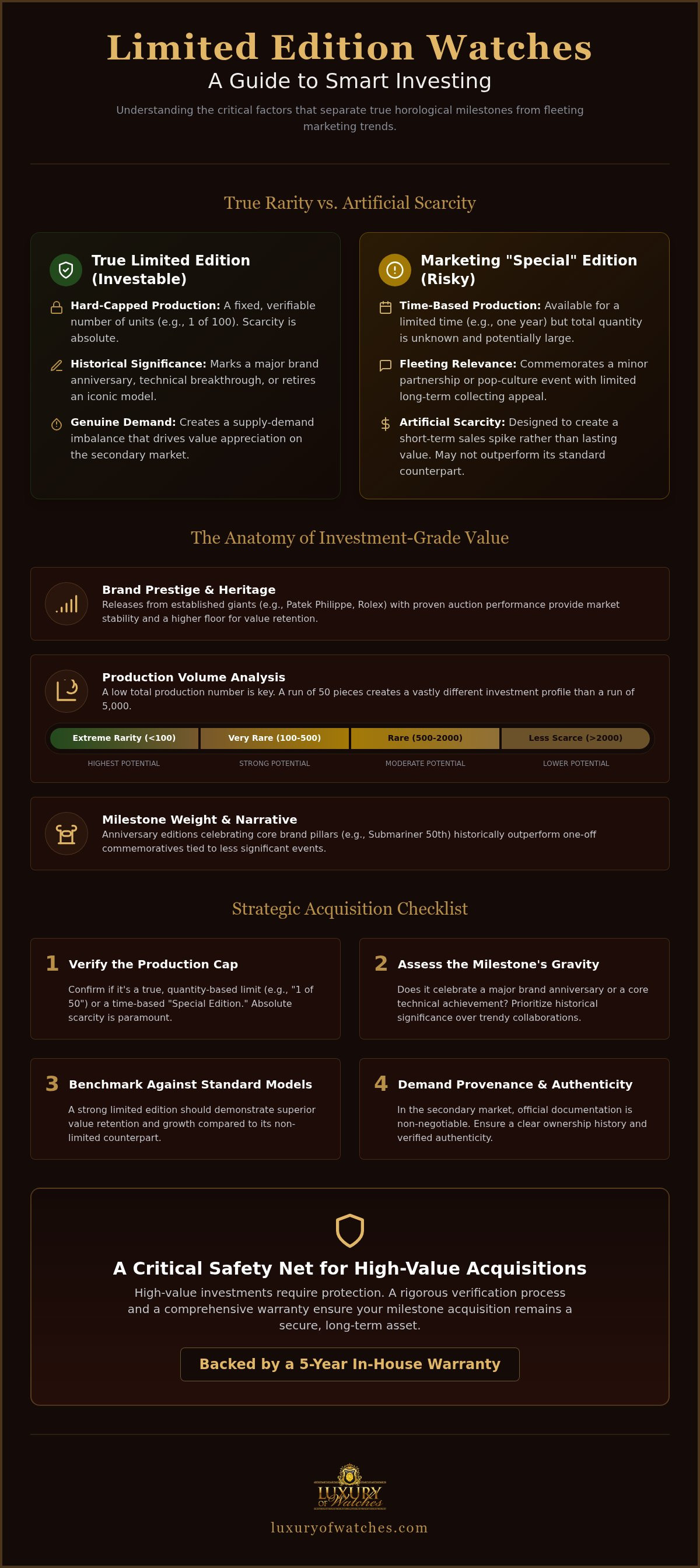
Understanding The Allure of Exclusivity is fundamental to answering the question: are limited edition watches a good investment? In luxury horology, the term "Limited Edition" is often used loosely, but for a serious collector, the technical definition determines future liquidity. A true limited edition features a hard cap on production, often indicated by a specific number on the caseback. In contrast, a "Special Edition" might only be available for a certain timeframe or through specific retailers without a fixed total quantity. This distinction is vital. Exclusivity triggers a psychological response where the desirability of an object increases as its rarity rises. A run of 50 pieces creates a different investment profile than a run of 5,000. While the latter might satisfy a broad fan base, the former creates the acute supply-demand imbalance necessary for significant price appreciation. Series releases, which follow a consistent design evolution, often provide more stability than one-off commemorative pieces that lack a clear lineage.
Production Caps vs. Production Windows
Investors must distinguish between quantity-based and time-based scarcity. These models typically fall into two categories:
- Quantity-Based: A hard ceiling where each unit is often numbered (e.g., 01/50). These command higher premiums because the scarcity is absolute and verifiable.
- Time-Based: A production window where the watch is made for a specific period, such as one year, but the total count isn't fixed at the start.
Boutique editions also play a role; these are only available at specific brand-owned locations, creating regional scarcity that can drive global demand. When looking at these pieces, it's essential to verify the official documentation to ensure the production claims are accurate. Because high-value investments require protection, we back our authenticated pre-owned pieces with a 5-year in-house warranty, ensuring your milestone acquisition remains a secure asset.
Commemorative vs. Anniversary Editions
Not all milestones carry equal weight in a brand's heritage. Anniversary pieces, such as a Rolex Submariner 50th Anniversary, often outperform standard limited runs because they celebrate a core pillar of the manufacturer's history. These watches are integrated into the brand's long-term narrative, making them highly desirable for thematic collectors. One-off commemorative releases tied to specific events or minor partnerships can be less predictable. While they offer a unique aesthetic, they may lack the historical gravity of a milestone anniversary. When assessing if are limited edition watches a good investment for your portfolio, look for pieces that represent a significant chapter in the brand's timeline. A watch that marks a technical breakthrough or a major company founding date is far more likely to retain value than a piece tied to a fleeting pop-culture collaboration.
The Anatomy of Value: What Makes a Limited Edition Watch Investable?
Determining whether are limited edition watches a good investment requires an analysis of the underlying pillars that support a timepiece's market value. It isn't enough for a watch to be rare; it must also be desirable. A limited release from a house like Patek Philippe carries immense weight because it's backed by centuries of established horological authority. In contrast, a niche brand might release a "one-of-ten" piece that fails to gain traction because there isn't a secondary market ecosystem to support it. True investability stems from a combination of brand prestige, technical advancement, and historical narrative. This intersection creates a product that collectors don't just want to own, but feel compelled to compete for.
The Power of Brand Heritage
Stability in the luxury market is often tied to auction house performance and long term historical data. When we examine the projected Rolex prices 2026, we see a consistent trend. Limited or discontinued models from established giants offer a level of security that emerging brands can't yet match. These manufacturers benefit from a "Halo Effect." This occurs when the legendary status of core collections, such as the Submariner or the Royal Oak, elevates every limited variant associated with the line. Collectors often view these pieces as safer entry points because the "standard" version already has a proven track record of value retention. You can explore our curated selection of pre-owned luxury watches to see how these heritage models maintain their market position through shifting economic cycles.
Material and Movement Innovation
Limited editions frequently serve as the industry's testing grounds for high complication movements and avant-garde materials. A watch that represents a "horological first" often sustains interest decades after its release. These technical milestones become anchor points for future valuations. Consider these value-driving innovations:
- Proprietary Alloys: Brands like Hublot develop unique gold blends or ceramic composites that offer superior scratch resistance and distinct aesthetics.
- Rare Dial Materials: The use of meteorite, lapis lazuli, or tiger's eye creates a natural uniqueness where no two watches in the edition are identical.
- Movement Milestones: The first implementation of a specific tourbillon configuration or a new escapement material can turn a limited run into a historical landmark.
While technical specifications are vital, the "story" or provenance acts as a value multiplier. A limited edition that commemorates a genuine achievement resonates more deeply than a forced marketing partnership. When you evaluate if are limited edition watches a good investment, look for pieces where the technical innovation matches the prestige of the name on the dial. Every timepiece we offer undergoes absolute verification to ensure that its documentation and provenance are as authentic as the craftsmanship itself.
Investment vs. Marketing: Avoiding the Artificial Scarcity Trap
The label "Limited Edition" is often used as a psychological lever rather than a guarantee of rarity. To decide if are limited edition watches a good investment, you must look past the marketing departments. Many brands suffer from "Limited Edition Fatigue," where the constant stream of "exclusive" releases actually dilutes the brand's core value. When every month brings a new commemorative piece, the scarcity becomes artificial. True value usually lies in models that represent a genuine design evolution. A simple color swap on a dial rarely sustains a premium on the secondary market. In contrast, changes to case geometry, movement architecture, or material application signify a piece that collectors will pursue for decades. Many limited editions lose value the moment they leave the boutique because the initial price includes a "novelty premium" that the secondary market refuses to pay.
Identifying Artificial Scarcity
Artificial scarcity is often hidden in plain sight. Some manufacturers use the "Numbered but not Limited" tactic. They might engrave a serial number on every watch, but without a hard cap on total production, that number is meaningless for investment purposes. Generally, a "limited" run exceeding 2,000 pieces for a high-end manufacturer is too high to drive significant appreciation. You should also examine the brand's release calendar. If a manufacturer is launching multiple limited editions per quarter, they are likely prioritizing short-term boutique sales over long-term collector value.
The Role of Niche Collaborations
Collaborations are a double-edged sword in the horological world. Partnerships with contemporary artists or pop-culture icons can create massive initial hype, but this often leads to a sharp price correction once the trend fades. Horological collaborations, those involving legendary watchmakers or historic racing teams, typically offer better long-term ROI. These pieces have "Cross-Over Appeal," attracting both watch enthusiasts and specialists in another field. This dual demand supports higher prices in the secondary market.
Because these pieces can be volatile, we provide a 5-year in-house warranty on all our authenticated timepieces. This coverage acts as a critical safety net, ensuring that your investment is protected from technical failure while the market finds its equilibrium. Whether you are eyeing a rare Patek Philippe or a unique Breitling, understanding the motive behind the release is the first step toward a secure portfolio. Every watch we sell undergoes absolute verification, so you can focus on the strategy of your collection rather than the authenticity of the documentation.
Strategic Acquisition: How to Evaluate a Limited Edition for Your Portfolio
Building a resilient portfolio requires a data-driven approach that moves beyond the initial aesthetic appeal of a timepiece. To determine if are limited edition watches a good investment for your specific goals, you must move beyond the allure of the dial and analyze the hard data. This requires a transition from emotional collecting to strategic acquisition. A disciplined buyer evaluates a prospective purchase through a multi-step framework designed to mitigate risk and identify long term growth potential. Research the numbers. It's the only way to be sure. A limited run of 500 pieces carries significant weight when the manufacturer only produces 10,000 watches annually, yet that same number becomes negligible for a high-volume brand. This methodical approach ensures that when you ask if are limited edition watches a good investment, your answer is based on market stability rather than temporary excitement.
- Analyze production volume: Compare the limited run against the brand's total annual output to gauge true rarity.
- Benchmark standard models: If the core collection doesn't hold value, the limited edition is unlikely to perform better over time.
- Verify the Full Set: Ensure the presence of the original box, papers, and the specific limited edition certificate.
- Assess condition: For pre-owned pieces, look for unpolished cases and original components to maintain maximum value.
- Consult a specialist: Use expert intermediaries to verify provenance and technical integrity before committing capital.
Documentation and Full Set Importance
In the world of limited releases, the "Limited Edition Certificate" is just as vital as the warranty card itself. This document serves as the primary proof of the watch's specific place within the production run. Missing accessories are more than just a nuisance; they are a financial liability. Data from the secondary market suggests that a missing box or certificate can reduce a limited edition's resale value by 20% or more. This is why we emphasize absolute verification for all our pre-owned luxury watches, ensuring every piece of documentation is accounted for to protect your future ROI.
Analyzing Secondary Market Performance
Real value is found in auction results, not just the "asking prices" seen on grey market listings. Auction data reflects what collectors are actually willing to pay, providing a transparent view of a model's liquidity. Many savvy investors adopt a "Wait and See" approach, purchasing a piece 1-2 years after its initial launch. This strategy allows the "hype tax" to dissipate, often revealing the true market floor. This period also helps identify "Sleeper" editions—watches that were overlooked at launch but possess the technical merits to appreciate as the supply of mint-condition examples dwindles. If you're ready to add a verified, high-value timepiece to your collection, you can browse our curated selection at luxuryofwatches.com to find models that have already demonstrated price stability.
Navigating the Secondary Market: Why Provenance and Authenticity Rule
The secondary market serves as the ultimate arbiter of value in the horological world. While a manufacturer sets a retail price based on production costs and positioning, the secondary market facilitates "price discovery." This is the process where actual demand determines what are limited edition watches a good investment in real-world terms. For a limited release, this environment acts as a truth-teller; it filters out the marketing noise and reveals which pieces collectors truly value. Navigating this space requires a shift from the boutique experience to a more analytical mindset. Peer-to-peer transactions often tempt buyers with lower entry points, but they carry significant risks regarding technical integrity and provenance. High-value acquisitions demand the security that only established dealers can provide, ensuring that the "one-of-a-kind" piece you're buying hasn't been compromised by unauthorized repairs or part swaps.
Verification Protocols and Long-term Security
Authenticity is the foundation of any investment. At Luxury of Watches, our 1999 founding provides us with over two decades of historical data to help guide your selection process. We understand the nuances that separate a genuine limited edition from a "Franken-watch"—a deceptive piece where a limited edition case might be paired with a standard movement. To mitigate these risks, we implement rigorous absolute verification protocols. Every timepiece we offer is backed by our five-year in-house warranty. This coverage is a critical safety net, especially when the original manufacturer's window has closed. It ensures that your investment remains a functional masterpiece, protected by the expertise of specialists who understand the heritage of brands like Rolex, Patek Philippe, and Audemars Piguet.
The Benefits of Curated Pre-Owned Acquisitions
Choosing the pre-owned route offers distinct strategic advantages for the modern investor. Many of the most desirable limited editions are discontinued and no longer available at retail. The secondary market is the only gateway to these historical milestones. Furthermore, buying pre-owned allows you to benefit from "Price Stabilization." Most luxury goods experience an initial dip after the first retail sale; by purchasing a curated, authenticated piece, you're often entering at a market floor that has already been tested. This approach allows you to answer the question of whether are limited edition watches a good investment with a resounding yes, provided you prioritize documentation and expert verification.
Your final strategy should balance personal passion with investment pragmatism. A watch that resonates with you emotionally is a joy to own, but its technical and historical merits ensure it remains a store of value. Whether you're seeking a rare Breitling or a specific Cartier limited run, our collection of pre-owned luxury watches provides the variety and security needed to build a world-class portfolio. By focusing on provenance and protected through our extensive warranty, you can collect with the modern efficiency and confidence that your high-value assets deserve.
Securing Your Horological Future in 2026
The landscape of luxury horology is increasingly defined by those who look past the veneer of marketing to find genuine substance. Determining if are limited edition watches a good investment depends on your ability to prioritize brand heritage and technical innovation over temporary trends. By focusing on hard-capped production numbers and verified provenance, you transform a simple purchase into a strategic asset for your portfolio. True value is never accidental; it's the result of meticulous research and disciplined acquisition.
Since 1999, we've acted as a trusted intermediary for serious collectors, providing the absolute verification necessary for high-tier transactions. Every timepiece in our collection is backed by a five-year in-house warranty and arrives via secure worldwide shipping, ensuring your investment remains protected against technical volatility. Don't leave your next milestone to chance. We invite you to Explore Our Curated Selection of Authentic Limited Edition Watches today. Build your collection with the confidence of an expert and the security that only a premier digital commerce platform can provide.
Frequently Asked Questions
Do limited edition watches always increase in value?
No, value appreciation isn't guaranteed simply by a label. Appreciation depends on brand heritage, technical significance, and global market demand. Many limited editions face an initial hype tax and depreciate once the novelty wears off. Investors must distinguish between genuine scarcity and marketing-driven releases to determine if are limited edition watches a good investment for their long term portfolio goals.
What is the difference between a limited edition and a special edition?
A limited edition features a strictly defined, hard-capped production number, which is often engraved directly on the caseback. A special edition is usually produced for a specific event or boutique but doesn't have a fixed total quantity. This lack of a hard cap often makes special editions less predictable from an investment standpoint compared to numbered limited runs.
Are Rolex limited editions better investments than Patek Philippe?
Both brands represent the pinnacle of value retention, but they serve different strategies. Rolex rarely releases limited editions, instead creating scarcity through controlled distribution of standard models and anniversary pieces. Patek Philippe's numbered commemorative pieces often command higher absolute premiums at auction. This is due to their historical weight, extreme technical complexity, and the house's century-long history of auction success.
How many pieces should a limited edition actually have to be rare?
Rarity is relative to the brand's total annual output. For high-tier manufacturers like Audemars Piguet, a run under 500 pieces is considered truly rare. If a brand produces 50,000 watches a year, a limited run of 5,000 pieces is unlikely to drive significant investment growth. The high volume of supply often exceeds the specific collector demand for that model.
Does a limited edition label matter if the brand is not prestigious?
Generally, the label carries little weight without underlying brand prestige. A limited run from a niche brand often lacks the secondary market infrastructure needed for price discovery and liquidity. Investors should prioritize established names like Cartier or Breitling. In these cases, the brand's historical significance supports the premium of the limited release and ensures future desirability.
How does the condition of a limited edition watch affect its ROI?
Condition is paramount for high-value investment pieces. An unpolished case with its original sharp edges and a pristine dial can command a 30% premium over a heavily worn example. Collectors specifically seek out "safe queens," which are watches kept in original condition. These examples ensure the highest possible return when it's eventually time to liquidate the asset.
Is it better to buy a limited edition watch new or pre-owned?
Buying pre-owned is often the safer strategic move for many collectors. It allows the initial retail depreciation to settle, letting you enter at a stabilized market price. We ensure every pre-owned piece undergoes absolute verification and include a 5-year in-house warranty to provide essential security. This helps you determine if are limited edition watches a good investment while protecting your capital.
What documentation should I look for when buying a limited edition watch?
You should prioritize the following items for a complete investment set:
- The original presentation box and outer packaging.
- The manufacturer's warranty card or papers.
- The specific numbered limited edition certificate.
Missing the certificate can reduce the value by 20% or more. Our verification process, established since 1999, ensures these documents are present and authentic before any timepiece reaches your collection.