
10 Essential Questions for Buying a Pre-Owned Watch
Posted by Luxury of Watches on 14th Aug 2026
Would you trust a $15,000 investment to a handshake and a blurry photo? With the global pre-owned luxury market projected to reach $28.99 billion in 2026, the secondary market offers incredible access to icons like the Rolex Daytona or Patek Philippe Aquanaut, but it also demands a higher level of scrutiny. Knowing the right questions to ask when buying a pre-owned watch is the difference between securing a legacy piece and inheriting a costly mechanical headache.
It's natural to feel a sense of hesitation when navigating the nuances of "frankenwatches" or shifting market prices influenced by the latest US import tariffs. You deserve a purchase experience that feels as prestigious as the watch itself. This article provides a professional framework to vet any timepiece, ensuring its authenticity and mechanical integrity. We'll examine ten essential queries, from tracing service history to understanding the security of a five-year in-house warranty, so you can buy with absolute confidence and long-term security.
Key Takeaways
- Learn why verifying a "Full Kit" with original documentation is the first step in protecting the long-term value of a luxury timepiece.
- Discover the specific questions to ask when buying a pre-owned watch to ensure the movement is operating within precise factory specifications.
- Understand the "Value Gap" and how navigating the secondary market can offer a superior return on investment compared to traditional retail.
- Identify the critical technical markers, such as amplitude and service history, that distinguish a well-maintained watch from a mechanical liability.
- Master the art of vetting sellers by prioritizing those who offer robust post-purchase protections like a comprehensive 5-year in-house warranty.
Navigating the Pre-Owned Luxury Market: Why Questions Matter
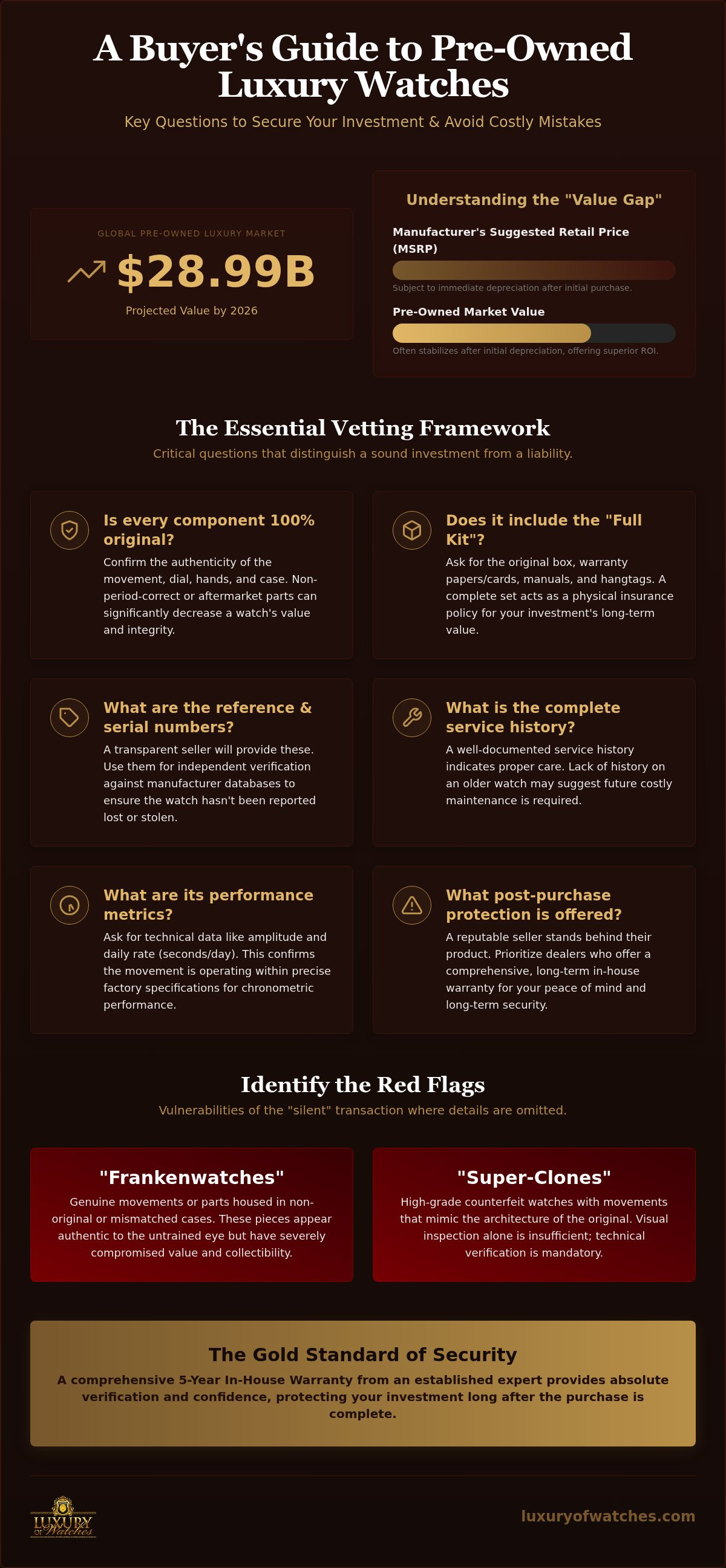
The secondary market is no longer a compromise; it's a strategic choice for discerning collectors. In 2026, the global pre-owned luxury watch market is projected to reach $28.99 billion. This growth is driven by buyers who recognize that the secondary market offers access to discontinued icons and avoids the immediate depreciation of retail. However, the complexity of this space means that the specific questions to ask when buying a pre-owned watch determine whether you're making a sound investment or a costly mistake.
Understanding the "Value Gap" is essential for any serious buyer. This gap represents the difference between a watch's MSRP and its secondary market price, combined with its long-term retention potential. By asking the right questions, you can identify pieces that have already weathered their initial depreciation curve. With new US import tariffs implemented in July 2026 adding costs to newly imported timepieces, domestic pre-owned inventory has become an even more powerful tool for maximizing your ROI.
The Distinction Between Pre-Owned and Vintage
While "vintage" typically refers to watches over thirty years old characterized by aged aesthetics and delicate movements, modern pre-owned timepieces are contemporary models featuring current technical specifications. These watches often still possess their original gaskets, sapphire crystals, and high-beat calibers. Incorporating pre-owned luxury watches into a collection requires a framework focused on performance rather than just patina. You aren't just looking for history. You're looking for a watch that meets current factory standards for water resistance and chronometric precision, necessitating a different set of technical inquiries.
The Risks of the "Silent" Transaction
The most dangerous purchase is one where the buyer assumes authenticity based on a high price tag or a reputable-looking storefront. The rise of high-grade "super-clones" has made visual inspection alone insufficient for the untrained eye. These sophisticated counterfeits often house movements that mimic the architecture of the original, making technical questions mandatory. A "silent" transaction, where details regarding internal components are glossed over, leaves you vulnerable to "frankenwatches"—genuine cases with aftermarket or incorrect internal parts. Establishing a rigorous vetting framework is the only way to ensure the watch on your wrist matches the documentation in your hand.
The Foundation: Questions on Authenticity and Provenance
Authenticity is the bedrock of any luxury acquisition. When you step into the secondary market, you aren't just buying a aesthetic; you're purchasing a specific mechanical pedigree. The most critical questions to ask when buying a pre-owned watch start with the integrity of the piece itself. You must confirm if the watch is 100% original, including the movement, dial, and hands. Even a genuine Rolex with a replaced, non-period-correct dial can lose a significant portion of its market value. Ask the seller directly: "Has any part of this watch been replaced with aftermarket or mismatched components?"
Beyond the physical watch, the documentation provides the paper trail necessary for long-term security. Always ask if the timepiece comes with the "Full Kit," which includes the original box, warranty papers or cards, and hangtags. Finally, request the reference and serial numbers. A transparent seller will provide these, allowing you to perform independent verification against manufacturer databases to ensure the watch hasn't been reported lost or stolen. Understanding the ownership history, or provenance, adds a final layer of reassurance to the transaction.
The "Box and Papers" Debate
In the world of high-end horology, a "Full Set" acts as a physical insurance policy for your investment. This complete packaging is why certain Rolex prices remain significantly higher than their "naked" counterparts. While collectors prefer the full kit, you don't always have to walk away from a watch-only deal. If the seller is an established expert who provides absolute verification and a 5-year in-house warranty, a naked watch can offer excellent value. The key is ensuring the serial numbers on the case match the documentation provided by the dealer, creating a closed loop of authenticity.
Spotting the "Frankenwatch"
A "Frankenwatch" is a genuine movement housed in a non-original or mismatched case. These pieces are the bane of the secondary market because they often look identical to a factory-original model at first glance. You must ask if the hands, bezel, or dial are service replacements. While service parts are genuine, they aren't "period-correct." For serious collectors, a 1990s model with 2020s service hands is less desirable than one with all its original components. If you're looking for an investment-grade piece, prioritize originality over a polished, "like-new" appearance. You can explore our meticulously vetted collection of pre-owned luxury watches to see how we maintain these rigorous standards of provenance.
Assessing Mechanical Integrity: Technical and Service Questions
Once you've confirmed that a timepiece is genuine, your focus must shift from authenticity to performance. A luxury watch is a high-precision machine; like any engine, its internal components require regular maintenance to function correctly. Among the most vital questions to ask when buying a pre-owned watch are those concerning the movement's current state and its history of professional care. A watch that looks pristine on the outside can still harbor dried lubricants or worn pivots that lead to expensive repairs down the road.
Before finalizing a transaction, ensure you have clear answers to these technical queries:
- When was the last time this movement was fully serviced by a certified watchmaker?
- What are the current timekeeping specifications, specifically the amplitude and the daily deviation in seconds?
- Has the watch passed a recent pressure test to confirm its water resistance?
- Are there any visible or internal signs of moisture ingress or corrosion on the movement or dial?
Decoding the Service History
A seller claiming a "recent service" without providing documentation is a significant red flag. You should ask for a specific service manifest that details exactly what was performed. A true overhaul involves the complete disassembly of the movement, ultrasonic cleaning of every part, and precise re-lubrication. It's also essential to ask about the amplitude. This health metric measures the degree of rotation in the balance wheel; a low amplitude often indicates a weak mainspring or excessive friction within the gear train. For a modern pre-owned watch, you're looking for a steady beat that reflects factory-grade chronometric precision.
Condition of the Exterior
The mechanical health is paramount, but the physical case and bracelet tell the story of how the watch was treated. You must ask about "over-polishing." While a light polish can restore a watch's luster, aggressive polishing rounds off the sharp edges of the lugs and thins the metal, which permanently diminishes the watch's silhouette and market value. Verify the integrity of the bracelet by checking for "stretch," which is the play between the links caused by years of wear. This is particularly relevant for high-performance Breitling watches, where the intricate finishes and professional-grade bracelets are central to the model's heritage and value. Ensuring the link count is correct for your wrist size avoids the additional cost of sourcing rare, discontinued components later.
The Transactional Layer: Questions for the Seller
Even a timepiece that meets every technical requirement remains a high-stakes investment until you vet the entity behind the sale. The final set of questions to ask when buying a pre-owned watch moves beyond the metal and into the legal and logistical framework of the transaction. You need to know exactly what happens if the watch arrives and fails to meet the described condition, or if it develops a mechanical fault months later.
A professional transaction should be transparent and documented. You should ask about the specific warranty coverage, the return window, and the methods used to secure high-value shipping. For any item exceeding $5,000, fully insured, overnight shipping isn't just a luxury; it's a necessity for protecting your capital. Never hesitate to ask for references or reviews from previous luxury buyers to confirm the seller’s history of successful, high-value deliveries. Understanding these questions to ask when buying a pre-owned watch ensures you're buying the peace of mind that comes with professional vetting.
Dealer vs. Private Seller: The Questioning Strategy
The level of recourse available to you depends heavily on who is across the table. While private sales might offer lower entry prices, they lack the institutional security of an established dealer. Professional dealers provide a layer of accountability that individuals simply cannot match, particularly regarding long-term mechanical support and absolute verification of the watch's history.
| Category | Questions for a Professional Dealer | Questions for a Private Seller |
|---|---|---|
| Accountability | What specific in-house warranty coverage do you provide? | Can you provide the original purchase receipt and ID? |
| Recourse | What is your official return and inspection policy? | Are you willing to use a third-party escrow service? |
| History | How long has your physical storefront or platform been active? | When and where was the last time this was serviced? |
The Reality of the Grey Market
Many collectors find their best value through the grey market. A grey market dealer is a professional entity selling genuine watches outside of official brand boutiques. When engaging with these specialists, ask if the watch was sourced from an authorized dealer or a private collection. Verifying a dealer’s physical presence and long-term reputation is vital for ensuring the watch’s legitimacy. Because manufacturer warranties often don't transfer or have already expired, the strength of the dealer’s own protection plan is your primary safety net. You can browse our collection with total peace of mind, knowing every piece is backed by our signature 5-year in-house warranty.
Securing Your Investment: The Luxury of Watches Standard
Knowing the right questions to ask when buying a pre-owned watch is the first step toward a successful acquisition. The second step is choosing a specialist who provides the answers before you even have to ask. At Luxury of Watches, we don't just facilitate transactions. We act as an expert intermediary, ensuring that every timepiece in our curated inventory has been meticulously pre-vetted for authenticity and mechanical integrity. This rigorous approach eliminates the anxiety of the secondary market, replacing uncertainty with the security of professional verification.
Our multi-point inspection process is exhaustive. We scrutinize every component, from the hairspring to the clasp, ensuring that no "frankenwatch" parts have compromised the piece's value. We verify serial numbers against official databases and confirm that every watch meets our strict standards for timekeeping and physical condition. By handling the technical vetting ourselves, we allow you to focus on the heritage and aesthetic of your chosen model rather than its mechanical risks.
Our Five-Year Performance Guarantee
Our signature five-year in-house warranty is the ultimate answer to concerns regarding future maintenance. In 2026, a standard overhaul for a luxury movement at an authorized service center can range from $800 to $1,600, with more complex calibers costing significantly more. By providing comprehensive coverage for mechanical failure and timekeeping precision, we bridge the gap for watches whose original manufacturer international warranties have long since expired. This level of protection is essential for high-performance brands like Rolex and Cartier, offering a safety net that a private sale simply cannot provide. We ensure your investment remains as reliable as the day it was first crafted.
A Legacy of Trust Since 1999
Founded in 1999, our business was built on a foundation of secure transactions and horological expertise. We understand that high-value purchases require more than just a digital storefront. They require a US-based support team that understands the nuances of the secondary market. Our commitment to absolute documentation and physical inspection means you never have to gamble on an unverified listing. We combine the prestige of the world's leading manufacturers with the modern efficiency of a premier commerce platform, ensuring every customer feels both emotionally inspired and intellectually secure. Browse our certified pre-owned Rolex collection today and experience the standard of excellence your collection deserves.
Master Your Next Horological Acquisition
Navigating the secondary market successfully requires shifting your focus from the allure of the timepiece to the accountability of the seller. By mastering the essential questions to ask when buying a pre-owned watch, you've moved beyond the risks of "frankenwatches" and unverified service histories. You now possess a professional framework to evaluate authenticity, technical amplitude, and the long-term value of your investment.
True security comes from pairing this knowledge with a partner who prioritizes your peace of mind. At Luxury of Watches, we eliminate the traditional anxieties of the pre-owned space through our rigorous multi-point inspection and a signature 5-year in-house warranty. Whether you're seeking a rare Rolex or a contemporary Cartier, our US-based support team and secure worldwide shipping ensure your journey is as seamless as the movement on your wrist.
Explore Our Authenticated Pre-Owned Luxury Watch Collection today and find the icon that defines your legacy. Your next masterpiece is waiting for you with the absolute verification and professional support you deserve.
Frequently Asked Questions
Is it worth buying a pre-owned watch without the original box and papers?
Buying a watch without the full kit is a viable strategy if you prioritize value over collectibility. While "box and papers" command a premium, a watch-only purchase from a trusted dealer ensures you're still receiving an authentic, high-performance machine. The key is to ensure the seller provides an alternative form of security, such as an official authentication certificate and a comprehensive five-year in-house warranty to protect your investment.
How do I know if a pre-owned luxury watch is authentic?
Absolute verification requires a multi-faceted approach. You should cross-reference the serial numbers with manufacturer databases and have a certified watchmaker inspect the movement for correct architecture. Professional dealers eliminate this burden by performing these inspections before the watch reaches inventory. This pre-vetting process guarantees that every component, from the escapement to the crystal, meets factory standards for authenticity and performance.
What is the most important question to ask a private seller?
You must ask for the original purchase receipt and a documented service history. Private sellers don't offer the institutional recourse of a professional dealer, so you need to verify the watch's legal provenance yourself. If a seller cannot provide a clear paper trail or is unwilling to meet at a certified watchmaker for an inspection, it's often safer to walk away from the transaction entirely.
Does a pre-owned watch still have a manufacturer warranty?
Most secondary market timepieces have already surpassed their original manufacturer's coverage period. While a newer model might have a remaining balance, it's rare in the pre-owned space. This reality highlights why we provide a unique 5-year in-house warranty. This coverage ensures your timepiece continues to operate within factory specifications long after the brand's international support has ended, offering a level of security that private sales cannot match.
What happens if a pre-owned watch needs service shortly after purchase?
The outcome depends entirely on your choice of seller. If you buy through a private sale, you're responsible for all subsequent repair costs, which can be significant for complex movements. When you purchase through an established expert, mechanical issues are typically addressed under a comprehensive service guarantee. Our five-year in-house warranty acts as a safety net, covering mechanical failures so your focus remains on the enjoyment of your timepiece.
How can I verify the service history of a luxury watch?
Request a detailed service manifest from a certified watchmaker. A legitimate service history isn't just a verbal claim; it's a documented record of cleaning, re-lubrication, and pressure testing. If the seller mentions a recent overhaul, they should be able to provide a receipt that lists the specific work performed. Without this documentation, you should assume the watch will require a professional service in the near future.
Is it safe to buy a pre-owned Rolex online?
Yes, provided you vet the digital platform's reputation and security measures. It's essential to confirm the dealer has a legacy of secure transactions and offers fully insured shipping for high-value items. One of the vital questions to ask when buying a pre-owned watch online concerns the return policy. A reputable dealer will allow a specific inspection period to ensure the timepiece meets your expectations and matches the description.
What is a "frankenwatch" and how do I avoid one?
A "frankenwatch" is a genuine movement housed in mismatched or non-period-correct parts. To avoid these, you must ask specific questions to ask when buying a pre-owned watch about whether the dial, hands, or bezel have been replaced with service components. While these parts are genuine, they diminish the watch's investment value. Buying from specialists who perform rigorous multi-point inspections is the most effective way to ensure every component is factory-original.