
The Ultimate Pre-Owned Watch Inspection Checklist: A Collector’s Guide for 2026
23rd Apr 2026
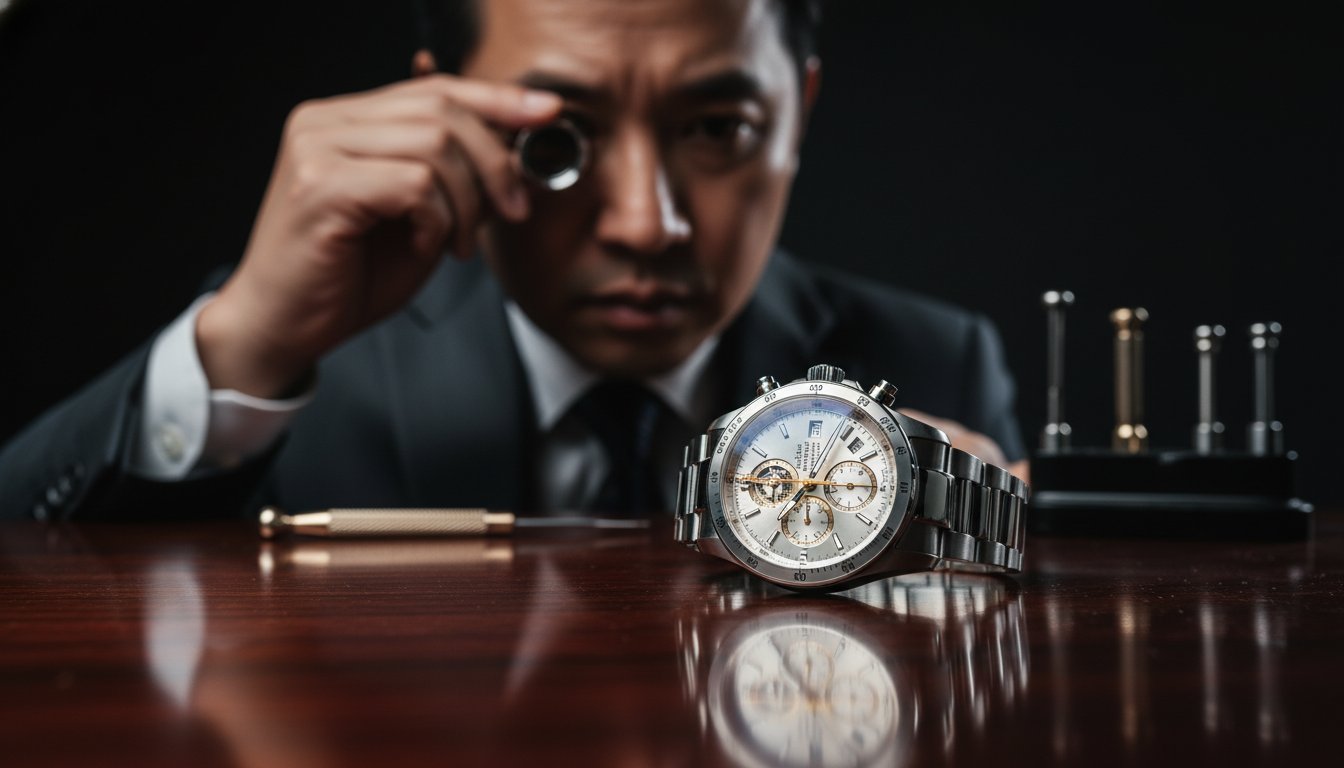
Would you be able to distinguish a masterfully crafted "super-clone" from a genuine 2025 Rolex Daytona under a standard jeweler's loupe? As horological engineering reaches new heights, the risk of acquiring an imitation or a mechanically compromised timepiece has never been more prevalent. You already know that the secondary market offers an exquisite opportunity to own prestigious brands without the traditional retail markup. However, the anxiety of hidden service costs or missing documentation can often overshadow the excitement of a new acquisition.
To protect your investment, we've developed the ultimate pre-owned watch inspection checklist for 2026. This expert-vetted guide provides the definitive checkpoints you need to verify authenticity and mechanical integrity before you commit. You'll learn how to scrutinize everything from the movement's beat rate to the specific hallmarks of "box and papers" significance. This article breaks down the technical evaluation process into a clear, actionable roadmap that ensures you walk away with a pristine timepiece and absolute confidence in your seller's promise.
Key Takeaways
- Discover how to establish baseline authenticity by matching specific reference numbers to production years and verifying the precise caliber of the movement.
- Master our professional pre-owned watch inspection checklist to evaluate aesthetic integrity, from identifying original case chamfers to verifying period-correct lume materials.
- Gain the technical expertise to assess a movement’s health through tactile winding feedback and the interpretation of essential timegrapher metrics like amplitude and beat error.
- Learn to verify the modern trail of provenance, ensuring that serial numbers align perfectly across physical components and the latest NFC-enabled warranty documentation.
- Understand why the seller is your final safeguard, emphasizing the importance of secure transactions and the long-term value of a comprehensive 5-year in-house warranty.
Pre-Inspection Research: Setting the Baseline for Authenticity
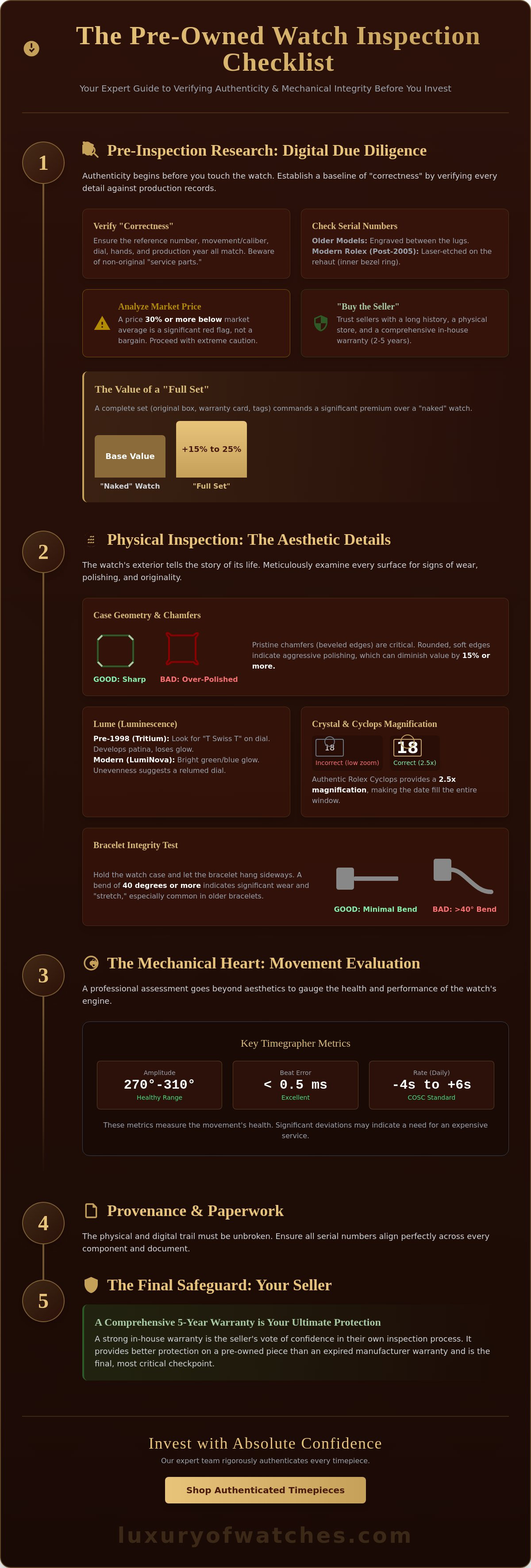
Authenticity begins long before you hold a timepiece in your hands. In the 2026 secondary market, a professional pre-owned watch inspection checklist starts with rigorous digital due diligence. The primary goal is to establish "correctness," a term collectors use to describe a watch where every component matches the specific reference number and its corresponding production year. It's common for vintage or pre-owned pieces to have "service parts," such as later-period hands or dials, which can significantly impact the valuation and historical integrity of the piece.
Researching the specific movement is a critical step for understanding watch movements and their expected performance. For instance, if you're eyeing a Rolex Submariner reference 126610LN, you must verify it contains the Calibre 3235. Identifying the caliber allows you to cross-reference technical specifications like power reserve and beat rate during your physical inspection. If a Cartier model from 2021 is advertised with a high-autonomy quartz movement but shows signs of a standard 2-year battery cycle, the watch's internal "correctness" is compromised.
The 2026 resale market places a high premium on "Full Set" acquisitions. A watch accompanied by its original box, warranty card, and hang tags typically commands a 15% to 25% price increase over "Naked" watches. While a naked watch is not necessarily a replica, it demands a more exhaustive verification process. Always establish a baseline price using 90-day market averages. A price point that sits 30% below the current market value is rarely a bargain; it's a red flag for potential mechanical issues or authenticity concerns.
The Reference Number Deep Dive
Reference and serial numbers are the DNA of a luxury timepiece. On older models, you'll find these engraved between the lugs, requiring the removal of the bracelet. On modern Rolex pieces produced after 2005, the serial number is laser-etched on the rehaut. The rehaut is the inner metal ring between the dial and the crystal, serving as a prominent security feature in modern horology. Use digital databases to ensure the dial variations, such as "Maxi" dials or specific font serifs, align perfectly with the production date indicated by the serial number.
Verifying the Seller’s Reputation
The "Buy the Seller" maxim is the most vital rule for any collector. A seller's longevity is a proxy for their legitimacy. A business with a brick-and-mortar presence and a history dating back to 1999 provides a level of security that a pop-up online dealer cannot replicate. When reviewing the listing, evaluate the strength of the in-house warranty. A comprehensive 2-year or 5-year dealer guarantee often provides better protection for a pre-owned piece than an expired international manufacturer warranty, as it proves the dealer has confidence in their own pre-owned watch inspection checklist and authentication process.
The Physical Exterior: A 10-Point Aesthetic Inspection
A meticulous physical evaluation forms the core of any pre-owned watch inspection checklist. You should begin by scrutinizing the case's geometric integrity. On a pristine Rolex Submariner or GMT-Master II, the chamfers, which are the beveled edges between the lugs and the case, must remain sharp and distinct. If these edges appear rounded or soft, the watch has likely undergone aggressive polishing. This can diminish the resale value by 15% or more compared to an unpolished example with original factory lines.
Next, evaluate the lume. Watches produced before 1998 typically feature Tritium, marked by "T Swiss T" or "T<25" at the bottom of the dial. This material eventually loses its glow and develops a creamy patina. Modern pieces use Super-LumiNova or Chromalight, which should provide a bright, consistent green or blue glow after exposure to light. Any unevenness in the glow suggests the dial might have been relumed, a detail that purists often avoid.
Bracelet integrity is another critical factor, particularly for vintage Rolex Jubilee or Oyster bracelets. You can test for "stretch" by holding the watch head-on and letting the bracelet hang sideways. A 40-degree or greater bend indicates significant wear in the pins and links. For the crystal, verify the Cyclops magnification. Authentic Rolex crystals provide a 2.5x zoom that makes the date fill the entire window. If the date looks small or lacks an anti-reflective coating on the bubble, it's a significant red flag.
Dial and Hands Under Magnification
Use a 10x jeweler’s loupe to inspect the dial's typography. High-end brands like Omega and Rolex use precision pad printing. Any bleeding ink or fuzzy edges suggest a counterfeit or a poorly executed service dial. Check the alignment of the hour markers against the minute track. You should also look for drag marks on the dial surface. These occur if the hands were improperly seated during a past repair. The markings at 6 o’clock, such as "Swiss Made," must be perfectly centered and crisp.
Bezel and Crown Functionality
Rotate the bezel to test the click-spring tension. A Submariner should have a crisp, 120-click unidirectional rotation with zero back-play. For ceramic Cerachrom bezels, look for micro-cracks or fading, though these materials are designed to be virtually scratch-proof. Finally, examine the crown. The logo should be well-defined and the threads should feel smooth when screwing it down. If you feel resistance or grittiness, the gaskets may be dry-rotted, which could compromise the 100-meter or 300-meter water resistance rating.
The Mechanical Heart: Evaluating Movement and Complications
Assessing the caliber is the most critical step in your pre-owned watch inspection checklist. A pristine exterior can hide a neglected engine, so you must rely on tactile feedback and technical data. Start by winding the crown manually. A genuine Swiss caliber, such as a Rolex 3235 or an Omega Master Co-Axial, provides a smooth, consistent resistance. If you feel a gritty sensation or hear a clicking sound that feels "crunchy," the movement likely requires a full overhaul or has internal debris.
A professional seller should provide a timegrapher reading to validate the watch's health. You're looking for specific metrics to ensure the timepiece meets factory standards. A healthy modern movement should display an amplitude between 270 and 310 degrees. If the amplitude falls below 230 degrees, the mainspring is likely fatigued or the lubrication has dried. The beat error should ideally remain below 0.5 milliseconds; anything higher suggests the balance wheel isn't swinging evenly, which affects long-term accuracy.
You must also listen to the rotor's movement. High-end calibers are engineered for efficiency and silence. While some ball-bearing rotors in brands like Breitling or TAG Heuer have a faint whir, a loud rattle or a "tinny" spinning sound is a red flag. It often indicates a loose rotor weight or a low-quality clone movement that lacks the refined tolerances of an authentic piece.
Crown Positions and Setting the Time
Pull the crown to its furthest position to verify the "hacking" seconds functionality. This feature, standard in most modern luxury calibers, should stop the seconds hand instantly for precise time setting. When you screw the crown back in, the threads should feel buttery smooth. Any resistance or "jumping" suggests the tube is cross-threaded, which can lead to a failure in water resistance. Test the quick-set date function by cycling through several days. The transition should be crisp, with no mechanical drag or hesitation as the gears engage.
Chronograph and GMT Testing
When inspecting a chronograph, start, stop, and reset the sweep hand multiple times. The hand must snap back exactly to the 12 o'clock marker every single time. A misalignment of even 0.1 millimeters is a sign that the hand has shifted on its post or the heart-piece cam is worn. For "True" GMT movements, such as the Rolex GMT-Master II, verify the independent hour hand. It should jump in clean, one-hour increments without disturbing the minute or seconds hands. This level of technical sophistication is a hallmark of horological excellence, as detailed in The Comprehensive Guide to Pre-Owned Luxury Watches. Ensuring these complications function perfectly is essential for maintaining the value of your investment. This thorough pre-owned watch inspection checklist approach guarantees that the "luxury" you're paying for is present under the dial as well as on it.
Provenance and Paperwork: Verifying the Digital and Physical Trail
The landscape of watch authentication has shifted dramatically. By 2026, the traditional paper certificate is no longer the sole arbiter of a timepiece's history. Modern collectors must evaluate a dual trail of physical and digital evidence. A critical step in your pre-owned watch inspection checklist involves verifying that the physical serial number on the watch case matches the warranty card and the original hangtags exactly. Discrepancies here often signal a "franken-watch" or a mismatched set that significantly devalues the piece. Service paperwork from a reputable house like Rolex or Omega acts as a powerful value-add. It provides a documented history of maintenance and confirms that a professional watchmaker has recently verified the movement's internal components.
Spotting forged documents requires a keen eye for detail. Original Rolex papers from the pre-digital era feature specific watermarks and consistent, high-quality font spacing that counterfeiters struggle to replicate. You should always inspect these documents under a loupe to check for ink bleeding or irregular patterns. In the current market, the presence of a "Certificate of Authenticity" from a premier dealer remains the gold standard for buyer protection. This document bridges the gap between the manufacturer's origin and the watch's current condition.
The Anatomy of a Full Set
A "Full Set" represents the pinnacle of collectibility. This typically includes the outer cardboard box, the inner presentation box, the instruction manual, and the warranty card or certificate. You should also look for the original hangtags and any extra bracelet links that were removed during initial sizing. A "naked" watch, which consists of the timepiece alone without its original packaging or papers, should be priced 15% to 20% lower than a complete set. While the watch itself may be pristine, the lack of provenance complicates future resale and reduces its appeal to serious investors.
Digital Provenance and Blockchain
The 2026 era has fully embraced digital passports to combat the rise of sophisticated replicas. Brands like Breitling and Vacheron Constantin now use encrypted ownership logs and digital twins to track a watch from the factory to the secondary market. You can often verify these records by using a smartphone to scan NFC-enabled warranty cards, which pull up official manufacturer data instantly. This encrypted trail ensures that the service history and ownership transfers are immutable. As you complete your pre-owned watch inspection checklist, ensure the digital record matches the physical watch in your hands. This technological layer provides the ultimate peace of mind for high-value luxury transactions.
Secure your next investment with a timepiece that meets the highest standards of documentation. Browse our certified authentic collection at Luxury of Watches and buy with total confidence.
Securing Your Investment: Why the Seller is the Final Checklist Item
The final entry on any pre-owned watch inspection checklist isn't a physical component of the timepiece. It's the integrity of the vendor. High-value transactions require more than a magnifying glass; they demand secure, encrypted payment gateways and fully insured shipping protocols. While a private sale might appear to save a small percentage upfront, it lacks the institutional safety nets that define a professional acquisition. Moving from inspection to purchase involves verifying that your investment is protected from the moment it leaves the vault until it circles your wrist.
A factory warranty on a five-year-old watch is often a ghost. By 2026, many pieces from the early 2020s have seen their manufacturer coverage expire. Luxury of Watches provides a 5-year in-house warranty that effectively restarts the clock on your peace of mind. This coverage often exceeds the utility of original manufacturer papers by providing a direct line to expert watchmakers who specialize in high-complication movements. We act as the Trusted Connoisseur, ensuring that every internal component matches the reference number on the case. The lowest price on a public marketplace is frequently a trap for the unwary. Without a 100% authenticity guarantee and a physical Certificate of Authenticity, a bargain can quickly become a liability.
The Grey Market Advantage
The primary benefit of the secondary market involves immediate access to horological icons. You don't have to endure a 60-month waitlist at a boutique for a stainless steel Daytona or a Nautilus. You can acquire these models today. Understanding the Rolex Prices 2026 market values helps you balance the price-to-prestige ratio effectively. You're paying for the privilege of immediate ownership and the certainty of a vetted, pristine instrument that has already passed a rigorous pre-owned watch inspection checklist.
Final Pre-Purchase Questions to Ask
Before you finalize your acquisition, ask these technical questions to verify the movement's health and the case's structural integrity:
- "When was this watch last pressure tested for water resistance to ensure the gaskets remain supple?"
- "Can you provide a timegrapher reading showing the current beat error and amplitude?"
- "Does the watch come with a verified Certificate of Authenticity from your in-house experts?"
A beat error above 0.3ms or an amplitude reading below 250 degrees suggests the movement requires a service. Professional sellers provide these metrics transparently to ensure the watch performs to chronometer standards.
Browse our curated collection of inspected pre-owned Rolex watches to find an exquisite timepiece backed by our 5-year warranty.
Master Your Next Horological Acquisition
Mastering the art of horology requires more than just an eye for design; it demands a rigorous commitment to technical verification. By utilizing a comprehensive pre-owned watch inspection checklist, you'll transform from a casual buyer into a disciplined collector. Focus your scrutiny on the 10-point aesthetic evaluation and the mechanical movement to ensure your investment stands the test of time. Always verify the provenance trail to confirm every component is pristine.
Luxury of Watches has refined this vetting process since we opened our doors in 1999. Our physical boutique in California serves as the foundation for a global reputation built on transparency and excellence. We eliminate the uncertainty of the secondary market. Every purchase includes a 100% Authenticity Certificate and is backed by our industry-leading 5-Year In-House Warranty. You deserve the prestige of a world-class timepiece without the risks of the unknown.
Explore Our 100% Authenticity Guaranteed Pre-Owned Collection
Your journey toward owning a timeless masterpiece is just beginning.
Frequently Asked Questions
Is it safe to buy a pre-owned luxury watch without the original papers?
It's safe to purchase a watch without papers if you buy from a reputable dealer that provides a Certificate of Authenticity. While collectors prefer a full set, a missing warranty card doesn't mean the timepiece isn't genuine. At Luxury of Watches, our experts verify every movement to ensure it's 100% authentic. This verification is a vital part of your pre-owned watch inspection checklist to ensure the piece meets our high standards.
How can I tell if a Rolex has been over-polished?
You can identify an over-polished Rolex by checking the sharpness of the lug edges and the definition of the crown on the clasp. A pristine, factory-finish lug has a crisp, defined angle; if the metal looks rounded or thin, it's been excessively buffed. On a Submariner, the 5-pointed coronet on the clasp should stand in high relief rather than looking faint or melted into the steel.
What is the most important thing to check on a used Breitling?
The most critical component to inspect on a Breitling is the anti-reflective coating on the sapphire crystal. Breitling uses a double-sided coating that can show visible scratches or a blue tint wear pattern after 3 to 5 years of regular use. Ensure the crystal is clear and the bezel's rider tabs are securely fastened with their original screws, as these are often lost during improper servicing.
Do pre-owned watches from Luxury of Watches come with a warranty?
Yes, every pre-owned timepiece we sell comes with a comprehensive warranty to give you total peace of mind. This protection covers the internal movement and mechanical functions of your watch. By providing this safety net, we eliminate the risks found on the private market. It's our way of ensuring your investment remains as reliable as it is prestigious while offering the lowest price possible.
What does "Full Set" mean in the watch world?
A "Full Set" means the watch includes its original outer box, inner presentation box, warranty papers, and the instruction manual. In many cases, this also includes the original hangtags and extra bracelet links. Collectors value these sets highly, and they often command a premium of 10% to 20% over naked watches because they provide a documented history and provenance for the specific timepiece.
Can I verify a watch serial number online for free?
You can use free databases like the Art Loss Register or Enquirus to check if a serial number is reported stolen. While these tools are helpful, they won't confirm if a watch is genuine. A professional pre-owned watch inspection checklist involves cross-referencing the serial number with manufacturer production dates. Brands like Rolex and Omega maintain private archives, so dealer verification remains the most reliable method for collectors.
How often should a pre-owned luxury watch be serviced?
Most manufacturers, including Rolex and Omega, recommend a full mechanical service every 5 to 10 years. If the watch is a vintage model from before 1990, a shorter interval of 3 to 5 years is better to preserve aging gaskets and lubricants. It's also smart to get a pressure test every 12 months if you plan to wear your timepiece in water to prevent moisture damage.
What are the red flags when looking at a pre-owned watch dial?
Look for bleeding text, uneven lume application, or misaligned hour markers, which are clear indicators of a counterfeit or a poorly executed redial. A genuine dial features crisp, raised printing and perfectly centered logos. If you notice dust particles or fingerprints under the crystal, it suggests the watch was opened in a non-sterile environment. This often leads to compromised movement integrity or future mechanical issues.