
Luxury Watches: The 2026 Collector’s Guide to Value, Heritage, and Craftsmanship
Posted by Luxury of Watches on 16th Sep 2026
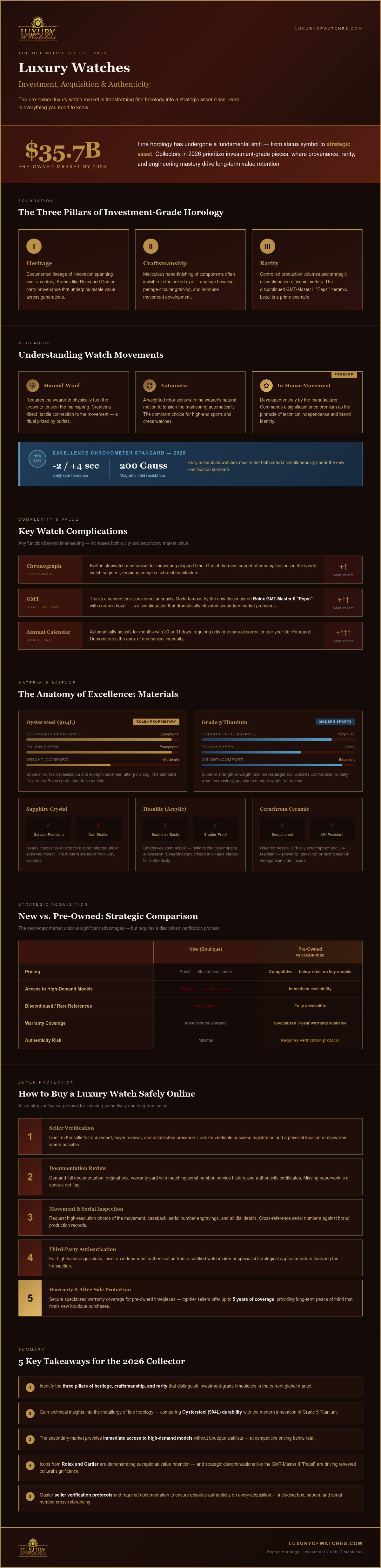
In 2026, the pre-owned market for luxury watches is projected to reach $35.7 billion. This staggering figure reflects a fundamental shift where fine horology is viewed as a strategic asset rather than a simple status symbol. You likely appreciate the profound craftsmanship behind a Rolex or a Patek Philippe, yet the secondary market often feels like a minefield of price volatility and sophisticated counterfeits. It's natural to feel a sense of hesitation when the stakes for authenticity and long term value are this high.
We promise to strip away the confusion and provide you with a clear, expert path toward securing your next timepiece. This guide offers a comprehensive look at the current landscape, from the new Excellence Chronometer standards to the strategic discontinuation of iconic models like the GMT-Master II "Pepsi." You'll gain the technical knowledge to distinguish between movements and the confidence to navigate verification protocols. We will examine how to leverage competitive secondary market pricing while ensuring your investment is protected by robust documentation and specialized five year warranty coverage.
Key Takeaways
- Identify the three pillars of heritage, craftsmanship, and rarity that distinguish investment-grade timepieces in the current global market.
- Gain technical insights into the metallurgy of fine horology, comparing the enduring strength of Oystersteel with the modern innovation of Grade 5 Titanium.
- Learn the strategic advantages of the secondary market for luxury watches, which provides immediate access to high-demand models without the constraints of boutique waitlists.
- Recognize the specific icons from Rolex and Cartier that are currently demonstrating exceptional value retention and renewed cultural significance.
- Establish a secure purchase path by mastering seller verification protocols and identifying the documentation required to ensure absolute authenticity.
What Defines a Luxury Watch in 2026?
Defining true luxury in horology requires looking beyond the price tag. In 2026, the industry rests upon three non-negotiable pillars: heritage, craftsmanship, and rarity. Heritage isn't merely the age of a manufacturer; it's the documented lineage of innovation that brands like Rolex and Cartier have maintained for over a century. Craftsmanship refers to the meticulous hand-finishing of components that are often invisible to the naked eye. Rarity, meanwhile, is now defined by controlled production volumes and the strategic discontinuation of specific models. A luxury watch is a masterpiece of micro-engineering and historical legacy.
Collectors in 2026 have moved past the "hype" phase of previous years. They now prioritize investment-grade pieces over ephemeral fashion trends. While high-end quartz movements offer undeniable precision, the heart of the collector's market remains the mechanical movement. The history of watches reveals a steady progression from basic timekeeping to these mechanical marvels that hold their value across generations. Today, luxury watches are viewed as engineered assets, where the provenance of the manufacturer is as vital as the physical materials used.
Mechanical vs. Automatic Movements
The movement, or calibre, is the soul of any timepiece. Manual-wind mechanisms require the wearer to physically turn the crown, creating a tactile connection to the machine. In contrast, automatic movements utilize a weighted rotor that spins with the wearer's natural motion to tension the mainspring. In-house movements, developed entirely by the manufacturer rather than sourced from third parties, command significant premiums because they represent the pinnacle of technical independence. The new Excellence Chronometer standards introduced in late 2026 further elevate these expectations, requiring fully assembled watches to maintain a daily rate tolerance of -2/+4 seconds while resisting magnetic fields up to 200 Gauss.
The Importance of Complications
A complication is any function on a watch that goes beyond simple timekeeping. These features add both utility and complexity to the build. Common examples include:
- Chronographs: Built-in stopwatches for measuring elapsed time.
- GMTs: The ability to track a second time zone, a feature made famous by models like the now-discontinued ceramic bezel Rolex GMT-Master II "Pepsi."
- Annual Calendars: Mechanisms that automatically adjust for months with 30 or 31 days.
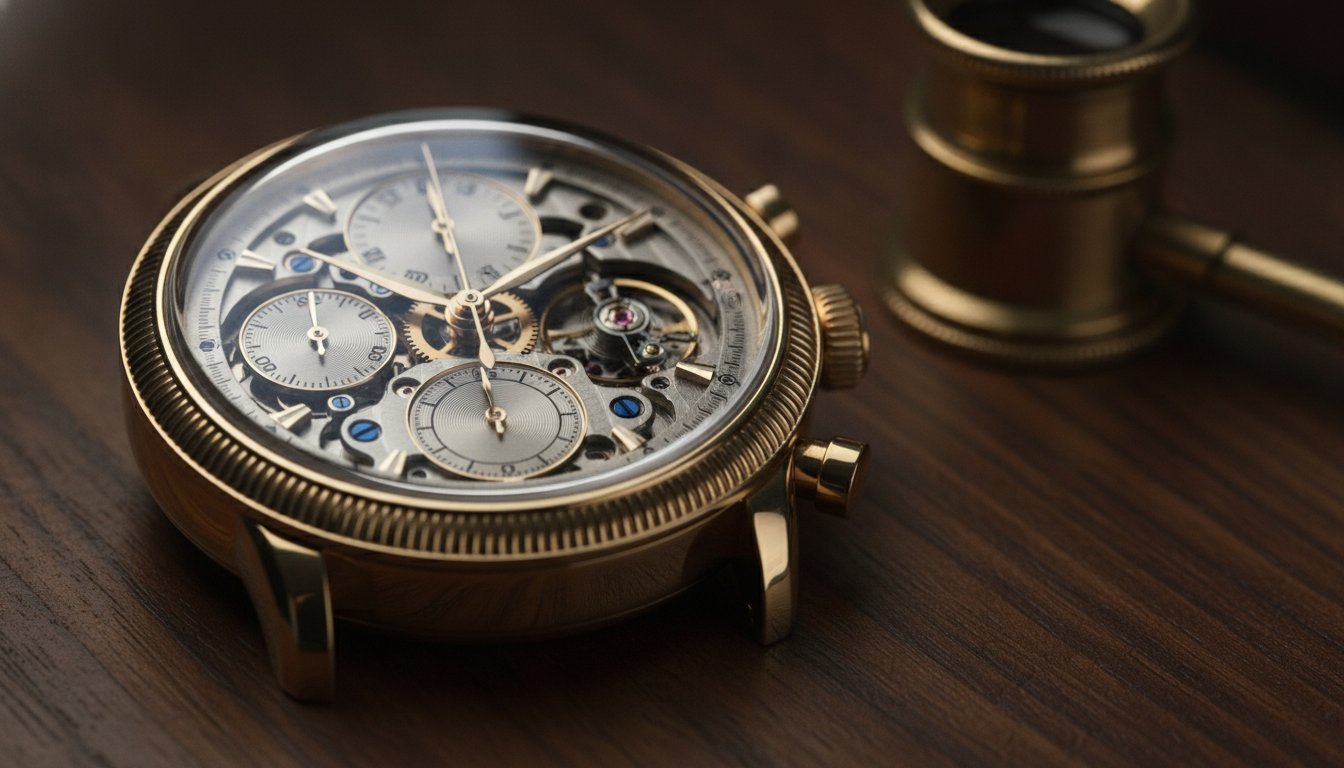
While these features increase the retail and secondary market price, they also offer a canvas for aesthetic expression. Skeletonized or "Open Heart" dials allow you to view the oscillating balance wheel and gear train, turning the dial into a living showcase of mechanical artistry. This transparency serves to validate the technical mastery that justifies a high-value acquisition.
The Anatomy of Excellence: Materials and Finishing
High-tier materials define the longevity and aesthetic permanence of luxury watches. While standard steel suffices for entry-level pieces, elite manufacturers utilize specialized alloys like Oystersteel (904L) for its superior corrosion resistance and exceptional sheen after polishing. Rolex's proprietary 18k Everose gold is another example of metallurgical mastery, providing a unique pink hue that won't fade over time due to its specific chemical composition. These materials ensure that a timepiece remains as striking as the day it was forged, even after decades of wear.
Modern sports watches have seen a significant shift toward Grade 5 Titanium and ceramic components such as Cerachrom. Titanium offers a strength-to-weight ratio that makes larger tool watches comfortable for daily use. Ceramic bezels are virtually scratchproof and resistant to UV rays, which prevents the "ghosting" or fading common in vintage aluminum inserts. This transition toward advanced materials reflects a broader trend of combining heritage aesthetics with modern resilience.
Choosing between sapphire crystal and Hesalite often involves a trade-off between clarity and shatter resistance. Sapphire is nearly impossible to scratch but can shatter under extreme impact. Hesalite, a form of acrylic, is more prone to surface scuffs but won't shatter, making it a historic choice for space exploration. The evolution of watchmaking demonstrates how these material choices have consistently balanced visual brilliance with the functional needs of the wearer.
Hand-finishing techniques like 'Anglage' (beveling edges) and perlage (circular graining) distinguish artisanal calibres from mass-produced movements. These details require hours of manual labor from master watchmakers, justifying the price gap found in the secondary market. If you are looking for a piece that showcases this level of detail, you can explore our collection of pre-owned luxury watches to find a model that fits your collection.
Precious Metals and Their Market Value
Platinum remains the most prestigious choice for collectors, often trading at a higher premium than yellow or white gold due to its density and rarity. However, the "Two-Tone" or Rolesor trend has seen a resurgence in 2026. It offers a sophisticated middle ground, blending the durability of steel with the prestige of 18k gold. When acquiring these pieces, always look for hallmark verification on the case back or lugs to confirm metal purity and maintain the watch's long term value.
The Dial and Bezel: The Face of the Icon
The dial is the face of the icon, where artistry meets utility. Enamel and sunray finishes provide classic elegance, while meteorite dials offer a unique, extraterrestrial pattern that ensures no two watches are identical. Functional bezels are equally critical; unidirectional bezels prevent divers from accidentally underestimating their immersion time, while bidirectional bezels allow pilots to track multiple time zones. For visibility, proprietary compounds like Chromalight offer a distinct blue glow that can last up to eight hours in total darkness.
Strategic Acquisition: New vs. Pre-Owned Luxury Watches
Acquiring a high-tier timepiece in 2026 requires a balance of patience and market intelligence. Boutique waitlists for the most coveted models, such as the Rolex Submariner or Daytona, continue to stretch into years. This scarcity has transformed the secondary market for luxury watches into the primary destination for serious collectors. While the boutique offers a specific ceremony, the online secondary market provides immediate availability and access to discontinued references that are no longer in production.
Understanding depreciation curves is essential for protecting your capital. Some manufacturers see their products appreciate the moment they're sold, while others may lose up to 30% of their value instantly. This volatility makes the "grey market" an attractive alternative; these retailers provide authentic goods sourced through official channels but sold without the massive overhead of a flagship boutique. While manufacturer warranties may not transfer, a comprehensive 5-year in-house warranty provides superior peace of mind.
Evaluating Pre-Owned Condition
Standardizing the grading of pre-owned pieces ensures transparency. A "Mint" designation implies the watch is indistinguishable from new, while "Excellent" and "Very Good" indicate varying degrees of light, honest wear. Beyond the physical state, the presence of the original box and papers is a critical value driver. This documentation acts as a secondary layer of verification and can increase the resale value by 10% to 15%. Always scrutinize the service history; a well-documented maintenance log is proof that the mechanical integrity has been preserved.
The Role of Independent Warranties
Since many manufacturer warranties are non-transferable, the secondary market relies on robust dealer-backed protection. A professional 5-year in-house warranty should be comprehensive, covering the movement's accuracy, the power reserve, and the integrity of the water-resistant seals. This protection is only as good as the verification protocols that precede it. Expert intermediaries conduct multi-point inspections to confirm every component is authentic and functioning to factory specifications before the watch is listed for sale. This rigorous process ensures that accessible prestige never comes at the cost of security.
Iconic Brands and Models to Watch in 2026
Rolex continues to set the tempo for the global market, maintaining an untouchable status that few other manufacturers can match. Its core lineup, specifically the Submariner, Daytona, and Datejust, remains the most liquid asset class in horology. While other brands have seen fluctuations, these models consistently attract both seasoned investors and first time buyers. The hierarchy of luxury watches is shifting, however, as Cartier and Breitling expand their influence through a mix of heritage revival and technical refinement.
Rolex Market Trends for 2026
The Rolex Submariner 126610LN remains the universal benchmark for the industry. In September 2026, the retail MSRP stands at $11,350, but the reality of boutique scarcity means unworn models trade for approximately $15,689 on the secondary market. This 38% premium is a direct result of the immediate availability offered by expert intermediaries. Collectors are also pivoting toward "Sleeping Beauties" like the Explorer II or specific Oyster Perpetual colors. These models are poised for growth, especially following the official discontinuation of the modern ceramic "Pepsi" GMT-Master II earlier this year.
Elegance and Performance: Cartier and Breitling
Cartier has secured a unique position where high jewelry meets horological precision. The Santos and Tank have emerged as the definitive unisex icons of 2026, appealing to a younger demographic that values geometric design over traditional round cases. For those who prioritize a more technical aesthetic, the Breitling Navitimer continues its reign as the ultimate pilot's tool. It's a watch that has successfully transitioned from a cockpit instrument to a luxury staple without losing its functional soul. Choosing between these brands often comes down to a preference for Cartier’s refined Roman numerals versus Breitling’s complex, high performance slide-rule bezels.
Patek Philippe and Audemars Piguet represent the pinnacle of the "Holy Trinity." The allure of the integrated bracelet, a design language perfected by the Nautilus and Royal Oak, shows no signs of waning. Even with the Nautilus 5711/1A trading between $65,000 and $85,000 for a full set, these pieces are regarded as the final word in prestige. The market for these luxury watches is increasingly professionalized, with a heavy emphasis on absolute verification and official documentation to protect these high value acquisitions. Explore our current selection of authentic timepieces to find an investment grade model that matches your personal legacy.
How to Buy a Luxury Watch Safely Online
Acquiring high-tier timepieces through digital platforms requires a transition from emotional appreciation to rigorous intellectual scrutiny. The digital landscape for luxury watches offers unparalleled access to inventory, yet it demands a disciplined approach to seller verification. You should prioritize dealers with established longevity; a business founded in 1999, for instance, provides a track record that a newer entity cannot match. Always verify a seller's physical presence and cross-reference their reputation across multiple independent review platforms to ensure their history of delivery matches their digital facade.
Price remains the most immediate indicator of risk. If a listing for a high-demand model is significantly lower than the market averages discussed in previous sections, it's a primary red flag. Fraudulent listings often use "too good to be true" pricing to bypass a buyer's logic. Secure your transaction by insisting on encrypted payment methods and fully insured, signature-required shipping. Once the piece arrives, don't hesitate to take it to a local horological expert for a second opinion. This final step provides a definitive layer of reassurance to your acquisition process.
Authenticity Verification Protocols
A professional listing must include high-resolution photography that captures the movement, the serial number, and the specific hallmarks of the case. These images allow you to perform initial serial number matching against known databases before the purchase is finalized. At Luxury of Watches, we utilize absolute verification and official documentation protocols to ensure every piece is 100% authentic. Our experts conduct multi-point inspections on every internal component, ensuring the caliber is original to the reference and performing to factory specifications.
Maintaining Your Investment
The security of your investment continues long after the purchase is complete. Proper storage is essential; while watch winders are convenient for keeping complications active, a climate-controlled safe deposit box is superior for long-term protection of rare metals and delicate dials. To preserve mechanical integrity, adhere to a five to seven year service interval. During a full overhaul, a specialist will disassemble the movement, replace worn components, and apply fresh lubricants to ensure the gear train operates without friction.
Water resistance is the most critical annual check you can perform. Even if you don't intend to dive with your timepiece, gaskets and seals can degrade over time due to temperature fluctuations and environmental exposure. A simple pressure test once a year ensures your luxury watches remain hermetically sealed against moisture and dust, protecting the intricate micro-engineering inside for the decades to come.
Securing Your Horological Legacy
The 2026 market for luxury watches has matured into a space where technical mastery and strategic acquisition go hand in hand. You've seen how specific materials like proprietary gold alloys preserve physical value, while absolute verification protocols protect your capital in the secondary market. Whether you're targeting an iconic Rolex Submariner or a refined Cartier Tank, the key to a successful collection lies in balancing emotional resonance with factual validation. This disciplined approach ensures that your timepiece remains a legacy asset for generations to come.
Since 1999, Luxury of Watches has provided this balance through A+ Rated customer support and a 100% Authenticity Guarantee on every Rolex and Breitling model we feature. We provide the long term security of an industry leading 5-year in-house warranty, ensuring your investment remains as precise as the day it was crafted. Explore Our Curated Collection of Authentic Luxury Watches and take the next step in your collecting journey with absolute confidence. Your pursuit of excellence deserves a partner that values heritage and security as much as you do.
Frequently Asked Questions
Is buying a luxury watch a good investment in 2026?
A luxury watch can be a stable investment in 2026 if you focus on models with high demand and low production. Rolex and Patek Philippe continue to lead the market, with some pieces reaching nearly 190% of their retail value on the secondary market. While the speculative hype has stabilized, these engineered assets provide a hedge against inflation and a tangible legacy. Always prioritize pieces with full documentation to maximize long term resale potential.
What is the difference between a grey market dealer and an authorized dealer?
Authorized dealers have a direct contractual relationship with the manufacturer, while grey market dealers sell authentic timepieces sourced through various legal channels. The primary advantage of a grey market specialist is immediate availability. You won't face the multi-year waitlists common at boutiques for high-demand luxury watches. While these dealers don't provide a manufacturer international warranty, reputable firms compensate with robust in-house protection and more competitive pricing structures.
Why don't secondary market watches have a manufacturer warranty?
Manufacturers typically restrict their international warranties to the original purchaser through an authorized boutique. When a watch enters the secondary market, this coverage often does not transfer or has already expired. To address this gap, Luxury of Watches provides a comprehensive 5-year in-house warranty. This ensures your investment is protected against mechanical failure and timing issues, offering a level of security that mirrors or exceeds original factory terms.
How can I tell if a luxury watch is authentic when buying online?
Verification begins with the seller's reputation and longevity. Look for high-resolution photography that allows for a detailed inspection of the movement and serial numbers. Authentic luxury watches will have crisp, perfectly aligned engravings and consistent finishing across the case and bracelet. A reputable dealer will use absolute verification protocols and provide official documentation. If a deal seems suspiciously low compared to market averages, it's likely a red flag for a counterfeit.
Which luxury watch brand holds its value best?
Rolex consistently holds its value better than any other brand in the industry. Models like the Submariner and Daytona frequently trade above their original MSRP on the secondary market due to extreme scarcity. Patek Philippe and Audemars Piguet also show exceptional value retention, particularly their integrated bracelet sports models. These brands are viewed as blue chip horological assets because their demand perpetually outstrips the limited annual production volumes set by the manufacturers.
Is it better to buy a new or pre-owned Rolex?
Buying a pre-owned Rolex is often the most pragmatic choice because it bypasses the years-long waitlists found at authorized retailers. While a new model offers the boutique experience, a pre-owned piece provides immediate access to iconic references and discontinued models that are no longer in production. Since Rolex builds watches to last for decades, a verified pre-owned model provides nearly identical performance and aesthetic appeal while often retaining its value more effectively.
What should I look for in a 5-year watch warranty?
A high-quality 5-year warranty should be comprehensive, covering the mechanical movement, timing accuracy, and the integrity of the water-resistant seals. It's essential that the warranty is backed by an established business with a physical presence and specialized watchmakers. At Luxury of Watches, our in-house protection acts as a signature of our brand promise, ensuring that your timepiece continues to perform to factory specifications long after the initial transaction is complete.
How do I maintain the water resistance of my luxury timepiece?
Maintaining water resistance requires an annual pressure test to ensure the gaskets and seals remain hermetically tight. Over time, environmental exposure and temperature changes can cause these components to degrade. You should always ensure the crown is fully screwed down before any water exposure and avoid using chronograph pushers while submerged. Regular maintenance at a professional facility will prevent moisture from entering the case and damaging the delicate micro-engineering of the movement.