
Is a Luxury Watch a Good Investment in 2026? A Pragmatic Collector’s Guide
31st Mar 2026
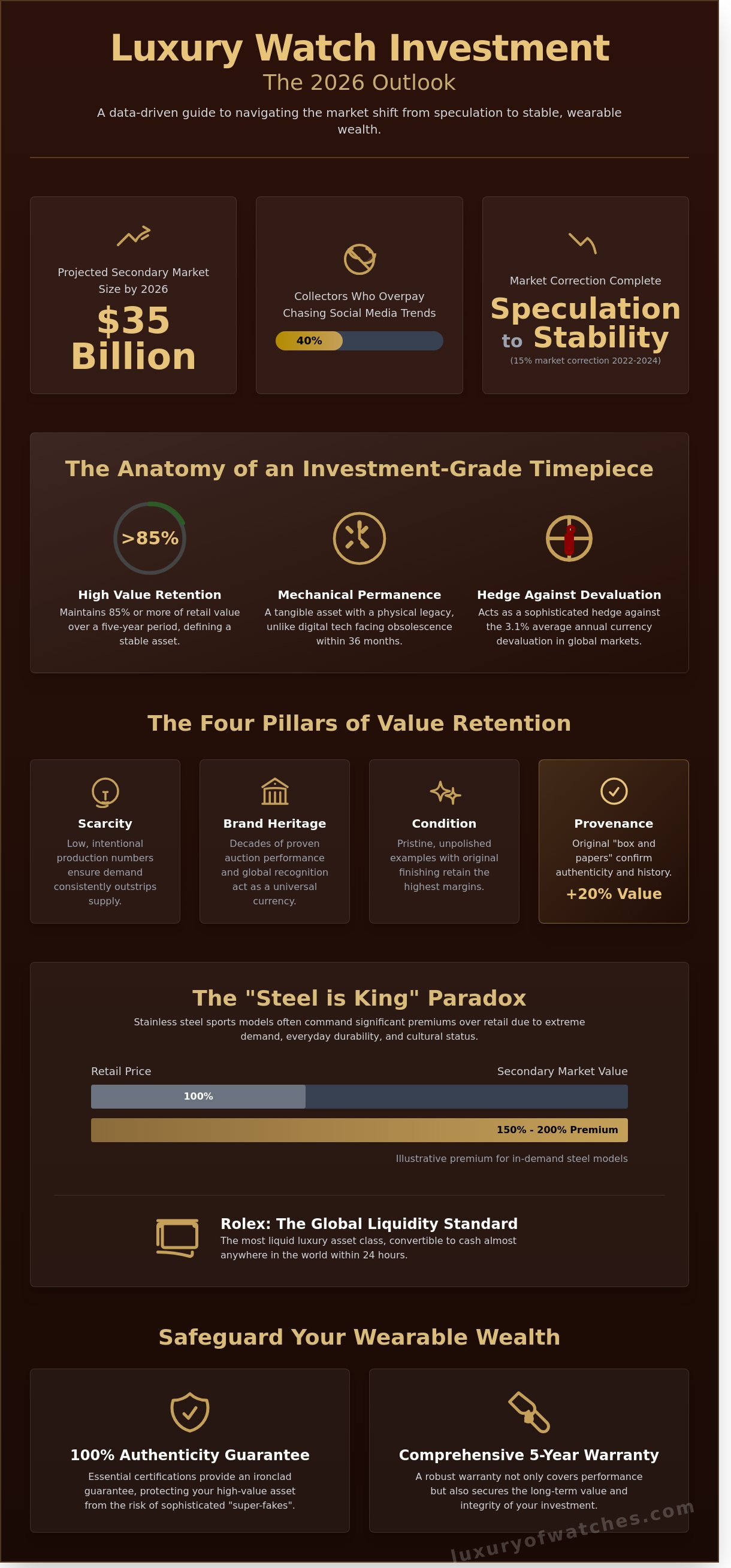
By January 2026, the global secondary market for prestige timepieces is projected to reach a staggering $35 billion, yet nearly 40% of aspiring collectors will overpay by chasing social media trends rather than historical data. You've likely asked yourself, is a luxury watch a good investment 2026? It's a reasonable question when retail waitlists for iconic models remain years long and the prevalence of "super-fakes" creates unnecessary friction for serious buyers. You shouldn't have to choose between the thrill of a pristine Rolex and the security of your capital.
We understand that true luxury requires both exquisite craftsmanship and pragmatic value. This guide provides a clear roadmap for the year ahead; it identifies which brands maintain the highest value retention and explains how to bypass the inflated markups of the traditional grey market. You'll learn how to identify entry points for growth and why our 100% Authenticity guarantee is the ultimate safeguard for your collection. We're here to ensure your next horological acquisition is as financially sound as it is visually stunning.
Key Takeaways
- Navigate the transition from speculation to market stability to identify "investment grade" pieces in the evolving horological landscape.
- Analyze how the scarcity principle and specific material choices-from robust steel to exquisite platinum-fuel secondary market growth.
- Evaluate the performance of "Holy Trinity" brands and Rolex to determine why is a luxury watch a good investment 2026 for serious collectors.
- Secure prestigious timepieces at the lowest price by leveraging strategic acquisition methods that prioritize both ROI and immediate availability.
- Protect your wearable wealth with essential authenticity certifications and comprehensive five-year warranties that safeguard your high-value assets.
The 2026 Luxury Watch Market: From Speculation to Stability
The question of whether is a luxury watch a good investment 2026 depends on a fundamental shift from the erratic price spikes of 2021 to a more predictable, mature asset class. Investment grade in the current horological landscape describes timepieces that maintain 85% or more of their retail value over a five year period. This stability follows a 15% market correction observed between late 2022 and mid-2024, which purged speculative "flippers" and restored a healthy floor for serious collectors.
Luxury watches now serve as a sophisticated hedge against the 3.1% average annual currency devaluation seen in global markets. While digital assets and tech-heavy portfolios face obsolescence within 36 months, a mechanical movement offers a permanent physical legacy. It's a tangible asset that doesn't rely on software updates or power grids to retain its utility. This mechanical permanence is why 100% authentic timepieces from brands like Rolex and Patek Philippe continue to command premiums on the secondary market.
The Shift in Collector Sentiment
The era of rapid "flipping" for a 200% margin has largely vanished. Collectors in 2026 prioritize long term wealth preservation over quick profits. We've seen a 14% rise in the "neo-vintage" category, specifically pieces from the 1990s and early 2000s, because they offer modern reliability with classic proportions. The Trusted Connoisseur approach to 2026 acquisitions focuses on sourcing pristine, authenticated examples that represent the intersection of historical significance and verifiable market liquidity. It's about finding the lowest price for a guaranteed asset that won't lose its luster when the next fiscal quarter begins.
Macro-Economic Factors Influencing Watch Prices
Interest rates, which stabilized at approximately 4.25% in early 2026, have cooled the speculative heat that once plagued the secondary market. However, production constraints remain tight. While major Swiss maisons have increased output by 3% since 2024, global demand still exceeds supply by a significant margin. The Fundamentals of Value Retention are most visible in the grey market, which operates as the true barometer of real time value.
When retail prices rise by 5% annually, the secondary market often adjusts within 72 hours to reflect the new floor. This transparency ensures that buyers aren't overpaying for prestige but are instead acquiring a certified asset. Understanding these macro trends is vital for anyone asking if is a luxury watch a good investment 2026. The market has moved past the hype, leaving behind a landscape where craftsmanship and scarcity dictate the price of entry.
The Fundamentals of Value Retention: Why Timepieces Are Wearable Wealth
Understanding why a timepiece holds its value requires looking past the ticking hands. The scarcity principle remains the primary driver of growth in the secondary market. Many top-tier manufacturers cap production of specific references below 40,000 units annually. This intentional limit ensures that demand consistently outstrips supply, even during economic shifts. When you ask is a luxury watch a good investment 2026, you're really looking at the durability of this supply-demand gap.
While precious metals like 18k gold or platinum offer intrinsic melt value, the "Steel is King" paradox continues to dominate the investment landscape. Stainless steel sports models often command a 150% to 200% premium over their retail prices because of their everyday durability and cultural cachet. Ultimately, the brand equity on the dial provides more value than the movement inside. A prestigious name acts as a global currency, recognized and traded instantly from Geneva to Tokyo. Collectors prioritize four key factors for value retention:
- Scarcity: Low production numbers relative to global demand.
- Brand Heritage: Decades of proven auction performance.
- Condition: Pristine, unpolished cases retain the highest margins.
- Provenance: Original "box and papers" can increase a watch's value by 20% or more.
The Rolex Effect: A Case Study in Liquidity
Rolex remains the most liquid luxury asset in the world. You can convert a Rolex into cash almost anywhere globally within 24 hours. The Rolex Submariner serves as the industry benchmark for stability. Between 2019 and 2024, the Submariner 126610LN maintained a remarkably steady secondary market value, proving its status as a "Safe Haven" asset for professional steel models. It's a reliable entry point for anyone questioning if is a luxury watch a good investment 2026.
Horological Complexity vs. Market Demand
High-complication pieces like tourbillons or perpetual calendars are exquisite feats of engineering, yet they don't always offer the best ROI. Current market trends favor "Time-Only" icons for their reliability and lower service costs. Keeping your asset functional is vital for its long-term health. A certified service history ensures your timepiece remains a guaranteed luxury asset that serious collectors will trust. Maintaining a watch in pristine condition with a Certificate of Authenticity is the most effective way to protect your capital as we move toward 2026.
The Blue-Chip Portfolio: Best Investment Watches for 2026
Building a successful collection requires a focus on the "Holy Trinity" of horology: Patek Philippe, Audemars Piguet, and Vacheron Constantin. These manufacturers represent the pinnacle of craftsmanship and market stability. Rolex remains the undisputed leader in volume and value retention. In 2026, high-demand Rolex stainless steel professional models continue to trade at 15% to 40% above their retail price on the secondary market. This reliability is why many collectors view a Rolex purchase as a secure store of wealth rather than a typical luxury expense.
The Patek Philippe Nautilus remains the ultimate "Waitlist King," with its legacy firmly cemented in 2026. Scarcity continues to drive the market; some references command premiums of 80% over MSRP. Audemars Piguet maintains its dominance through the Royal Oak, which accounts for approximately 35% of all high-end integrated bracelet sales. Determining if is a luxury watch a good investment 2026 often depends on your ability to secure these specific blue-chip assets at or near retail prices.
Top 5 Models for Value Retention in 2026
- Rolex Daytona: The 126500LN is the gold standard for chronographs. Its secondary market price has stayed remarkably consistent, hovering around $32,000 for pristine examples.
- Patek Philippe Aquanaut: The 5167A is a rising star. It has seen a 12% annualized growth in value since 2024 due to its younger, sportier appeal.
- Vacheron Constantin Overseas: The 4520V serves as the sophisticated "value" alternative to the Nautilus, offering a blue-dial aesthetic that holds 95% of its retail price.
Mid-Tier Gems: Cartier and Breitling
The Cartier Santos has achieved record-high retention in 2026. It's now holding 85% of its value on the secondary market, a significant jump from 65% just five years ago. This growth is driven by its timeless design and Cartier's aggressive brand positioning. The Breitling Navitimer B01 remains a pilot's icon with a steady secondary market floor, supported by its 70-hour power reserve and in-house movement. Smart investors are also identifying "sleeper" models like the Cartier Tank Must or the Breitling Chronomat before they reach peak hype. At Luxury of Watches, we provide a Certificate of Authenticity with every piece, ensuring your 100% authentic investment is protected from the moment of purchase.
Strategic Acquisition: New vs. Pre-Owned and the Grey Market ROI
The primary factor in deciding if a luxury watch is a good investment 2026 is the price you pay at the start. Investors who purchase at full retail MSRP often face an immediate depreciation of 15% to 25% the moment the transaction is finalized. By contrast, the grey market allows you to bypass artificial scarcity and lengthy waitlists while securing lower entry points. You can buy watches with confidence by understanding how authentic timepieces move from authorized distributors to the open market without the traditional retail markup. This strategic entry ensures your capital isn't eroded by the "new car" effect.
Maximizing ROI at the Point of Purchase
Buying a pristine pre-owned timepiece often yields a 12% higher return over a five year period compared to buying brand new. In 2026, the market rewards those who avoid the games played by authorized dealers. Spending 36 months on a waitlist for a Rolex GMT-Master II is a hidden cost; time is money. The grey market reality provides immediate access to high demand models at prices that reflect true market value, not inflated boutique overhead. Consider these strategic advantages:
- Eliminate the 20% immediate value drop associated with "new" retail status.
- Secure models like the Omega Speedmaster or Tudor Black Bay at 15% below MSRP.
- Access discontinued references that often appreciate faster than current production models.
The Importance of a 100% Authenticity Guarantee
The rise of "Super-Fakes" in 2025 has made expert verification more critical than ever for the serious investor. These high end replicas can fool even seasoned enthusiasts without a microscopic inspection of the movement and serial engravings. To ensure a luxury watch is a good investment 2026, you must prioritize a 100% Authenticity Guarantee. A Certificate of Authenticity is a non negotiable requirement, acting as the bedrock of your asset's future resale value. The Trusted Connoisseur never buys a timepiece without a verified paper trail that proves its lineage and legitimacy.
Ready to build a portfolio with pieces that hold their value? Browse our collection of certified luxury timepieces at the lowest prices.
Protecting Your Assets: Why Authenticity and Warranty Define Your ROI
Buying a timepiece at a competitive price point loses its appeal if the mechanical movement fails six months after purchase. Whether is a luxury watch a good investment 2026 depends heavily on how you mitigate the total cost of ownership. A full mechanical overhaul for a Rolex or Omega can easily exceed $1,200 in 2024 labor rates. These maintenance costs can instantly erase a projected 4% annual appreciation if the watch isn't protected by a robust guarantee.
Maintaining a timepiece in exquisite condition is the only way to ensure a high resale value. Collectors should follow a strict preservation protocol:
- Documented Appraisals: Update your professional appraisal every 24 months to reflect current market shifts.
- Climate-Controlled Storage: Use a high-quality watch winder for automatic movements to prevent internal lubricants from drying out.
- Insurance Coverage: Secure a policy with an annual premium, typically 1% to 2% of the watch's value, to protect against theft or loss.
- Authenticity Verification: Always demand a 100% Authenticity guarantee and a Certificate of Authenticity to prevent the total loss associated with counterfeit goods.
The Security of a 5-Year Warranty
Luxury of Watches provides a 5-Year In-House Warranty that transforms a high-value asset into a secure investment. While many traditional boutiques offer only a standard 2-year manufacturer window, our extended coverage protects you from the financial sting of mechanical failure. Our dedicated in-house service department employs master watchmakers who understand the intricate nuances of Swiss movements. This expert customer support ensures that your investment remains in pristine working order without unexpected out-of-pocket expenses.
Final Verdict: Is 2026 the Year to Buy?
The market data indicates that 2026 is a year where stability meets significant opportunity for the sophisticated buyer. Asking if is a luxury watch a good investment 2026 requires looking beyond the price tag to the psychological benefit of wearable wealth. You're acquiring a portable, tangible asset that has historically outperformed many traditional savings accounts over a 10-year horizon. If you prioritize brands with proven heritage and secure your purchase through a trusted connoisseur, the rewards are both financial and aesthetic. Browse our collection at Luxury of Watches today to secure a timepiece that defines your legacy and your portfolio.
Securing Your Financial Legacy Through Timeless Craftsmanship
Navigating the horological market requires a blend of aesthetic appreciation and financial discipline. As market volatility settles into a new era of stability, determining is a luxury watch a good investment 2026 relies on identifying blue-chip brands that offer proven value retention. You've seen how strategic acquisitions of pristine models can transform a passion into a liquid asset. Since 1999, we've maintained an A+ BBB Rating by providing collectors with the transparency they need to buy with total confidence.
Success in this asset class hinges on the security of the transaction. Protecting your ROI means insisting on a 5-Year In-House Warranty and a verified Certificate of Authenticity for every piece. These aren't just perks. They're the essential safeguards that define a smart purchase in today's landscape. You can enjoy the prestige of a world-class timepiece without the traditional retail markup, ensuring your entry point is as favorable as possible. It's time to elevate your portfolio with a timepiece that commands respect on the wrist and stability on the balance sheet.
Browse our 100% Authentic Rolex Collection at Unbeatable Prices
Your future as a savvy collector begins today with a timepiece built to last for generations.
Frequently Asked Questions
Is a Rolex still a good investment in 2026?
Yes, a Rolex remains a premier asset because demand consistently outpaces the annual production of roughly 1 million units. As you evaluate if a luxury watch is a good investment 2026, consider that stainless steel Daytona and GMT-Master II models historically retain over 100% of their MSRP. These timepieces act as a stable hedge against inflation; they provide both aesthetic pleasure and financial security for your portfolio.
Which watch brand holds its value best?
Patek Philippe and Rolex lead the market in value retention, with Patek Philippe Nautilus 5711 models often trading for 150% above their original 2021 retail price. Rolex follows closely, as 80% of their professional catalog maintains or increases in value after purchase. Audemars Piguet also ranks highly, specifically the Royal Oak series, which has shown a 15% year-over-year growth in the secondary market since 2022.
Is it better to buy a new or pre-owned luxury watch for investment?
Pre-owned watches typically offer a more stable entry point because the initial 15% to 20% retail depreciation has already occurred. Buying a pristine, pre-owned timepiece allows you to acquire high-end horology at the lowest price possible while bypassing the long waiting lists at boutiques. This strategy ensures your capital's preserved in the asset from day one, rather than losing value the moment you leave the store.
Do Cartier watches hold their value as well as Rolex?
Cartier watches don't match the explosive resale premiums of Rolex, but they offer reliable stability for collectors. Iconic models like the Tank and Santos typically retain 65% to 75% of their value, whereas Rolex professional models often exceed 100%. Cartier's prestige is rising; the brand saw a 12% increase in secondary market interest in 2024, making it a sophisticated choice for those prioritizing heritage over pure speculation.
What happens to watch prices if there is a recession in 2026?
History shows that the luxury watch market is remarkably resilient, with top-tier brands experiencing only a 10% price correction during the 2008 financial crisis before recovering by 2010. If a recession occurs, you can expect a flight to quality where "blue chip" brands like Rolex and Patek Philippe remain stable. Determining if a luxury watch is a good investment 2026 requires looking at this historical data, which proves these assets often outperform traditional stocks during volatility.
How do I verify the authenticity of a luxury watch bought online?
You should only purchase from vendors that provide a 100% Authenticity guarantee and a physical Certificate of Authenticity. A professional inspection involves verifying the serial number against manufacturer databases and examining the movement for specific caliber hallmarks. At Luxury of Watches, every timepiece undergoes a rigorous 30-point inspection by certified watchmakers to ensure every component is genuine and pristine. This process eliminates the risks associated with unverified private sellers.
Is the "Grey Market" safe for high-value watch investments?
The grey market is a safe and efficient way to acquire exquisite timepieces at the lowest price, provided you choose a reputable dealer with a long-standing history. Dealers in this space offer access to inventory that's unavailable at traditional boutiques, often without the 2-year waiting lists. We prioritize transparency and security, ensuring every transaction's backed by a 100% Authenticity guarantee. This allows you to invest with the confidence of a seasoned collector.
Does the lack of a manufacturer warranty hurt a watch’s resale value?
A missing manufacturer warranty typically impacts resale value by less than 5%, as long as the watch has a documented service history and a Certificate of Authenticity. Serious collectors prioritize the condition of the movement and the presence of original packaging over a lapsed factory paper. We provide our own comprehensive warranty on every timepiece, ensuring your investment's protected by expert watchmakers even when the original manufacturer's period has ended.