
How to Authenticate a Pre-Owned Cartier Watch: The Connoisseur’s Guide (2026)
8th May 2026

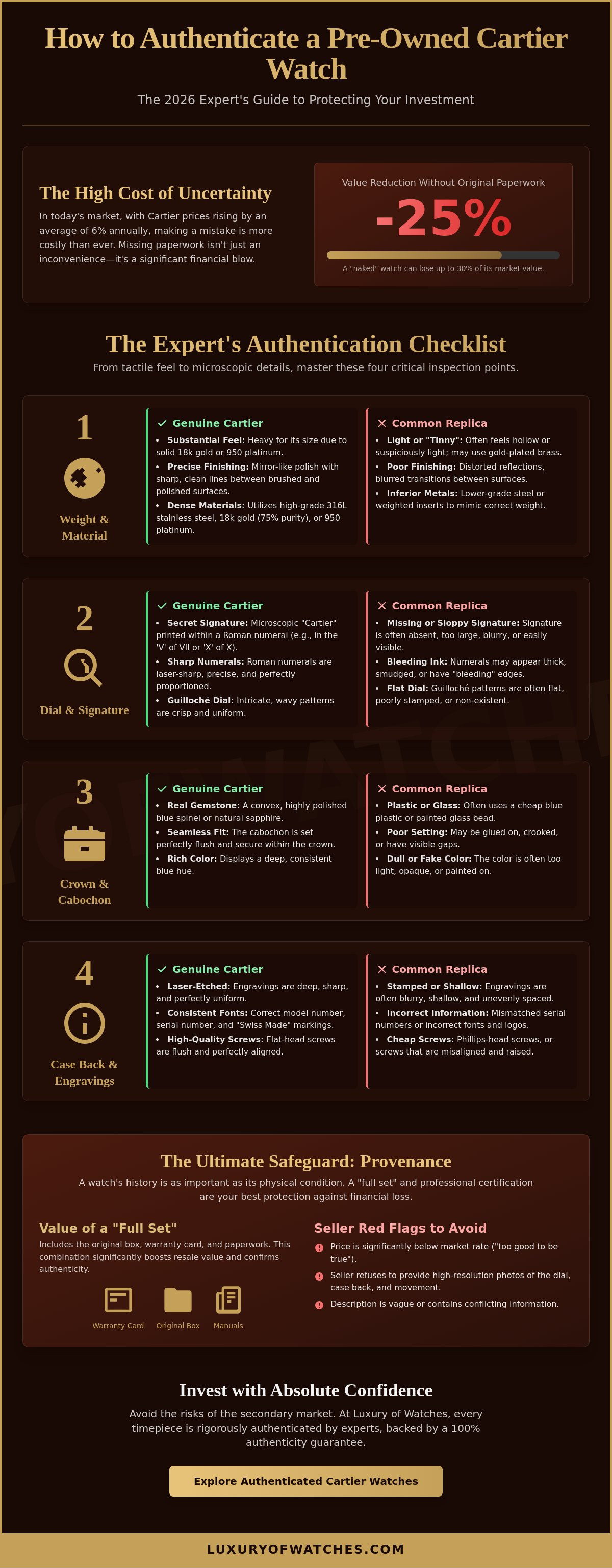
Did you know that the simple absence of original paperwork for a pre-owned Cartier Tank can slash its market value by as much as 25% in 2026? With Cartier implementing an average price increase of 6% this year, the financial stakes of making a mistake have never been higher. You likely recognize that owning a piece of horological history, such as the new Tortue collection or a vintage model from Sotheby's 15 million dollar "The Shapes of Cartier" auction, is a prestigious milestone. Yet, the persistent fear of losing a significant investment to a high-quality replica often creates a stressful barrier for collectors.
Mastering how to authenticate a pre-owned cartier watch doesn't require a lifetime of training; it requires a disciplined eye for detail. We promise to equip you with an expert-led, 10-point authentication framework that replaces uncertainty with technical precision. This guide provides a definitive checklist for self-inspection, explains the complexities of modern serial number formats, and reveals the specific red flags that signal it's time to walk away from a transaction. You'll gain the clarity needed to secure an exquisite timepiece with absolute confidence while ensuring your investment remains pristine and protected.
Key Takeaways
- Identify why standard visual checks are insufficient in 2026 and how to detect the sophisticated hallmarks of modern "superfakes."
- Learn to evaluate the tactile integrity of 18k gold and 950 platinum to ensure the weight of your timepiece matches Cartier's exacting standards.
- Master how to authenticate a pre-owned cartier watch by inspecting the dial for the microscopic "secret signature" and laser-sharp Roman numerals.
- Discover the difference between authentic laser-etched case back engravings and the stamped imitations found on lower-quality replicas.
- Understand the premium value of a "full set" and why a Certificate of Authenticity acts as the ultimate safeguard for your luxury investment.
The Landscape of Cartier Authentication: Why Details Matter in 2026
Authentication is the rigorous verification of a timepiece's physical composition, internal caliber, and historical provenance. For the serious collector, understanding how to authenticate a pre-owned cartier watch is the only way to safeguard a high-value investment. In 2026, the luxury market has seen a surge in "superfakes." These aren't the obvious counterfeits of the past; they often utilize high-grade 316L stainless steel and even mimic the correct weight with hidden weighted inserts. Surface-level checks are no longer sufficient to protect your capital. You must adopt the mindset of a "Trusted Connoisseur," seeking a perfect harmony between the dial, the case, and the movement. Each model speaks its own language. A vintage Tank Must requires different scrutiny than a refreshed 2026 Santos Chronograph. Consistency is your greatest ally. If one single element feels "off," the entire piece is compromised.
The Cartier Heritage: Craftsmanship as a Security Feature
Cartier’s reputation as the "Jeweler of Kings" is central to its horological DNA. This History of Cartier reveals how their mastery of precious metals translates into watches that are essentially fine jewelry designed to tell time. Whether you're inspecting a classic Tank, a robust Santos, or a delicate Panthère, the material integrity remains consistent across decades. Genuine Cartier watches utilize 18k gold or 950 platinum, materials that possess a specific density and luster that replicas rarely replicate perfectly. This jewelry-first approach means that every screw, link, and bezel is finished with a level of precision that serves as a built-in security feature. When you hold a pristine Cartier, the quality isn't just visible; it's felt in the smoothness of the metal and the balance of the proportions.
The Risk of the Secondary Market
Buying from private listings carries inherent dangers that can lead to devastating financial loss. In 2026, the absence of original paperwork can decrease a Cartier watch's value by 15% to 25%. A "naked" watch without its original warranty card might even see a 30% reduction in market rate. Common red flags include blurred engravings on the case back or a seller's refusal to provide high-resolution shots of the internal movement. If the price is significantly lower than the standard market rate, it's the first indicator of a replica. Professional gray market dealers provide a vital safety net for collectors. They offer a Certificate of Authenticity and a 100% authenticity guarantee, ensuring your prestigious acquisition is exactly what it claims to be without the traditional retail markup. This professional vetting process is the most effective way to manage the risks of the secondary market while securing an unbeatable value.
Tactile and Physical Markers: The Weight of Authenticity
Physicality is the first line of defense for any serious collector. Because Cartier began as a high-jewelry house, their timepieces are crafted with a density and balance that replicas rarely achieve. Genuine Cartier watches utilize 18k gold (75% purity), 950 platinum, or high-grade 316L stainless steel. These materials provide a "substantial" feel on the wrist; the watch should feel heavy for its size but never clunky or unbalanced. Learning how to authenticate a pre-owned cartier watch involves trusting your sense of touch. If a gold Tank feels suspiciously light or "tinny" when tapped, it's likely a hollow-link replica or made of gold-plated brass rather than solid 18k gold.
The finishing of the metal is another critical indicator. Authentic Cartier cases undergo rigorous polishing that results in a mirror-like luster without distortion. In A Collector's Guide to the brand, experts emphasize that the transitions between brushed and polished surfaces must be sharp and intentional. If you're looking for a piece with a guaranteed history, choosing from a curated selection of Cartier watches ensures the weight and material integrity have been verified by professionals.
The Crown and the Blue Cabochon
The crown of a Cartier watch is almost always adorned with a blue cabochon, a signature design element. In authentic pieces, this is a convex, polished gemstone, usually a blue spinel or, in higher-end models, a natural sapphire. The stone should be securely set into the crown, never glued. Replicas often use cheap plastic or glass that has a purple tint or visible air bubbles. A genuine cabochon has a deep, rich blue hue and a perfectly smooth, rounded finish that reflects Cartier’s jewelry heritage.
Case Construction and Screw Precision
Precision is found in the smallest details, particularly the screws. On iconic models like the Santos, the flathead screws on the bezel and bracelet must sit perfectly flush with the metal surface. They should be aligned with microscopic accuracy. Any "burring" or damage on the screw heads often suggests amateur tampering or low-quality manufacturing. Furthermore, the point where the sapphire crystal meets the metal bezel should feel seamless. There shouldn't be any gaps or uneven edges that could compromise the watch's water resistance or aesthetic flow. Authentic Cartier construction is airtight and visually perfect, leaving no room for the structural inconsistencies common in counterfeit production.
The Dial and Hands: Spotting the Cartier Secret Signature
The dial of a Cartier timepiece is a masterpiece of micro-engineering. For many collectors, the face of the watch is the most revealing element when learning how to authenticate a pre-owned cartier watch. Unlike mass-produced replicas, genuine Cartier dials feature crisp, high-definition Roman numerals with no ink bleeding or "fuzziness" at the edges. The ink itself often has a subtle, raised profile that creates a three-dimensional effect under a jeweler's loupe. Many prestigious models also feature an exquisite guilloché pattern, which consists of intricate, radiating lines etched into the metal. While authentic guilloché reflects light with mathematical precision, counterfeiters often use cheap stamping techniques that result in a flat, dull appearance without the signature shimmer of a genuine dial.
Decoding the Roman Numerals
A signature hallmark of Cartier is the "secret signature" integrated into the Roman numerals. In most modern Tank models, the word "CARTIER" is micro-printed into one of the legs of the VII numeral. However, on larger models like the Santos or certain vintage pieces, you'll often find it hidden within the X numeral instead. This placement varies significantly by both model and production year. For instance, the Panthère collection frequently utilizes the X numeral for this mark. Cross-referencing the specific model year is essential to confirm the correct placement. Additionally, verify the text at the 6 o'clock position. Authentic pieces will typically state "Swiss Made" or, in rare vintage instances, "Paris," with perfectly centered, microscopic lettering that remains sharp even under high magnification.
Luminescence and Hand Alignment
Cartier is world-renowned for its "Epee" or sword-shaped hands. In authentic watches, these hands are crafted from heat-blued steel. This traditional horological process involves heating the steel to precisely 590 degrees Fahrenheit to achieve a deep, iridescent blue that changes shade depending on the light. Replicas frequently use blue paint, which looks static and lacks the metallic sheen of the genuine article. If the watch features luminescence, the application must be perfectly even across all markers. Grainy or "clumpy" lume is a definitive red flag. For mechanical movements, the second hand should exhibit the smooth "Cartier sweep," moving with a consistent rhythm that reflects the high-frequency caliber within. Even a slight stutter can indicate a low-quality quartz movement masquerading as a prestigious mechanical one.
Case Back and Movement: The Final Verdict
The case back serves as the definitive identity card of the timepiece. While the dial and hands provide strong visual clues, the technical specifications found on the reverse side are often where replicas fail. Authentic Cartier engravings are executed with laser precision, resulting in clean, deep lines that remain legible even after years of wear. Counterfeiters often rely on chemical etching or shallow stamping, which creates faint, uneven lettering. When learning how to authenticate a pre-owned cartier watch, the serial number is your most powerful tool. Cartier typically uses a 4-digit model code, such as 2384 for a quartz Tank Française, followed by a unique string of digits. These numbers must be crisp and perfectly aligned. If the engraving looks "fuzzy" or the font style of the "C" or "R" deviates from the brand's signature typography, the watch requires further scrutiny.
Verification doesn't stop at the surface. Cross-referencing the 4-digit model code with the physical features of the watch is a vital step. For example, if the code indicates a mechanical movement but the watch has a quartz "tick," you've identified a discrepancy. To ensure your investment is backed by professional verification, you can browse a curated selection of authentic pre-owned Cartier watches that have already passed these rigorous standards.
Reading the Case Back Engravings
Every authentic Cartier watch includes specific metal hallmarks that must match its physical composition. For an 18k gold piece, you should find the "750" hallmark clearly engraved. Platinum models will feature "950." These marks are usually accompanied by a small, detailed icon, such as a St. Bernard dog's head for Swiss-made gold. Replicas often miss these microscopic details or use incorrect hallmarks for the material. Check the consistency of the font; the spacing between words like "Water Resistant" and "Swiss Made" must be uniform and centered. Faint or crooked engravings are immediate indicators of a counterfeit product.
Inspecting the Heart of the Watch
The movement is the ultimate proof of authenticity. Genuine Cartier mechanical movements feature exquisite "finissage," including Côtes de Genève patterns on the bridges and a Cartier-branded rotor. The engravings on the movement should be as sharp as those on the case back. One of the most glaring red flags is the presence of a plastic spacer holding the movement in place. Cartier uses high-quality metal spacers or precisely machined cases to secure the caliber. Even in their quartz models, Cartier maintains a high standard of decoration. A generic, unbranded quartz movement or a messy, unpolished mechanical caliber is a definitive sign of a fake. Authentic movements are pristine, reflecting the brand’s commitment to internal excellence as much as external beauty.
Securing Your Investment: Provenance and Professional Guarantees
Physical inspection provides the foundation for confidence, but the final verdict on how to authenticate a pre-owned cartier watch often rests on its historical paper trail. In the 2026 market, a "full set"-consisting of the original red box, instructional booklets, and the warranty certificate-remains the gold standard for collectors. As established earlier, the absence of these documents can slash a watch's resale value by 15% to 25%. While a "naked" watch isn't necessarily a replica, the lack of provenance requires a significantly higher level of scrutiny. Documented service history from reputable horological experts adds another layer of validation, as it proves the timepiece has been maintained to professional standards without compromising its internal integrity.
The gray market offers a sophisticated alternative for those seeking the highest tier of craftsmanship without the traditional retail markup. By choosing authentic pre-owned luxury watches, you can access prestigious models like the 2026 Roadster or the timeless Tank at an unbeatable value. This market segment thrives on transparency and expert vetting, providing a secure environment for high-stakes transactions that heritage boutiques sometimes lack in efficiency.
Evaluating the Seller’s Reputation
The adage "buy the seller, not just the watch" is a fundamental rule for any serious connoisseur. You should prioritize established businesses that maintain a physical presence and offer secure, transparent transaction methods. A reputable dealer will never hesitate to provide a detailed Certificate of Authenticity or high-resolution imagery of the movement. Avoid private listings or sellers who can't offer a clear, legally binding guarantee of legitimacy. In a landscape where "superfakes" are increasingly common, the seller’s professional standing is your most effective shield against financial loss.
The Safety Net: Warranties and Guarantees
One of the primary concerns when purchasing pre-owned is the expiration of the original manufacturer's terms. We address this gap directly by providing a 5-year in-house warranty on our timepieces, offering a level of long-term security that private sellers simply cannot match. This comprehensive coverage replaces the missing international warranty and ensures your investment is protected against mechanical discrepancies. Our commitment to 100% Authenticity is the cornerstone of our business; every piece is rigorously inspected by experts who understand the nuances of Cartier’s horological DNA. You can explore our meticulously curated collection of Cartier watches with the absolute certainty that your acquisition is both pristine and prestigious. This combination of expert verification and robust safety nets ensures that your journey into luxury watch ownership is as secure as it is inspiring.
Secure Your Legacy with Expert Precision
Mastering how to authenticate a pre-owned cartier watch is about more than just avoiding a financial loss; it's about honoring the heritage of a brand that has defined horological excellence since 1847. By focusing on the microscopic details of the secret signature and the substantial weight of 18k gold, you now possess the tools to navigate the secondary market with the eye of a connoisseur. Technical perfection in the movement and the presence of verified provenance remain the final pillars of a secure investment.
At Luxury of Watches, we've provided expert horological support since 1999, ensuring every timepiece in our collection meets the highest standards of excellence. We remove the burden of doubt by offering a 100% Authenticity Guarantee and a comprehensive 5-Year In-House Warranty. You're invited to Shop Our Guaranteed Authentic Pre-Owned Cartier Collection and discover a pristine timepiece that reflects your own commitment to quality. Your pursuit of a timeless masterpiece deserves the security of a trusted partner, and we're ready to help you secure your next investment with absolute confidence.
Frequently Asked Questions
Do all Cartier watches have a secret signature?
No, the secret signature isn't present on every model. While it's a hallmark of modern Roman numeral dials, many vintage pieces produced before the 1960s or models with diamond-set dials lack this feature. You'll typically find it in the VII or X numeral, but its absence on an older piece doesn't automatically mean it's a counterfeit.
How can I verify a Cartier serial number online?
You can verify a serial number by registering the timepiece on the official Cartier Care digital platform. This database allows owners to check the warranty status and authenticity records of modern pieces. If the serial number doesn't appear in the system, it could indicate a vintage model produced before digital record-keeping or a potential replica.
Is the cabochon on a Cartier watch always a real sapphire?
No, Cartier frequently utilizes synthetic blue spinel for the cabochon in many of its stainless steel and gold-plated models. Higher-end collections, such as those in solid 18k gold or platinum, are more likely to feature a natural sapphire. Regardless of the material, the stone should be securely set rather than glued, showing a deep blue hue without the purple tint of plastic.
What should I do if my pre-owned Cartier doesn’t have original papers?
If your timepiece lacks original paperwork, obtaining a professional appraisal or a service receipt from a recognized expert is the best course of action. In the 2026 market, a "naked" watch can lose 25% of its value, so documented verification is essential. Professional dealers often provide a Certificate of Authenticity to bridge this gap and protect your investment.
Are fake Cartier watches heavy enough to pass the weight test?
Some sophisticated "superfakes" in 2026 utilize lead or tungsten inserts to mimic the substantial feel of genuine luxury metals. However, they rarely match the exact density of 18k gold or 950 platinum. Learning how to authenticate a pre-owned cartier watch involves checking for an unbalanced center of gravity, which is a common flaw in weighted replicas.
Can a local jeweler authenticate a Cartier watch for me?
A local jeweler can provide a general opinion, but true authentication requires a specialist with deep horological expertise. Cartier movements are intricate; many general jewelers lack the specific tools to verify internal components or identify model-specific serial formats. It's always safer to consult an established luxury watch dealer who handles these prestigious brands daily.
What is the most faked Cartier watch model?
The Cartier Tank and the Santos are the most frequently faked models due to their iconic status and high demand. Because these designs are so recognizable, counterfeiters invest significant resources into replicating their geometric cases and Roman numeral dials. This high volume of replicas makes it critical to understand how to authenticate a pre-owned cartier watch before finalizing a purchase.
Does Cartier provide an official authentication service?
Cartier doesn't offer a standalone service titled "authentication." Instead, you can submit the watch for a "Complete Service" or a "Restoration" at an official boutique. If the watch is genuine, they'll issue a service receipt that acts as a de facto verification. If they refuse to service the watch, it's a definitive sign that the piece is not authentic.