
Common Mistakes Buying a Pre-Owned Watch: The 2026 Collector’s Guide
24th Apr 2026
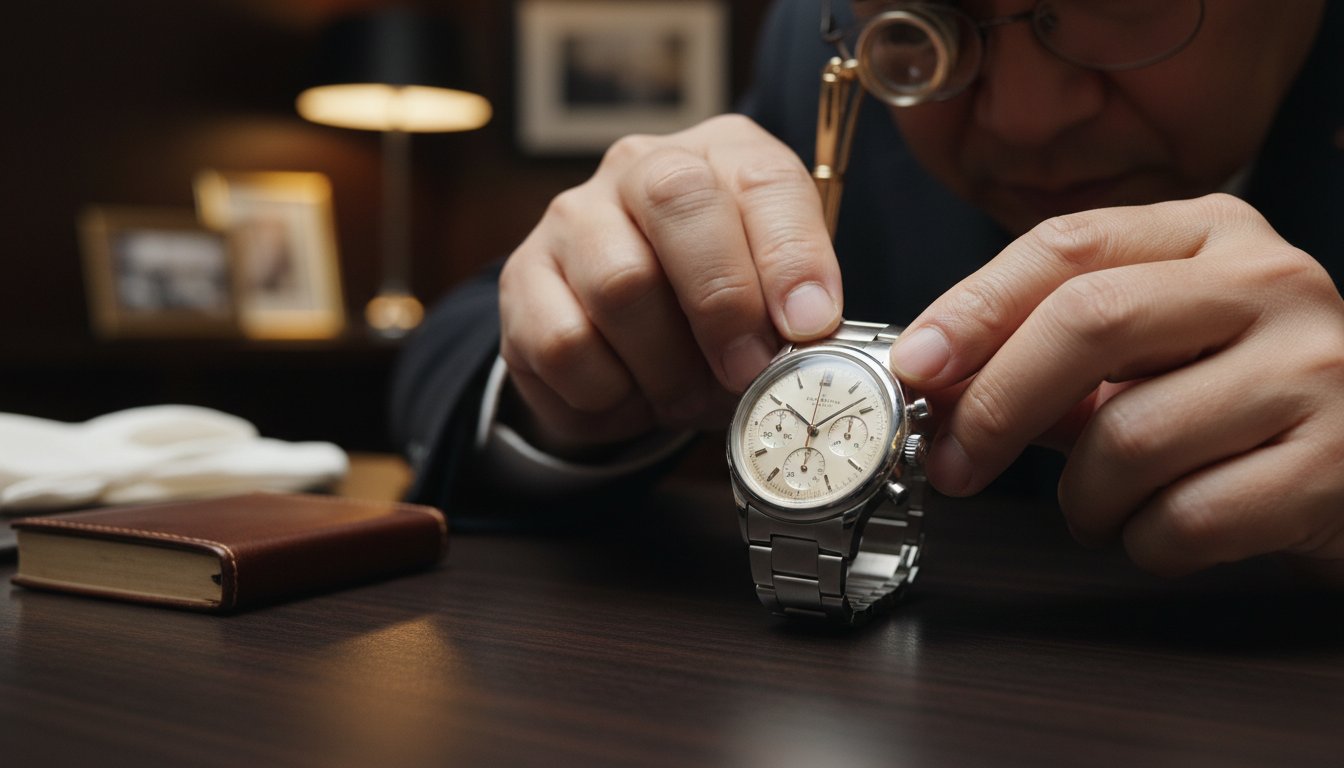
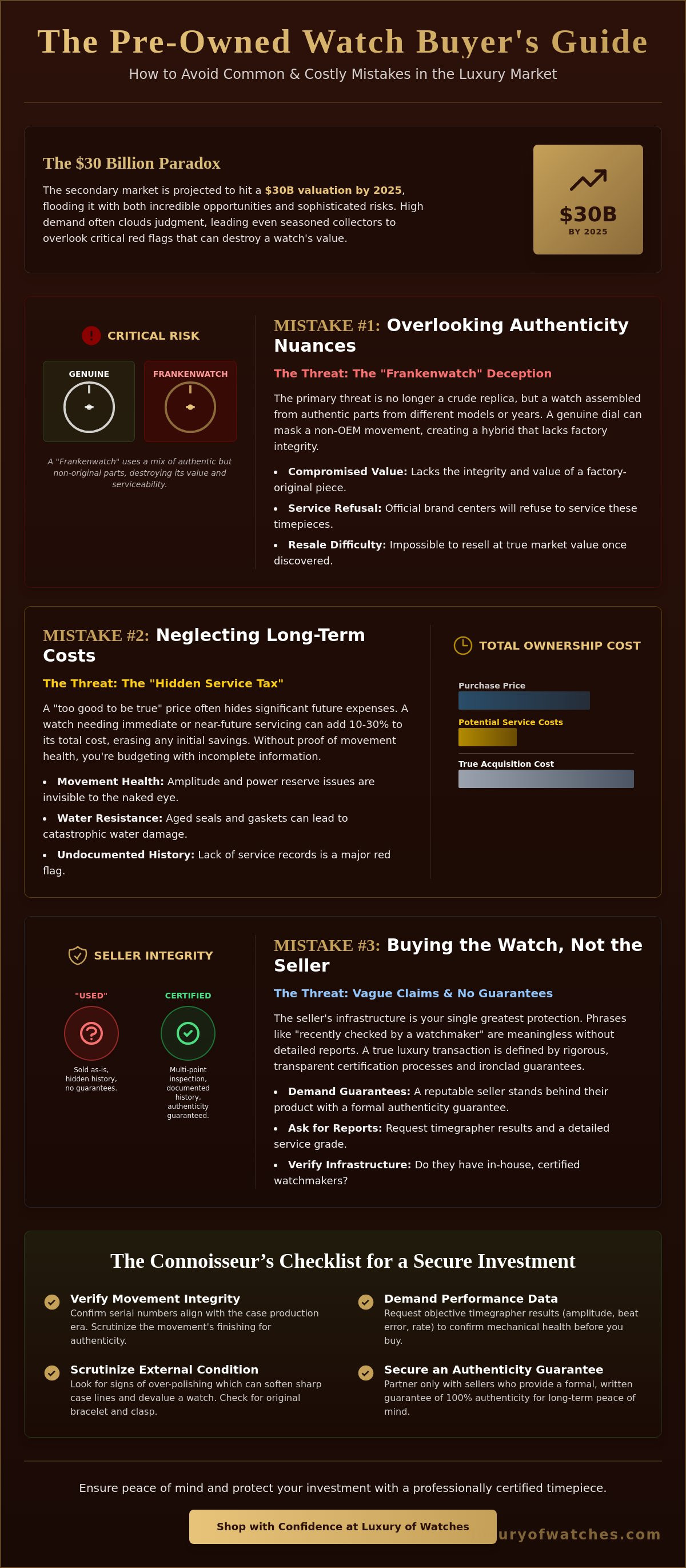
The most expensive timepiece you'll ever purchase is the one that arrives with a non-original movement hidden behind an otherwise pristine bezel. As the secondary market expands toward a projected $30 billion valuation by 2025, according to industry reports from McKinsey, the risks for collectors have become increasingly sophisticated. You likely understand that finding a vintage Rolex or a contemporary Omega requires a keen eye, but even seasoned enthusiasts often fall victim to common mistakes buying a pre-owned watch. It's natural to feel trepidation when faced with the threat of a "Frankenwatch" or the uncertainty of fair market pricing in a volatile economy.
We believe that acquiring a luxury timepiece should be an experience defined by prestige, not anxiety. This guide provides an expert-led checklist to help you avoid costly pitfalls and secure 100% authentic luxury watches with absolute confidence. You'll learn how to verify horological integrity, calculate the total cost of ownership including future service requirements, and identify a partner that guarantees long-term security for your investment. We've built a clear framework to ensure your next acquisition remains a source of pride and a sound store of value for years to come.
Key Takeaways
- Identify the subtle warning signs that distinguish a genuine investment from a "prestige trap" in the increasingly complex secondary market.
- Protect your investment by learning how to detect "Frankenwatches" and avoid other common mistakes buying a pre-owned watch that destroy long-term resale value.
- Factor the "hidden service tax" into your acquisition budget with expert tips on evaluating movement health and power reserve issues before you commit.
- Secure total peace of mind by vetting seller infrastructure and demanding the rigorous authenticity guarantees that define a true luxury transaction.
- Follow our professional connoisseur’s checklist to ensure every pristine timepiece you acquire meets the highest standards of horological excellence.
The Pre-Owned Market Paradox: Why Smart Buyers Make Costly Errors in 2026
The secondary market in 2026 offers an allure that traditional retail cannot match. Collectors now turn to pre-owned channels to bypass the multi-year waitlists still plaguing models like the 2024 GMT-Master II or to acquire discontinued gems from the early 2000s. However, this accessibility creates a dangerous paradox. High demand has flooded the market with both opportunities and sophisticated risks. One of the most common mistakes buying a pre-owned watch is assuming that a high price or a reputable platform automatically guarantees a pristine movement.
The psychological landscape has shifted. Buyers no longer view a timepiece merely as a functional accessory; they see it as a portable asset. This investment mindset often clouds judgment. Collectors might focus so intently on potential appreciation that they overlook mechanical red flags or subtle signs of over-polishing. In 2026, supply chain stabilization has increased the volume of available pieces, yet the quality of these listings varies wildly. Gaining a deep level of proficiency in understanding counterfeit watches is now mandatory, as 2025 industry data suggests that high-tier clones have reached a level of visual fidelity that can deceive even seasoned enthusiasts.
The Difference Between "Used" and "Certified Pre-Owned"
Terminology in the horological world is often used loosely to mask deficiencies. A "used" watch is a baseline transaction, often sold as-is with all its hidden history. Conversely, a certified timepiece should undergo a rigorous multi-point inspection. You'll often see listings claiming a watch was "recently checked by a watchmaker," but without a detailed service grade or timegrapher results, this statement is functionally meaningless. It doesn't tell you if the waterproof seals were replaced or if the amplitude is within acceptable limits. Utilizing a professional pre-owned luxury watches guide helps you distinguish between a superficial cleaning and a true mechanical restoration.
The "Too Good to be True" Pricing Trap
Luxury watches have established market floors that rarely fluctuate without a global economic catalyst. If you're tracking current Rolex prices and find a Professional model listed 25% below the average, it's rarely a bargain. These outliers typically signal missing original components, an undocumented service history, or "Frankenwatch" traits where parts from different years are mixed. Market Value is the intersection of condition, rarity, and demand. Falling for a low-price trap is another of the common mistakes buying a pre-owned watch that often leads to a repair bill exceeding the initial "savings." Authenticity and mechanical integrity are the only metrics that preserve long-term value.
Mistake #1: Overlooking the Nuances of Authenticity and "Frankenwatches"
Modern forgery has evolved far beyond the crude replicas of the early 2000s. By 2026, the primary threat to collectors is no longer the obvious counterfeit, but the "super-clone" and the "Frankenwatch." One of the most common mistakes buying a pre-owned watch is assuming that a genuine dial or case guarantees a genuine timepiece. Sophisticated sellers often use a legitimate dial to mask a non-OEM movement or a case harvested from a different production year. This creates a hybrid that lacks the integrity of a factory-original piece.
Authenticity must be verified from the inside out. A true expert doesn't just look at the logo; they scrutinize the movement's finishing and the consistency of hallmarks on the lugs and case back. If the serial number on the movement doesn't align with the production era of the case, you're looking at a compromised asset. These discrepancies often lead to a refusal of service at official brand centers, leaving you with a timepiece that's impossible to maintain or resell at market value.
The "Frankenwatch" Phenomenon Explained
A "Frankenwatch" consists of authentic parts harvested from various donor watches. While each component might be "real," the combination is not. This mismatch destroys the investment value. A 1968 Rolex Submariner with 1980s service hands is no longer a pristine collector's piece. Identifying these requires scrutiny of mismatched patina between hands and hour markers, or incorrect date wheel fonts for the specific caliber. High-complication movements, such as those found in Patek Philippe perpetual calendars, are particularly vulnerable. Inserting a single non-OEM gear can cause mechanical failure and a total loss of provenance.
The Real Weight of "Box and Papers"
Collectors often debate the necessity of original packaging. While a missing box doesn't inherently mean a watch is fraudulent, it impacts the resale price by 10% to 22% depending on the model's rarity. For certain brands, documentation is vital for historical context. The provenance provided by original papers significantly influences the valuation of Breitling watches, where the COSC chronometer certification is a core part of the brand's performance identity.
When papers are missing, you must seek a professional Certificate of Authenticity. This document acts as a modern safeguard, ensuring the movement, dial, and case are period-correct and factory-original. Avoiding the common mistakes buying a pre-owned watch requires this level of due diligence. Before finalizing your next acquisition, review our certified inventory to ensure your investment is protected by a 100% Authenticity guarantee and expert verification.
Mistake #2: Neglecting the Long-Term Costs of Ownership and Service
Buying a luxury timepiece is an investment, but many collectors overlook the recurring "Service Tax" that accompanies mechanical excellence. A mechanical movement is a complex engine of gears and springs that requires consistent lubrication and calibration. One of the most common mistakes buying a pre-owned watch is assuming a polished case reflects a healthy interior. A watch that looks pristine on the outside can hide dried oils, worn pivots, or even rusted components. If a movement has been neglected for years, a full overhaul often costs $800 or more, suddenly turning a "great deal" into a financial burden.
Technical health is paramount when evaluating a potential purchase. Professional collectors rely on timegrapher results to check the beat error and amplitude. A low amplitude, usually below 250 degrees, indicates the movement is struggling and needs immediate attention. Power reserve is another vital metric. If a watch rated for 72 hours dies after 30, the mainspring or gear train is failing. Water resistance also degrades as gaskets dry out and lose their elasticity. This is a critical consideration for leading luxury watch brands like Rolex or Omega, where a failed seal can lead to catastrophic moisture damage and expensive dial degradation.
The Invisible Service Bill
Service intervals vary significantly by manufacturer. Rolex typically recommends maintenance every 10 years for modern movements, while Cartier and Omega often suggest 5 to 8 years depending on the specific caliber. Don't accept a verbal claim that a watch was "recently serviced." Always demand physical invoices from a certified watchmaker that detail the work performed. Without this documentation, you should factor the cost of a full service into your offer. Vintage models present even higher risks; replacing proprietary parts in a discontinued movement can be prohibitively expensive and may require months of sourcing.
Warranty Misconceptions: Manufacturer vs. In-House
Most pre-owned watches on the secondary market are sold "as-is," leaving the buyer vulnerable to mechanical failure the moment they leave the shop. An expired international manufacturer warranty provides zero protection. It's a common mistakes buying a pre-owned watch to assume that brand prestige equals a lifetime guarantee. Smart collectors look for a safety net. While some dealers offer a limited 12-month window, a dedicated 5-year in-house warranty provides the security needed for high-value transactions. This level of protection reflects the seller's confidence in the timepiece's 100% authenticity and mechanical integrity.
Mistake #3: Buying the Watch Instead of Vetting the Seller
One of the most common mistakes buying a pre-owned watch is falling in love with a dial before you've verified the person behind the desk. In the horological world, the golden rule remains absolute: you are buying the seller's reputation and their physical infrastructure. A prestigious Rolex or Omega means very little if the retailer disappears the moment your funds clear. You're not just purchasing a timepiece; you're purchasing the guarantee that the item is exactly what the listing claims it to be.
You should watch for immediate red flags in online listings. Low-resolution, grainy photos are often signs of stolen imagery harvested from legitimate sites. If a listing lacks clear contact information or insists on a strict "no return" policy for a five-figure asset, walk away. Secure, encrypted transaction processes are mandatory for high-value acquisitions. A reputable dealer utilizes 256-bit SSL encryption and offers protected payment gateways to ensure your financial data remains private throughout the exchange.
Evaluating a seller's physical history is equally vital. A business with a ten-year track record and a verified physical location offers a level of accountability that a digital-only pop-up cannot match. History in the industry suggests a commitment to the craft that fly-by-night operations simply don't possess.
Vetting an Online Luxury Retailer
Before committing, examine third-party review platforms like Trustpilot or Google Business. Look for long-term consistency rather than just a handful of recent five-star ratings. A transparent return policy is a non-negotiable requirement for pre-owned goods. If a retailer doesn't offer a clear inspection period, they aren't standing behind their inventory. Excellent sellers also provide multiple support channels, including direct phone lines and live concierge services, to answer technical questions in real-time.
The Role of In-House Experts
You must determine if a seller employs their own certified watchmakers or simply outsources the work. In-house experts ensure that every movement is tested for accuracy and every case is inspected for authenticity before it reaches your wrist. A Trusted Connoisseur can explain the specific history of a reference, providing the context you need for a confident purchase. A seller’s deep horological expertise serves as your most effective defense against fraud and mechanical failure. This technical vetting ensures the watch remains an exquisite addition to your collection for years to come.
Ensure your next investment is protected by choosing a partner that prioritizes your security and peace of mind. Browse our certified authentic collection at Luxury of Watches today to find your next pristine timepiece.
The Connoisseur’s Checklist: Securing Your Investment at Luxury of Watches
Securing a high-end timepiece is a significant milestone that shouldn't be overshadowed by uncertainty. One of the most common mistakes buying a pre-owned watch is failing to verify the seller's long-term accountability after the transaction is complete. We eliminate that risk by combining the heritage of master craftsmanship with modern consumer protections. Our process ensures that when you invest in a prestigious brand like Rolex or Omega, you're acquiring a legacy rather than a liability. By following a structured audit, you can finalize your purchase with the absolute confidence that your investment is protected.
Your 10-Point Pre-Purchase Audit
A sophisticated collector knows that the fine details separate an exquisite find from a costly error. Before you commit to a purchase, use this rigorous audit to ensure the timepiece meets our standards of excellence:
- Serial Number Verification: We cross-reference case and movement numbers to ensure total internal consistency and provenance.
- Movement Health: Every watch undergoes a diagnostic to ensure it maintains timing accuracy within manufacturer specifications.
- Bracelet Integrity: We inspect for link "stretch" and pin wear, ensuring the physical structure remains robust.
- Dial and Hand Alignment: Our experts check for perfect synchronization and the presence of original, period-correct components.
- Certificate of Authenticity: This document serves as your ultimate safeguard, confirming the watch is 100% genuine.
This systematic approach bridges the gap between the high cost of traditional retail and the volatility of the private market. It's the foundation of our "prestige at a price" value proposition, allowing you to enjoy luxury without the typical markup.
Why Our Guarantee Changes the Game
While many secondary market dealers offer a limited 12-month or 24-month protection plan, Luxury of Watches provides a comprehensive 5-year in-house warranty on every timepiece. This 1,825-day commitment covers the mechanical heart of your watch, providing the same level of security you'd expect from a brand-new boutique purchase. It's a bold industry-leading standard that reflects our unwavering confidence in our inventory.
The peace of mind that comes with our 100% authenticity guarantee means you don't have to worry about the common mistakes buying a pre-owned watch that plague many first-time buyers. We act as your trusted connoisseur, handling the technical scrutiny so you can focus on the aesthetic and emotional allure of your new watch. Our streamlined e-commerce platform brings modern efficiency to the world of horology, ensuring your next acquisition is as smooth as it is secure. Browse our curated collection of authentic pre-owned Rolexes to discover your next investment-grade timepiece.
Secure Your Horological Legacy
Navigating the secondary market requires a blend of aesthetic passion and technical scrutiny. By 2026, the rise of sophisticated "Frankenwatches" and hidden service liabilities makes your choice of partner more critical than ever. You can avoid the common mistakes buying a pre-owned watch by prioritizing seller history over a low entry price. Since 1999, Luxury of Watches has provided the expert horological support necessary to verify every movement and component. Every timepiece we offer includes a 100% Authenticity Guarantee, ensuring your investment remains as pristine as the day it was crafted. Our 5-Year In-House Warranty protects you from the unforeseen costs of ownership that often trap less prepared collectors. It's time to move beyond the risks of the open market and embrace a more secure way to build your collection. We invite you to explore our curated selection of prestigious brands where every detail is certified for your peace of mind. Secure your next investment with a 5-year warranty at Luxury of Watches. Your journey into high-end horology deserves a foundation of absolute trust and enduring quality.
Frequently Asked Questions
What is the most common mistake when buying a used Rolex?
The most frequent error is purchasing from an unverified source without a written guarantee of internal components. Industry reports from 2024 indicate that approximately 10% of watches sold through peer-to-peer marketplaces contain non-genuine parts. You should prioritize dealers who offer a Certificate of Authenticity and a rigorous multi-point inspection. This ensures your Submariner or Datejust remains a pristine investment rather than a costly repair project.
Is it safe to buy a luxury watch without the original papers?
It's safe to acquire a luxury timepiece without original papers if you purchase from a reputable dealer who provides a 100% Authenticity guarantee. While original warranty cards from brands like Omega or Breitling can add 15% to 20% to the resale value, they don't prove current mechanical condition. Professional dealers verify every watch against global databases to ensure it isn't lost or stolen; a certified appraisal acts as a modern safeguard for your collection.
How can I tell if a pre-owned watch has original parts?
You can identify original parts by examining the serial numbers and the consistency of the luminous material under a 10x loupe. Genuine Rolex movements from the 2010s onwards feature specific engravings that counterfeiters often miss. If the hands look significantly newer than the dial, it's likely a service replacement. Expert horologists use high-resolution photography to compare gear teeth and bridges against manufacturer blueprints from 1950 to the present day to ensure total accuracy.
Does a pre-owned watch hold its value as well as a new one?
Pre-owned watches frequently hold their value better than new models because the first owner absorbs the 20% to 30% retail depreciation. Historical data from the Knight Frank Luxury Investment Index shows that high-end watches have seen a 147% value increase over the last decade. By avoiding the initial markup, you secure a prestigious asset at the lowest price possible. This makes the secondary market an intelligent choice for savvy 2026 collectors.
What should I look for in a pre-owned watch warranty?
A robust pre-owned warranty should cover the movement's accuracy and mechanical integrity for a minimum of 24 months. Avoid "as-is" sales, which account for nearly 40% of private transaction disputes according to 2025 consumer surveys. Ensure the warranty includes water resistance testing and covers the cost of genuine replacement parts. This professional protection mirrors the security of a boutique purchase while maintaining the value of the grey market.
How do I verify the authenticity of a watch movement online?
Verify a movement's authenticity by cross-referencing the caliber number and finishing techniques with official manufacturer archives. Authentic Patek Philippe movements, for instance, feature the Patek Philippe Seal, a quality benchmark established in 2009. Look for the specific perlage and Geneva stripes that low-quality replicas can't replicate. If a seller refuses to provide clear images of the balance wheel or escapement, it's a significant red flag for any serious collector.
What is a Frankenwatch and why should I avoid it?
A Frankenwatch is a timepiece constructed from genuine parts that didn't originally belong together, such as a 1970s dial in a 1990s case. These hybrids are common mistakes buying a pre-owned watch because they lack horological integrity and historical value. Auction houses like Phillips often reject these pieces, which can lead to an 80% loss in potential resale value. Always demand a Certificate of Authenticity to ensure every component is period-correct and factory-original.
Is the grey market safe for buying high-end watches like Patek Philippe?
The grey market is a safe and efficient way to acquire Patek Philippe timepieces when you choose a dealer with a 100% Authenticity record. Since authorized retailers often have waitlists exceeding 5 years for Nautilus or Aquanaut models, the secondary market provides immediate access. Reputable dealers offer the same exquisite quality and prestigious service as boutiques but at a competitive price point. This allows you to bypass restrictive waitlists while securing a guaranteed, pristine timepiece.