
What Is a Perpetual Calendar Watch? The Ultimate Guide to Horology’s Greatest Complication
Posted by Luxury of Watches on 15th Sep 2026
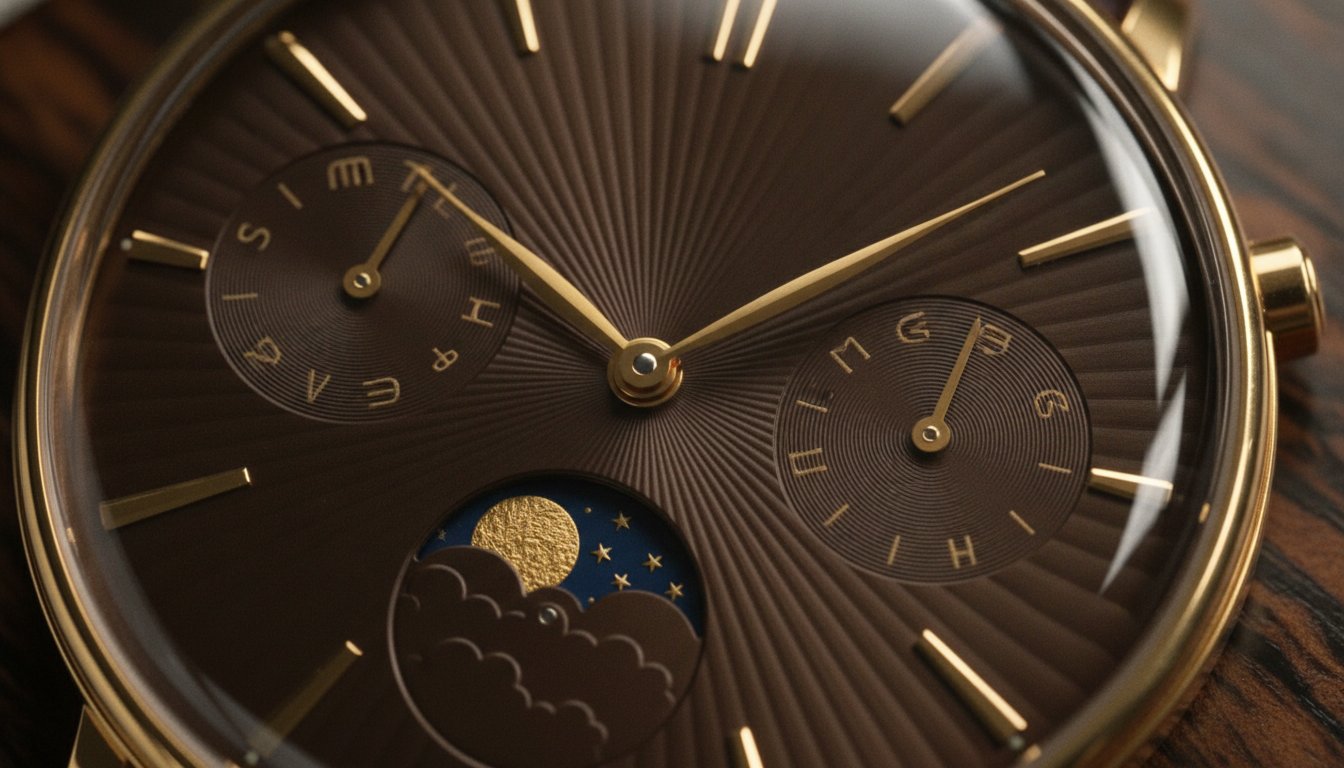
Could a collection of microscopic gears and springs actually outsmart the irregularities of the Gregorian calendar for over a century? For many enthusiasts, asking what is a perpetual calendar watch leads to the discovery of a mechanical computer that accounts for short months and leap years without human intervention. It's a feat of engineering that transforms a simple timepiece into a self-adjusting legacy.
You likely appreciate the artistry of a fine movement but feel a sense of hesitation when faced with the complexity of high complications. We'll demystify this pinnacle of horology by explaining how these watches master the four-year cycle and why they don't require manual correction until the year 2100. This guide provides the clarity you need to distinguish between annual and perpetual calendars, ensuring you can invest in a masterpiece like a Patek Philippe or IWC with absolute confidence. We'll explore the mechanical logic and investment value of these pieces, backed by the security of our five-year in-house warranty. From technical nuances to market trends, we'll prepare you to select the ultimate legacy complication for your collection.
Key Takeaways
- Understand what is a perpetual calendar watch by exploring its mechanical memory, which tracks dates, months, and leap year cycles without human intervention.
- Learn to distinguish between complete, annual, and perpetual complications to choose the level of mechanical sophistication that best suits your lifestyle and collection.
- Identify the "danger zone" for manual adjustments and other essential care practices to protect your movement's intricate gears and levers from accidental damage.
- Evaluate the investment potential of heritage brands like Patek Philippe and IWC while benefiting from the security of a 5-year in-house warranty.
- Discover why these engineering marvels are considered legacy pieces, requiring no manual correction for the Gregorian calendar's irregularities until the year 2100.
Defining the Perpetual Calendar: Horology’s Mechanical Computer
The term Quantième Perpétuel represents one of the most revered achievements in the watchmaking world. To understand what is a perpetual calendar watch, one must view it as a mechanical computer capable of tracking the date, day, month, and leap year cycle without manual intervention. While a standard timepiece simply counts to 31, a perpetual calendar accounts for the varying lengths of every month over a four-year cycle. This sophistication elevates the movement from a standard complication to the foundation of a grand complication, serving as a testament to a manufacturer's technical prowess. Determining what is a perpetual calendar watch requires looking past the dial and into the architecture of the movement itself.
A Perpetual calendar is more than a luxury; it's a solution to a mathematical nightmare. The Gregorian calendar doesn't follow a simple linear pattern. Because our solar year doesn't divide perfectly into days, watchmakers must engineer a system of cams and levers that "know" when to skip from the 30th to the 1st, or from the 28th of February directly to the start of March. This requires a level of micro-engineering that remains the ultimate test for any master watchmaker.
The Problem of the Irregular Month
Standard mechanical watches operate on a simple 31-day wheel. This design forces owners to perform a manual "date dance" five times a year. Every April, June, September, November, and February, you have to pull the crown and advance the date. This repetition isn't just a minor inconvenience. It introduces the risk of human error. Forgetting to adjust the date can lead to confusion in professional settings, while incorrect manual adjustments during specific hours can actually damage the delicate internal components of the movement. Automation removes this friction, ensuring the watch remains perfectly synchronized with the passage of time.
The 2100 Exception: Is It Truly Perpetual?
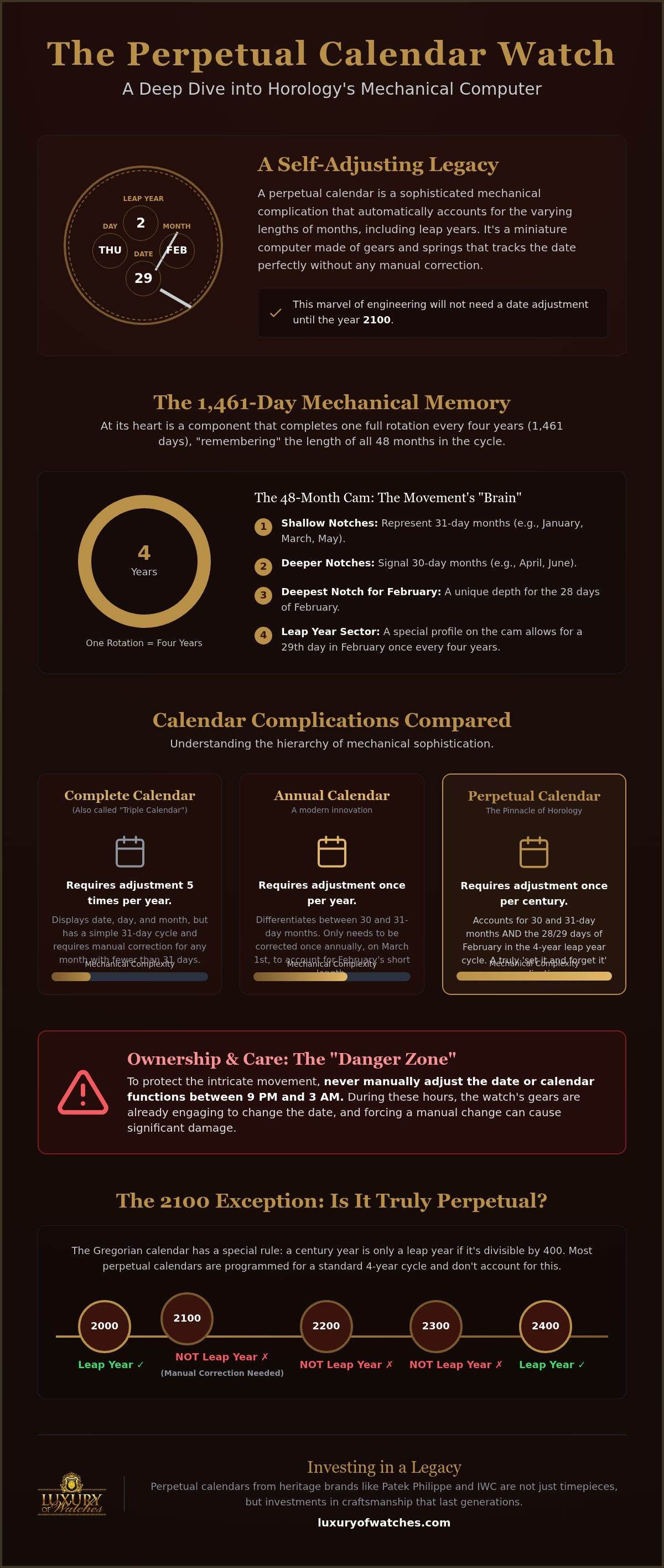
While the name suggests eternity, most of these timepieces aren't technically "forever" machines. The Gregorian calendar dictates that a century year is only a leap year if it's divisible by 400. This means that 2100, 2200, and 2300 are not leap years. Most current movements are programmed for a standard four-year cycle and will incorrectly display February 29 in the year 2100. On March 1 of that year, owners of these masterpieces will need a single manual correction. Only a handful of "secular" perpetual calendars exist that can account for these 400-year anomalies, remaining the rarest and most expensive examples in the secondary market.
How It Works: Inside the 1,461-Day Mechanical Memory
To truly grasp what is a perpetual calendar watch, you must visualize a mechanical memory that spans 1,461 days. This specific number represents three standard years of 365 days plus the 366 days of a leap year. While a digital device uses code to track time, these masterpieces rely on a physical architecture of gears to calculate the date. The movement functions as a mechanical computer, using a sophisticated "feeler" called the grand lever to sample the positions of various cams. This lever determines exactly how many days are in the current month by physically measuring the depth of a specialized wheel's teeth.
Most perpetual calendars also integrate a moon phase complication. This is a natural pairing because the lunar cycle of approximately 29.5 days requires similar reduction gearing to the calendar. The result is a dial that presents a complete celestial and terrestrial map of time. Because these movements are incredibly complex, they require expert verification to ensure every lever and spring is perfectly tensioned. You can explore our curated collection of pre-owned luxury watches to see how different manufacturers execute this mechanical puzzle.
The 48-Month Cam: The Heart of the Movement
The "brain" of the movement is the 48-month cam. Imagine a small wheel with 48 distinct notches around its perimeter, representing every month in a four-year leap year cycle. The depth of each notch corresponds to the length of the month. Shallow notches represent 31-day months, while deeper notches signify 30-day months. The deepest notches are reserved for February. During a leap year, a small satellite gear or a specific sector on the cam allows the grand lever to stop at the 29th day instead of the 28th. It's a beautifully simple solution to a complex mathematical problem.
Traditional vs. Modular Perpetual Calendars
Watchmakers generally follow two paths when building these complications. Integrated movements, like those found in high-end Patek Philippe models, are designed from the ground up as a single cohesive unit. These are often thinner and more prestigious but require immense skill to service. Modular calendars, conversely, use a base movement with a calendar "plate" added on top. While slightly thicker, they can be more practical for regular wear. A significant breakthrough occurred with the IWC Kurt Klaus system, which synchronized all calendar indications. This innovation allowed the wearer to adjust the date, day, month, and year simultaneously using only the crown, significantly reducing the risk of damaging the movement through incorrect setting.
Annual vs. Perpetual vs. Complete Calendars
While many calendars share a similar aesthetic on the dial, the mechanical intelligence beneath the surface varies significantly. To the uninitiated, a triple calendar and a perpetual calendar might look identical, both displaying the day, date, and month. However, the triple or complete calendar is the most basic tier. It simply advances the date every 24 hours, meaning you must manually adjust it five times a year for any month with fewer than 31 days. It provides the visual complexity of a high-end timepiece without the automated logic found in more advanced movements.
Defining what is a perpetual calendar watch requires looking at the tiers above this baseline. The hierarchy of calendar complications represents a ladder of engineering difficulty and, consequently, prestige. As you move from complete to annual and finally to perpetual, you aren't just buying more gears; you're acquiring a movement that mirrors the astronomical cycles of our world with increasing precision.
When to Choose an Annual Calendar
The annual calendar is a relatively modern innovation, famously pioneered by Patek Philippe in 1996. It serves as a pragmatic bridge between standard date displays and the high-complication world. An annual calendar movement distinguishes between 30 and 31-day months, requiring only one manual correction each year at the end of February. This makes it an excellent choice for collectors who value daily functionality. Many luxury watch brands utilize this complication to offer sophisticated engineering at a more accessible entry point. These movements are often slightly more durable for regular use, as they lack some of the hypersensitive levers required for the four-year leap year cycle.
The Perpetual Advantage
The pinnacle of this hierarchy is the perpetual calendar. When asking what is a perpetual calendar watch, the answer lies in its ability to master the 1,461-day leap year cycle without intervention. This is a "legacy" purchase. It's a timepiece intended to be set once and passed through generations, remaining accurate for decades. This mechanical superiority ensures that perpetual models command the highest resale value and collectability in the pre-owned luxury watches market. For the serious collector, the perpetual calendar is more than a tool; it's a piece of kinetic art that represents the absolute ceiling of traditional watchmaking skill.
Ownership & Care: The Golden Rules of Perpetual Calendars
Owning a perpetual calendar is a privilege that comes with a specific set of responsibilities. Because these movements contain hundreds of microscopic parts working in perfect synchronization, they are more sensitive than a standard date watch. When you understand what is a perpetual calendar watch, you realize you're wearing a mechanical computer that requires precise handling to maintain its accuracy. The primary rule for any owner is avoiding the "Danger Zone." Between 9 PM and 3 AM, the internal gears are already engaged in the slow process of advancing the calendar indicators. Manually forcing a change during these hours can shear teeth off the date wheel or bend the grand lever, leading to significant mechanical failure.
Different movements handle the date transition in different ways. Some models, like those from Patek Philippe, often feature an "instantaneous" jump where all displays change at exactly midnight. Others use a dragging system where the day and date wheels slowly creep forward over several hours. Regardless of the mechanism, regular service every five to seven years is non-negotiable. Fresh lubrication ensures that high-tension springs and delicate cams don't suffer from premature wear. To protect your investment, every timepiece we offer comes with a 5-year in-house warranty, providing the security required when owning such a complex complication.
The Essential Watch Winder
For most collectors, a watch winder isn't an accessory; it's a necessity. Letting a perpetual calendar stop is more than a minor inconvenience. Because the displays are synchronized, resetting a watch that has been sitting for months can be a logistical challenge. You may have to cycle through hundreds of days to reach the current date, moon phase, and leap year cycle. A high-quality winder keeps the movement running at its optimal tension. Most modern perpetual calendars require approximately 650 to 850 turns per day to stay fully wound without overstressing the mainspring.
Setting Your Watch Safely
When you do need to adjust the settings, most manufacturers provide recessed pushers, also known as correctors, on the side of the case. These should only be operated with the dedicated stylus provided by the brand. Modern innovations from IWC and Cartier have introduced synchronized systems where the crown controls all indications. This "sync" feature prevents the user from setting the day and date out of alignment. If you ever feel resistance while using a pusher or turning the crown, stop immediately. It's always better to seek professional guidance than to force a calendar wheel that has met mechanical resistance.
Investing in a Perpetual Calendar: Iconic Models & Market Insight
Investing in a high complication is the ultimate milestone for any serious collector. When you evaluate what is a perpetual calendar watch from an investment perspective, you're looking at a piece of mechanical history that transcends fleeting trends. These timepieces represent the peak of a manufacturer's catalog, often produced in limited quantities due to the immense labor required for their assembly. While the broader market may fluctuate, the demand for "Holy Trinity" perpetual calendars remains remarkably resilient. Navigating the secondary market for these complex movements requires a specialist's eye to ensure that every internal lever and cam is functioning with the precision intended by its creator.
The Patek Philippe Legacy
Patek Philippe remains the undisputed sovereign of this complication. The brand's historical significance was cemented by Reference 1518, the world's first serially produced perpetual calendar chronograph, and its successor, the legendary Reference 2499. Modern icons like the 5327 and 5270 families continue this tradition, offering refined aesthetics paired with peerless mechanical depth. It's often observed that rolex prices influence the wider high-end market, yet Patek Philippe perpetual calendars exist in a distinct tier of collectability. These models frequently hold their value or appreciate as they are discontinued, making them a cornerstone for any diversified horological portfolio.
Audemars Piguet and IWC: Innovation and Design
Audemars Piguet has consistently pushed the boundaries of this complication, specifically through the Royal Oak Perpetual Calendar. Their focus on ultra-thin movements has set multiple world records, proving that a mechanical computer doesn't need to be bulky to be powerful. Conversely, IWC Schaffhausen revolutionized the category in the 1980s with the Kurt Klaus system. By synchronizing all calendar indications to the crown, IWC made the perpetual calendar accessible and user-friendly. This innovation removed the fear of damaging the movement during adjustment, allowing a new generation of enthusiasts to appreciate the mastery of the 1,461-day cycle.
Buying with Confidence at Luxury of Watches
The secondary market offers a compelling value proposition, allowing collectors to acquire these masterpieces without traditional retail premiums. However, authentication is non-negotiable. Every perpetual calendar we sell undergoes a rigorous expert verification process to confirm its mechanical health and provenance. Because we understand the complexity of these movements, we provide a 5-year in-house warranty on every timepiece. This protection ensures that your investment is secure, allowing you to focus on the prestige of owning a watch that will remain accurate until the year 2100. By bridging the gap between exclusive manufacturers and discerning buyers, we provide a transparent path to owning horology's greatest complication.
Securing Your Horological Legacy
Owning a perpetual calendar is more than a simple acquisition; it's a commitment to preserving the pinnacle of mechanical engineering. By mastering the 1,461-day leap year cycle, these timepieces provide a convenience that remains unparalleled in the watchmaking world. Whether you're drawn to the historical weight of a Patek Philippe or the user-friendly innovations of IWC, understanding what is a perpetual calendar watch ensures you can navigate the secondary market with absolute clarity. You now have the knowledge to distinguish between calendar tiers and the practical rules to protect your movement's delicate architecture for decades to come.
At Luxury of Watches, we bridge the gap between manufacturer prestige and pragmatic value. Every timepiece in our inventory undergoes a rigorous verification process by our expert horologists, ensuring its mechanical health is as flawless as its aesthetic. We stand behind every high complication with an industry-leading 5-year in-house warranty, providing the security you need for a legacy purchase. Our specialists are available to guide you through the nuances of each model, helping you select a masterpiece that will remain accurate until the year 2100. Explore Our Collection of Authentic Perpetual Calendar Watches today and find the centerpiece for your growing collection.
Frequently Asked Questions
Do I have to reset my perpetual calendar every leap year?
No, you don't need to manually reset your timepiece during a leap year. The mechanical memory of the 48-month cam automatically accounts for the 29th of February every four years. This automation is precisely what is a perpetual calendar watch at its core. Unlike an annual calendar, which requires a correction every March 1st, a perpetual movement remains perfectly synchronized with the Gregorian calendar without human intervention for decades.
What happens if my perpetual calendar watch stops running?
If the power reserve depletes and the movement stops, you'll need to manually advance the calendar to the current date. This can be a complex process, as all indications are typically synchronized. To avoid this inconvenience, we strongly recommend using a high-quality watch winder. Keeping the movement active prevents the lubricants from settling and ensures that your moon phase and leap year indicators stay accurate without the need for a tedious, manual reset.
Is it safe to wear a perpetual calendar watch as a daily driver?
Modern perpetual calendars from brands like IWC and Patek Philippe are engineered for regular wear. While they are more delicate than a standard sports watch, they are perfectly suitable for daily use in professional or social environments. You should avoid high-impact activities or environments with strong magnetic fields. Ensuring your timepiece is covered by a robust 5-year in-house warranty provides the necessary peace of mind for enjoying such a sophisticated movement every single day.
Why is the year 2100 important for perpetual calendar watches?
The year 2100 is a centurial year that the Gregorian calendar designates as a non-leap year. Because most perpetual movements are programmed on a standard four-year cycle, they will incorrectly advance to February 29th in 2100. Consequently, almost every perpetual calendar currently in existence will require a one-time manual adjustment on March 1st, 2100. This is the only scheduled correction required for these masterpieces until the next exception occurs in the year 2200.
What is the difference between a perpetual calendar and a moon phase?
A perpetual calendar tracks the terrestrial date, month, and leap year cycle, while a moon phase complication tracks the 29.5-day lunar cycle. While they are distinct mechanical systems, they are frequently paired together in high-end horology. The calendar ensures you're synchronized with the sun and the Gregorian system, whereas the moon phase offers a celestial display. Together, they represent a complete mechanical map of time on your wrist, providing both functional and aesthetic depth.
Can a perpetual calendar be adjusted backwards?
Most traditional perpetual calendars cannot be adjusted backwards without risking severe damage to the movement. If you overshoot the current date, you often have to wait for the watch to stop or cycle through the entire calendar again. However, some modern innovations, particularly from brands like Cartier or IWC, have introduced systems that allow for safer adjustments. Always consult your specific model's manual or an expert horologist before attempting to move the indicators in reverse.
How much does it cost to service a perpetual calendar watch?
Servicing costs for these complications are higher than standard movements due to the hundreds of intricate parts involved. While official service centers charge a premium, regular maintenance every five to seven years is essential for preserving the watch's value. These services typically include full disassembly, cleaning, and fresh lubrication of the calendar works. To help manage these long-term ownership needs, we provide a 5-year in-house warranty on our pre-owned luxury watches to ensure your investment remains protected.
Are perpetual calendar watches a good investment?
Perpetual calendars are widely considered a blue-chip investment in the horological world. Models from Patek Philippe and Audemars Piguet historically maintain or increase in value, especially when they are discontinued. Beyond the financial aspect, these watches are legacy pieces that retain their prestige across generations. Purchasing pre-owned allows you to avoid initial retail depreciation while securing a masterpiece that remains a cornerstone of the secondary market due to its extreme mechanical rarity.