
What Is a 'Holy Trinity' Watch Brand? The Definitive Guide to Haute Horlogerie
Posted by Luxury of Watches on 21st Sep 2026
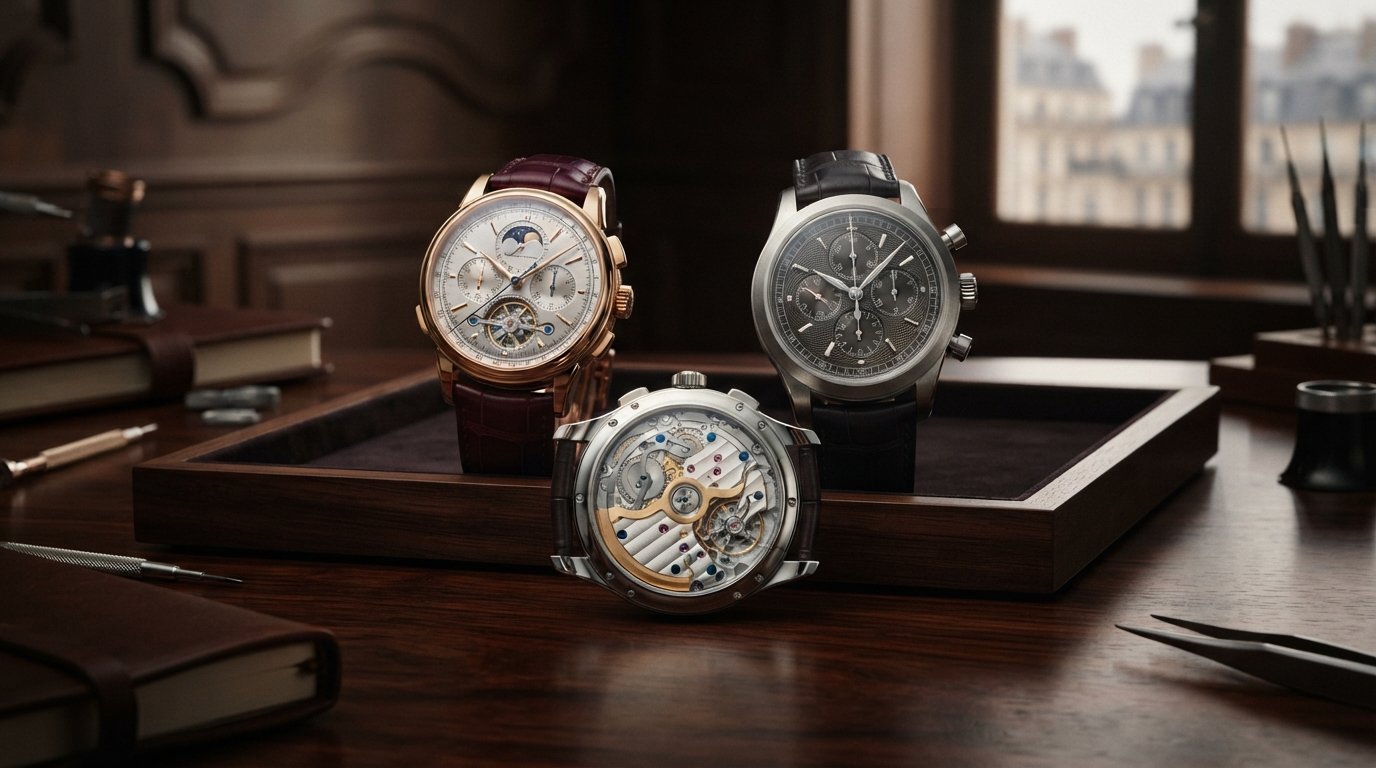
Rolex manufactures over 1.1 million watches each year, yet Vacheron Constantin crafts barely 32,000. That stark contrast in philosophy highlights why collectors frequently ask: what is a 'holy trinity' watch brand, and why does industrial luxury sit outside of it? If you feel uncertain deciphering complex horological terms like anglage, the Geneva seal, and grand complications, you aren't alone. It's natural to wonder why these rare creations command significant price premiums over mass-manufactured alternatives, or how to acquire them on the secondary market without the fear of encountering counterfeit pieces.
In this guide, you'll uncover the unbroken lineage, relentless innovation, and iconic timepieces behind Patek Philippe, Audemars Piguet, and Vacheron Constantin. We'll examine the precise artisanal benchmarks that separate hand-decorated calibers from assembly-line production, while providing actionable advice on how to evaluate, authenticate, and collect premier Swiss masterworks with complete peace of mind. Here is your definitive look into the highest echelon of haute horlogerie.
Key Takeaways
- Understanding what is a 'holy trinity' watch brand comes down to recognizing the unbroken lineages, hand-finished calibers, and extreme production limits of Patek Philippe, Audemars Piguet, and Vacheron Constantin.
- The definitive divide separating these historic houses from industrial leaders like Rolex lies in hand decoration, complex micro-mechanics, and artisanal finishing rather than mass-market volume.
- Each maison earned its status through defining moments in horological history, from legendary grand complications to pioneering luxury steel sports watch design.
- Evaluating high horology pieces requires prioritizing original, unpolished case chamfers, authentic dial textures, and movement integrity over aggressive cosmetic refurbishments.
- Sourcing pre-owned luxury timepieces through vetted platforms bypasses exhaustive boutique waitlists while providing the essential protection of rigorous authentication and dedicated warranty coverage.
Defining the 'Holy Trinity' of Haute Horlogerie
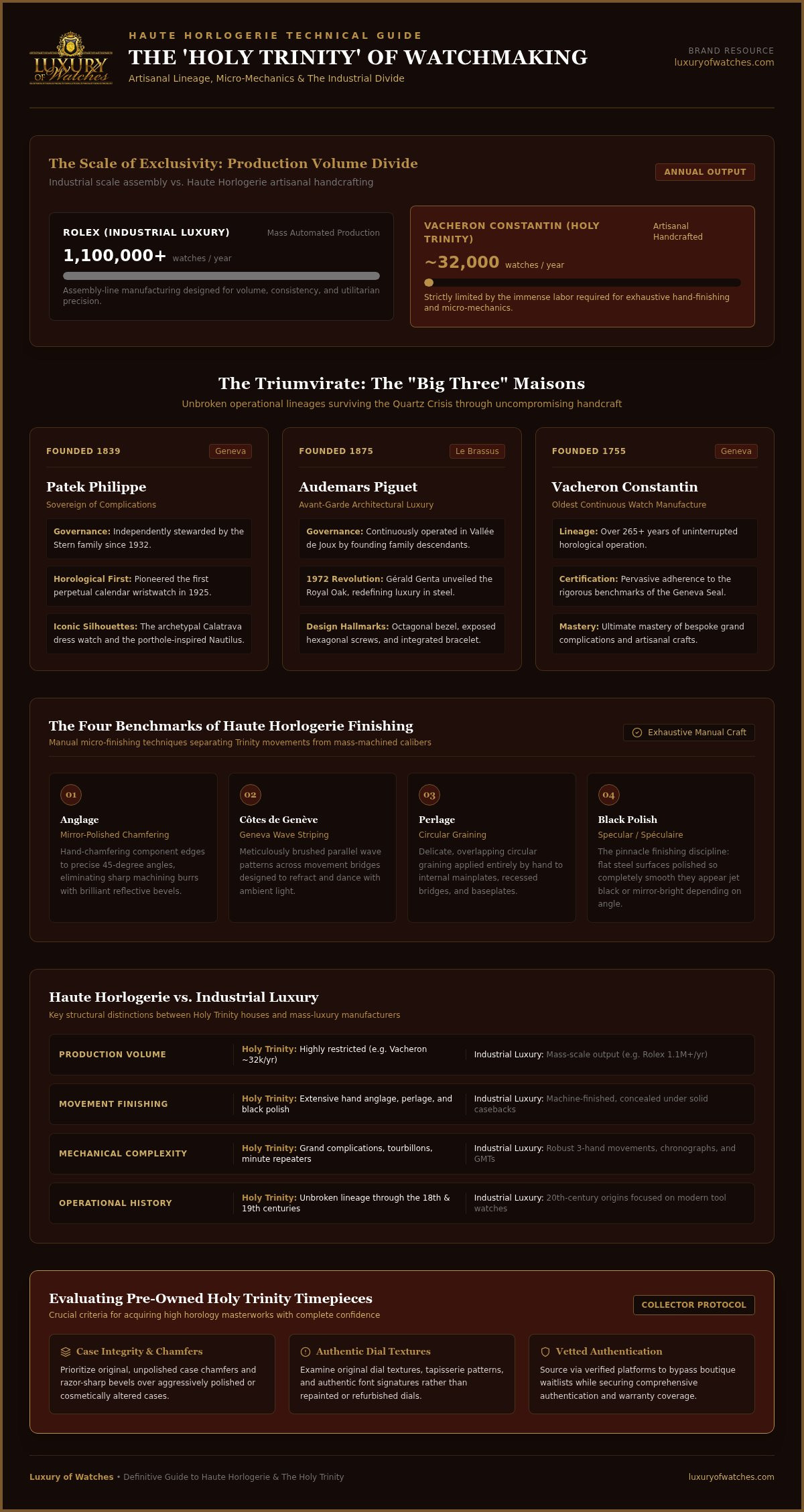
To grasp what is a 'holy trinity' watch brand, one must look beyond commercial luxury and enter the exclusive domain of traditional Swiss craft. The phrase refers specifically to three historic manufactures: Patek Philippe, Audemars Piguet, and Vacheron Constantin. Often hailed as the "Big Three," these maisons represent the undisputed zenith of mechanical timekeeping, setting benchmarks that ordinary watchmakers cannot replicate.
Haute horlogerie elevates watchmaking from utilitarian engineering into fine art. Rather than mass-assembling functional instruments, these three houses focus on artisanal micro-mechanics. Each timepiece serves as a canvas where centuries of heritage, inventive engineering, and meticulous manual finishing converge to produce horological masterworks.
The Historical Origins of the 'Big Three' Classification
The term was never a corporate slogan or marketing campaign. It was coined organically by journalists, auctioneers, and dedicated collectors during the 1970s and 1980s. When the quartz crisis flooded the market with inexpensive battery-powered movements, mechanical watchmaking faced potential extinction. While hundreds of historic workshops collapsed, these three houses stood firm. They refused to compromise on hand-executed complications or time-honored assembly methods, solidifying a collective identity that preserved classical Swiss horology.
The Hallmarks of Haute Horlogerie: Finishing, Innovation, and Lineage
Understanding what is a 'holy trinity' watch brand requires evaluating the microscopic hand-finishing applied to every internal component. Industrial calibers hide rough machining beneath closed casebacks. In contrast, Trinity calibers showcase exhaustive manual decoration visible through sapphire crystals:
- Anglage: Hand-chamfering component edges to mirror-polished 45-degree angles, eliminating sharp machine burrs.
- Côtes de Genève: Precise parallel wave striping brushed across movement bridges to refract ambient light.
- Perlage: Overlapping circular graining meticulously applied by hand to mainplates and recessed bridges.
- Black Polish: The ultimate finishing discipline, creating flat steel surfaces that reflect light so perfectly they appear deep black from certain angles.
True haute horlogerie also demands mechanical mastery over grand complications. These houses routinely pioneer split-second chronographs, astronomical perpetual calendars, multi-axis tourbillons, and chiming minute repeaters. Paired with continuous operational histories dating back to the 18th and 19th centuries, this devotion to mechanical purity ensures their status remains unchallenged across the global luxury landscape.
The Triumvirate Examined: Patek Philippe, Audemars Piguet, and Vacheron Constantin
Every member of the Big Three contributes a distinct philosophy to high horology. Exploring what is a 'holy trinity' watch brand means recognizing how their individual creative paths shaped modern watchmaking. While they share an obsession with perfection, their expressions of design and engineering couldn't be more distinct.
Patek Philippe: Sovereign of Complications and Timeless Elegance
Founded in 1839 and stewarded independently by the Stern family since 1932, Patek Philippe represents the gold standard of classical watchmaking. The Geneva manufacture pioneered the first perpetual calendar wristwatch in 1925 and established the archetype of the quintessential dress watch with the Calatrava. Its cultural impact expanded dramatically with the porthole-inspired Nautilus silhouette, proving that haute horlogerie could thrive in stainless steel. For collectors studying the broader landscape of premier luxury watch brands, Patek Philippe remains the definitive authority on mechanical prestige.
Audemars Piguet: The Avant-Garde Architect of Modern Luxury
Operating continuously out of Le Brassus under founding family descendants since 1875, Audemars Piguet thrives on audacious design. In 1972, the maison upended Swiss traditions when visionary designer Gérald Genta unveiled the Royal Oak. Crafted in finished steel with an octagonal bezel, visible hexagonal screws, and an integrated bracelet, it invented the modern luxury sports watch category. Audemars Piguet pushed boundaries again with the muscular Royal Oak Offshore and openworked calibers, demonstrating how independent family ownership nurtures bold technical risk-taking.
Vacheron Constantin: Centuries of Unbroken Watchmaking Heritage
Established in Geneva in 1755 by Jean-Marc Vacheron, this maison holds the unmatched title of the world's oldest continuously operating watchmaker. For over two and a half centuries, it has never ceased production. Vacheron Constantin expresses this uninterrupted pedigree through refined classics like the minimalist Patrimony collection, complex bespoke cabinotiers commissions, and the dynamic Overseas line. The house executes every component with aristocratic grace, cementing its place among the pinnacle makers.
Discerning collectors looking to bypass elusive boutique allocations can explore curated pre-owned luxury watches through specialized platforms that authenticate each rare reference with rigorous inspection standards.
Why Isn't Rolex Included in the Holy Trinity?
No name commands greater global recognition than Rolex. The Crown represents the absolute pinnacle of luxury marketing, chronometric precision, and resale resilience. Yet in conversations exploring what is a 'holy trinity' watch brand, Rolex is purposefully absent. This omission isn't a critique of quality, but a reflection of fundamentally divergent manufacturing philosophies.
Industrial Automation vs. Hand-Finished Artisanship
Rolex excels at producing the world's most dependable, robust mechanical tool watches. Achieving this level of accuracy requires cutting-edge robotics, automated CNC machining, and rigorous industrial tolerances. Movements are engineered for daily durability rather than aesthetic display, which is why most feature solid casebacks concealing cleanly machined plates.
The Holy Trinity operates under an entirely different discipline. Master watchmakers dedicate hundreds of painstaking hours to manually beveling bridges, shaping internal angles, and polishing minute pinions under a loupe. While Rolex perfects precision engineering at scale, the Big Three dedicate their resources to complex astronomical complications and delicate hand finishing.
Production Volumes and the Illusion of Scarcity
The gap in production scale between Geneva's industrial titan and haute horlogerie marques is immense. According to Swiss watch industry estimates from Morgan Stanley and LuxeConsult, Rolex manufactures roughly 1.15 million timepieces annually. By comparison, annual Trinity outputs are strictly limited:
- Patek Philippe: Approximately 70,000 pieces per year.
- Audemars Piguet: Approximately 52,000 pieces per year.
- Vacheron Constantin: Approximately 32,000 pieces per year.
Rolex produces more than seven times the combined output of all three Trinity houses put together. Boutique shortages often create an illusion of extreme rarity, but actual availability is shaped by broader market forces, as detailed in our guide to rolex prices. Trinity scarcity, on the other hand, is driven by the physical limitations of artisanal hand assembly.
The Challengers: Brands That Rival the Traditional Triumvirate
Modern collectors frequently debate whether the historic Big Three classification should expand. Germany's A. Lange & Söhne matches Trinity caliber decoration through its signature double-assembly process and hand-engraved balance cocks. Independent creators like F.P. Journe and classical pillars like Breguet also demonstrate breathtaking mechanical ingenuity. Even so, when collectors define what is a 'holy trinity' watch brand, they honor the specific triumvirate that preserved Swiss mechanical artistry through the quartz era without interruption.
Evaluating Holy Trinity Timepieces: Rarity, Provenance, and Mechanics
Acquiring a premier high horology piece requires a meticulous, analytical approach. While understanding what is a 'holy trinity' watch brand introduces you to peerless craftsmanship, evaluating individual specimens demands careful scrutiny of physical condition and mechanical health. Value in this tier hinges on historical integrity rather than superficial shine.
Condition Assessment: Originality, Case Geometry, and Caliber Health
Case geometry takes absolute priority over surface perfection. Novice collectors often seek flawless, scratch-free metal, yet seasoned connoisseurs actively seek original, unpolished cases. Routine polishing wheels round off factory chamfers, erode crisp bevels, and soften the razor-sharp lines that define complex case architectures. A watch with honest light wear and sharp factory edges holds far higher collector value than one over-polished into soft contours.
Originality across the dial and movement is just as critical. Watch for intact fonts, correct period-specific luminous material, and factory-original hands. Beneath the caseback, the movement requires diagnostic evaluation:
- Amplitude: Healthy balance wheel oscillation indicates clean jewels and fresh lubrication.
- Beat Error: Minimal millisecond discrepancy ensures the balance swings symmetrically in both directions.
- Water Resistance: Modern testing confirms case gaskets are pliable and properly seated against moisture.
Provenance, Extracts, and Documentation
Documented lineage provides vital security against Franken-watches, modified calibers, or questionable histories. An original Certificate of Origin or guarantee card stamped by the selling boutique remains the premier validation of authenticity, confirming the original delivery date and matching case and movement numbers.
When original papers are absent on historic models, official Extracts from the Archives offer essential verification. These documents certify that the case and movement numbers left the manufacture together according to historical ledger books. For detailed guidance on assessing certified references, explore our collector overview for pre-owned luxury watches.
Purchasing at this level demands verifiable mechanical inspection and trusted consumer reassurance. To secure fully verified references protected by comprehensive multi-point authentication and an industry-leading five-year in-house warranty, explore our curated selection of timepieces at Luxury of Watches today.
Navigating Pre-Owned Holy Trinity Acquisitions with Confidence
Primary boutique distribution for high horology remains strictly managed. Between extensive purchase histories and multi-year waitlists, acquiring an allocation directly from an authorized salon is often impractical. Turning to vetted pre-owned luxury watches provides immediate access to iconic references. Still, entering the secondary market requires a clear understanding of what is a 'holy trinity' watch brand regarding authentication standards and technical protection.
Specialized digital platforms have revolutionized high-value collecting. They eliminate the opacity of peer-to-peer message boards and the aggressive premiums of heritage storefronts. By pairing curated digital inventories with rigorous operational safeguards, reputable intermediaries deliver genuine peace of mind alongside horological exclusivity.
Authentication Benchmarks in the Secondary Luxury Market
Superficial visual inspections are wholly inadequate for high-value horology. Sophisticated counterfeits and assembled Franken-watches can deceive an untrained eye, demanding multi-point physical inspection protocols conducted by master technicians:
- Internal Movement Auditing: Technicians inspect the escapement, balance assembly, and bridge anglage under high magnification to confirm genuine factory components.
- Registry Cross-Referencing: Individual case and caliber serial numbers are systematically cross-checked against international lost and stolen registries to ensure uncompromised legal title.
- Caseback and Bezel Verification: Screws, gaskets, and locking mechanisms are assessed to ensure factory tolerances have not been altered by uncertified third parties.
Working exclusively with established dealers who back their collections with documented authentication guarantees is the single most effective way to eliminate transactional risk.
The Value of Comprehensive In-House Warranty Coverage
Original manufacturer warranties eventually expire, leaving secondary market buyers vulnerable to costly servicing expenses. Restoring an intricate perpetual calendar or an ultra-thin split-second caliber through factory channels can take months and incur significant expenses. For collectors seeking what is a 'holy trinity' watch brand without mechanical uncertainty, dedicated post-purchase coverage changes the equation entirely.
Luxury of Watches resolves this vulnerability by pairing competitive market pricing with an industry-leading five-year in-house warranty. Every mechanical movement is thoroughly regulated and protected, giving you the freedom to wear and enjoy high horology without lingering anxiety over operational failure. Browse our authenticated collection of Patek Philippe and Audemars Piguet watches to discover premier Swiss craft backed by complete mechanical protection.
Elevate Your Collection with Haute Horlogerie Mastery
Understanding what is a 'holy trinity' watch brand reveals that true horological prestige transcends sheer production numbers and mainstream recognition. Patek Philippe, Audemars Piguet, and Vacheron Constantin have earned their sovereign status through centuries of uninterrupted lineage, inventive micro-mechanics, and peerless hand finishing. Whether you're drawn to the architectural lines of an integrated steel icon or the quiet complexity of a classical perpetual calendar, collecting at this level celebrates mechanical art in its purest form.
Navigating the secondary market shouldn't involve technical guesswork or transactional anxiety. Serving collectors with accessible luxury prestige since 1999, Luxury of Watches eliminates secondary market risk through proven specialist care. Every timepiece passes our rigorous multi-point authenticity inspection and comes backed by a comprehensive five-year in-house mechanical warranty. Ready to experience the pinnacle of Swiss watchmaking? Explore our authenticated selection of Holy Trinity timepieces today, and take the next step in building a personal collection that will endure for generations.
Frequently Asked Questions
What brands make up the Holy Trinity of watches?
The Holy Trinity consists of Patek Philippe, Audemars Piguet, and Vacheron Constantin. Coined by collectors and journalists in the late 20th century, the term honors these three Swiss manufactures for their unbroken operating histories and uncompromising dedication to haute horlogerie finishing. Together, they represent the absolute peak of classical watchmaking craft.
Why is Rolex not considered part of the Holy Trinity?
Rolex focuses on automated precision manufacturing and extreme durability rather than low-volume, hand-finished artisanship. While Rolex produces over one million watches annually to impeccable industrial standards, Trinity maisons strictly limit their output to accommodate exhaustive manual decoration and delicate grand complications. It's a fundamental difference in horological philosophy, not build quality.
Can another brand like A. Lange & Söhne replace a Holy Trinity member?
No, because the classification is an established historical designation rather than a rotating industry award. German master watchmaker A. Lange & Söhne matches or exceeds Trinity caliber decoration, but its post-war operational hiatus prevents it from meeting the unbroken historical lineage criteria. When collectors ask what is a 'holy trinity' watch brand, they're referencing that specific, historic Swiss triumvirate.
Do Holy Trinity watches hold their value over time?
Iconic sports models like the Royal Oak and Nautilus historically retain exceptional value, often commanding strong secondary premiums. Classical complications and gold dress watches may trade below their original boutique retail levels initially, yet they offer remarkable stability over decades. Historical provenance, pristine case geometry, and complete paperwork remain the primary drivers of long-term retention.
What is the difference between haute horlogerie and standard luxury watchmaking?
Haute horlogerie centers on manual movement finishing, intricate micro-engineering, and limited production. Standard luxury watches rely heavily on automated CNC machining and mass-assembled movements designed for tool utility. Haute horlogerie elevates timekeeping into fine art, requiring master craftsmen to spend hundreds of hours hand-polishing internal bevels, applying delicate striping, and assembling complex chiming or astronomical complications.
Is it safe to buy a pre-owned Holy Trinity watch online?
Yes, provided you purchase through an established specialist platform rather than unvetted peer-to-peer marketplaces. Reputable dealers employ master watchmakers to conduct multi-point physical inspections, verifying genuine bridge engravings, escapement components, and uncompromised serial numbers. Checking dealer tenure, documented return guidelines, and authentication guarantees ensures a secure, transparent acquisition.
What warranty protection should I look for when buying a pre-owned luxury timepiece?
Look for a comprehensive in-house mechanical warranty that covers the movement against internal defects. Most pre-owned haute horlogerie pieces have expired factory coverage, leaving owners exposed to high servicing costs. Specialized retailers like Luxury of Watches solve this by providing a dedicated five-year in-house warranty, delivering complete mechanical protection and long-term peace of mind on authentic luxury timepieces.