
Understanding Different Types of Watch Movements: A Collector’s Guide to Horological Engines
Posted by Luxury of Watches on 13th Jul 2026
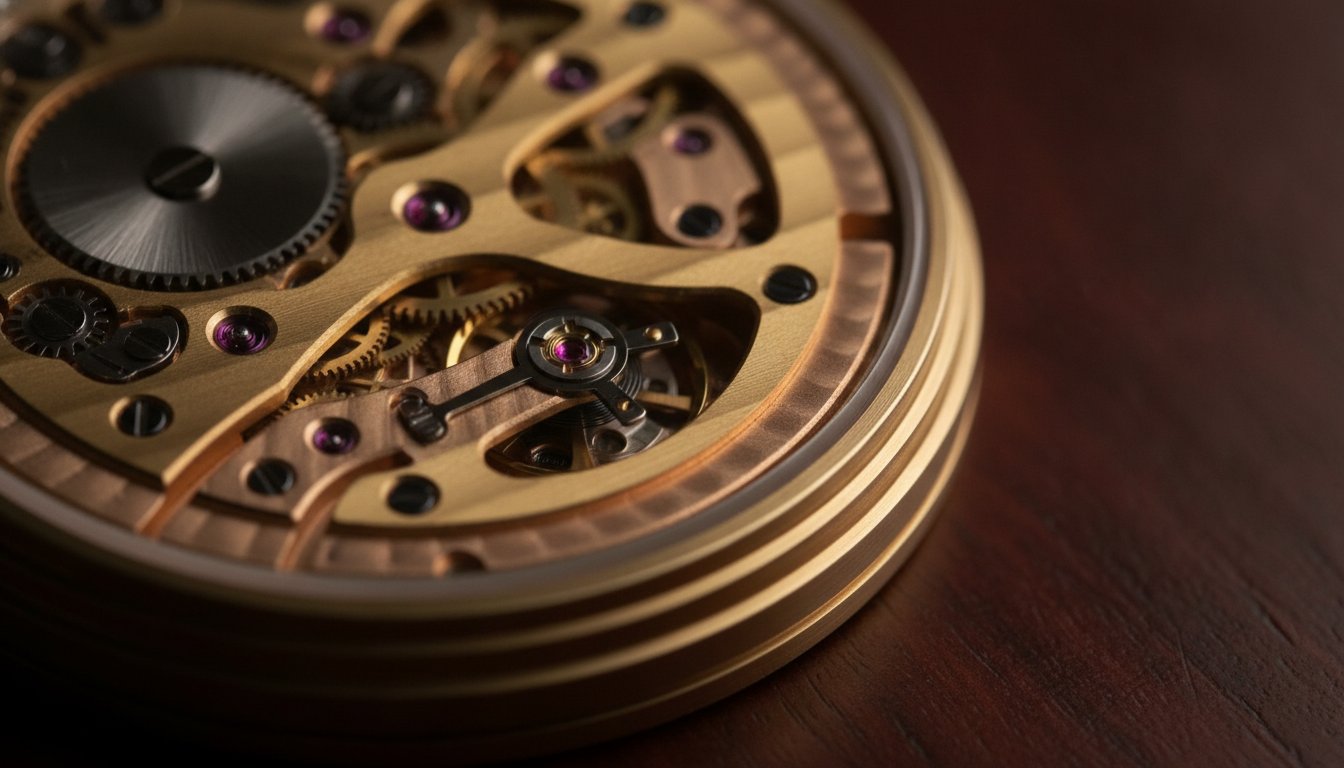
Why would a serious collector pay the price of a luxury sedan for a mechanical timepiece that loses four seconds a day, when a basic quartz watch keeps near-perfect time for the cost of a dinner? It's a paradox that often creates hesitation for those just beginning the journey of understanding different types of watch movements. You might feel overwhelmed by technical jargon like "escapements" or "calibres," or perhaps you worry about the long-term maintenance costs of a complex mechanical heart. It's natural to seek reassurance when navigating high-value acquisitions like a Rolex or Patek Philippe.
In this guide, we'll demystify the technical nuances and heritage of mechanical, automatic, and quartz movements. You'll learn to identify a high-grade movement from a generic one, ensuring your next investment is backed by both horological soul and financial logic. We'll also discuss the latest 2026 industry standards, such as the COSC Excellence Chronometer certification, and explain how the movement type directly impacts a watch's resale value and longevity. By the end, you'll have the expertise to discuss specifications with the authority of a seasoned collector while feeling secure in the technical integrity of your timepiece.
Key Takeaways
- Gain a clear perspective on understanding different types of watch movements by distinguishing between traditional mechanical artistry and modern quartz precision.
- Discover why mechanical calibres remain the gold standard for luxury investments and how they influence a timepiece's long-term resale potential.
- Learn to identify high-tier craftsmanship through technical markers like the new 2026 COSC Excellence certification and exquisite finishing techniques.
- Understand the practicalities of long-term maintenance and how a 5-year in-house warranty offers essential protection for your complex horological engines.
- Determine which movement best aligns with your lifestyle, whether you require the heritage of a manual wind or the modern efficiency of an automatic.
The Heart of the Timepiece: Defining the Watch Movement
Every luxury timepiece is defined by its internal engine. To begin understanding different types of watch movements, one must look beyond the dial and hands to the intricate assembly of parts that tracks time and drives complications. The watch movement is the primary factor determining a watch's retail price and its future value on the secondary market. It represents the soul of the piece, dictating how the hands move, how often the watch needs attention, and the level of craftsmanship involved in its creation.
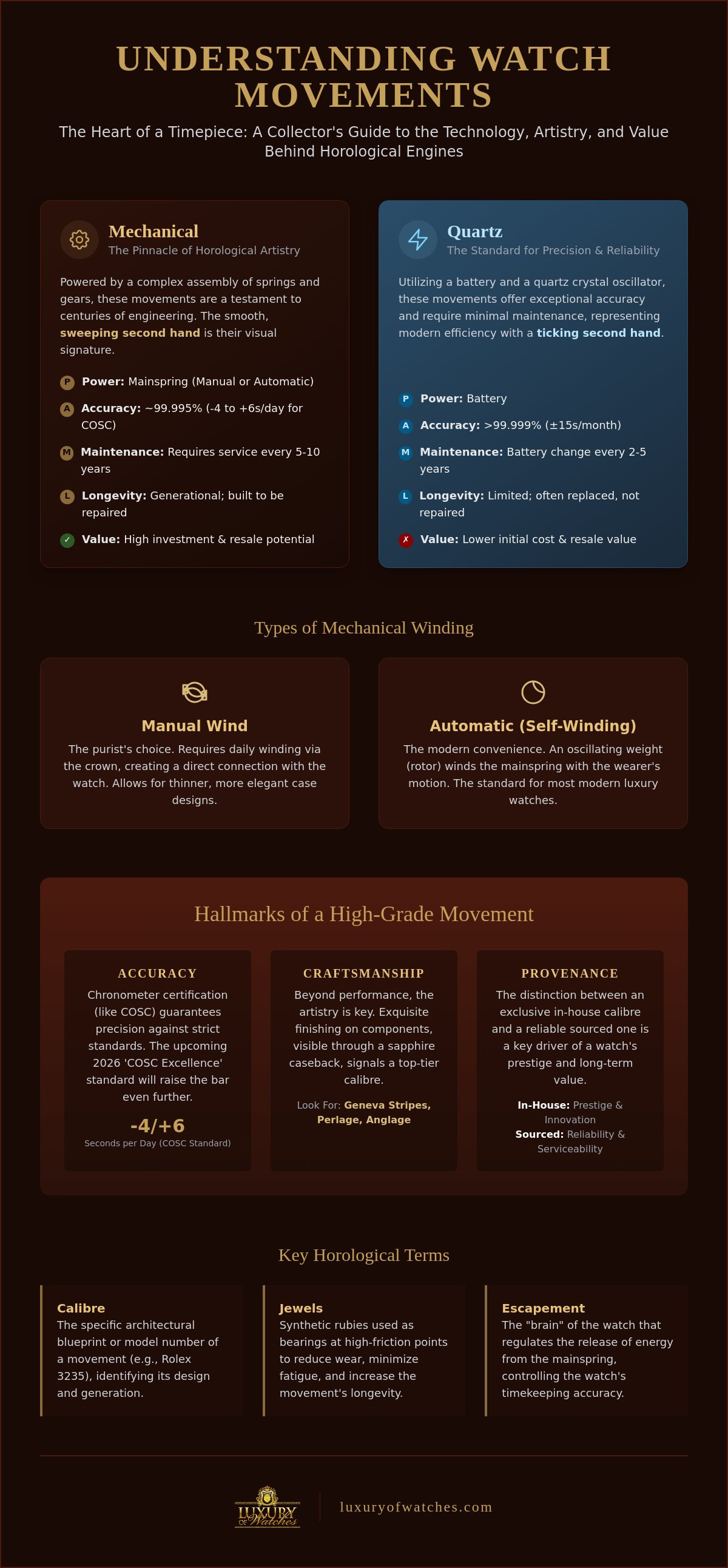
The market is broadly split between mechanical and quartz engines. While both serve the same fundamental purpose, their internal architectures are worlds apart. Mechanical movements rely on a complex system of gears and springs, while quartz movements utilize an electronic oscillator regulated by a crystal. For the serious collector, the movement is the heart of the investment; it's the component that requires the most rigorous verification of authenticity and condition to ensure long-term value.
Movement vs. Calibre: Is There a Difference?
Collectors often use the terms "movement" and "calibre" interchangeably, but a technical distinction exists that signals a deeper level of horological knowledge. A movement is the general mechanism that powers the watch. A calibre refers to the specific architectural blueprint of a watch engine. Manufacturers use calibre numbers to identify specific generations of technology. For example, the Rolex 3235 calibre represents a specific era of engineering with distinct performance metrics and part configurations. Recognizing these numbers allows you to track the evolution of a brand's technical prowess and helps in identifying the specific era of a pre-owned timepiece.
The Quartz Revolution and the Return of Mechanical Prestige
The 1970s marked a turning point known as the "Quartz Crisis," a period when inexpensive, battery-powered watches from Asia nearly decimated the traditional Swiss industry. Electronic precision was suddenly accessible to everyone, making the mechanical watch seem like an obsolete relic. However, the industry didn't disappear. Instead, it pivoted. Mechanical watches moved from being essential tools to being recognized as high-end art pieces and symbols of heritage.
Brands like Patek Philippe led this resurgence by doubling down on traditional craftsmanship and complex complications. Today, the choice between a sourced movement from a provider like ETA or Sellita and a brand's own "In-House" calibre is a major talking point. While sourced movements offer exceptional reliability and easier servicing, in-house calibres are prized for their exclusivity and brand-specific innovation. This distinction is a key driver in the secondary market, where a unique manufacturer-specific movement can significantly bolster a watch's resale value.
Mechanical Movements: The Pinnacle of Traditional Horology
The true depth of understanding different types of watch movements begins with the mechanical engine. These calibres represent centuries of engineering evolution, distilled into a space smaller than a coin. Unlike digital counterparts, a mechanical watch relies on a mainspring to store potential energy. This energy is released through a delicate dance between the balance wheel and the escapement, which regulates the power to ensure precise timekeeping. This high-frequency release creates the elegant "sweeping" second hand, a visual signature that immediately distinguishes a luxury timepiece from a mass-produced quartz model.
The longevity of these movements is bolstered by synthetic jewels, typically rubies. These components are placed at high-friction points within the gear train to minimize wear. It's common to see "17 jewels" or "31 jewels" engraved on a calibre, signaling the level of protection against mechanical fatigue. Collectors prioritize these hand-assembled engines because they are built to be serviced and passed down through generations, rather than replaced. The complexity of hundreds of micro-components working in harmony is what justifies the premium price of high-end horology.
Manual Wind: The Purist’s Connection
A manual wind movement requires the wearer to physically turn the crown to tighten the mainspring. This ritual creates a tactile bond between the owner and the machine. Because they lack the added weight of an automatic rotor, manual movements allow for remarkably thin case profiles. This makes them the preferred choice for elegant dress watches from manufacturers like Cartier and Patek Philippe. The absence of a rotor also provides an unobstructed view of the gears through an exhibition caseback, turning the movement into a visible gallery of horological art.
Automatic (Self-Winding): Engineering for Daily Wear
Automatic movements incorporate an oscillating weight, or rotor, that spins with the natural motion of your wrist. This kinetic energy winds the mainspring automatically, offering a level of convenience that has made them the dominant choice for modern collectors. In fact, automatic movements are projected to hold a 72.2% share of the mechanical watch market in 2026. Rolex pioneered this with their "Perpetual" movement, setting a standard for reliability that remains a benchmark today. When considering your next purchase, it's helpful to explore pre-owned luxury watches that feature these robust calibres to find a piece that balances heritage with modern utility.
A critical specification for any automatic watch is the power reserve. This indicates how long the movement will continue to run while stationary. Modern high-end calibres often provide 48 to 72 hours of reserve, allowing you to set the watch aside for a weekend without needing to reset the time on Monday morning. This blend of traditional mechanics and modern efficiency is why the automatic movement remains the heartbeat of the luxury watch industry.
Quartz and Hybrid Movements: Precision and Innovation
While mechanical engines represent the heritage of horology, quartz movements represent its peak of functional precision. The mechanism is elegantly simple yet incredibly effective. A small battery sends an electric current through a synthetic quartz crystal, causing it to vibrate at a consistent frequency of exactly 32,768 Hz. An integrated circuit then translates these vibrations into a single pulse every second, driving the gear train. This process creates the characteristic "ticking" motion of the second hand. This reliable performance is a foundational element in understanding different types of watch movements, especially for collectors who value a "grab and go" timepiece that requires no winding.
Luxury quartz is far from a compromise. It is an engineering choice that prioritizes accuracy and slimness. While a mechanical watch might lose several seconds a day, a standard quartz movement might only deviate by seconds per month. For the professional or the traveler, this reliability is often more valuable than the traditional complexity of gears. The maintenance profile is also significantly different, as these pieces typically only require a battery replacement every few years rather than the labor-intensive overhauls required by mechanical calibres.
High-End Quartz: When Luxury Meets Electronic Precision
Prestige brands have integrated quartz technology into some of their most iconic designs to offer a blend of elegance and practicality. The Cartier Tank, for instance, frequently utilizes high-end quartz to maintain its signature ultra-slim profile. This allows the watch to sit flush against the wrist, a feat often difficult to achieve with thicker automatic rotors.
In professional sectors, Breitling watches have set a high bar with their "SuperQuartz" technology. These movements are thermocompensated, meaning they use internal sensors to adjust the crystal's frequency based on temperature changes. This ensures an accuracy level ten times greater than a standard quartz engine. It is a vital feature for pilots and adventurers who operate in environments where temperature fluctuations could otherwise compromise timekeeping integrity.
The Spring Drive: A Category of Its Own
The Spring Drive represents a unique hybrid category that bridges the gap between mechanical soul and electronic precision. This technology, a marvel of modern Japanese horology, uses a traditional mainspring to store energy and a gear train to transmit it. However, it replaces the traditional mechanical escapement with a "Tri-synchro regulator." This regulator uses an electromagnetic brake to control the release of energy, governed by a quartz oscillator.
The visual result is a second hand that glides in a perfectly smooth, continuous motion, devoid of the micro-vibrations seen in mechanical sweeps or the jumps of quartz ticks. It provides the wearer with the tactile satisfaction of a winding mainspring while delivering the extreme accuracy of an electronic circuit. For many collectors, the Spring Drive is the ultimate expression of innovation, proving that the future of the watch movement can honor traditional craftsmanship while embracing modern technology.
What Makes a 'Great' Movement? Accuracy, Artistry, and Value
Moving beyond basic mechanics reveals the distinction between a standard engine and a horological masterpiece. A "great" movement is defined by its ability to maintain precision under duress, the complexity of its functions, and the level of hand-applied finishing. These factors are the primary drivers of pre-owned luxury watch value, as they represent the pinnacle of a manufacturer's technical achievement. A deeper level of understanding different types of watch movements requires an eye for these specific technical and aesthetic signatures.
The relationship between movement rarity and market value is direct. When a brand like Patek Philippe or Rolex introduces a new calibre, the previous generations often become more desirable to collectors due to their finite production. Furthermore, the addition of complications, such as a chronograph or a perpetual calendar, exponentially increases the difficulty of assembly. Each extra function requires dozens of additional parts, all of which must be perfectly synced. This complexity ensures that the watch remains a significant asset over time.
Chronometer Certification: The Quest for Perfect Time
Precision is the ultimate metric for any high-end calibre. The COSC (Contrôle Officiel Suisse des Chronomètres) is the independent Swiss benchmark for mechanical precision. Historically, this meant a deviation of -4 to +6 seconds per day. However, starting in October 2026, the new "Excellence Chronometer" certification raises the bar to -2 to +4 seconds per day. This new standard tests the fully assembled watch rather than just the movement, including resistance to 200 Gauss magnetic fields. Brands like Rolex take this further with their "Superlative Chronometer" designation, ensuring performance that exceeds these standard industry requirements.
Movement Decoration: The Invisible Art
Finissage, or movement finishing, is where mechanical engineering transitions into fine art. Even in parts hidden from the wearer's view, prestigious manufacturers apply intricate patterns to the plates and bridges. These decorations serve a dual purpose. While they are aesthetically stunning, they also act as a primary indicator of authenticity for experts. Replicating true hand-finishing is exceptionally difficult, making it a "fingerprint" of a genuine high-end calibre. Common techniques include:
- Côtes de Genève: Parallel wave-like patterns that catch the light.
- Perlage: Overlapping circular graining often found on the base plate.
- Anglage: Meticulously hand-beveled and polished edges on the bridges.
The Geneva Seal remains the ultimate mark of quality, certifying that a movement was produced and finished within the Canton of Geneva to exacting standards. If you are ready to invest in a piece that exemplifies this level of artistry, browse our collection of pre-owned luxury watches, each verified for authenticity and backed by our comprehensive 5-year in-house warranty.
Choosing the Right Movement for Your Lifestyle
Selecting a timepiece requires more than an appreciation for aesthetics; it demands a practical alignment with your daily habits. If you intend to wear your watch every day, a robust automatic movement is the most logical choice. These engines capture the energy of your active life, ensuring the watch remains powered without intervention. For those seeking a piece for special occasions, a manual wind or high-end quartz might be more appropriate. A manual wind movement offers a slim profile that slides effortlessly under a tuxedo cuff, while quartz provides the convenience of absolute precision even after weeks of sitting in a safe.
Owning a mechanical masterpiece also brings the responsibility of maintenance. Just as a fine automobile requires periodic tuning, a mechanical calibre needs professional servicing every 5 to 10 years. Budgeting for this care is a vital part of understanding different types of watch movements and their long-term ownership costs. This durability is exactly why Rolex prices remain so resilient in the secondary market. Their calibres are engineered for extreme longevity, often performing with chronometer-level accuracy decades after their initial production.
The Importance of Verification and Warranty
The secondary market can be treacherous for the uninitiated, particularly with the rise of "Franken-watches." These are pieces where a genuine exterior case has been paired with a non-matching or inferior movement. At Luxury of Watches, we eliminate this risk through a rigorous verification process. Our specialists inspect every internal component to ensure it matches the manufacturer's original specifications. To provide absolute peace of mind, we back every movement with a 5-year in-house warranty. This coverage is essential when investing in complex horological engines, protecting you against the unexpected costs of mechanical fatigue.
Practical Tips for First-Time Buyers
If you're beginning your collection, focus on watches with a reputation for "workhorse" reliability. The Rolex 3135 and 3235 calibres are world-renowned for their ability to withstand daily wear while maintaining exceptional timing. If you choose a model with a complex perpetual calendar, consider investing in a watch winder. This keeps the movement active while off your wrist, sparing you the intricate process of resetting the date and moon phase. Ultimately, the movement you choose is the legacy you wear on your wrist; it's a silent partner that marks the passage of your most significant moments.
Securing Your Horological Legacy
The movement is the soul of the watch, distinguishing an investment-grade piece from a simple tool. Whether you favor the sweeping grace of a mechanical calibre or the unmatched precision of high-end quartz, the internal engine defines the value and longevity of your timepiece. Mastering the nuances of understanding different types of watch movements allows you to navigate the luxury market with the confidence of a seasoned specialist, ensuring your acquisition is backed by technical excellence. This knowledge transforms a purchase into a disciplined investment in craftsmanship and heritage.
At Luxury of Watches, we prioritize the security of your investment through rigorous authenticity verification on all movements. Every piece is supported by our industry-leading 5-year in-house warranty and A+ Rated customer support, providing the reassurance required for high-value horological transactions. We invite you to explore our collection of expertly verified luxury timepieces to discover a watch that aligns with your lifestyle and legacy. Your journey into the world of elite watchmaking is just beginning, and we're here to ensure every second counts.
Frequently Asked Questions
Which watch movement is the most accurate?
Quartz movements are the most accurate timekeeping engines available today. While a high-end mechanical chronometer is celebrated for deviating by only a few seconds per day, a standard quartz watch typically deviates by only seconds per month. This superior precision is due to the consistent 32,768 Hz vibration of the quartz crystal, which remains far more stable than a mechanical balance wheel.
How often does a mechanical watch movement need to be serviced?
A mechanical movement typically requires professional servicing every 5 to 10 years to ensure peak performance. This maintenance involves cleaning the delicate components, applying fresh lubricants, and replacing any worn gears or springs. Regular servicing is essential for preserving the integrity of the calibre and is a key requirement for maintaining our comprehensive 5-year in-house warranty on pre-owned pieces.
What is the difference between a movement and a calibre?
A movement is the general term for the internal mechanism, while a calibre refers to the specific model or architectural design of that mechanism. You can think of "movement" as the engine of a vehicle and "calibre" as the specific engine model number. Distinguishing between these terms is a fundamental part of understanding different types of watch movements and their technical generations.
Why are mechanical movements more expensive than quartz?
Mechanical movements are more expensive because they require hundreds of microscopic, hand-assembled parts and hours of expert labor. In contrast, quartz movements rely on mass-produced electronic circuits and a battery. The premium price of a mechanical watch reflects the heritage, artistry, and extreme engineering required to achieve precision through physical gears and springs rather than simple electronic pulses.
Can an automatic watch be manually wound?
Yes, almost all modern automatic watches allow for manual winding through the crown. If your watch has been stationary and the power reserve is empty, you can turn the crown approximately 30 to 40 times to provide initial tension to the mainspring. This restarts the mechanism safely before the oscillating rotor takes over the task of maintaining power through your natural wrist movements.
What is a 'hacking' movement and why does it matter?
A hacking movement is a mechanism where the second hand stops completely when you pull the crown to the time-setting position. This allows you to synchronize your watch to an external reference clock with absolute precision. While it was originally a military requirement for coordinating missions, it's now a standard feature in high-end luxury watches that collectors use to monitor daily accuracy.
How can I tell what movement is in my watch without opening it?
You can usually identify the movement by observing the motion of the second hand or checking the reference numbers on the caseback. A mechanical watch features a smooth, sweeping motion, while a quartz watch has a distinct, once-per-second tick. For more detail, the model number engraved on the caseback can be cross-referenced with official documentation to confirm the exact calibre and its specifications.
Does a quartz movement affect the resale value of a luxury watch?
A quartz movement generally results in a lower resale value compared to mechanical versions of the same model. Collectors and enthusiasts typically prioritize the complexity and traditional craftsmanship of mechanical engines, which drives higher demand in the secondary market. However, quartz models from prestigious houses like Cartier or Breitling still maintain respectable value due to their iconic designs and specialized professional utility.