Top 15 Best Luxury Watch Brands: The Ultimate Collector’s Guide (2026)
6th Apr 2026
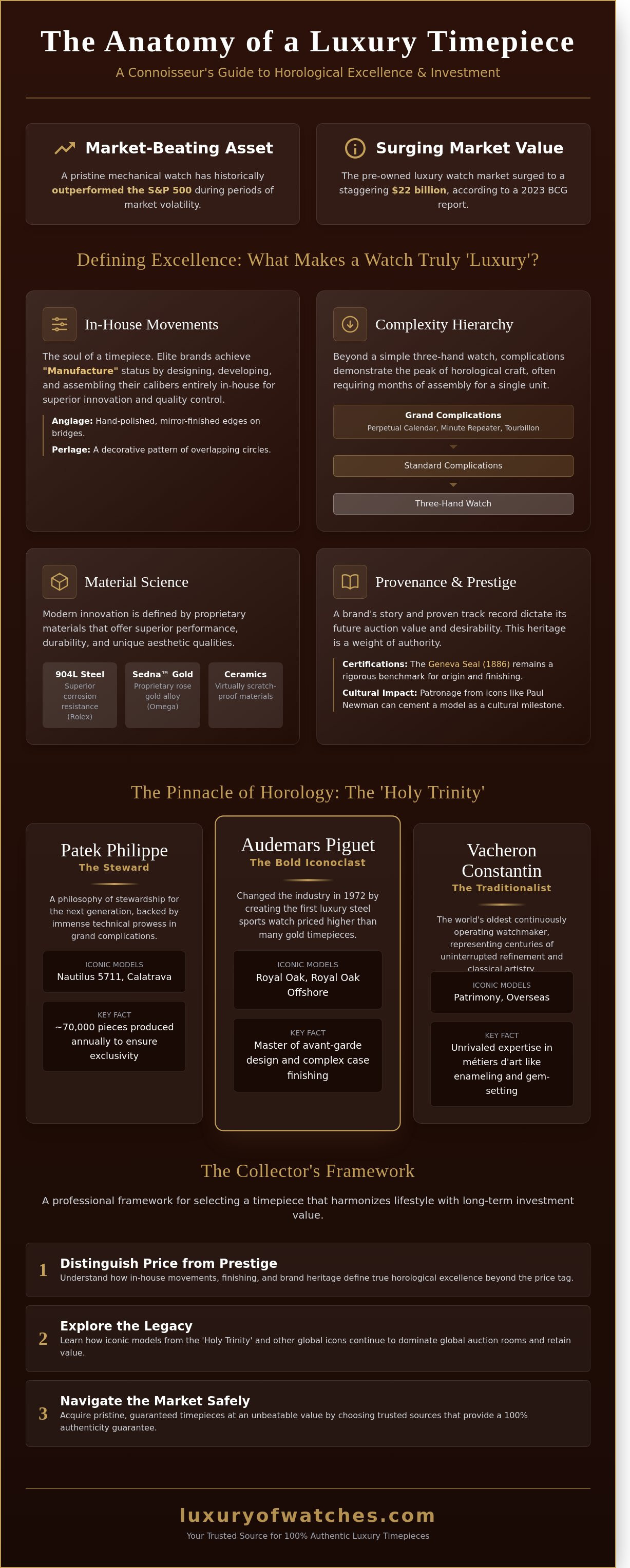
A pristine mechanical timepiece is the only asset you can wear on your wrist that has historically outperformed the S&P 500 during periods of market volatility. You likely recognize that selecting from the top luxury watch brands isn't merely a purchase; it's a high-stakes decision involving heritage, technical precision, and long-term value. It's natural to feel overwhelmed by the volume of marketing noise, especially when a 2023 report by Boston Consulting Group shows the pre-owned market has surged to $22 billion. You want to ensure you aren't overpaying for a name that lacks true horological depth.
We've curated this guide to provide you with the clarity of a trusted connoisseur. You'll discover the actual craftsmanship behind the world's most prestigious names and learn which manufacturers offer the best investment potential for 2026. From the rigorous standards of the Patek Philippe Seal to the robust reliability of Rolex, we're stripping away the hype to find your next heirloom. We'll break down the current brand hierarchy and identify which timepieces suit your specific lifestyle, giving you the confidence to secure a certified, authentic masterpiece that holds its worth.
Key Takeaways
- Understand the critical distinction between price and prestige by learning how in-house movements and heritage define true horological excellence.
- Explore the legacy of the "Holy Trinity" and discover how iconic models from Patek Philippe and Audemars Piguet continue to dominate the global auction room.
- Master a professional framework for selecting luxury watch brands that harmonize your daily lifestyle with long-term investment value.
- Navigate the complexities of the market to acquire pristine, guaranteed timepieces at an unbeatable value while ensuring a 100% authenticity guarantee.
Defining Excellence: What Makes a Watch Brand Truly 'Luxury'?
Price acts as a mere entry fee in the world of high horology. While a significant investment is required, a high price tag alone doesn't grant a label luxury status. True luxury watch brands distinguish themselves through a commitment to technical verticality and artistic precision that mass-market producers cannot replicate. It's the difference between a mass-produced tool and a mechanical masterpiece designed to last for generations. When you invest in a premier timepiece, you're paying for thousands of hours of research, development, and hand-applied artistry.
The Horological Standard: Movements and Complications
The soul of a timepiece lies in its movement. Elite brands strive for "Manufacture" status, meaning they design, develop, and assemble their calibers entirely in-house. This independence allows for greater innovation and stricter quality control than using third-party movements. Collectors look for specific artisanal touches like anglage, which involves hand-polishing the sharp edges of bridges to a mirror finish, and perlage, a decorative pattern of overlapping circles. These details require a level of human skill that machines haven't mastered yet.
- Complexity Hierarchy: A simple three-hand watch is the foundation. However, "Grand Complications" featuring perpetual calendars, minute repeaters, and tourbillons represent the peak of the craft, often requiring months of assembly for a single unit.
- Material Science: Innovation defines the modern era. Rolex began using 904L steel in 1985 for its superior corrosion resistance, while other brands utilize proprietary alloys like Omega's Sedna Gold or high-tech ceramics that are virtually scratch-proof.
The Prestige of Provenance
A brand's story dictates its future auction value and collector desirability. Understanding the history of watches reveals how centuries of innovation led to the modern mechanical renaissance. This heritage isn't just nostalgia; it's a proven track record of reliability and prestige. When a brand has survived the Quartz Crisis of the 1970s or provided chronometers for 19th-century naval expeditions, its modern offerings carry that weight of authority.
Certifications offer the ultimate reassurance for any high-value transaction. The Geneva Seal, a standard established in 1886, remains one of the most rigorous benchmarks for origin and finishing. Beyond technical specs, royal warrants and celebrity patronage from icons like Paul Newman have cemented certain models as cultural milestones. At Luxury of Watches, we recognize that you aren't just buying a tool to tell time. You're acquiring a piece of history with 100% authenticity guaranteed, ensuring your investment remains as pristine as the day it left the workshop.
The Pinnacle of Horology: The 'Holy Trinity' and Global Icons
The landscape of luxury watch brands is anchored by a select few manufactures that define the limits of technical excellence. These houses represent centuries of refinement and mechanical innovation. According to the Federation of the Swiss Watch Industry, the heritage of these brands is what secures Switzerland’s position as the global center of fine timekeeping. For the serious collector, understanding the "Holy Trinity"—Patek Philippe, Audemars Piguet, and Vacheron Constantin—is the first step in appreciating high horology.
Patek Philippe and the Pursuit of Perfection
Patek Philippe operates on a philosophy of stewardship. Their famous 1996 marketing campaign reminded collectors that they merely look after the watch for the next generation. This emotional resonance is backed by immense technical prowess in perpetual calendars and minute repeaters. The Calatrava remains the definitive dress watch, while the Nautilus 5711 has seen secondary market prices exceed 100% of its original retail value. Patek maintains these premiums by limiting annual production to roughly 70,000 pieces, ensuring demand always outstrips supply.
Audemars Piguet: The Bold Iconoclast
Audemars Piguet changed the industry in 1972 with the Royal Oak. Designed by Gérald Genta, it was the first steel sports watch priced higher than many gold timepieces. You can explore this history in our Audemars Piguet Royal Oak guide. The brand continues to push boundaries with the Royal Oak Offshore series; the 1993 debut was nicknamed "The Beast" for its massive 42mm case. Today, they lead the market in avant-garde materials like forged carbon and sand gold.
Vacheron Constantin completes the Trinity as the world's oldest continuous watchmaker, founded in 1755. Their "Les Cabinotiers" department produces bespoke, one-of-a-kind masterpieces for the world's most elite clients. In 2015, they cemented their legacy by releasing the Reference 57260, which contains 57 complications and stands as one of the most complex mechanical watches ever engineered.
Rolex: The Master of the Professional Watch
Rolex is the most recognized of all luxury watch brands because it treats its timepieces as liquid assets. The "Big Three" of the Rolex catalog include the Submariner, the GMT-Master II, and the Daytona. These models utilize the Oyster case, patented in 1926, and the Perpetual self-winding movement. Rolex uses 904L stainless steel, a superalloy that resists corrosion better than the standard 316L steel used by other manufacturers. If you're looking for a timepiece that balances prestige with incredible value retention, you can browse our certified Rolex collection to find your next investment piece.
Professional Tiers: Comparing Performance, Design, and Heritage
Choosing between top-tier luxury watch brands often comes down to a preference for technical mastery or aesthetic heritage. While the "Big Three" represent the peak of investment, these professional-tier brands offer specialized excellence that resonates with specific lifestyles. Whether you're looking for a tool that survived the vacuum of space or a design that redefined 20th-century fashion, these manufacturers provide the benchmark for modern horology.
Omega and Breitling: The Professional's Choice
Omega remains the primary rival to the crown. Their 1999 adoption of the Co-Axial escapement changed the game by reducing friction and extending service intervals to 5 or 8 years. The Speedmaster Professional, famously known as the "Moonwatch," is perhaps the most tested chronograph in history. It remains one of the few pieces of equipment flight-qualified by NASA for EVA use.
Breitling offers a different kind of utility. The 1952 Navitimer remains a favorite for pilots because of its integrated circular slide rule, allowing for complex flight calculations on the wrist. When comparing the two for daily wear, the Seamaster 300M offers a versatile 300-meter water resistance and a modern ceramic bezel. The Navitimer is better suited for the cockpit or the boardroom than the ocean, but it carries a rugged, technical charm that few other luxury watch brands can replicate.
- Omega: Focuses on METAS-certified precision and anti-magnetic movements.
- Breitling: Specializes in aviation chronographs and robust "tool watch" aesthetics.
Cartier: The Master of Shapes
Cartier bridges the gap between high jewelry and horology with unmatched grace. They created the first purpose-built men's wristwatch in 1904 for aviator Alberto Santos-Dumont, effectively moving the watch from the pocket to the wrist. The 1917 Tank followed soon after, featuring a silhouette inspired by the geometry of Renault military vehicles. You can explore the full history of these icons in this Cartier watches guide.
These pieces are the gold standard for elegant luxury. They prioritize silhouette and proportion over raw technical specifications. While other luxury watch brands race for deeper water resistance, Cartier focuses on the "Roman" dial and the blue cabochon crown. It's the premier choice for collectors who value a timepiece that functions as a piece of art.
IWC and Panerai: The Military and Engineering Legacy
IWC Schaffhausen approaches watchmaking with an engineer's mindset. Their 1939 Portugieser and 1940 Big Pilot models define the category of legible, oversized tool watches. This IWC watches guide highlights how they balance complex complications, like perpetual calendars, with clean industrial aesthetics. They're the "Engineer's Brand" for a reason.
Panerai offers a bold alternative with deep-sea roots. Originally developed for Italian Navy frogmen in the 1930s, the Luminor and Radiomir are known for their massive 44mm cases and patented crown-protecting bridges. You'll find more on their unique naval history in this Panerai watches guide. We ensure every piece from these prestigious brands comes with a Certificate of Authenticity, providing the security you need when investing in these engineering marvels.
The Collector’s Framework: How to Choose Your First Luxury Brand
Acquiring your first high-end timepiece is a milestone that marks a transition into the world of horological appreciation. It's a decision that requires balancing personal taste with technical specifications and market data. When you evaluate various luxury watch brands, you're not just buying a tool to tell time; you're securing a piece of engineered art that should reflect your personal identity while serving as a stable store of value.
Matching Brand to Lifestyle
Your watch must survive your daily environment. For the boardroom, brands like Patek Philippe, Vacheron Constantin, or Cartier provide an understated power that complements a tailored suit. These pieces prioritize slim profiles and precious metals. If your life is more kinetic, the active professional should look toward Rolex, Omega, or the bold technicality of Hublot. These brands offer the ruggedness required for a 100-meter depth rating without sacrificing prestige. If you want to understand how modern materials like sapphire and titanium are used to create durable, high-fashion pieces, read this Hublot watch guide for a deep dive into contemporary innovation.
The "One Watch Collection" is a popular strategy for new collectors. This concept focuses on finding a versatile daily wearer that functions across all social settings. A 40mm stainless steel sports watch is the gold standard for this approach. Why 40mm? It's the industry's recognized "sweet spot." This diameter fits approximately 85% of male wrist sizes comfortably, providing enough presence to be noticed while remaining slim enough to slide under a shirt cuff. Pieces like the Rolex Submariner or the Omega Seamaster have maintained this proportion for decades because it works for almost everyone.
The Value Retention Factor
While passion should drive your purchase, ignoring the financial aspect is a mistake. Certain luxury watch brands consistently outperform others on the secondary market. Rolex and Patek Philippe currently hold the highest retention rates, with some professional steel models appreciating by 20% to 50% immediately after leaving the boutique. To protect your investment, you must prioritize "Box and Papers." A watch with its original packaging and warranty card typically sells for 15% to 22% more than a "naked" watch.
- Rolex: Consistently high demand ensures liquidity and price stability.
- Patek Philippe: Rare production numbers drive long-term auction records.
- Omega: Strong historical significance, especially with the Speedmaster line, ensures steady interest.
Be cautious with "Limited Editions." In the current market, a standard production model with a rich heritage often holds more value than a 1-of-5000 special release that lacks a clear connection to the brand's DNA. Stick to iconic silhouettes for your first purchase to ensure your capital remains secure.
Securing Your Investment: Navigating the Luxury Watch Market Safely
Acquiring a timepiece from the world's premier luxury watch brands requires more than just capital. It demands a strategic approach to the secondary market. The "Grey Market" isn't a shadowy corner; it's a legitimate channel where authentic pieces move without the restrictive markups of authorized dealers. By bypassing traditional retail constraints, collectors often secure savings of 15% to 35% on brand-new models that are otherwise waitlisted for years. This efficiency allows you to bypass the artificial scarcity often found in boutique environments.
Authenticity and the Certificate of Promise
We eliminate uncertainty through a rigorous verification protocol. Every timepiece, whether factory-fresh or pre-owned, undergoes a 30-point technical inspection performed by certified horologists. This process scrutinizes the movement's beat rate, water resistance seals, and the microscopic alignment of the dial. We don't just claim authenticity; we document it. Every purchase includes a physical Certificate of Authenticity. This document serves as your permanent proof that the watch is 100% genuine and pristine. It's the standard of trust that high-value transactions require in 2026.
The Luxury of Watches Advantage
Collectors choose us because we bridge the gap between boutique prestige and online value. While most luxury watch brands offer a standard 2-year international warranty, our 5-year in-house warranty provides more comprehensive coverage. We manage repairs and servicing directly, ensuring your investment is protected long after the initial sale. Our "Trusted Connoisseur" model focuses on these specific advantages:
- Price Transparency: You'll find prices up to 30% lower than traditional MSRP by cutting out unnecessary retail overhead.
- Immediate Availability: We stock "hard-to-find" models that usually carry a 12-month waitlist at physical retail stores.
- Expert Support: Every client works with a specialist who understands the 2026 market trends and specific technical movements.
Securing a high-end watch is a significant financial decision. We prioritize your security by using encrypted transaction portals and fully insured shipping. You're not just buying a watch; you're entering a partnership with experts who value the heritage of horology as much as you do. This professional guidance ensures that your collection grows in value and remains in peak mechanical condition for decades.
Begin Your Horological Legacy Today
Investing in a high-end timepiece is a decision that bridges the gap between personal expression and lasting value. By 2026, the elite horological landscape has evolved to prioritize both mechanical innovation and historical provenance. You've explored the technical prowess of the Holy Trinity and learned how to navigate market complexities with confidence. Now, it's time to move from research to ownership. At Luxury of Watches, we eliminate the uncertainty often found in high-value transactions. Every timepiece we sell comes with a 100% Authenticity Guaranteed promise and our signature 5-Year In-House Warranty. Our horological connoisseurs provide expert support to ensure your choice meets the highest standards of excellence. Whether you're seeking a pristine Rolex or an exquisite Omega, we offer the lowest prices on the market without compromising on prestige. Explore our curated collection of 100% authentic luxury watch brands and secure a masterpiece that'll define your collection for decades. Your journey into the world of elite horology starts with a single, confident step.
Frequently Asked Questions
What are the 'Holy Trinity' watch brands?
The 'Holy Trinity' of Swiss horology consists of Patek Philippe, Vacheron Constantin, and Audemars Piguet. These three manufacturers represent the pinnacle of craftsmanship and heritage, a status cemented in the 1970s. While Patek Philippe was founded in 1839, Vacheron Constantin dates back to 1755, making it the oldest continuous watchmaker. Each brand is renowned for producing complicated movements and exquisite finishing that few others can match.
Which luxury watch brand holds its value best?
Rolex consistently holds its value better than almost any other name in the industry. Popular steel sports models like the Submariner or the Daytona often trade for 100% to 200% above their original retail prices on the secondary market. Patek Philippe also maintains exceptional resale value, particularly with the Nautilus collection. Collectors often view these luxury watch brands as stable assets because demand outpaces annual production by thousands of units.
Is Rolex better than Omega?
Determining whether Rolex is better than Omega depends on your priorities as a collector. Rolex leads in brand recognition and resale value, with a 95% retention rate across most models. Omega offers superior technical specifications at a lower price point, such as the Master Chronometer certification which guarantees 15,000 Gauss magnetic resistance. Both brands provide exceptional quality, but Omega often provides more horological innovation for 30% less than a comparable Rolex.
What is the most affordable luxury watch brand?
Tissot and Longines are widely considered the most accessible entry points into the world of Swiss timepieces. You can acquire a Tissot PRX with a 80-hour power reserve for under $750, while Longines offers heritage designs starting around $1,500. These brands provide a genuine luxury experience and mechanical movements without the $5,000 price tag typical of higher-tier manufacturers. They serve as the perfect starting point for any new collector.
Why are some luxury watch brands so expensive?
High prices stem from extreme R&D costs, precious materials, and hundreds of hours of manual labor. A single Patek Philippe movement can contain 400 unique parts, each hand-polished to a tolerance of 0.001 millimeters. Brands also invest millions in proprietary alloys like Rolex’s Oystersteel or Omega’s Sedna Gold. You aren't just paying for a tool; you're investing in centuries of tradition and a guarantee of 100% authenticity and precision.
How do I know if a luxury watch is authentic when buying online?
You can verify a watch's legitimacy by checking for a matching serial number and a valid Certificate of Authenticity. Reputable dealers provide a 100% authenticity guarantee and detailed high-resolution photos of the movement and case back. Always cross-reference the 8-digit serial number with the manufacturer’s database when possible. Buying from a trusted source ensures you receive a pristine timepiece rather than a counterfeit with a 15% weight discrepancy or incorrect engravings.
What is a 'Manufacture' movement and why does it matter?
A 'Manufacture' movement is a caliber designed and produced entirely in-house by the watch brand itself. This matters because it demonstrates a high level of technical independence and horological expertise. While many luxury watch brands used third-party ETA movements for decades, the shift toward in-house production since 2010 has increased exclusivity. Owners benefit from a movement specifically tailored to the watch's dimensions, often leading to better performance and higher long-term value.
Is it better to buy a new or pre-owned luxury watch?
Buying new offers the security of a full manufacturer warranty and a pristine, unworn condition. However, purchasing pre-owned can save you 20% to 40% on brands that experience initial depreciation, such as Breitling or TAG Heuer. If you're looking for a specific vintage aesthetic or a discontinued 40mm model, the secondary market is your only option. We ensure every pre-owned piece meets rigorous standards so you enjoy the lowest price without compromising quality.