
The Smart Collector’s Guide: Luxury Watches That Hold Their Value Best in 2026
22nd Apr 2026
Your next luxury watch purchase will likely lose 30% of its market value the moment you leave the store unless you select your piece with clinical precision. Many collectors realize too late that a prestigious brand name doesn't always guarantee a return, especially when certain models struggle to maintain their original price points. Identifying the watches that hold their value best requires a shift from emotional buying to data-driven acquisition. You likely share the common anxiety of distinguishing between a temporary retail trend and a lasting asset that retains its pristine worth over time.
This guide provides the clarity you need to avoid the depreciation trap by highlighting pieces that offer both aesthetic prestige and financial stability. We've analyzed secondary market performance data from 2024 and 2025 to reveal which specific models are acting as the safest harbors for your capital in 2026. You'll discover a curated shortlist of high-potential timepieces and learn how to secure them with 100% authenticity outside of the traditional boutique environment. We'll show you how to blend the allure of horology with the pragmatic security of a smart investment.
Key Takeaways
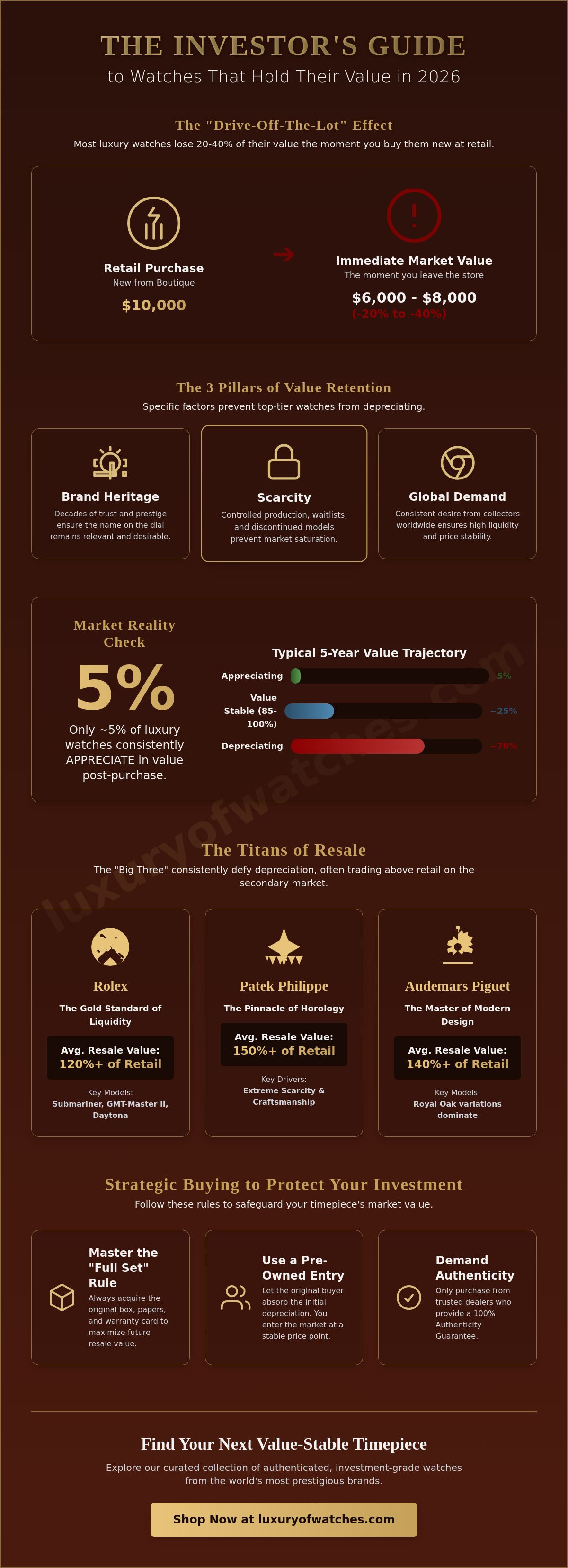
- Understand the "Drive-Off-The-Lot" effect and why most luxury timepieces immediately depreciate by 20-40% when purchased at retail.
- Discover the specific market drivers that allow the "Big Three" brands to consistently dominate resale charts and maintain a prestigious premium.
- Identify the high-performance alternatives and specific watches that hold their value best to diversify your collection with stable, fashion-forward assets.
- Master the "Full Set" rule and the pre-owned entry strategy to safeguard your timepiece's market price against common financial pitfalls.
- Learn how to secure your investment through a rigorous 100% Authenticity Guarantee and professional inspection processes.
Understanding the Mechanics of Watches That Hold Their Value Best
Acquiring a luxury timepiece is a significant commitment. For the astute collector, the primary concern is identifying watches that hold their value best over time. In horology, value retention refers to the capacity of a timepiece to maintain its market price relative to its original purchase cost. While most luxury goods suffer from a 'drive-off-the-lot' effect, seeing an immediate 20% to 40% depreciation at retail, a select group of global watch manufacturers defies this trend through strategic supply management and centuries of prestige.
Retention is built upon three specific pillars. Brand Heritage provides the foundational trust, ensuring the name on the dial remains relevant for decades. Scarcity, whether natural or intentionally manufactured, prevents market saturation. Global Demand ensures that a buyer in London or Hong Kong will pay a premium for the same reference. Collectors must distinguish between 'Investment Grade' pieces, which are expected to appreciate, and 'Value Stable' models that simply protect your capital. In a volatile market, the latter is often the more pragmatic goal for a primary collection.
Depreciation vs. Appreciation: Setting Realistic Expectations
Data from the last 24 months suggests that only about 5% of luxury watches consistently appreciate in value. Most timepieces are depreciating assets that eventually plateau. In 2026, global inflation rates of approximately 3% have made price stability even more critical for collectors. It's vital to recognize that 'holding value' often means retaining 85% to 95% of the MSRP after five years of wear. Market equilibrium for luxury watch resale is the price point where secondary supply meets persistent collector demand while resisting downward volatility.
The Scarcity Loop: How Manufacturers Control the Secondary Market
Top-tier brands like Rolex and Patek Philippe utilize waitlists to cultivate a sense of exclusivity that translates directly into secondary market premiums. This 'Scarcity Loop' ensures that demand always outstrips supply, often resulting in used models selling for more than their retail price. The role of discontinued models is also pivotal; when a manufacturer ceased production of specific steel sports models in January 2026, secondary prices spiked by 18% within weeks.
Collectors should consider these factors when evaluating scarcity:
- Core Icons: Models like the Speedmaster or Submariner offer more stability than experimental limited editions.
- Intentional Scarcity: Artificial waitlists created by boutiques to maintain high entry barriers.
- Natural Scarcity: Low production numbers due to the extreme complexity of the movement.
Limited editions are frequently less stable than core iconic models. While they offer initial hype, they often lack the long-term historical significance required to sustain prices over a decade. For those seeking watches that hold their value best, the safest path remains the established classics with a proven track record of desirability.
The Titans of Resale: Rolex, Patek Philippe, and Audemars Piguet
The secondary market consistently favors a small group of manufacturers often referred to as the "Big Three." These brands dominate because they balance extreme scarcity with a global demand that transcends economic cycles. While other labels may see volatile price swings, these watches that hold their value best rely on decades of brand equity and strict production limits. Collectors view these timepieces as liquid assets, often more stable than traditional equities or currency. The "Rolex Premium" exemplifies this; even entry level models like the Oyster Perpetual maintain prices near or above their original retail cost because they serve as the gateway to a prestigious ecosystem.
Rolex: The Gold Standard of Liquidity
Rolex remains the most recognized name in horology, and its "Professional" steel models are the primary drivers of market stability. The Submariner, GMT-Master II, and Daytona aren't just tools; they're the most liquid assets in the watch world. If you're tracking the market, our Rolex Prices 2026: The Comprehensive Market Value & Buying Guide provides a detailed breakdown of current valuations. The "Pepsi" bezel GMT and the "Panda" dial Daytona remain the gold standard for resale. Their ability to be converted into cash almost anywhere in the world makes them essential for any serious portfolio. This liquidity is bolstered by the brand’s 100% authenticity guarantee and the universal trust in its mechanical durability.
The Holy Trinity: Patek Philippe and Audemars Piguet
Patek Philippe and Audemars Piguet operate in a different stratosphere of exclusivity. The "Nautilus Effect" has created a halo over the entire Patek catalog. This phenomenon occurs when the intense demand for the Nautilus 5711 or 5811 spills over into the Aquanaut and even the classic Calatrava. Expert analysis of Patek Philippe resale value suggests that the brand’s commitment to finishing and its historical auction performance keep prices at a premium. While grand complications are exquisite, integrated bracelet sports watches currently lead in price retention.
Audemars Piguet has turned the Royal Oak into a singular asset class. In 2026, the market has shifted noticeably toward smaller case sizes. Vintage 36mm and 37mm Royal Oaks have seen a 12% increase in interest as collectors move away from oversized silhouettes. For these high tier brands, the "Original Certificate" is the most critical component of the sale. A pristine watch without its papers can lose up to 20% of its potential value. If you're looking to start your collection with a verified timepiece, you can browse our certified inventory to find a model that fits your investment goals. These brands don't just tell time; they preserve wealth through impeccable craftsmanship and a refusal to overproduce.
High-Performance Alternatives: Cartier, Omega, and Breitling
While the "Big Three" often dominate the headlines, savvy collectors recognize a "Tier 2" of manufacturers that offer exceptional value retention. These brands provide a sophisticated entry point for those seeking watches that hold their value best without the extreme premiums often found in the ultra-luxury segment. By 2026, the market has shifted to reward brands that balance historical prestige with modern manufacturing consistency. Success in this tier depends on buying at the right entry price, often through trusted secondary markets where the initial retail depreciation has already occurred.
Omega: The Moonwatch and Seamaster Stability
The Omega Speedmaster Professional, affectionately known as the "Moonwatch," remains a cornerstone of any stable collection. Whether you opt for the Hesalite or the Sapphire Sandwich version, these timepieces rarely drop below a specific price floor. Historical data shows that a well-maintained Speedmaster typically retains between 75% and 85% of its value, even after years of daily wear. This stability is driven by a global community of enthusiasts who ensure demand never wavers.
When you compare the Seamaster Diver 300M to the Rolex Submariner, the "Value for Money" argument becomes clear. While the Submariner often commands a higher resale percentage relative to its MSRP, the Seamaster provides nearly identical technical specifications for a significantly lower initial investment. It's a pragmatic choice for collectors who prioritize performance over speculative hype. Additionally, the 321 Caliber Speedmasters have officially entered the realm of "blue-chip" collectibles. Their limited production numbers and the use of the historically accurate column-wheel movement make them highly resistant to market fluctuations.
Cartier and Breitling: Style Meets Secondary Market Strength
We're currently witnessing a "Cartier Renaissance" that has fundamentally changed the secondary market. The Santos de Cartier is currently outperforming many traditional steel sports watches in terms of year-over-year price stability. It's a unique asset that bridges the gap between high-end jewelry and serious horology. The Tank series also maintains a robust following, as its timeless silhouette remains immune to the changing whims of fashion trends.
Breitling has also seen a marked stabilization in its secondary market performance. This is largely due to the comprehensive design overhaul initiated around 2022, which returned the brand to its heritage roots. The Navitimer remains their most resilient model. Its historical significance as a pilot's tool ensures it stays relevant to collectors. By moving away from the oversized aesthetics of the early 2010s, Breitling has reclaimed its status as a manufacturer of enduring classics. For a broader look at how these makers compare to their peers, consult our Top 15 Best Luxury Watch Brands: The Ultimate Collector’s Guide (2026). Identifying watches that hold their value best involves looking past the initial marketing and focusing on these proven, high-performance alternatives.
Strategic Buying: How to Ensure Your Watch Retains Maximum Value
Success in horological investment isn't just about selecting a prestigious brand; it's about your specific entry point into the market. Securing watches that hold their value best requires a shift from emotional purchasing to a disciplined, strategic approach. By understanding the mechanics of the secondary market, you can effectively eliminate the steep depreciation that often plagues retail buyers.
Buying Pre-Owned: Avoiding the "New Car" Depreciation Curve
Most luxury timepieces lose 15% to 30% of their retail price the moment you leave the boutique. Buying pre-owned allows you to enter at the "price floor," where the previous owner has already absorbed that initial hit. This strategy ensures you start your ownership with equity rather than a deficit. For a deeper look at this process, see The Comprehensive Guide to Pre-Owned Luxury Watches: Value, Authenticity, and Ownership. Use this checklist when evaluating a pre-owned piece:
- Case Integrity: Verify the sharpness of the lug edges to ensure minimal polishing.
- Bezel Condition: Inspect ceramic or metal bezels for chips that can be costly to replace.
- Dial Originality: Check for any signs of oxidation or moisture under magnification.
- Serial Matching: Ensure the numbers on the case match the documentation exactly.
The Importance of Provenance and Maintenance
Collectors place a massive premium on "unpolished" pieces. While a service polish might make a watch look new, it rounds off the sharp angles and chamfers that define a model's character. A watch with its original factory lines intact often commands 25% more than a heavily polished equivalent. Beyond aesthetics, documentation is king. Missing the original box or papers typically slashes 10% to 20% off the eventual resale price.
We provide a 5-year in-house warranty that acts as a transferable layer of security for the next owner. This certificate proves the watch was inspected by experts and maintained to high standards. When you eventually exit your position, having a documented history of professional care justifies a higher asking price. Buying through the gray market offers another advantage: you get authentic, pristine pieces below MSRP, which is the most reliable way to find watches that hold their value best from day one.
Ready to secure a timepiece with built-in equity? View our collection of investment-grade timepieces at the market's most competitive prices.
Finding Your Next Value-Stable Piece at Luxury of Watches
Selecting a timepiece that serves as a legitimate financial asset requires more than just brand recognition. It demands a partner that understands the intricacies of the secondary market and the technical precision of horology. Luxury of Watches stands as the premier destination for collectors seeking watches that hold their value best. We've built our reputation on a simple but powerful philosophy: providing prestige at the lowest possible price. By eliminating traditional retail markups, we ensure your investment starts from a position of financial strength. Every Rolex, Patek Philippe, and Cartier in our curated collection undergoes a rigorous multi-point inspection to verify its mechanical condition and aesthetic performance.
Luxury of Watches functions as a trusted connoisseur in a market that often feels opaque. We bridge the gap between the high-end elegance of a heritage boutique and the modern efficiency of a premier e-commerce platform. Our inventory is carefully selected to include only those models with proven track records of price stability and appreciation. This focused approach allows us to offer unbeatable value while maintaining the exclusivity that luxury collectors expect.
Our 100% Authenticity Guarantee and 5-Year Warranty
Our dedicated in-house horologists scrutinize every movement and serial number to eliminate the risks associated with unverified private sales. We provide a 100% Authenticity Guarantee, backed by a physical Certificate of Authenticity. This document isn't just a promise; it's a foundational asset for future resale. Collectors know that a watch with verified provenance fetches a higher price than one without. While unverified market transactions often leave buyers guessing about the history of a piece, our professional oversight ensures your timepiece remains in pristine, investment-grade condition. Our comprehensive 5-year warranty provides a safety net that protects the internal mechanics of your watch, maintaining its long-term functional value.
Navigating Our Collection for Best Value
Identifying a specific reference like a Rolex Submariner or an Omega Speedmaster is seamless with our refined search tools. You can filter our inventory by brand, material, and movement type to find watches that hold their value best within your specific budget. Our platform is designed for the modern collector who values both time and security. We utilize encrypted protocols for every transaction to protect high-value transfers, while our expert support team remains available to answer technical questions about caliber variations or bezel materials. Whether you're a seasoned collector or a first-time buyer, we provide the tools needed for a confident purchase. Explore our selection of watches that hold their value best to secure your next horological investment today.
Secure Your Legacy with a Timeless Investment
Investing in horology requires a sharp eye for both artistry and shifting market trends. As we look toward 2026, industry data confirms that the "Big Three" manufacturers continue to dominate the resale landscape. The 2024 Morgan Stanley Swiss Watch Industry Report also indicates a significant rise in the market share of brands like Cartier and Omega, proving they're formidable contenders for any diversified portfolio. Identifying the watches that hold their value best means prioritizing pieces with documented provenance and exceptional mechanical integrity. At Luxury of Watches, we eliminate the uncertainty often found in high-value transactions. Every timepiece we offer comes with a 5-Year In-House Warranty and a 100% Authenticity Guarantee to ensure your peace of mind. Our A+ rating with the Better Business Bureau serves as a testament to our transparent and professional service. You don't have to navigate the complexities of the luxury market without an expert guide by your side. We invite you to explore our selection of pristine models that balance prestigious craftsmanship with long-term financial stability.
Browse Our Curated Collection of Value-Stable Luxury Watches
Start building a collection that stands the test of time today.
Frequently Asked Questions
Do Rolex watches really hold their value better than other brands?
Rolex watches consistently lead the industry in secondary market price retention. Data from the 2023 Knight Frank Wealth Report indicates luxury watches grew 10% in value annually; with Rolex capturing nearly 30% of the total pre-owned market share. This dominance occurs because the brand limits supply while maintaining universal demand. Collectors often find these timepieces are the premier watches that hold their value best due to their iconic status and mechanical reliability.
Is it better to buy a new or pre-owned watch for investment purposes?
Buying a pre-owned watch often provides a more secure entry point for investment because the initial retail depreciation has already occurred. A new watch can lose 15% to 20% of its value the moment it leaves the boutique. By choosing a pristine pre-owned model, you bypass this immediate loss. This strategy allows collectors to acquire prestigious pieces at a price closer to their actual market floor while ensuring 100% authenticity.
Which specific watch models are expected to appreciate in 2026?
The Rolex GMT-Master II 126710BLRO and the Patek Philippe Nautilus 5811 are expected to show strong appreciation through 2026. Industry analysts at Boston Consulting Group projected the luxury pre-owned market to reach $35 billion by 2026, driven by these high-demand steel sports models. Limited production runs and long waiting lists at authorized dealers ensure these specific references remain in high demand among serious horological investors looking for exquisite craftsmanship.
How much value does a watch lose if it doesn’t have the original box and papers?
A luxury watch typically loses 10% to 20% of its resale value if it lacks the original box and papers. These components serve as a primary Certificate of Authenticity for future buyers. In a 2022 survey of luxury auction results; full set listings consistently achieved higher final bids than naked watches. Keeping the original warranty card and packaging is essential for maintaining the pristine provenance required for a high-value transaction.
Does the Gray Market affect the resale value of a luxury watch?
The gray market increases the availability of authentic timepieces without negatively impacting the long-term resale value of the model itself. While gray market dealers offer a lower initial purchase price, the watch's value remains tied to its condition and brand prestige. Since these watches are guaranteed authentic, they trade at the same market rates as those from authorized dealers once they enter the secondary collector circuit as pre-owned items.
Can I wear my watch every day and still expect it to hold its value?
You can wear your watch daily while maintaining its value, provided you follow a strict service schedule every 5 to 10 years. Minor surface scratches are expected; many collectors prefer pieces that haven't been over-polished to preserve the original case geometry. However, deep gouges or water damage can reduce the resale price by 15% or more. Using a professional service center ensures the movement remains in exquisite working order.
Are Omega watches considered a good investment compared to Rolex?
Omega watches are exceptional timepieces, but Rolex generally maintains a higher percentage of its retail price on the secondary market. According to 2023 Morgan Stanley industry reports; Rolex commands roughly 30% of the total Swiss watch market share by value. While Omega Speedmaster Professional models are excellent watches that hold their value best within their price tier, Rolex continues to lead in overall investment liquidity and price stability.
What is the most important factor in a watch’s resale value?
Scarcity combined with the physical condition of the watch is the most critical factor in determining resale value. A rare reference in mint condition will always command a premium over a common model in poor repair. Collectors look for unpolished cases and original components to verify the piece's history. This combination of rarity and preservation creates the trusted connoisseur level of value that drives the most successful luxury watch investments.