
Rolex Day-Date Prices, Bracelets and Water Resistance
Posted by Luxury of Watches on 6th Nov 2026
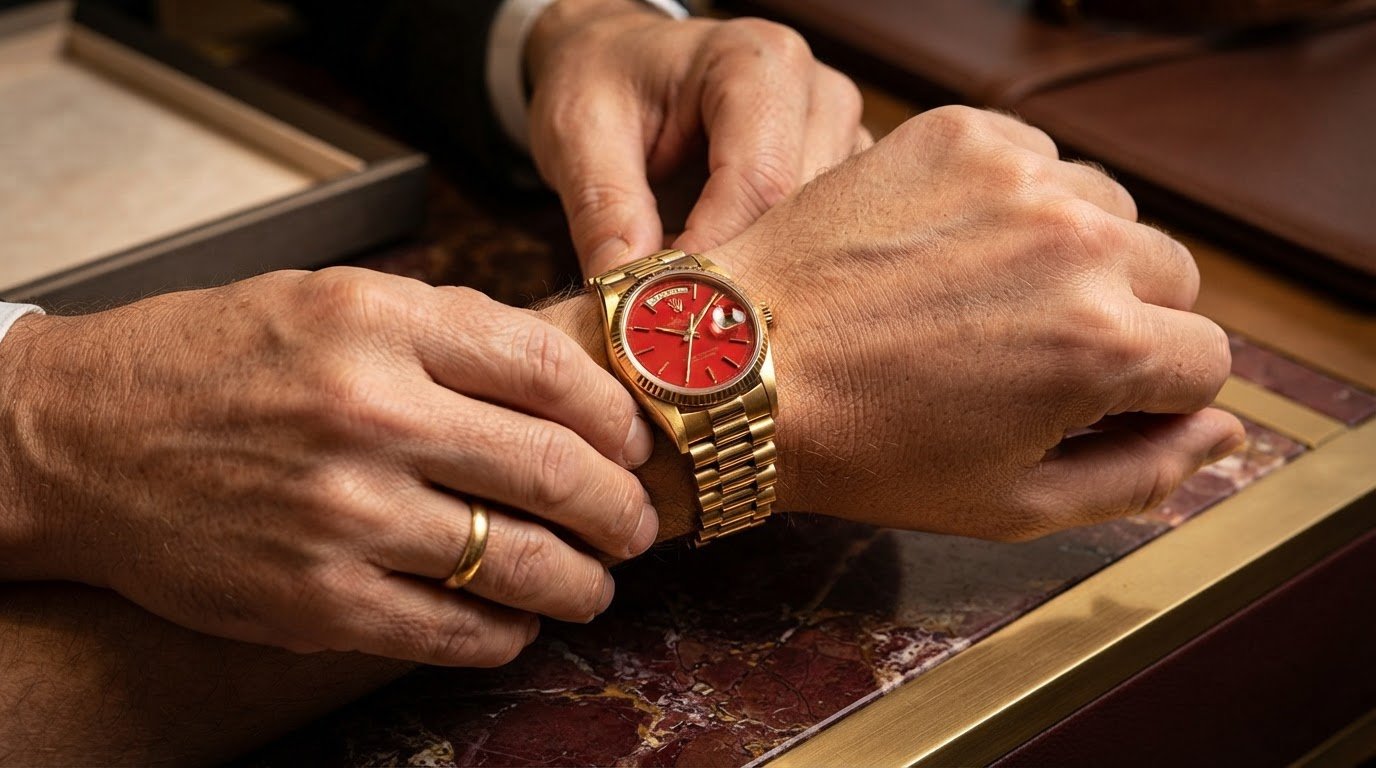
The cost of a Rolex Day-Date varies by reference, precious-metal case and bracelet, dial, condition, and market listing, so there isn’t one price for every example. Rolex introduced the watch in 1956 as the first calendar wristwatch to display the day of the week in full alongside the date. That combination of material, design, and heritage still shapes how each version is distinguished.
It’s easy to focus on price first, but the details behind it tell a richer story. From the signature President bracelet to the Oyster case’s water resistance, the Rolex Day-Date has evolved while preserving its distinctive character.
Explore how prices vary by reference, what sets the bracelet and case apart, and how the model has developed over time. You’ll also find key specifications to help put a particular Day-Date in context, whether you’re drawn to a modern design or a vintage example.
Key Takeaways
- Compare pre-owned listings by reference, precious metal, dial, and condition to understand why asking prices can differ.
- Learn what the Oyster case’s 100-meter water resistance means and how its construction supports the watch.
- Trace the model’s development from its 1956 introduction, including the history of its distinctive bracelet.
- Recognize useful authenticity details, including the date-window Cyclops lens, and understand why they should be considered together.
What does a Rolex Day-Date cost?
There isn’t one price for every Rolex Day-Date: the reference, precious metal, dial, condition, and listing all matter. Rolex recommends periodic professional servicing, and the expense depends on the watch’s condition and the work required.
Pre-Owned Listings and Prices
Pre-owned listings show how much specification and condition can shape an asking price. A platinum 228236 with an ice-blue dial and 40 mm case differs substantially from a yellow-gold 18238 with a 36 mm case. Compare reference, material, case size, dial, and condition together. These details help explain listing differences, rather than treating age alone as a reliable price guide.
List Prices Versus Market Prices
A list price reflects a model’s retail positioning, while a market listing reflects an individual watch offered for sale. These figures aren’t interchangeable. Compare like with like: the reference, metal, dial, bezel, and condition should align before you draw conclusions. A diamond-set version and a simpler configuration can differ within the same family, as precious materials and dial details affect each model’s appeal.
Prices by Reference
Reference numbers provide a useful starting point for understanding price differences. For example, 18078 and 118206 represent earlier configurations, while 218239 and 228396TBR identify other distinct specifications. Case size, movement generation, bezel, and precious metal all help explain why references sit at different market levels. Platinum examples and diamond-set versions can occupy a different tier from less embellished gold watches.
Vintage and Modern Price Trends
Vintage and modern Day-Dates don’t follow one uniform price path. Older references such as 18038 and 18238 have different specifications from contemporary examples such as 228238. Condition, originality, metal, and dial influence how a vintage listing compares with a newer watch. Modern models also vary by configuration, so compare specific references rather than assuming age alone determines value or price direction.
Water resistance and Oyster case construction
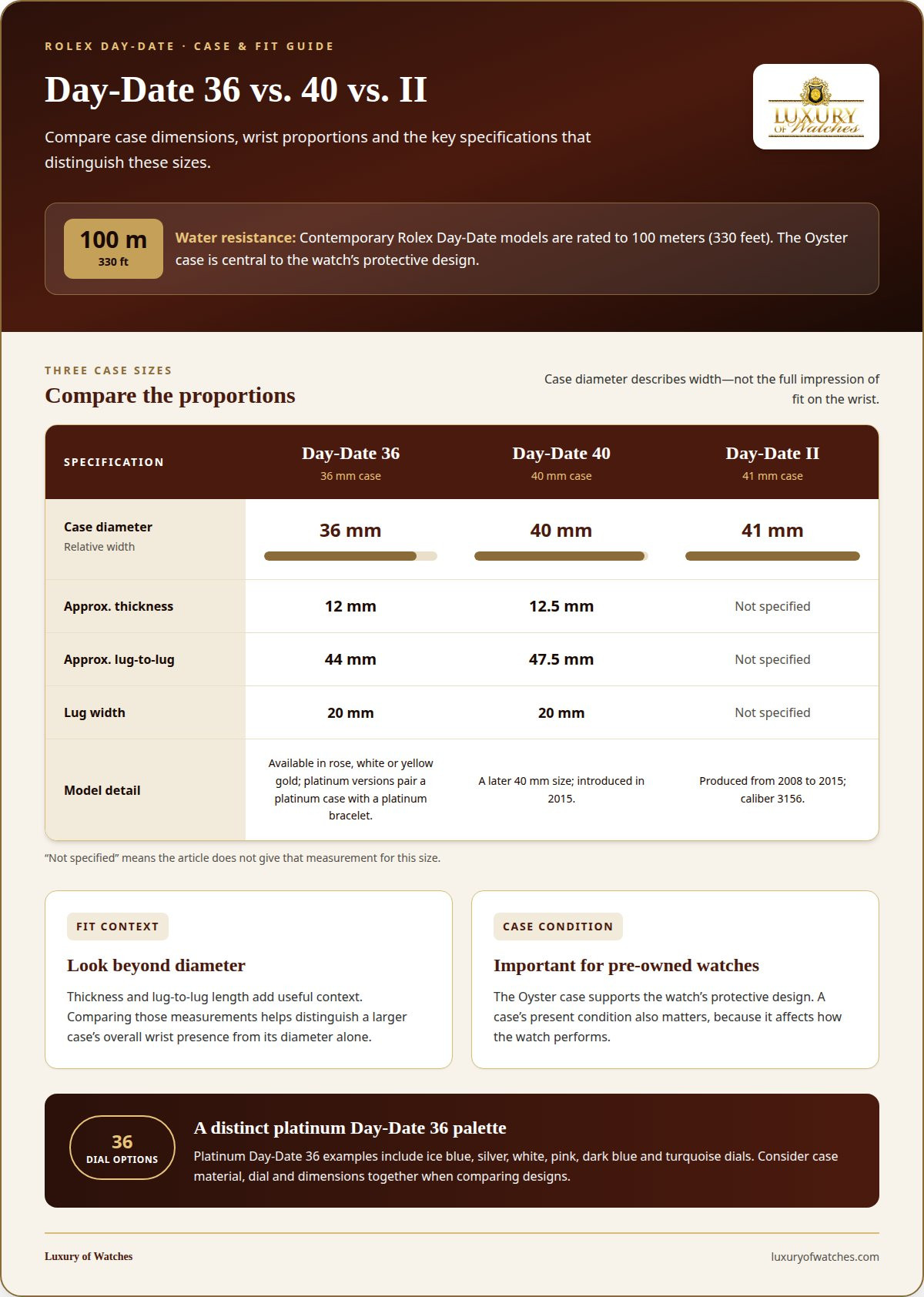
Contemporary Rolex Day-Date models are rated to 100 meters (330 feet) of water resistance. The Oyster case is central to the watch’s protective design, while the rating gives a clear specification for comparing current models. A case’s condition also matters, particularly for a pre-owned watch, because its present state affects how it performs.
Case size changes the watch’s proportions on the wrist. The Day-Date 36 measures 36 mm across, while the Day-Date 40 measures 40 mm. The Day-Date II, produced in a 41 mm size, offers another option for those who prefer a larger case. These dimensions describe width, not the full impression of fit.
Thickness and lug-to-lug length add useful context. The Day-Date 36 is approximately 12 mm thick, with an approximate 44 mm lug-to-lug measurement. The Day-Date 40 is approximately 12.5 mm thick and 47.5 mm lug to lug. Both sizes have a 20 mm lug width. Comparing these measurements helps distinguish a larger case’s overall wrist presence from its diameter alone.
The Day-Date 36 comes in rose, white, or yellow gold, and platinum versions pair a platinum case with a platinum bracelet. Material therefore affects both the look and the weight of the watch.
Dial choices add another layer of distinction. Platinum Day-Date 36 examples include ice blue, silver, white, pink, dark blue, and turquoise. Consider the case material, dial, and dimensions together when comparing designs. For a closer look at different watch profiles, compare case details alongside these measurements.
Rolex Day-Date history
The Day-Date’s defining idea arrived in 1956: showing the weekday spelled out in full beside the date. Rolex had registered four patents for timepieces featuring day and date indications between 1950 and 1955. The model brought that calendar display into a wristwatch, making its layout central to its identity. The day appears at 12 o’clock, with the date at 3 o’clock.
Its bracelet belongs to the same origin story. Rolex created the President bracelet in 1956 specifically for the Day-Date. Its three-piece links became a signature, complementing cases made from precious metals. The fluted bezel has a separate history: Rolex presented it on the Oyster in 1926. That earlier design detail later became one of the visual cues associated with many Day-Date configurations.
Language options expanded the calendar’s reach. Since 1973, the day-disc display has been available in 26 languages. This evolution preserved the original full-word display while allowing owners to choose a language suited to their preference. The dial’s weekday window remains a practical distinction from watches that show only an abbreviated day.
Case size and movement mark later chapters. Rolex produced the Day-Date II from 2008 to 2015, with a 41 mm case and caliber 3156. In 2015, the Day-Date 40 followed. Earlier generations used calibers 3055 and 3155 before the modern caliber 3255. These reference and movement changes help place a watch within the model’s timeline, alongside its case and dial details.
The history is more than a sequence of new references. From the 1956 calendar display and President bracelet to later case sizes and movements, each milestone shows what Rolex retained and refined. For collectors, the takeaway is clear: identify the reference and movement first, then read its design as part of that longer development.
How can you tell if a Rolex Day-Date is authentic?
Start by comparing the reference with the watch’s visible features. A genuine Rolex Day-Date places the weekday display at 12 o’clock and the date at 3 o’clock. The weekday appears in full, not as an abbreviation. These are useful points to assess, but one matching feature alone can’t establish authenticity.
Examine the crystal and date display together. The Oyster Perpetual Day-Date has a sapphire crystal with a Cyclops lens over the date at 3 o’clock. Consider whether that detail, the dial layout, and the case design align with the stated reference. If they don’t appear consistent, the watch merits a closer assessment.
Next, consider the case, bezel, and bracelet as a complete design. The President bracelet is associated with the model, while references differ in case size, dial, and bezel. A 36 mm reference and a 40 mm reference, for example, should be assessed against their respective specifications.
Movement and reference information provide further context. Earlier generations used calibers 3055 and 3155; modern models use caliber 3255. The Day-Date II used caliber 3156. An assessment should consider whether the movement, case, and design details align with the claimed generation. No single visual clue replaces examining the watch as a whole.
For a high-value purchase, choose an authentication process that evaluates the watch’s components and documentation together. That’s more dependable than relying on photographs or one familiar feature. Browse authenticated timepieces as you consider your next purchase.
Luxury of Watches
Luxury of Watches gives readers considering a Day-Date a place to explore Rolex Watches, including used examples. Its selection of pre-owned luxury watches also lets you consider other models as you weigh reference, condition, and design. Each watch in its authentic selection includes a five-year in-house warranty, adding practical reassurance to a significant purchase.
When you’re ready to move from learning about Day-Date history and specifications to considering a watch, explore the Luxury of Watches collection. It also includes Breitling watches if you’re comparing luxury timepieces. Contact Luxury of Watches to discuss your interests and find a watch that suits your preferences.
Choose the Day-Date That Fits Your Perspective
A considered purchase involves more than a reference number. Think about how a Rolex Day-Date’s proportions, materials, and design suit your personal style, then decide which details matter most for everyday wear or a growing collection. This approach can help narrow your options without reducing the choice to price alone.
The Rolex Day-Date has a distinctive character, but the right example is ultimately the one that feels right to you. Take time to weigh its design against your preferences and consider what you value most in a fine watch.
When you’re ready to take the next step, contact Luxury of Watches to discuss your interests. A thoughtful choice can make ownership all the more rewarding.
Frequently Asked Questions
What is the Rolex Day-Date and what are its key features?
The Rolex Day-Date is a calendar wristwatch with separate windows for the weekday and date. Its distinctive display and precious-metal construction give it a recognizable place in Rolex’s collection. When considering a particular example, start with its reference and generation: these identify which movement, case design, and details belong together. That context makes comparisons more useful than relying on the model name alone.
How much does a new model cost in the United States?
There isn’t one price for every configuration. The reference, case size, metal, dial, and bezel all affect how models compare. To assess a specific watch, compare its exact configuration with a like-for-like listing rather than using a different metal or gem setting as a benchmark. Retail list prices and individual market offers are separate pricing contexts, so keep them distinct.
What are typical pre-owned prices in the U.S.?
Pre-owned asking prices vary by reference, condition, age, metal, and dial, so the model name alone can’t establish a typical figure. For a useful comparison, match the reference and configuration first, then consider condition and included documentation. A Rolex Day-Date with a different bezel or precious-metal case may sit in a different market segment, even if both watches belong to the same model family.
What are the differences between the Day-Date 36 and Day-Date 40?
The main distinction is case diameter, but wrist fit also depends on thickness and lug-to-lug length. If you prefer a more compact profile, you may favor the smaller case, while the larger version has greater wrist presence. Evaluate the whole silhouette, including bracelet proportions, rather than choosing by diameter alone. Personal comfort and visual balance are useful deciding criteria.
Which metals, dial colors, and bracelet options are available?
Available configurations include yellow, white, and rose gold, as well as platinum. Dial choices vary by reference and material, so a color offered on one configuration may not appear on another. The President bracelet is the signature style, with three-piece links in precious metal. Compare the bracelet material with the case, then consider how the dial color and markers complete the overall design.
What movement and power reserve does the latest Rolex Day-Date have?
The latest Day-Date uses Rolex caliber 3255, which has a 70-hour power reserve.