
How to Use a Chronograph Watch: Expert Guide
Posted by Luxury of Watches on 3rd Aug 2026
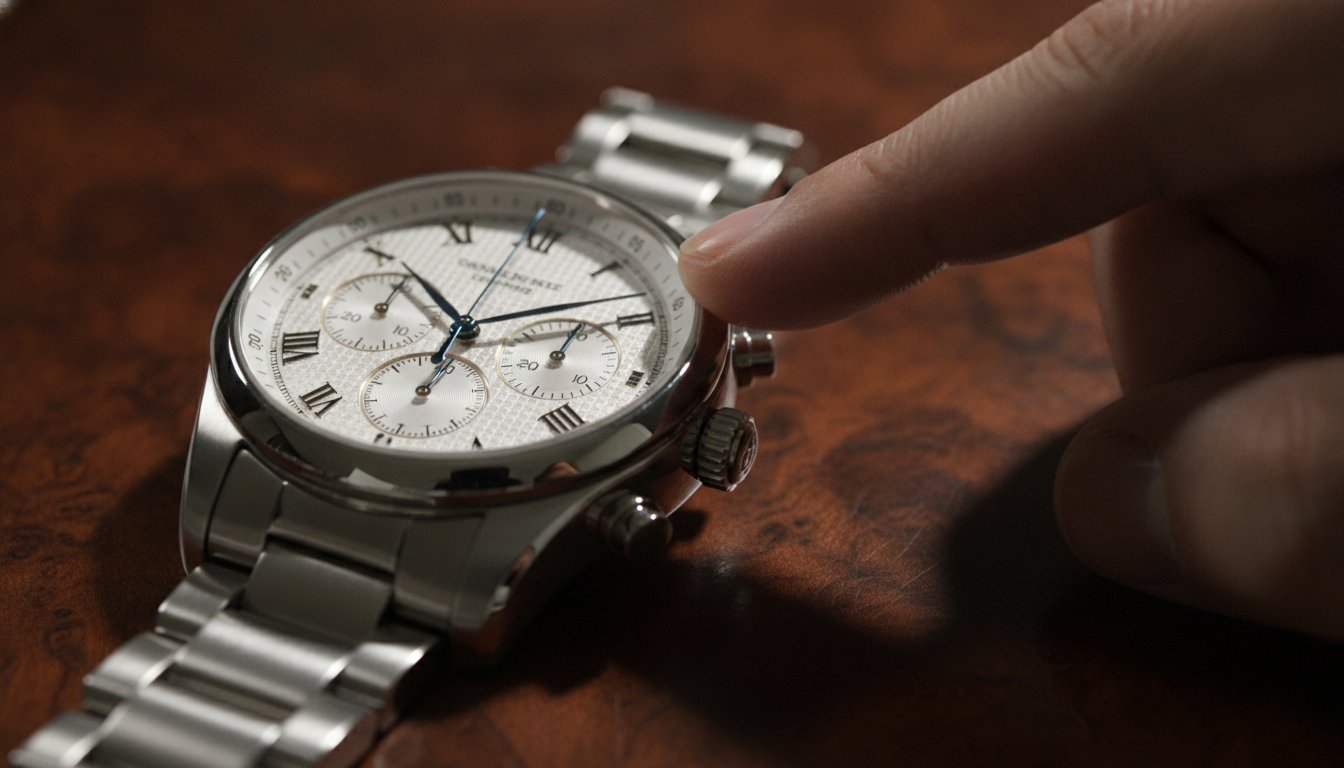
Owning a high-end chronograph is a definitive milestone for any serious collector, yet many owners hesitate to engage those precise pushers for fear of compromising a delicate mechanical movement. You've likely invested in a masterpiece of engineering, perhaps a Rolex Daytona or a Breitling Navitimer, and it's natural to feel protective of such a sophisticated instrument. However, learning how to use a chronograph watch is the only way to truly appreciate the heritage and technical prowess resting on your wrist.
We understand that the intricate sub-dial layouts and the specialized tachymeter scale can appear daunting at first glance. Mastering these mechanics is essential not just for functionality, but for preserving the long-term value of your timepiece in a market that increasingly rewards connoisseurship and technical knowledge. This comprehensive guide will demystify the operation of your watch, providing you with the confidence to utilize its stopwatch functions without hesitation. We will walk you through reading complex displays and implementing the maintenance routines necessary to protect your investment for decades to come.
Key Takeaways
- Identify the essential components of your timepiece, including the crown and pushers, to navigate the classic Tri-Compax layout with precision.
- Discover the exact sequence of steps for how to use a chronograph watch, from ensuring a full wind to managing water-resistant screw-down locks.
- Learn to interpret specialized scales like the tachymeter to calculate speed and understand the rapid reset functionality of flyback movements.
- Protect the long-term integrity and resale value of your luxury investment by following professional maintenance schedules and proper operational protocols.
- Clarify the distinction between a chronograph and a chronometer to better understand the specific engineering excellence of your watch’s movement.
What is a Chronograph Watch? Defining the Icon
The term chronograph finds its roots in the Greek words chronos, meaning time, and graph, meaning to write. In its earliest iterations, this complication literally lived up to its name by using a small pen to mark a rotating disc with ink. Today, the ink is gone, but the spirit of "writing time" remains through the intricate dance of hands across a multi-layered dial. It's the most popular complication in luxury horology because it transforms a passive timekeeper into a high-precision instrument. Beyond mere aesthetics, understanding What is a Chronograph? requires appreciating the mechanical architecture that allows a wearer to measure elapsed intervals without interrupting the main timekeeping function.
While many enthusiasts appreciate the "busy" look of the sub-dials and pushers, the chronograph's appeal lies in its history as a tool for professionals. It represents a transition from 19th-century horse racing stopwatches to the modern status symbols found in the collections of serious horologists. Mastering how to use a chronograph watch is a rite of passage for any collector, as it signals a shift from simply wearing a luxury item to operating a piece of engineering excellence.
Chronograph vs. Chronometer: The Key Differences
Confusion often exists between these two similar-sounding terms, yet they represent entirely different aspects of watchmaking. A chronometer refers to a movement's precision and accuracy, specifically one that has passed rigorous testing by the COSC (Contrôle Officiel Suisse des Chronomètres). In contrast, a chronograph is a functional complication that acts as a stopwatch. It's quite common for a high-end timepiece to hold both titles. For instance, the Rolex Cosmograph Daytona is a "Superlative Chronometer," meaning it's exceptionally accurate, while also being a world-class chronograph. You can typically identify a chronometer by specific text on the dial, whereas a chronograph is distinguished by the presence of at least two pushers and multiple sub-dials.
A Brief History of the 'Time Writer'
The journey of the chronograph began in 1816 when Louis Moinet invented a "compteur de tierces" to track astronomical objects with unprecedented precision. The technology remained specialized for decades until Breitling revolutionized the design in the 1930s by introducing independent start and reset pushers. This innovation made the device practical for pilots and race car drivers who needed to time events with a single hand. By the mid-20th century, these watches became essential equipment in aviation and motorsports, cementing their reputation for reliability in high-stakes environments. When you learn how to use a chronograph watch today, you're engaging with a legacy of timing that once determined the safety of transatlantic flights and the winners of the 24 Hours of Le Mans.
Anatomy of a Luxury Chronograph: Sub-Dials and Pushers
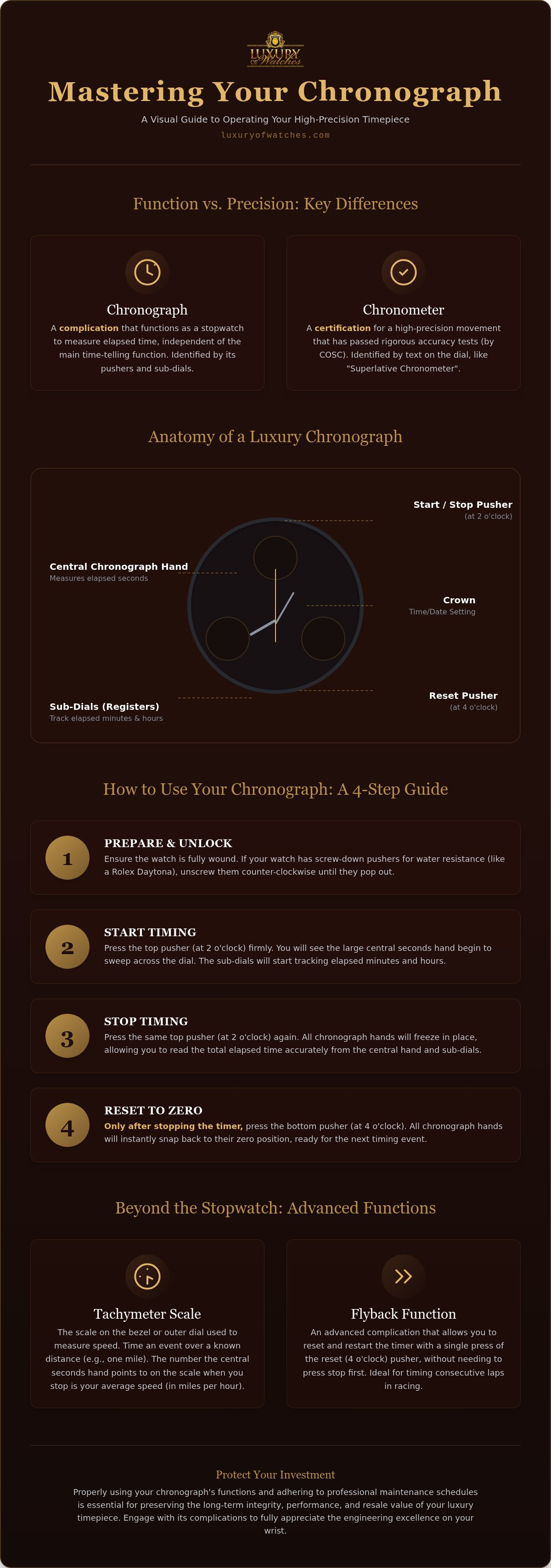
The visual architecture of a high-end chronograph is immediately recognizable. It's often defined by a trio of sub-dials and protruding pushers flanking the crown. To the uninitiated, these features might look like decorative flourishes, but each serves a specific mechanical purpose. One of the most common mistakes beginners make is assuming the large central seconds hand tracks the current time. In reality, this hand is dedicated exclusively to the stopwatch function. It remains stationary at the 12 o'clock position until you activate the timing mechanism. This design allows for high-precision reading against the outer scale, often measured in fractions of a second.
Understanding the layout is the first step in learning how to use a chronograph watch effectively. Most luxury models, such as the Breitling Navitimer, utilize a "Tri-Compax" configuration. This term refers to the three distinct registers on the dial. These sub-dials provide a clear visual record of elapsed time while keeping the main dial legible for daily wear. The craftsmanship involved in these movements is immense. Brands often use premium materials like 904L stainless steel or 18k gold to house these complex calibers, ensuring the exterior is as durable as the interior is precise.
The Pushers: Command and Control
The two buttons located on the side of the case are your primary interface with the movement. The pusher at 2 o'clock is the start and stop command. Pressing it once engages the gear train to begin timing. Pressing it again pauses the hands. The pusher at 4 o'clock is the reset button. It should only be pressed when the timer is stopped; otherwise, you risk putting unnecessary strain on the delicate internal cams. For those with a Rolex Daytona, you'll notice these pushers are threaded. These screw-down locks must be unscrewed before operation to maintain the watch's water resistance, a hallmark of professional-grade tool watches.
Reading the Sub-Dials (Registers)
Each register on the dial tells a different part of the story. Typically, one sub-dial is a 30-minute or 60-minute counter that tracks the revolutions of the central seconds hand. Another is a 12-hour register, allowing you to time long-duration events like a cross-continental flight. The third sub-dial is perhaps the most important for daily use: the running seconds. This small hand moves constantly, providing a visual confirmation that your mechanical movement is actually ticking. If you're exploring the pre-owned luxury watch market, checking the fluid motion of this small hand is a quick way to verify the watch's basic operation. Understanding these nuances is vital when mastering how to use a chronograph watch and appreciating the horological art on your wrist.
How to Use a Chronograph Watch: Step-by-Step Instructions
Operating a luxury chronograph is a tactile experience that rewards a deliberate approach. It's not just about pushing buttons; it's about engaging with a complex mechanical system that has been calibrated for precision. Before you begin the timing sequence, you must verify that the watch has a sufficient power reserve. A mechanical movement with low energy may lack the torque necessary to engage the chronograph gears, potentially causing the watch to skip or stop entirely. If you're handling a model with screw-down pushers, ensure they're fully released before attempting to engage the mechanism.
Once the movement is ready, the process of how to use a chronograph watch follows a logical, five-step progression:
- Winding: Ensure your manual or automatic movement is fully powered to support the extra energy consumption of the complication.
- Unlocking: Unscrew the pusher guards if your timepiece features them to maintain its water-resistant seal.
- Activation: Press the top pusher at the 2 o'clock position firmly to engage the central seconds hand.
- Pausing: Press the same top pusher again to stop the timing, allowing for an accurate reading of the elapsed interval.
- Resetting: Press the bottom pusher at 4 o'clock to return the central hand and sub-dial registers to their zero positions.
The Golden Rule of Mechanical Chronographs
There is one non-negotiable rule when operating a standard mechanical chronograph: never press the reset button while the timing function is active. In traditional lateral clutch movements, the gears are physically interlocked while the timer runs. Forcing a reset during this phase places immense stress on the reset hammers and the heart-shaped cams, which can lead to a catastrophic mechanical jam. The rare exception is the Flyback complication, which is specifically engineered to handle instant resetting for rapid-fire timing. Unless you are certain your watch features a Flyback movement, always stop the timer before you reset to preserve the movement's integrity.
Readability and Precision
Achieving a precise reading requires focus on the outer track of the dial, where the central seconds hand indicates fractions of a second. You should feel a crisp, mechanical click when engaging the pushers, which signifies that the column wheel or cam has successfully transitioned the gears. The central seconds hand should remain stationary when not in use to save power. Keeping the chronograph running constantly increases friction and can significantly reduce the power reserve of your timepiece.
Advanced Complications: Tachymeters, Flybacks, and More
The allure of a high-complication timepiece lies in its ability to solve complex mathematical problems through purely mechanical means. Once you have mastered the basic start, stop, and reset sequence, the next level of how to use a chronograph watch involves engaging with specialized scales and advanced movement types. These features aren't merely decorative. They represent the peak of horological engineering, designed for professionals who require split-second accuracy in high-stakes environments. Whether you're tracking velocity on a race track or navigating via dead reckoning, these complications transform your watch into a versatile analog computer.
Collectors often gravitate toward these advanced models because they offer a deeper level of engagement with the movement. For example, the IWC Pilot's Double Chronograph Rattrapante remains a favorite in 2026 for its ability to track two separate events simultaneously. Understanding these nuances doesn't just improve your user experience; it anchors your appreciation for the craftsmanship required to build such intricate calibers. If you're ready to elevate your collection, exploring our selection of luxury chronographs will reveal the sheer variety of these mechanical wonders.
Mastering the Tachymeter Scale
The tachymeter is the numerical scale typically found on the bezel or the outer edge of the dial on racing-inspired watches like the Rolex Daytona. It allows you to calculate units per hour, such as speed or distance, based on elapsed time. The mathematical formula powering this scale is 3600 divided by the number of elapsed seconds. You don't need a calculator to use it. Simply start the chronograph at a starting marker and stop it exactly one mile or kilometer later. The central seconds hand will point to your average speed on the tachymeter scale. For instance, if it takes you exactly 30 seconds to cover a mile, the hand will point to 120, indicating a speed of 120 mph.
High-Horology Variations
Beyond the standard movement, three specific variations stand out for their technical complexity. The Flyback chronograph is a favorite among pilots because it allows the wearer to reset the timer to zero and restart it with a single press of the 4 o'clock pusher. This eliminates the stop-reset-start delay, which is vital for rapid navigational changes. The Rattrapante, or split-seconds chronograph, features two superimposed seconds hands. It's one of the most difficult complications to manufacture, famously perfected by Patek Philippe. Finally, the Monopusher offers a minimalist aesthetic by housing the start, stop, and reset functions within a single button, often integrated into the crown. Each variation requires a specific touch, and learning how to use a chronograph watch with these specialized movements is a rewarding challenge for any enthusiast.
Caring for Your Chronograph and Choosing Your Next Icon
Owning a luxury chronograph is as much about stewardship as it is about operation. While the previous sections of this guide detailed the technical specifics of how to use a chronograph watch, maintaining the health of that movement is what ensures it remains a high-value asset. These timepieces are significantly more complex than standard three-hand watches. They contain hundreds of microscopic components that rely on specialized lubricants to reduce friction during high-speed operation. Over time, these oils naturally degrade. To maintain peak performance, a professional service is recommended every five to seven years. This interval ensures that the delicate pivots and gears remain protected from unnecessary wear.
Proper usage directly influences the long-term resale value of your timepiece. A movement that has been operated with care, avoiding the mechanical strain of improper resets, will always command a higher premium among serious collectors. Documentation of regular maintenance acts as a certificate of health, validating the integrity of the caliber. For those entering the secondary market, prioritizing a watch with a transparent history is the most effective way to secure your investment.
Preserving Mechanical Integrity
Magnetic fields are a silent but pervasive threat to mechanical movements. Household electronics, such as high-end speakers or magnetic tablet covers, can easily magnetize a watch's hairspring, causing it to run erratically. It's also essential to verify the seals on your pushers regularly. Even professional-grade tool watches require gasket replacements to ensure moisture doesn't compromise the movement. Given the intricate nature of these calibers, our five-year in-house warranty is vital for chronograph owners. It provides a robust layer of security, ensuring that your timepiece receives expert attention should any mechanical issues arise.
Investment Icons to Consider
Selecting your next chronograph should be a balance of aesthetic preference and market fundamentals. If you're focused on long-term value retention, the current Rolex prices for the Cosmograph Daytona highlight its position as a dominant market leader. For collectors who value a performance-driven, technical aesthetic, Breitling watches offer a rich heritage in aviation and professional timing. Movement purists often seek out the Zenith El Primero, celebrated for its high-frequency beat and historical significance as the first integrated automatic chronograph. Whether you're drawn to a rugged pilot's instrument or a refined racing icon, understanding how to use a chronograph watch allows you to appreciate the engineering excellence of these legendary models. Explore our curated collection of luxury watch brands today to find a piece that matches your lifestyle and investment goals.
Elevate Your Collection with Precision and Confidence
Mastering the mechanics of a high-end chronograph transforms your timepiece from a luxury accessory into a functional masterpiece of engineering. By understanding the nuances of pusher operation and the specific layout of your registers, you protect the delicate internal architecture from unnecessary strain. Learning how to use a chronograph watch isn't just a technical requirement; it's a way to honor the heritage of manufacturers like Rolex and Breitling. Whether you're calculating speed on a tachymeter or timing multiple intervals, your knowledge ensures the longevity and resale value of your investment.
At Luxury of Watches, we support your journey with an industry-leading 5-year in-house warranty and a commitment to absolute verification for every model. Our expert support team is dedicated to providing the security you need through secure worldwide shipping and rigorous authentication protocols. Don't let the complexity of a mechanical movement hold you back from enjoying its full potential. Discover Your Next Masterpiece at Luxury of Watches and wear your next icon with the confidence that only a true connoisseur possesses.
Frequently Asked Questions
Can I leave my chronograph running all the time?
It is generally not recommended to leave your chronograph running continuously. While it won't cause immediate damage, it increases friction and wear on the movement's components, which can lead to a shorter service interval. Additionally, keeping the complication engaged significantly reduces the power reserve of the watch, as the movement must work harder to drive the extra gears and hands. For most collectors, it's best to only engage the timer when needed.
What is the difference between a chronograph and a stopwatch?
A chronograph is a sophisticated timepiece that integrates a stopwatch function into a standard watch movement, whereas a stopwatch is a standalone instrument dedicated solely to measuring elapsed time. While both serve the same timing purpose, a luxury chronograph allows the wearer to track time intervals without sacrificing the elegance of a high-end wrist instrument. It represents a higher tier of mechanical complexity and craftsmanship compared to simple digital or analog stopwatches.
How do I use the tachymeter scale on my watch bezel?
To use the tachymeter scale, start the chronograph at a distance marker, such as a mile marker, and stop it exactly one mile later. The central seconds hand will point to a number on the bezel that indicates your average speed in units per hour. This classic racing complication is a staple on iconic models like the Rolex Daytona, allowing for rapid speed calculations without the need for manual arithmetic during high-speed events.
Why doesn't my chronograph hand line up perfectly with 12 o'clock?
Misalignment of the central seconds hand is often caused by a mechanical shock or the hand slipping on its pinion over time. In quartz models, this can usually be corrected through a specific button sequence found in the manual. For mechanical luxury watches, this often indicates the need for a professional adjustment. Ensuring you know how to use a chronograph watch properly, including stopping it before resetting, helps prevent these alignment issues from occurring.
Is it bad to reset a chronograph while it is running?
Yes, resetting a standard mechanical chronograph while it's running can cause significant damage to the internal cams and reset hammers. The mechanical parts are physically locked while the timing function is active, and forcing a reset can lead to a costly jam. Always stop the timer using the top pusher before engaging the reset button at 4 o'clock. This practice preserves the integrity of your movement and prevents the need for unnecessary repairs.
Do all chronograph watches have three sub-dials?
No, chronograph layouts can vary significantly depending on the caliber and the brand's aesthetic goals. While the three-register Tri-Compax layout is the most common, many heritage designs use a Bi-Compax configuration with only two sub-dials. Some minimalist luxury models even utilize a single sub-dial or hide the counters entirely to maintain a cleaner dial profile. The number of sub-dials is often determined by the specific timing requirements of the movement's intended design.
What is a flyback chronograph and how does it work?
A flyback chronograph is a specialized complication that allows the wearer to reset and restart the timing sequence with a single press of the reset pusher. Unlike standard movements that require a stop-reset-start sequence, the flyback instantly flies back to zero and begins timing again. This was originally developed for pilots who needed to perform rapid navigational calculations without the delay of multiple button presses, making it a favorite for those who value functional efficiency.
How often should a mechanical chronograph be serviced?
A mechanical chronograph should be professionally serviced every 5 to 7 years to ensure the specialized lubricants remain fresh and effective. Because these movements are more complex than standard watches, regular maintenance is essential for preserving accuracy and long-term value. Learning how to use a chronograph watch correctly between these service intervals will further protect the movement from premature wear. This proactive approach ensures your timepiece remains a reliable instrument for decades of use.