
How to Start a Luxury Watch Collection: The Connoisseur’s Guide for 2026
31st Mar 2026
A single misstep in your first acquisition can cost you $10,000 or more in immediate market depreciation. Learning how to start a luxury watch collection requires more than just a healthy bank balance; it demands a disciplined eye for horological integrity and market timing. You've likely felt the weight of the 40 million counterfeit watches that flood the global market annually. It's natural to feel overwhelmed by technical jargon or the fear that your investment will lose its luster the moment it leaves the boutique.
We'll transform that anxiety into the confidence of a seasoned collector. This guide provides a pragmatic framework for 2026 to help you master the art of curation, from verifying movements to securing the lowest possible price on pristine models. You'll learn how to build a balanced three-watch collection, identify hallmark quality in brands like Rolex and Omega, and ensure every purchase includes a vital Certificate of Authenticity. We're moving beyond mere aesthetics to focus on the security and prestige your investment deserves.
Key Takeaways
- Learn to distinguish between a casual buyer and a true horological curator by prioritizing intentional asset management and artistic value.
- Discover our definitive five-step framework on how to start a luxury watch collection, from establishing a 2026 budget to selecting your foundational "Daily Driver."
- Master the technical nuances of prestige timepieces by identifying the critical differences between in-house movements and high-grade materials like 904L steel.
- Navigate the modern market with confidence by understanding the strategic advantages of grey market availability versus traditional authorized dealer waitlists.
- Ensure the long-term evolution of your portfolio by implementing professional maintenance standards and the disciplined "One In, One Out" rule.
What Does It Mean to Start a Luxury Watch Collection in 2026?
In 2026, understanding how to start a luxury watch collection requires a sophisticated synergy between appreciating the science of time measurement and strategic asset management. Collecting has transitioned from a niche hobby into a refined discipline where art meets engineering. A buyer simply acquires a timepiece for utility or status, but a collector curates a narrative through intentional selection. This distinction is vital. By 2026, the global pre-owned luxury watch market is projected to exceed $35 billion, representing a consistent 10% annual growth since 2023. This surge is fueled by unprecedented grey market transparency and the widespread adoption of blockchain-backed digital identities for high-end pieces.
Setting your "Horological North Star" is the first step in this journey. You must decide if your collection will be driven by raw passion or investment potential. While these paths often overlap, your primary motivation determines your acquisition strategy. Modern collectors benefit from a market that rewards authenticity and technical mastery over mere brand recognition. Successful curation involves three core pillars:
- Intentionality: Every piece should serve a specific purpose within the broader set.
- Transparency: Utilizing verified platforms to ensure 100% authenticity.
- Curation: Focusing on quality and provenance rather than sheer volume.
The Psychology of the Collector
Heritage brands like Rolex and Patek Philippe dominate the collector's psyche because they represent a lineage of excellence that transcends temporary trends. There's a profound emotional reward in owning a mechanical masterpiece that functions independently of software or batteries. Your first watch is more than a purchase; it dictates the DNA of your entire future collection. If you begin with a professional diver, you'll likely find yourself gravitating toward tool watches with robust specifications. If you start with a vintage complication, your eye will naturally seek out intricate movements and historical significance.
Investment vs. Aesthetic Value
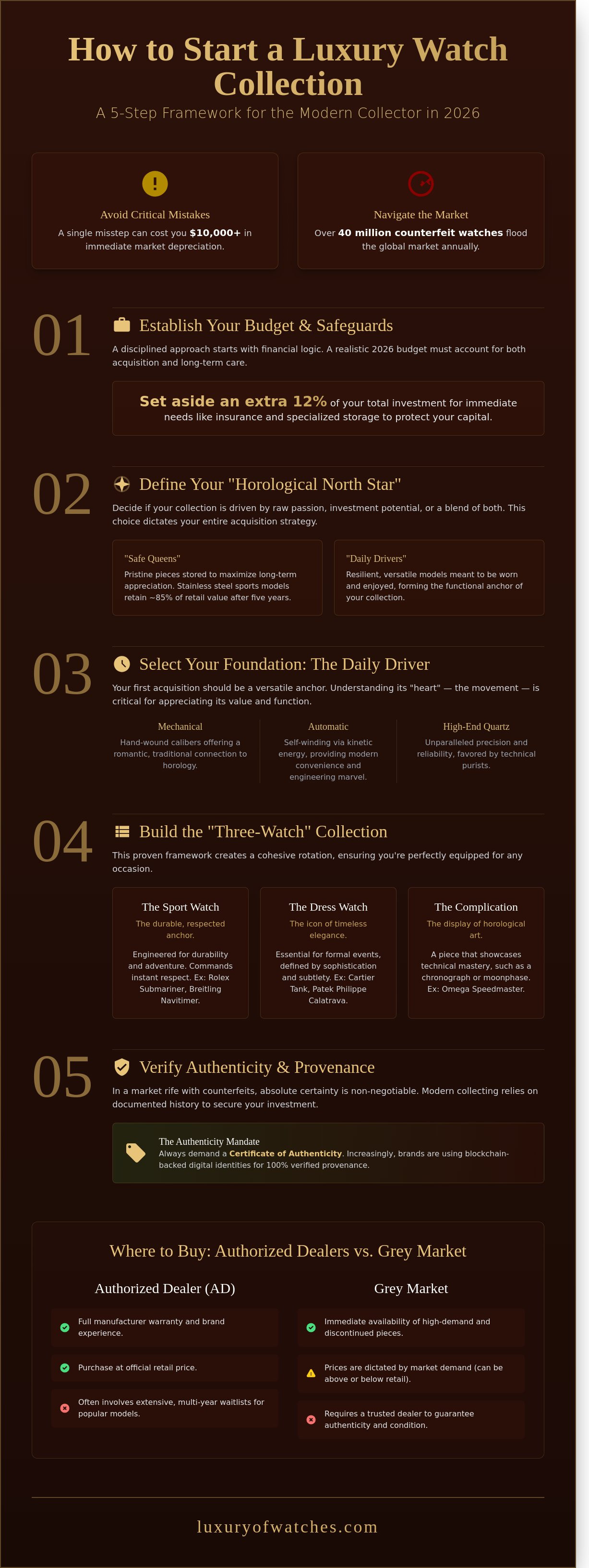
Balancing watches that hold value with those you genuinely want to wear is the hallmark of a seasoned collector. "Safe Queens" are pristine pieces stored in vaults to maximize long-term appreciation, whereas "Daily Drivers" are resilient models meant for the wrist. Data from 2025 indicates that iconic stainless steel sports watches retain roughly 85% of their retail value after five years. Horological provenance is the documented history of a timepiece. Modern collecting relies on this history to justify the "prestige at a price" model, ensuring that your investment remains as secure as it is beautiful.
Of course, not every luxury item has to be an investment. Many collectors also enjoy high-fashion accessories and sneakers that capture a specific aesthetic without the same financial weight. For those building a broader luxury lifestyle, resources like Sneaker Double provide access to designer styles that complement a curated watch collection.
The 5-Step Framework for Building Your Foundation
Starting your journey into horology requires more than just an appreciation for fine craftsmanship. To understand how to start a luxury watch collection effectively, you must establish a structural approach that balances desire with financial logic. A realistic 2026 budget should account for the acquisition price and the ongoing commitment to the timepiece's longevity. Experts suggest setting aside an additional 12% of your total investment for immediate needs like insurance and specialized storage. This ensures your capital is protected before you even make your first purchase.
Your first acquisition should be a "Daily Driver," the versatile anchor that transitions from the boardroom to a weekend social gathering without hesitation. When selecting this piece, you'll encounter different movements. Mechanical calibers offer a romantic connection to tradition; however, Automatic movements provide modern convenience through kinetic energy. High-end Quartz movements from brands like Grand Seiko offer unparalleled precision that appeals to technical purists. If you're exploring the nuances of vintage watches, remember that movement condition is paramount to long-term value preservation.
The Three-Watch Collection Rule
A well-rounded collection relies on the Three-Watch Rule to ensure you're never underdressed or over-equipped. This framework creates a cohesive rotation that covers every social requirement:
- The Sport Watch: A Rolex Submariner or Breitling Navitimer serves as a non-negotiable anchor. These watches are engineered for durability and command instant respect.
- The Dress Watch: The timeless elegance of a Cartier Tank or a Patek Philippe Calatrava is essential for formal engagements where subtlety is the highest form of sophistication.
- The Wildcard: This is where you inject personality. A GMT-Master II for travel or a TAG Heuer Carrera for racing heritage adds a unique layer to your horological narrative.
Budgeting Beyond the Sticker Price
Smart collectors look past the initial transaction. In the 2026 luxury watch market, prices for iconic models have seen a steady 5.4% annual appreciation, making timing crucial. The "hidden costs" are where many beginners stumble. Professional servicing every 5 years can cost between $750 and $1,600 depending on the complexity of the complication. Insurance premiums typically hover around 1.5% of the watch’s appraised value annually.
Prioritize "buying the seller" over chasing the absolute lowest price. A reputable source that provides 100% authenticity guarantees and a Certificate of Authenticity is vital for your peace of mind. You can find exquisite timepieces at unbeatable prices through verified platforms that eliminate the risks of the secondary market. This security ensures your investment remains pristine and protected from the moment it arrives at your door.
Evaluating Horological Quality: What to Look For
Learning how to start a luxury watch collection requires an eye for technical excellence. You aren't just buying a brand name; you're investing in a machine that houses hundreds of microscopic components working in perfect unison. Discerning collectors prioritize the movement above all else, as it dictates both the watch's longevity and its future market value.
Decoding the Movement
Mechanical movements are the heartbeat of any serious collection. While quartz watches offer precision, they lack the soul and engineering heritage found in automatic or manual-wind calibers. In-house movements represent the pinnacle of prestige. When a brand like Rolex or Patek Philippe designs and manufactures its own caliber, it demonstrates a level of vertical integration that outsourced ETA or Sellita movements cannot match. A complication is any function on a watch beyond telling the time.
- COSC Certification: The Contrôle Officiel Suisse des Chronomètres tests movements for 15 days in five positions. A certified chronometer must maintain an accuracy of -4 to +6 seconds per day.
- Finishing: Look for "Côtes de Genève" or "Perlage" on the base plates. These decorative techniques signal a high level of hand-craftsmanship.
- Power Reserve: Modern luxury standards now expect at least 70 hours of power, allowing you to set the watch down on Friday and find it running on Monday.
This appreciation for meticulous hand-craftsmanship is not limited to horology. The same principles of heritage and artistry apply to fine jewelry, where master goldsmiths create timeless pieces. For those interested in exploring this parallel world of luxury, you can check out Juwelier Risch to see how a six-generation tradition informs modern design.
Case Materials and Aesthetics
Material choice defines the watch's durability and daily utility. While standard 316L stainless steel is the industry norm, Rolex utilizes 904L Oystersteel. This superalloy contains higher levels of chromium and molybdenum, making it exceptionally resistant to pitting and corrosion. For those seeking weight and exclusivity, 18k gold or platinum remains the gold standard, though these materials are softer and more prone to scratches.
By 2026, the luxury market has seen a 22% increase in the use of Grade 5 Titanium and Zirconium Dioxide (Ceramic). These materials offer a lightweight feel and near-total scratch resistance, perfect for a modern daily wearer. When buying pre-owned, "pristine" condition means the case retains its original factory chamfers. Over-polishing can ruin a watch's profile by rounding off the sharp edges where the lugs meet the bracelet. You should always verify these details against a Certificate of Authenticity to ensure every component is 100% authentic.
Wrist presence is the final hurdle in how to start a luxury watch collection. A 40mm case diameter is often considered the "sweet spot," but the lug-to-lug measurement is actually more important. If the distance from the top lug to the bottom lug exceeds 48mm, the watch may overhang a standard 7-inch wrist, which breaks the silhouette of a well-tailored look. It's about the balance between technical specs and how the piece feels on your skin.
Where to Buy: Navigating ADs, Boutique, and Grey Markets
Finding the right source is the most critical step as you learn how to start a luxury watch collection. By 2026, the landscape of Authorized Dealers (ADs) remains restrictive for new entrants. For example, securing a stainless steel Rolex Submariner through an AD often requires a 24-month wait or a pre-existing spending history exceeding $50,000. This reality makes the grey market an indispensable tool. You gain immediate access to exquisite timepieces without the performative rituals of boutique waiting lists. While ADs offer the traditional manufacturer card, the "authenticity gap" is easily bridged by choosing reputable dealers who provide their own rigorous verification processes and unbeatable pricing.
Buying Pre-Owned with Confidence
Every timepiece in a professional secondary market inventory undergoes a 10-point authenticity check. Experts scrutinize microscopic details that counterfeiters often miss, including:
- The precision of laser-etched crowns on Rolex crystals.
- The exact beat rate and finishing of the internal movement.
- The weight and hallmarking of precious metals.
- Serial number alignment against manufacturer databases.
While "Box and Papers" can increase a watch's value by 10% to 15%, they aren't always mandatory for a starter piece. A Certificate of Authenticity from a trusted source provides the same security. Luxury of Watches ensures 100% authenticity on every Rolex and Cartier by putting each watch through this intensive vetting process. This allows you to focus on the prestige of the brand rather than the paperwork.
The Warranty Revolution
Many collectors realize that manufacturer warranties are often overvalued in the secondary market. Once a watch is resold, the original factory coverage might have only 12 months remaining, or it might be voided if the card wasn't properly dated. A dedicated 5-year in-house warranty offers a superior safety net for long-term peace of mind. It's a modern standard that protects the mechanical integrity of your movement for half a decade. This security is vital when you discover how to start a luxury watch collection without the overhead of retail markups. For more details on selecting your first pristine timepiece, consult our Guide to Pre-Owned Luxury Watches.
Curating for the Long Term: Maintenance and Evolution
Mastering how to start a luxury watch collection requires a shift in perspective from mere acquisition to disciplined curation. Many seasoned collectors adopt the "One In, One Out" rule to maintain a focused, high-quality assembly. This practice ensures that every new addition serves a specific purpose, preventing your collection from becoming cluttered with redundant styles. It's the moment you transition from an enthusiast to a true connoisseur, valuing the prestige and narrative of each individual piece over sheer volume.
Maintenance is the cornerstone of long-term value. A mechanical movement is a complex engine containing between 130 and 400 microscopic parts. These components rely on specialized lubricants that degrade over time. Adhering to a strict 5-year service interval ensures your movement remains in exquisite condition, preventing costly repairs and preserving its chronometric precision. Pristine internal mechanics are just as vital as a flawless exterior for future resale potential.
Storage and Protection
Environmental factors can silently degrade a prestigious timepiece. High humidity levels, specifically those exceeding 60%, can lead to dial spotting or gasket failure. Magnetism is another invisible threat; proximity to speakers or tablets can disrupt the hairspring and cause the watch to run erratically. While watch winders are convenient for perpetual calendars, a luxury safe offers the physical security required for high-value assets. Always ensure your pieces are covered by a dedicated insurance rider, as standard homeowner policies often limit jewelry payouts to a mere $1,500 or $2,500, which is insufficient for most luxury brands.
Your First Purchase Checklist
Understanding how to start a luxury watch collection is only the first step; protecting that investment is what defines a successful collector. Before you finalize your investment, perform a rigorous final verification. A Certificate of Authenticity is non-negotiable, acting as the definitive proof of your watch's legitimacy and origin. Follow these steps to ensure a secure transaction:
- Verify the Reference: Cross-reference the model number and movement caliber to ensure they are period-correct.
- Document Everything: Retain all original packaging, hangtags, and paperwork to maximize future value.
- Confirm Terms: Ensure the seller offers a clear return policy and a comprehensive warranty.
Begin Your Horological Legacy Today
Learning how to start a luxury watch collection is a journey that rewards patience and expert guidance. You've explored the essential framework for evaluating horological quality, from movement precision to the nuances of market sourcing. Success in 2026 depends on curating for the long term while ensuring every acquisition is backed by ironclad provenance. It's about finding that perfect balance between the emotional allure of a prestige timepiece and the technical validation of its craftsmanship.
Since 1999, Luxury of Watches has served as a trusted connoisseur for collectors worldwide. With over 25 years of industry experience, we understand the importance of security in high-value transactions. Every watch we offer is backed by a 100% Authenticity Guarantee and includes a formal Certificate of Authenticity. To provide ultimate peace of mind, we include a 5-year industry-leading in-house warranty on our pristine inventory. You don't have to navigate the complexities of the market alone when you have a partner dedicated to your legacy.
Explore Our Authentic Rolex Collection & Start Your Legacy
Your first significant timepiece is more than a purchase; it's the foundation of a story that will last for generations.
Frequently Asked Questions
How much should I spend on my first luxury watch?
You should typically budget between $1,500 and $5,000 for your first acquisition. This price bracket provides access to prestigious entry-level models like the TAG Heuer Carrera or the Tudor Black Bay. While high-end horology can reach six figures, starting in this range ensures you receive a high-quality Swiss movement and a 100% authentic timepiece without overextending your initial investment. It's a solid foundation for anyone learning how to start a luxury watch collection.
Is a pre-owned Rolex a good investment for a beginner?
A pre-owned Rolex is one of the most stable investments for a new collector. According to market data from the last 10 years, models like the Submariner Ref. 116610 have shown consistent value retention of 15% to 25% above retail in the secondary market. Buying pre-owned allows you to bypass the initial retail depreciation while securing a piece that carries an industry-leading Certificate of Authenticity and a timeless aesthetic.
What is the "Holy Trinity" of watch brands?
The "Holy Trinity" consists of Patek Philippe, Vacheron Constantin, and Audemars Piguet. These three manufacturers represent the pinnacle of horological craftsmanship, with histories dating back to 1755 for Vacheron Constantin. They're recognized for their exquisite hand-finishing and complex movements. Owning a piece from these brands is often considered the ultimate goal for those who understand how to start a luxury watch collection at the highest level of prestige.
Do luxury watches really hold their value over time?
Many luxury watches retain 70% to 90% of their value, while specific stainless steel sports models from Rolex or Patek Philippe frequently appreciate. For example, a 2020 Rolex Daytona can currently trade for 100% more than its original MSRP. While not every watch is a financial asset, choosing prestigious brands with limited production runs ensures your collection remains a store of wealth over 5, 10, or 20 years.
How can I tell if a luxury watch is authentic when buying online?
You must verify the serial numbers against manufacturer databases and ensure the seller provides a 100% Certificate of Authenticity. Professional dealers will provide high-resolution photos of the movement and the 12-digit or 8-digit serial codes. Avoid any listing that lacks a clear return policy or a 5-year warranty. Trusted platforms like Luxury of Watches guarantee every component is pristine and original to the manufacturer, providing unbeatable security for your purchase.
Should I buy a watch winder for my new collection?
You should invest in a watch winder if your collection includes automatic timepieces with complex calendars or moon phase complications. These devices keep the internal lubricants flowing and maintain the 40 to 70-hour power reserve when the watch isn't on your wrist. For a standard 3-hand automatic, a winder is optional but helpful for maintaining 100% accuracy without manual resetting every 2 days. It's a practical tool for protecting your movement's longevity.
What is the best "everyday" luxury watch for a first-time collector?
The Rolex Datejust 36mm or 41mm is widely considered the premier everyday luxury watch. Its 100-meter water resistance and 904L stainless steel construction make it durable enough for daily wear. Alternatively, the Omega Seamaster Aqua Terra offers a 15,000-gauss magnetic resistance, providing technical excellence for a modern lifestyle. Both pieces offer an unbeatable blend of prestige and practical utility for a new owner who wants a versatile, single-watch solution.
Can I start a collection with just one watch?
You can absolutely start a collection with a single, high-quality timepiece. This "one-watch collection" philosophy focuses on acquiring a versatile "GADA" (Go Anywhere, Do Anything) watch like the Tudor Black Bay 58. By investing your entire budget into one pristine model, you ensure your first piece is a significant horological achievement. Many collectors spend 12 to 24 months enjoying their first watch before considering a second acquisition to expand their variety.