
How to Authenticate a Luxury Watch: The Collector’s 2026 Guide
Posted by Luxury of Watches on 9th Sep 2026
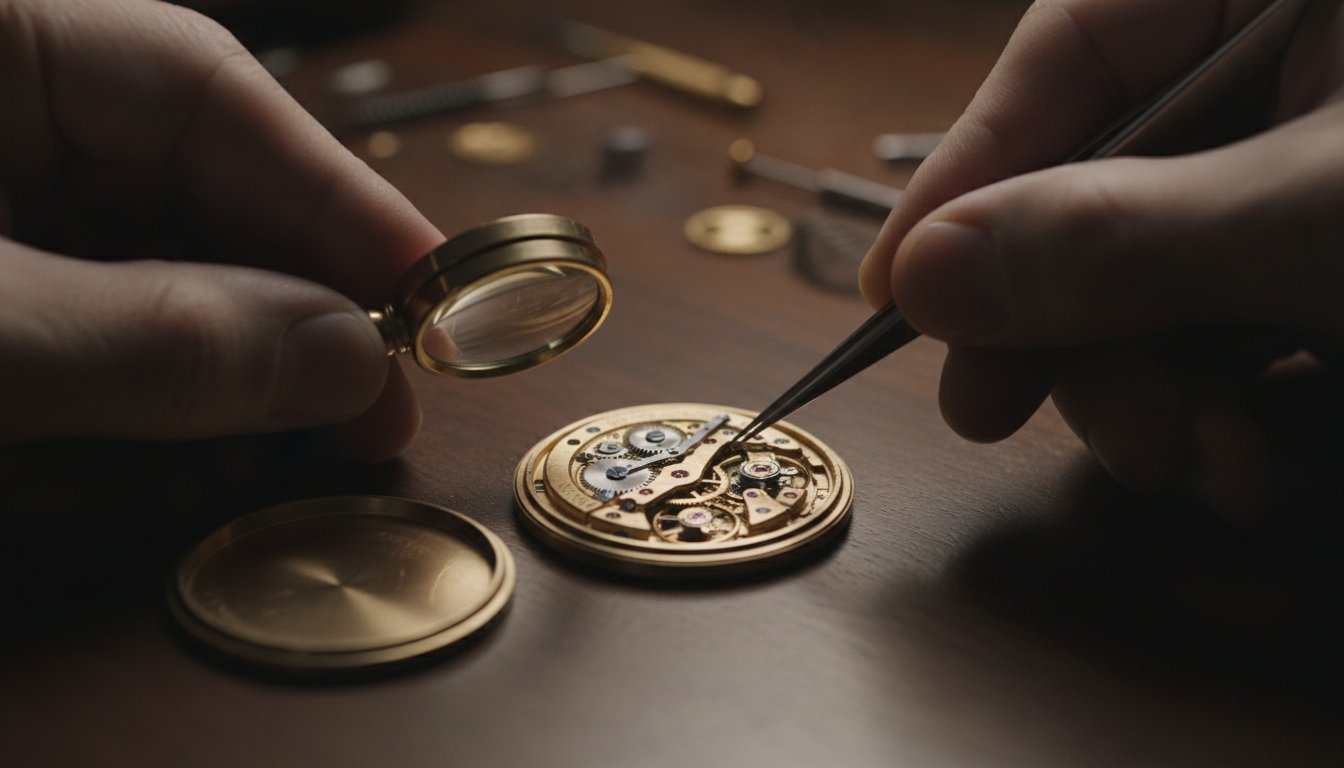
Did you know that the Swiss watch industry loses nearly $1.9 billion every year to the increasingly sophisticated market of counterfeit horology? In 2026, the challenge for collectors has intensified as "super-clones" now mimic the weight and aesthetic of genuine timepieces with startling precision. If you've felt a sense of hesitation when considering a "naked" watch or a piece with missing paperwork, you're not alone. Learning how to authenticate a luxury watch is no longer just a hobbyist's skill; it's an essential safeguard for your investment.
We understand that the prestige of owning a Rolex or Cartier should come with absolute peace of mind, not a list of technical anxieties. You deserve to feel as confident in the movement's heartbeat as you do in the dial's finish. This guide will help you master the specific aesthetic and mechanical markers experts use to distinguish genuine craftsmanship from even the most advanced replicas.
We'll provide a comprehensive physical inspection checklist and explain why movement verification is the ultimate truth in horology. You'll also learn why a five-year in-house warranty serves as the most reliable signature of authenticity in today's secondary market.
Key Takeaways
- Understand why visual inspections alone are insufficient in 2026 and how to look past the surface of sophisticated "super-clones."
- Master the three pillars of professional verification, focusing on the intricate mechanical heart and the precise finishing of the internal movement.
- Learn how to authenticate a luxury watch by identifying specific red flags for prestigious brands like Rolex, Cartier, and Patek Philippe.
- Equip yourself with the professional tools and techniques required to perform a macro-level audit of dials, logos, and case weights against official specifications.
- Discover how a rigorous multi-point inspection and a five-year in-house warranty provide the ultimate security for your high-value investment.
The Evolution of Counterfeits: Why Visual Checks Aren't Enough
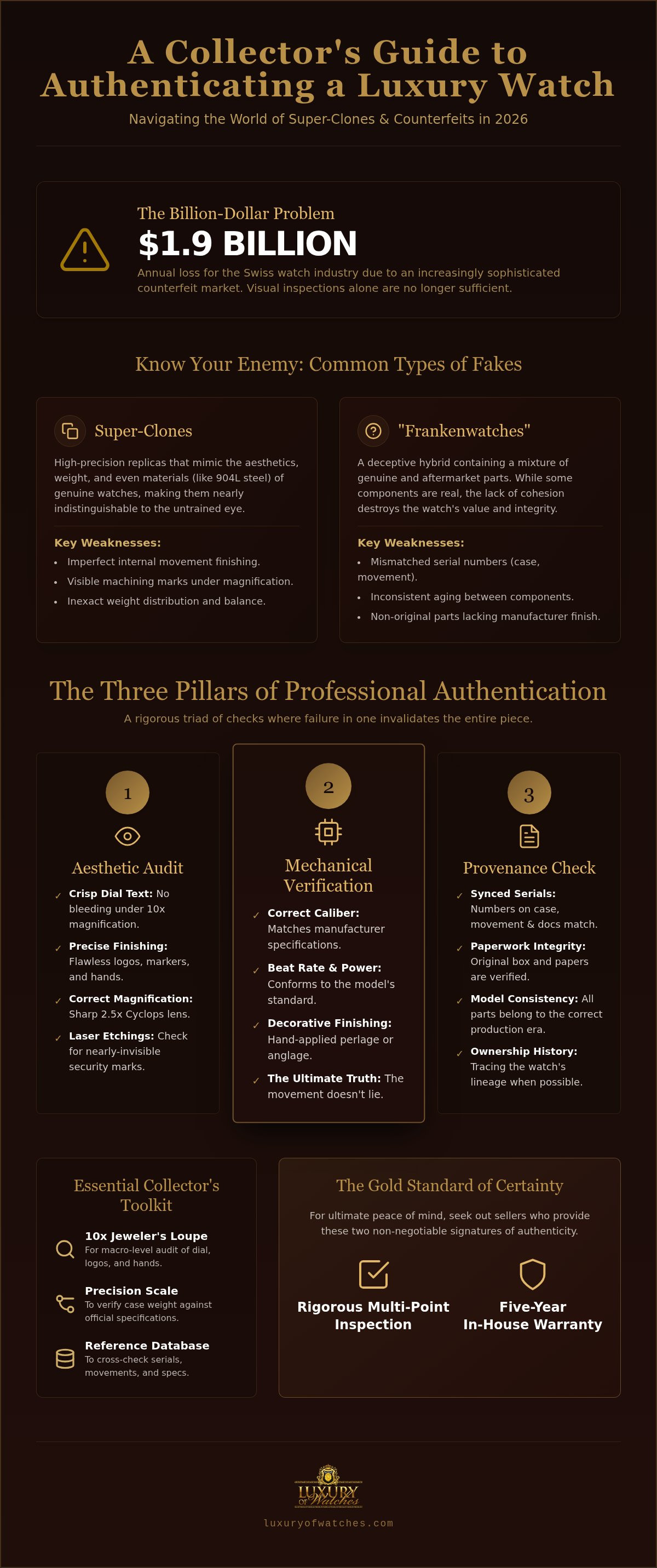
The landscape of horology has shifted dramatically. In 2026, the Swiss watch industry faces a loss of nearly $1.9 billion annually due to sophisticated counterfeiting. Understanding how to authenticate a luxury watch is no longer optional; it's a necessity for any serious investor. The Evolution of Counterfeits has moved from easily identifiable replicas to "super-clones" produced by specialized facilities like the N-factory. These pieces often utilize the same materials as the originals, such as 904L stainless steel, making visual identification nearly impossible for the untrained eye.
If you're wondering how to authenticate a luxury watch using only high-resolution photos, the answer is increasingly complex. Digital imagery can be deceptive. A seller might use stock photos, or a replica might possess a visually perfect dial while hiding a generic movement beneath the case back. This is why a physical inspection by a specialist remains the gold standard for security. Professional verification is the only way to achieve a 100% guarantee in a market where visual perfection is now a commodity.
Understanding the 'Frankenwatch' Risk
A "Frankenwatch" presents a unique challenge for collectors. Unlike a total counterfeit, these pieces contain a mixture of genuine and aftermarket parts. A seller might house a legitimate dial and case with a non-original movement or a bracelet from a different era. While parts of the watch are "real," the lack of cohesion destroys the piece's historical and financial value. Serious collectors must ensure that serial numbers match across the case, movement, and paperwork. This consistency is vital when evaluating a Rolex Submariner or other high-value assets.
The Limitations of Modern Super-Clones
Despite their name, super-clones still have weaknesses. Counterfeiters often cut corners on the parts the owner rarely sees. While the exterior might look flawless, the internal finishing often lacks the hand-applied perlage or anglage found in a genuine masterpiece. Machining marks are often visible under a loupe on replica movements. Weight also remains a critical factor. Replicas sometimes use tungsten inserts to mimic the density of precious metals, but they rarely achieve the exact balance of a genuine gold or platinum piece.
When you invest in a pre-owned luxury watch, you are buying more than just a timepiece; you are buying a legacy. Relying on a knowledgeable expert intermediary is the only way to bypass these risks. At Luxury of Watches, our multi-point verification process ensures that every component is exactly as the manufacturer intended. Our five-year in-house warranty serves as a testament to our confidence in the absolute authenticity of every piece we feature.
The Three Pillars of Professional Watch Authentication
Professional verification relies on a rigorous triad of checks. If even one pillar falters, the piece cannot be considered genuine. The stakes for collectors are immense; the U.S. Department of Justice recently reported the largest-ever seizure of counterfeit goods, totaling over $1 billion in estimated retail value. Learning how to authenticate a luxury watch requires looking beyond the surface and analyzing the synthesis of aesthetic, mechanical, and historical data.
- Aesthetics: Every font, logo, and surface finish must match the manufacturer's historical archive.
- Mechanics: The caliber must exhibit the correct beat rate, power reserve, and decorative finishing.
- Provenance: Serial numbers on the case, movement, and documentation must be perfectly synchronized.
The Aesthetic Audit: Precision Under the Loupe
High-end manufacturers use sophisticated pad-printing techniques that "super-clones" still struggle to replicate. Under a 10x jeweler's loupe, the text on a genuine dial appears crisp with slightly raised ink and no visible bleeding. The cyclops lens should provide sharp magnification, typically 2.5x, with a distinct anti-reflective coating that eliminates glare. A hallmark of modern Rolex crystals is the laser-etched coronet located at the 6 o'clock position, which remains nearly invisible to the naked eye.
The Mechanical Heart: Listening for Authenticity
A luxury movement is a silent marvel of engineering. Most modern calibers operate at high frequencies, usually 28,800 beats per hour, resulting in a smooth, sweeping second hand rather than a stuttering tick. Listen closely to the case. A genuine movement is remarkably quiet and smooth. If the watch features a sapphire case back, inspect the movement plates for traditional finishing like Cotes de Geneve or perlage. Counterfeits often use rough, machine-stamped plates that lack the depth and luster of hand-finished components.
The Sensory Audit: Weight and Texture
The tactile experience is often where replicas fail. Precious metals like gold and platinum have a distinct density and "heft" that steel or tungsten-weighted alloys cannot perfectly mimic. A genuine luxury bracelet feels substantial and articulated. It shouldn't rattle or have excessive "play" between the links. Sapphire crystal also feels significantly colder to the touch than mineral glass or plastic. These sensory cues are vital for anyone seeking a pre-owned luxury watch with absolute confidence.
Because these details are so minute, many collectors prefer to rely on a specialist. You can explore our curated selection of pre-owned timepieces, each of which has passed our rigorous multi-point verification process to ensure it meets the highest standards of the manufacturer.
Brand-Specific Red Flags: Rolex, Patek Philippe, and Cartier
Every legendary manufacturer possesses a unique horological DNA that counterfeiters find nearly impossible to replicate with total accuracy. According to the Federation of the Swiss Watch Industry, tens of millions of counterfeit timepieces are produced annually. This massive volume makes it imperative for collectors to understand the specific "tells" associated with the world's most prestigious houses. Mastering these nuances is a vital part of learning how to authenticate a luxury watch in a market flooded with replicas.
Rolex: The Gold Standard of Verification
The Rolex Submariner is frequently the primary target for high-end "super-clones." When inspecting a modern Rolex, start with the rehaut, the inner metal ring between the crystal and the dial. The "ROLEX" engraving should be crisp and align perfectly with the hour markers. The winding experience provides another immediate tactile clue. A genuine Rolex caliber winds with a smooth, consistent resistance often described as "buttery." If you feel any grit or uneven tension, proceed with caution. Additionally, verify the serial number placement; on modern pieces, it's laser-etched at the 6 o'clock position on the rehaut, perfectly centered with the hour marker.
Patek Philippe: The Art of the Movement
Authentication for Patek Philippe often centers on the movement's finishing. Look for the Patek Philippe Seal, which established a new standard for excellence in 2009. This seal ensures that every component, from the micro-rotor to the bridge engravings, exhibits perfect symmetry and hand-finished luster. Replicas often struggle with the complexity of Patek's complications. A perpetual calendar or a minute repeater requires immense mechanical precision. If the date doesn't jump instantaneously at midnight or the chime sounds tinny, the piece is likely a counterfeit. Real Patek movements are as beautiful as the dials they power, with no rough edges or machine-stamping marks visible under a loupe.
Cartier: Elegance in the Details
Cartier utilizes microscopic signatures to protect its heritage. On most models with Roman numerals, look closely at the VII or X. You'll find the name "Cartier" hidden within the lines of the numeral itself. This requires a 10x loupe to verify. The crown is another hallmark; genuine Cartier watches feature a cabochon made of deep blue sapphire or spinel. These stones are flawlessly set and never appear cloudy or glued. Finally, examine the case back. Cartier uses high-polish, stainless steel screws that sit perfectly flush with the case. If the screws are recessed or protrude slightly, it's a sign of inferior mass-production. Knowing how to authenticate a luxury watch involves these brand-specific deep dives that go beyond general aesthetics.
Essential Tools and Steps for the At-Home Collector
Developing a personal protocol for how to authenticate a luxury watch is a rewarding endeavor for any serious collector. While digital tools and AI scans offer a baseline, nothing replaces a tactile, macro-level inspection. By assembling a professional-grade toolkit, you can verify the technical specifications that counterfeiters often neglect to perfect. This physical audit provides a level of reassurance that a photograph simply cannot match.
The Collector's Toolkit
A 10x or 20x jeweler's loupe is your most critical investment. Look for a triplet lens; these use three separate lenses to correct chromatic and spherical aberrations, ensuring the image remains sharp to the very edge. Pair this with a dedicated inspection station featuring soft, diffused lighting and a clean microfiber cloth. Digital calipers are equally vital. Counterfeit cases often deviate from official thickness by as little as 0.5mm. This discrepancy is invisible to the naked eye but obvious when measured against manufacturer specifications.
The Verification Process Step-by-Step
Step 1: Weight verification. Use a digital scale to compare the watch against the manufacturer’s official technical sheet. Gold and platinum models are particularly difficult to replicate perfectly. Tungsten inserts rarely match the exact density and heft of precious metals.
Step 2: Macro-analysis. Under 10x magnification, examine the lume application and dial printing. Genuine luxury watches exhibit a smooth, even coating without the pitting or uneven borders found on mass-produced replicas. Check the alignment of the markers and the crispness of the logo.
Step 3: Functional testing. Engage the chronograph or jump the GMT hand. The movement should feel mechanical and purposeful. The date flip should be crisp and, in many modern movements, instantaneous at midnight rather than a slow, dragging transition.
Advanced collectors may also utilize a timegrapher to measure the movement’s health. A high beat error or low amplitude often signals an inferior clone movement rather than a Swiss-certified caliber. If any doubt remains after these steps, it's wise to stop the DIY process and consult a professional. At Luxury of Watches, we act as the expert specialist, performing these technical audits so you don't have to. You can browse our collection of Pre-Owned Luxury Watches with the certainty that every piece has passed our rigorous multi-point verification and includes our signature five-year in-house warranty.
Buying with Absolute Certainty: The Luxury of Watches Standard
The secondary market offers unparalleled access to rare and discontinued timepieces, but it also places the burden of verification on the buyer. While individual sellers might offer a certificate of authenticity, these documents are often easier to forge than the watches themselves. This is why many collectors choose to work with an expert intermediary. At Luxury of Watches, we eliminate the guesswork of how to authenticate a luxury watch by assuming all technical and legal responsibility for the piece before it ever reaches your wrist.
Our reputation is built on a 25-year history of secure, US-based operations. Founded in 1999, we have spent decades refining a multi-point inspection process that scrutinizes every millimeter of a pre-owned luxury watch. We don't just look for surface-level perfection; we verify the movement's integrity and the provenance of the components to ensure your investment is sound. This rigorous standard is what allows our customers to buy with absolute confidence.
The 5-Year In-House Warranty Advantage
A primary differentiator of our service is the unique five-year in-house warranty. Most secondary market sellers provide a basic guarantee or none at all. Our warranty is a direct testament to our confidence in our authentication process. It covers performance standards that mirror the manufacturer's own requirements. For those tracking high-value Rolex prices and looking to secure an appreciating asset, this long-term coverage provides an essential layer of financial protection. It's a promise that the watch's heartbeat is as genuine as its dial.
Secure Transactions and Expert Support
Acquiring a high-tier timepiece should be a steady and reassuring experience. We protect your investment through secure payment protocols and fully insured shipping, ensuring the transition from our vault to your collection is seamless. Our team of horological experts remains available for any post-purchase questions, offering a level of specialist knowledge that generic marketplaces cannot match. Whether you are exploring the heritage of various luxury watch brands or seeking a specific reference, our 25 years of expertise ensure you move forward with absolute intellectual and emotional security. Knowing how to authenticate a luxury watch is a valuable skill, but having a partner that guarantees it is the ultimate safeguard.
Securing Your Horological Legacy
Mastering the intricacies of a mechanical movement or the precision of a laser-etched crystal is a hallmark of the serious collector. We've examined the rise of "super-clones" and why tactile markers, such as the weight of precious metals and the smoothness of a winding crown, are more reliable than digital photos. Understanding how to authenticate a luxury watch is the first step in protecting your passion from the risks of a complex global market. It's about recognizing that true craftsmanship cannot be mass-produced.
While technical knowledge is empowering, the most secure acquisitions are backed by professional expertise and long-term accountability. Since 1999, we've acted as the expert intermediary for thousands of collectors, providing a level of security that generic marketplaces simply can't match. Every timepiece in our inventory undergoes a rigorous multi-point verification process to ensure absolute authenticity before it's shipped securely to your door with dedicated support.
Shop our collection of 100% verified authentic luxury watches today. With our unique five-year in-house warranty and decades of specialized experience, you can invest in the world's most prestigious manufacturers with total confidence. Your next masterpiece is waiting for you.
Frequently Asked Questions
Can a fake luxury watch have a real serial number?
Yes, a counterfeit watch can certainly feature a legitimate serial number. Sophisticated counterfeiters often harvest real serial numbers from genuine watches found in online listings, auction catalogs, or social media posts to make their replicas appear more convincing. This is why a simple database check isn't enough. You must verify that the serial number's engraving style, depth, and specific placement on the rehaut or case match the manufacturer's historical standards exactly.
Do all authentic luxury watches come with original boxes and papers?
Not all authentic luxury watches include their original boxes and paperwork. Many genuine pre-owned timepieces are sold as "naked" watches because the previous owners lost the documentation over decades of ownership. While these items add provenance and value, their absence doesn't automatically indicate a counterfeit. In these situations, relying on a specialist with a 25-year history and a secure five-year in-house warranty is the most effective way to ensure your investment is genuine.
How can I tell if a Rolex is real without opening the case?
You can often identify a genuine Rolex by inspecting the rehaut engraving, the cyclops lens magnification, and the second hand's sweep. A real Rolex features a laser-etched coronet at the 6 o'clock position on the crystal and a winding crown that operates with a smooth, "buttery" resistance. If the date magnification isn't exactly 2.5x or the metal feels unusually light, those are immediate red flags. These tactile cues are essential when learning how to authenticate a luxury watch.
What is a 'super-clone' and can experts spot them?
A "super-clone" is a high-tier replica that uses the same materials, like 904L steel, and mimics the internal movement architecture of the original timepiece. While they can deceive casual observers, experts use macro-photography and timegraphers to identify them. They look for rough machining marks on the movement plates or incorrect beat rates that reveal the watch's non-Swiss origins. Professional verification remains the only way to catch these advanced fakes during the process of how to authenticate a luxury watch.
Is a watch fake if it doesn't have the original manufacturer's warranty?
No, the absence of an original manufacturer's warranty doesn't mean a watch is fake. Manufacturer warranties are often lost or expire over time in the secondary market. At Luxury of Watches, we don't provide the manufacturer's international warranty; instead, we offer our own five-year in-house warranty on every piece. This comprehensive coverage serves as our signature of absolute authenticity and ensures your high-value investment is protected by our team of US-based specialists.
Why does the weight of a watch matter for authentication?
Weight is a critical factor because luxury brands use high-density materials like 18k gold, 950 platinum, or 904L steel. Counterfeiters often use tungsten-weighted alloys to mimic this heft, but they rarely achieve the exact balance found in a genuine masterpiece. A digital scale can reveal discrepancies of even a few grams compared to the manufacturer's official technical specifications. This makes weight a vital physical marker that helps collectors distinguish genuine horology from sophisticated, lighter replicas.
Can I authenticate a watch just by looking at the movement?
The movement is the most reliable evidence of authenticity, but visual inspection alone isn't always sufficient for modern super-clones. You must look for hand-applied finishes like perlage or Cotes de Geneve and verify the caliber's beat rate on a timegrapher. Genuine luxury movements are remarkably silent and smooth. Clones often exhibit rough stamping marks or stuttering gears when viewed under a 10x loupe. A movement's heartbeat is the ultimate truth in the verification process.
What should I do if I suspect my luxury watch is a counterfeit?
If you suspect your watch is a counterfeit, stop wearing it immediately and consult a certified horologist or a reputable specialist for a physical audit. Don't rely on online forums or AI photo scans, as they lack the tactile precision required for a final verdict. If you've purchased from a trusted dealer like Luxury of Watches, your investment is already secured by our rigorous multi-point verification and a five-year in-house warranty that protects you from financial loss.