How the Carrera Panamericana Became Part of Watch History
Posted by Luxury of Watches on 14th Nov 2026
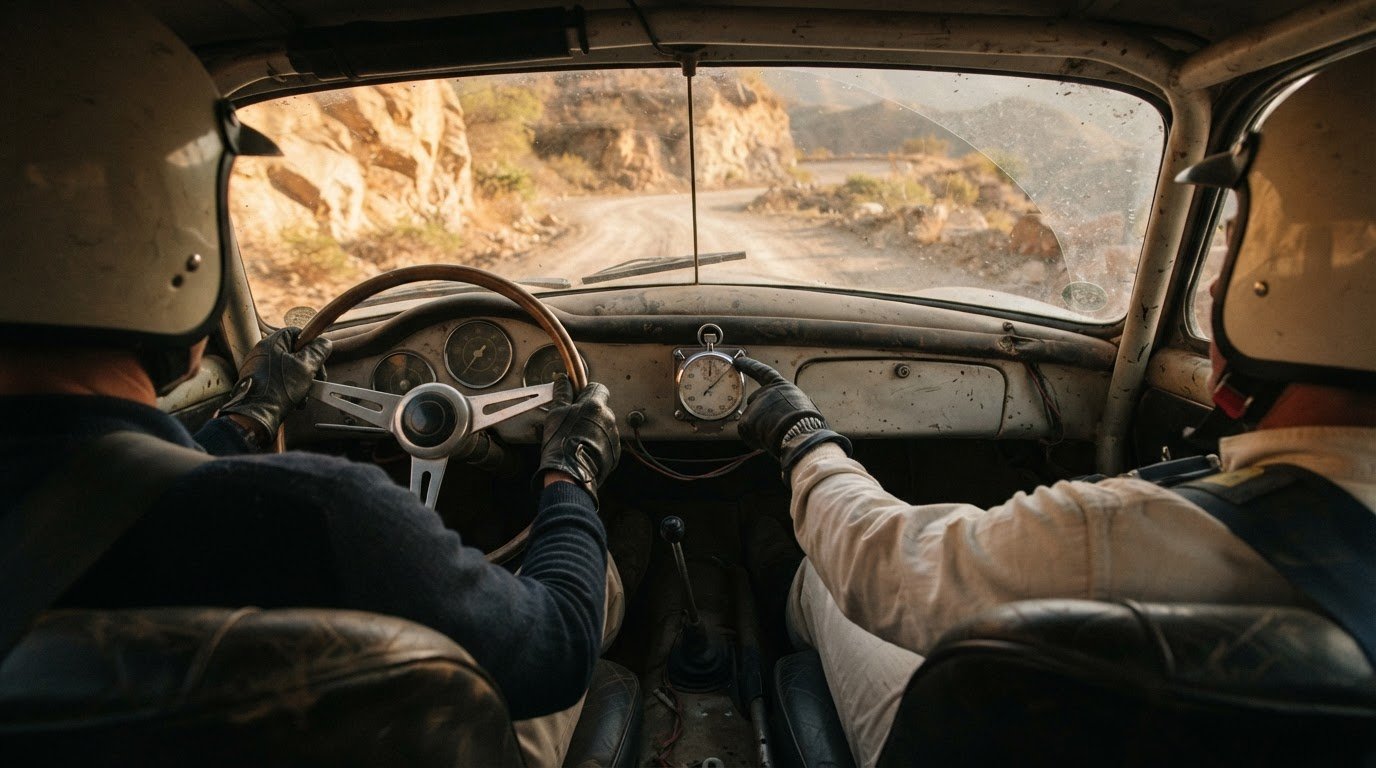
TAG Heuer’s motorsports story began in 1911, when Heuer designed a dashboard chronograph for cars. That early focus on precision timing is the starting point for understanding tag heuer's history in motorsports, long before the Carrera became its best-known racing watch.
The connection between watches and racing goes beyond a name on a dial. Drivers and teams needed clear, dependable timing, and Heuer developed instruments to meet that need as motorsport evolved.
Here, you’ll learn how dashboard timers established the brand’s racing credentials, how Formula 1 and Ferrari deepened its role in competition, and why the Carrera Panamericana inspired the Carrera watch. Together, these milestones show how practical timing equipment became part of watch history.
Key Takeaways
- Trace Heuer’s motorsports entry from dashboard chronographs to onboard timing instruments, and see how precision shaped its racing identity.
- Understand how Formula 1 timekeeping and team sponsorship brought the Heuer name into the heart of competition.
- Discover how the Ferrari partnership linked timing technology with a leading racing team.
- Learn how the Carrera Panamericana inspired the Carrera name and helped turn racing heritage into an enduring watch design.
Early dashboard chronographs and onboard timing
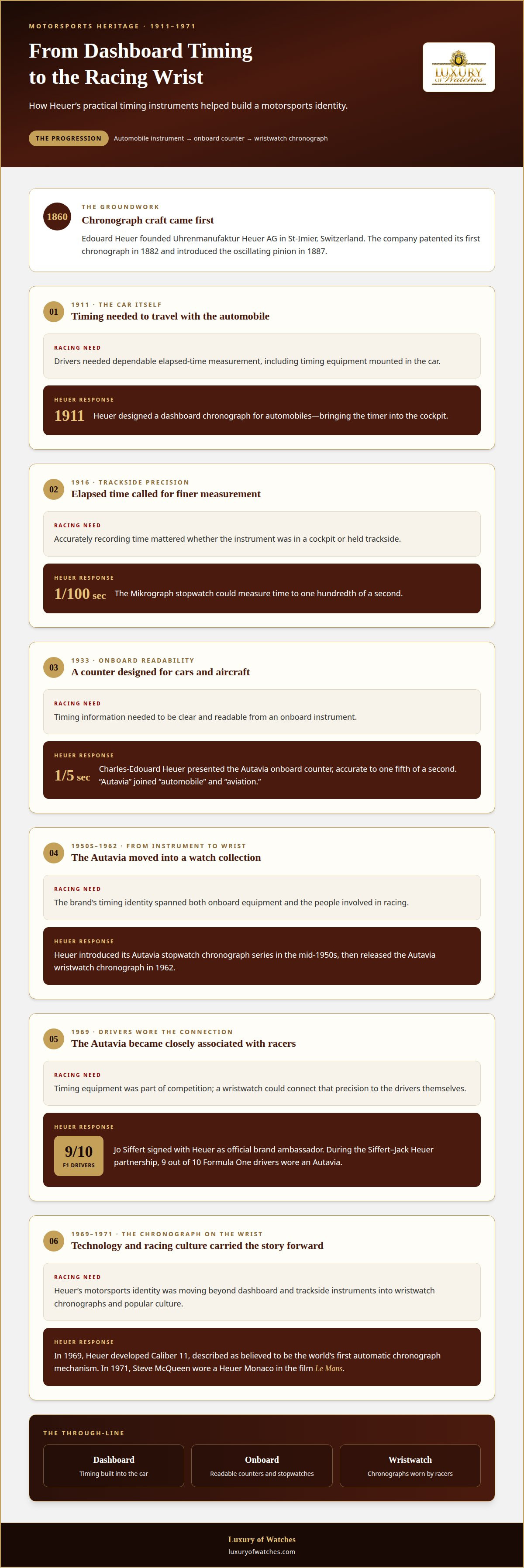
Edouard Heuer founded Uhrenmanufaktur Heuer AG in St-Imier, Switzerland, in 1860. The company’s early chronograph work laid the groundwork for its later connection with sports timing. Heuer patented its first chronograph in 1882 and introduced the oscillating pinion in 1887, a mechanism that became part of its chronograph development.
Heuer brought timing into the car itself in 1911, designing a dashboard chronograph for automobiles. In 1916, it introduced the Mikrograph stopwatch, which could measure time to one hundredth of a second. Those instruments answered a practical racing need: recording elapsed time with precision, whether a device was mounted in a cockpit or held trackside.
In 1933, Charles-Edouard Heuer presented the Autavia onboard counter. It recorded times to an accuracy of 1/5th of a second, making clear, readable timing a central feature of the instrument. Heuer introduced its Autavia stopwatch chronograph series in the mid-1950s, then released the Autavia wristwatch chronograph in 1962. The name joined “automobile” and “aviation,” reflecting the settings its timing instruments were designed to serve.
The Autavia also became closely associated with racing drivers. In 1969, Jo Siffert signed with Heuer as its official brand ambassador. During the partnership between Siffert and Jack Heuer, 9 out of 10 Formula One drivers wore an Autavia, linking the wristwatch to the people timing and competing in races. Heuer’s dashboard instruments and wristwatches thus formed complementary parts of its motorsports identity.
Heuer developed Caliber 11 in 1969, described as believed to be the world’s first automatic chronograph mechanism. The addition marked a major step from manual timing instruments toward automatic wristwatch chronographs. The Monaco later carried this racing association into popular culture: Steve McQueen wore a Heuer Monaco in the 1971 film Le Mans, bringing the watch’s distinctive motorsports image to cinema audiences.
TAG Heuer’s historical Formula 1 timekeeping role
Heuer’s Formula One involvement grew from precision timing into official roles, team partnerships and engine branding. This chapter in TAG Heuer's history in motorsports shows how technical timing work became a lasting presence in racing.
Formula One timekeeping roles
Formula One timekeeping means measuring race performance with dedicated timing systems and official partnerships. Heuer became the series’ official timekeeper in 1974, using its Automatic Car Identification Timing System to time each car to 1/100th of a second. TAG Heuer resumed the role in 1992 and held it until 2003. The brand has been the official timekeeper of the Formula 1 Grand Prix since 2011, reinforcing timing as a defining part of its racing identity.
Pioneering Formula One sponsorship
Heuer’s sponsorship helped establish a new place for watch brands within Formula One. Its logo appeared on a Formula One car in the late 1960s, the first logo there that wasn’t from a car manufacturer. In 1969, Jo Siffert signed a personal sponsorship deal with Heuer, described as Formula One’s first non-automotive personal sponsorship. That shift connected a watchmaker directly with a driver and made its name visible in competition.
TAG Heuer later extended its presence through engine branding. The brand entered Formula One as an engine manufacturer at the 2016 Australian Grand Prix, with TAG Heuer-badged engines used in 62 races. They recorded 9 race victories, 42 podiums, 1,255 points, 3 pole positions, and 13 fastest laps. The partnership ended at the 2018 Abu Dhabi Grand Prix, leaving a defined record of results alongside its timekeeping history.
The brand’s relationship with Porsche also reached electric racing. TAG Heuer began sponsoring Porsche’s next-generation Formula E racing team in 2019, then became title sponsor of Porsche Formula E Team in September 2023. This later chapter in TAG Heuer's history in motorsports carries its racing identity into a different championship, shaped by electric power and modern racing technology.
Heuer’s Ferrari partnership and racing sponsorship
Heuer’s relationship with Ferrari combined sponsorship with practical race timing. In 1971, Heuer signed a deal with Enzo Ferrari, became one of Scuderia Ferrari’s main sponsors, and supplied the team with its timing system. Jack Heuer made a further deal in 1973, making Heuer Scuderia Ferrari’s official timekeeper. The partnership continued until 1979.
Which racing teams and drivers have partnered with TAG Heuer? The names include Scuderia Ferrari and Oracle Red Bull Racing, as well as driver Jo Siffert, who signed with Heuer in 1969. The Ferrari agreement connected the watchmaker to a leading team, while Siffert’s personal sponsorship brought the brand closer to an individual driver.
How has TAG Heuer’s motorsports sponsorship evolved over time? It grew from supporting drivers and supplying timing systems to teams into partnerships with major racing organizations. The Ferrari relationship brought sponsorship and timekeeping together, while later partnerships expanded the brand’s presence across Formula One and other racing formats.
The watches carried that racing identity beyond the track. In the 1990s, TAG Heuer began reissuing historic racing models, including the Carrera, Monaco, Autavia, Monza, and Silverstone. These reissues brought names shaped by motorsports back into the collection, connecting design heritage with contemporary watchmaking. In 2015, a special-edition Carrera marked McLaren’s 50th anniversary, linking a historic watch line with another prominent name in racing.
Oracle Red Bull Racing represents a later chapter in the sponsorship story. TAG Heuer has been the team’s official timekeeper and partner since 2016. That partnership places the brand alongside a Formula One team, while its earlier Ferrari role shows how its racing presence has shifted across generations. Across these relationships, accurate timing and visible team association have helped make motorsports central to the brand’s identity.
Partnership with the Carrera Panamericana
TAG Heuer’s distinction in motorsports comes from the direct link between racing, timing and watch design. The Carrera Panamericana gave the Carrera its name, while partnerships and historic models built a broader racing identity.
The Carrera’s racing connection
The Carrera watch carries the name of the Carrera Panamericana, a Mexican road race launched in 1950 and spanning over 2,000 miles. That origin gives the watch a connection to a demanding motorsport event rather than a general racing aesthetic. TAG Heuer has partnered with the Carrera Panamericana since 1991, extending the association beyond the watch’s original inspiration.
Jack Heuer and the Carrera name
Jack Heuer chose Carrera after hearing about the race at the 12 Hours of Sebring. The 1962 Carrera Panamericana inspired the name, and Heuer introduced the Carrera watch in 1963. The sequence matters: a motorsport story became a concise name, then a watch collection. It gave the Carrera a clear link to racing history from its beginning.
Carrera and Autavia collections
The Carrera and Autavia both reflect Heuer’s motorsports heritage, but their histories connect to different racing contexts. The Carrera’s name came from the Mexican road race, while Autavia began as an onboard counter name. Porsche later brought Carrera into its own model names: it introduced the 356A Carrera roadster in 1954 and the first 911 Carrera in 1973. These examples show how the name became part of wider motoring culture. Steve McQueen’s appearance in Le Mans wearing a Heuer Monaco also helped carry racing watches into popular culture.
For a closer look at watches shaped by this heritage, explore TAG Heuer watches and consider how the Carrera’s racing origins compare with the Autavia’s onboard-timing roots.
Luxury of Watches: TAG Heuer Watches
Luxury of Watches offers TAG Heuer watches for readers drawn to the brand’s motorsports heritage. The racing histories behind the Carrera, Autavia and Monaco explain why these names mean more than competition alone. This context can help collectors choose a watch that reflects their interest in timing, design or motorsport culture.
Explore TAG Heuer watches alongside the brand’s racing legacy, then focus on the details and style that suit your preferences. Luxury of Watches also offers pre-owned luxury watches, including options from other established watchmakers.
For help with your watch search, contact Luxury of Watches.
Choose a Watch With a Story That Speaks to You
A watch can mark more than the time. Its design may reflect a personal connection to racing, an appreciation for mechanical craft or simply the style you want to wear every day. Understanding TAG Heuer’s history in motorsports offers a richer way to appreciate that connection, while your preferences can guide what matters most in a watch.
As you explore your next timepiece, consider whether you’re drawn to a racing legacy, distinctive design or a watch with a history of its own. Luxury of Watches offers TAG Heuer watches, Rolex watches, used Rolex watches and pre-owned luxury watches for different tastes and collecting interests.
If you’re ready to continue your search, contact Luxury of Watches and take the next step toward finding a watch that feels right for you.
Frequently Asked Questions
When Did TAG Heuer Start?
The company began as Heuer in 1860; the TAG Heuer name dates from TAG’s acquisition of Heuer in 1985. Its motorsports work started earlier, with a car dashboard chronograph in 1911. So the answer depends on whether “start” means the watchmaker’s founding, its first automotive timing instrument, or the later TAG Heuer identity used today.
What is the history of Heuer and TAG Heuer in Formula One?
Heuer’s Formula One history joined brand visibility with race timing. Its logo appeared on a car in the late 1960s, and it became the series’ official timekeeper in 1974. After TAG acquired Heuer, TAG Heuer resumed the timekeeping role from 1992 until 2003. Later involvement also included engines bearing the TAG Heuer name and partnerships with racing teams.
How did Jack Heuer influence the brand’s motorsports history?
Jack Heuer developed the brand’s racing presence through watch naming, driver relationships, and team partnerships. He introduced the Carrera in 1963, naming it after the Carrera Panamericana, and worked with Jo Siffert, who became Heuer’s official brand ambassador in 1969. Jack Heuer also arranged for Heuer to become Scuderia Ferrari’s official timekeeper in 1973, connecting the brand with both drivers and teams.
What are TAG Heuer’s most important racing-inspired watch models?
The Carrera, Autavia, Monaco, Monza, and Silverstone are key models associated with the brand’s racing heritage. The Carrera takes its name from the Carrera Panamericana, while the Autavia originated as an onboard counter name. The Monaco gained wider cultural recognition when Steve McQueen wore one in the 1971 film Le Mans. TAG Heuer began reissuing these historic racing watches in the 1990s.
When did TAG Heuer become the official timekeeper of Formula One?
Heuer first became Formula One’s official timekeeper in 1974, using an Automatic Car Identification Timing System that timed each car to 1/100th of a second. TAG Heuer resumed the role in 1992 and held it until 2003. The brand has also been the official timekeeper of the Formula 1 Grand Prix since 2011, marking a later chapter in its timing history.
What does TAG Heuer do as a motorsports timekeeper and technology partner?
As a timekeeper, Heuer’s historical systems measured race times and identified individual cars, including through its 1974 Formula One timing system. Its technology and team relationships have also taken other forms: Heuer supplied Scuderia Ferrari with a timing system, while TAG Heuer-badged engines later competed in Formula One. These examples show roles spanning measurement, equipment, and racing partnerships.