
7 Critical Signs a Rolex Has Been Over-Polished: A Collector’s Guide
Posted by Luxury of Watches on 11th Aug 2026
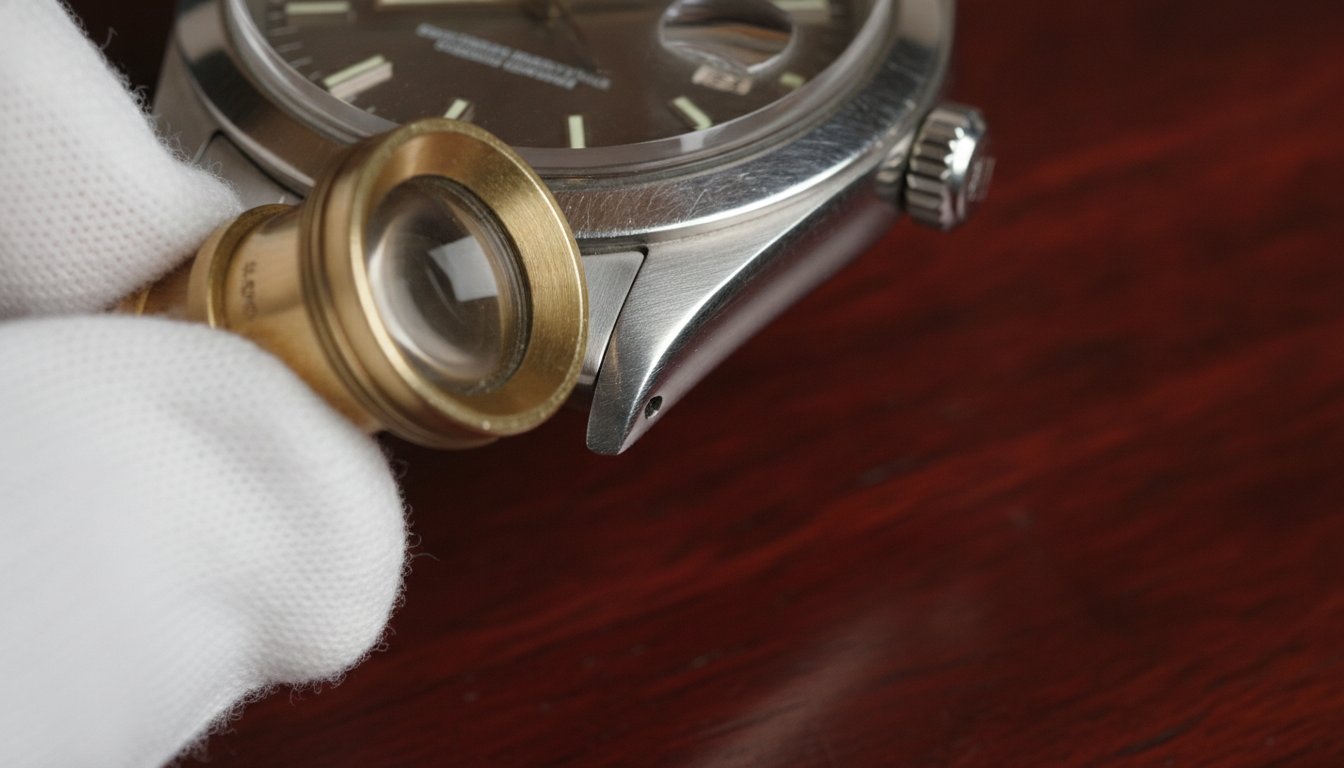
In the world of high-end horology, a mirror-like shine is often the greatest enemy of a Rolex's long-term value. While a gleaming case looks impressive under boutique lights, seasoned collectors know that excessive buffing can permanently strip away the geometric precision that makes these watches iconic. You likely appreciate the pristine look of a luxury timepiece, yet that brilliance often masks a significant loss of structural integrity and historical character. Understanding the specific signs a rolex has been over-polished is the most effective way to safeguard your capital when navigating the secondary market.
We understand that purchasing a pre-owned Rolex is as much a financial decision as it is an emotional one. This guide will teach you how to identify a "sharp" case versus a "soft" one, ensuring you don't overpay for a watch that has lost its original factory chamfers. You'll learn to analyze lug thickness, bezel definition, and the clarity of crown engravings to verify a piece's condition. We'll provide you with the expert vocabulary needed to secure a well-preserved investment piece that retains its value and prestige for decades to come.
Key Takeaways
- Learn to identify "soft" lug transitions and thinning chamfers that indicate a permanent loss of original factory geometry.
- Discover why a "melted" or flattened coronet on the clasp is one of the most reliable signs a rolex has been over-polished.
- Understand the significant market premiums, often exceeding 20%, that collectors pay for unpolished examples compared to aggressively buffed pieces.
- Master the process of using macro-photography and service history to verify case integrity before finalizing a high-value transaction.
- Explore how expert verification and extended warranties safeguard your collection against the hidden risks of poor maintenance.
The Collector's Dilemma: Why Rolex Polishing Matters
For the discerning collector, a Rolex represents more than a tool for timekeeping; it's a masterpiece of industrial design. A common mistake in the pre-owned market is prioritizing a mirror-like shine over the original lines of the watch. When we discuss the signs a rolex has been over-polished, we're specifically referring to the irreversible loss of original case geometry and metal thickness. While a light factory refinish is designed to restore luster without altering shape, aggressive third-party buffing often destroys the very lines that make the watch valuable.
In the secondary market, "unpolished" has transitioned from a simple description to a high-value buzzword. Collectors frequently pay a significant premium for pieces that retain their factory-fresh "sharpness." This preference exists for several practical reasons:
- Historical Authenticity: An unpolished case represents the watch exactly as it left the manufacturer.
- Value Retention: High-quality examples often command premiums of 20% to 50% over their polished counterparts.
- Structural Longevity: Avoiding metal loss ensures the case remains strong enough for future decades of wear.
Sharpness serves as the primary indicator of a watch's history, telling a story of careful ownership rather than heavy-handed maintenance. Once those original lines are gone, they cannot be replaced, making the initial inspection a vital step in any acquisition.
Factory Finish vs. Aftermarket Polishing
Rolex employs specialized lapping machines to create perfectly flat surfaces and razor-sharp transitions. These tools provide the industrial precision required to ensure that the contrast between polished and brushed surfaces remains crisp. In contrast, amateur polishing often relies on soft buffing wheels. These wheels lack the rigidity required to maintain a straight edge, which causes them to "round off" the design and soften the watch's profile. The factory look is defined by distinct, contrasting brushed and mirrored finishes.
The Impact of Metal Loss on Case Integrity
Every time a watch meets a polishing wheel, it loses a microscopic layer of 904L stainless steel or precious gold. While a single professional refinish is negligible, repeated or heavy-handed sessions lead to "thin" lugs that may appear asymmetrical or disproportionate. This metal loss isn't just an aesthetic concern. Aggressive metal removal can eventually compromise structural integrity, affecting how the bezel sits or how the spring bars fit within the lug holes. Identifying the signs a rolex has been over-polished is a critical skill for any investor looking to secure a piece that will stand the test of time.
How to Spot the Visual Signs of an Over-Polished Rolex
Visual inspection is your primary defense against a bad investment. While a watch may look brilliant at a glance, a closer look often reveals the subtle signs a rolex has been over-polished. You must train your eyes to look past the luster and focus on the architecture of the case itself. A well-preserved watch should look as though it was carved from a single block of steel, with every plane and angle serving a specific aesthetic purpose.
The 'Soft Lug' and Asymmetry Test
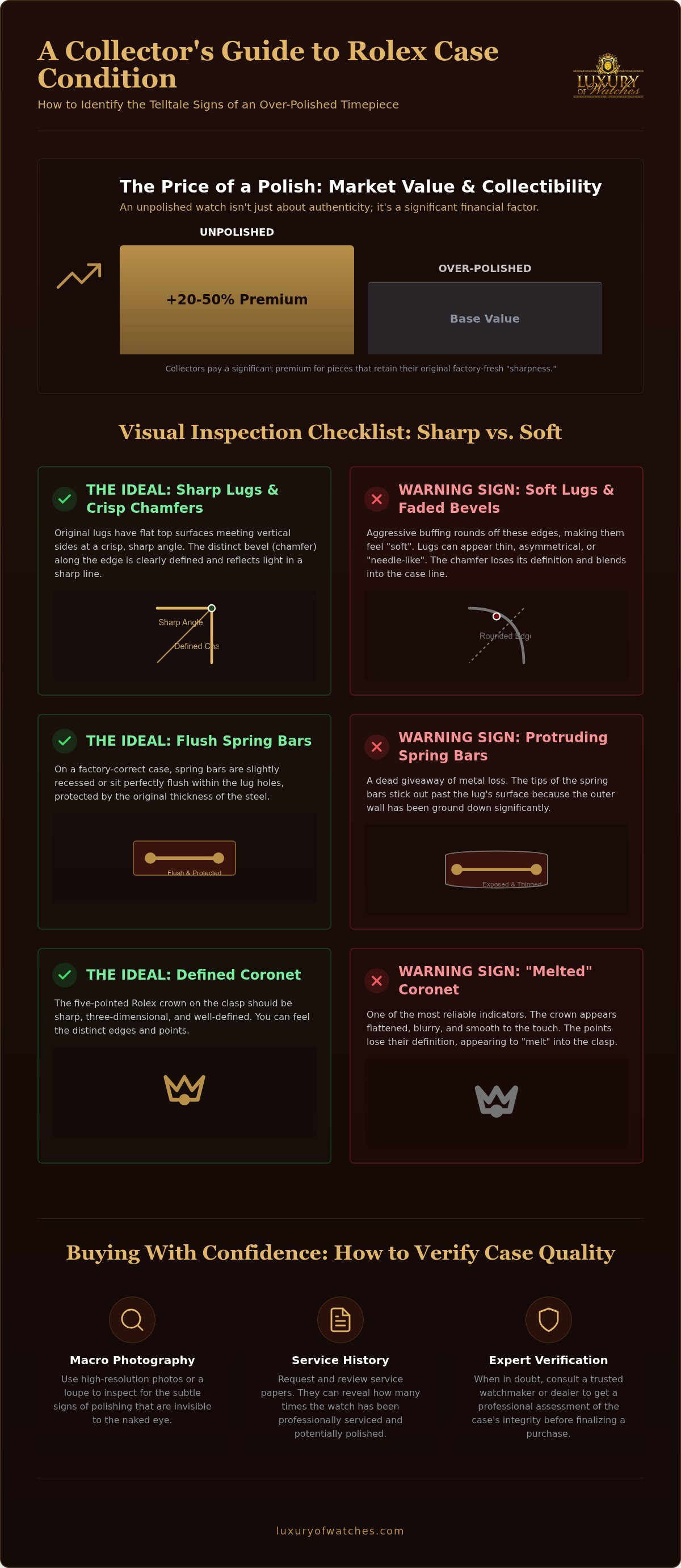
The lugs are often the first area to suffer under a heavy-handed buffing wheel. Original lugs possess a flat top surface that meets the vertical side at a crisp, sharp angle. As metal is removed, these edges become rounded and "soft" to the touch. In extreme cases, the lugs may appear needle-like or significantly thinner than they should be. Always compare the left and right sides of the case. If one lug is noticeably slimmer than its counterpart, the watch has been unevenly polished to remove deep scratches or dents. Our curated collection of Used Rolex watches is vetted specifically for these geometric standards to ensure every piece maintains its intended profile.
Spring Bar Protrusion: A Dead Giveaway
Checking the spring bar holes is perhaps the most objective way to identify metal loss. In a factory-correct case, the spring bars are usually slightly recessed or perfectly flush with the lug holes. They are protected by the original thickness of the steel. If you notice the tips of the spring bars sticking out past the surface of the lug, it's a clear sign that the metal has been thinned. This protrusion is one of the most undeniable signs a rolex has been over-polished, as it proves the outer wall of the lug has been ground down significantly.
Faded Chamfers and Lost Bevels
Many classic Rolex models feature a distinct bevel, or chamfer, that runs along the edge of the lug. These chamfers should be uniform in width and perfectly straight. Aggressive polishing "washes away" these lines, blending the top and side surfaces into one continuous, rounded curve. A "ghost chamfer" describes the faint, blurry line left behind when a technician attempts to re-cut a bevel on a lug that lacks sufficient metal, serving as a clear indicator of a poorly executed restoration. When these bevels lose their definition, the watch loses the light-catching "sparkle" that defines its luxury status.
Analyzing the Bracelet, Clasp, and Coronet
The bracelet and clasp are often the first points of contact with hard surfaces, leading to the "desk diving" scratches that tempt owners into frequent polishing. While a restored bracelet can look attractive at a glance, it often hides significant metal loss that compromises the original design. Examining these components provides essential clues to the watch's maintenance history, as they are frequently subjected to the most aggressive buffing.
The Clasp Coronet Integrity
A crisp, three-dimensional coronet on the clasp is a hallmark of a well-preserved Rolex bracelet. On unpolished or lightly refinished examples, the crown logo should stand proud of the surface with sharp points and clear definition between its five fingers. When a clasp is subjected to aggressive buffing, the abrasive wheels "melt" the logo. This results in a coronet that looks smeared, flattened, or nearly flush with the surrounding metal. Such deterioration is a major red flag because the coronet cannot be easily recut once the metal is gone. A flattened logo significantly decreases the desirability and market value of pre-owned luxury watches, as it signals a lack of respect for the original factory specifications.
Brushed vs. Polished Finish Consistency
Standard Rolex Oyster bracelets feature a specific grain in their brushed finish. This vertical satin effect should be uniform across all links. If you notice "stray" mirror-polished marks on the brushed surfaces, or if the transition between polished center links and brushed outer links is blurry, the bracelet has likely undergone a non-professional refurbishment. A true factory-authorized finish maintains a distinct, sharp boundary between these contrasting textures. At Luxury of Watches, our expert verification protocols prioritize the preservation of these original textures, ensuring the pieces we offer maintain their factory-intended character.
Inspect the sides of the links with a loupe. On a factory-fresh bracelet, the sides are perfectly flat. If they appear convex or "pillowed," too much metal has been removed. Pay close attention to the screw holes. In an unpolished link, the screw head sits slightly recessed or perfectly flush within a sharp-edged hole. If the hole looks "volcano-like" or rounded at the edges, it's one of the undeniable signs a rolex has been over-polished. This level of metal loss is irreversible and often leads to a "loose" feel in the bracelet that even a professional tightening cannot fully fix.
The Price of a Polish: Market Value and Collectibility
The financial delta between a "sharp" watch and a "soft" one is substantial. In the secondary market, unpolished "safe queens" often command a 20% to 50% premium over polished examples of the same reference. For vintage icons like the Submariner 5513, case sharpness remains the single most important value driver. A watch that has been aggressively buffed loses its factory soul, and with it, a significant portion of its resale potential. While a daily wearer might prioritize a clean appearance, a pure investment collector will always choose the sharp, scratched original over a soft, polished piece that looks "perfect" but lacks its original lines.
Why Collectors Pay More for Scratches
It might seem counterintuitive to prefer a scratched watch over a gleaming one. However, surface scratches prove the original metal is still present. While a professional can remove a scratch, they can't add metal back once it's been ground away. Collectors value "honest wear" because it guarantees the watch hasn't been tampered with or thinned. This preservation of geometry is a key factor when analyzing Rolex prices 2026, as rarity increasingly hinges on condition rather than just model number. A watch with its original factory bevels intact is a finite resource; once those lines are gone, the watch is permanently altered.
When Polishing is Acceptable
Not all polishing is destructive. A light touch-up to remove hairline swirls is vastly different from a full machine polish. Rolex Service Centers (RSC) follow strict protocols to maintain factory standards, and their work is generally trusted by the community. For watches already showing signs a rolex has been over-polished, modern restoration techniques like laser welding offer a solution. This process allows a specialist to add 904L steel back to thin lugs, rebuilding the case geometry before a final, precise refinish. While effective, this is a restorative measure for compromised pieces rather than routine maintenance for healthy ones.
Buying a watch with a known service history is the best way to ensure it hasn't been subjected to multiple aggressive buffing sessions. If you're looking for a piece that has been expertly vetted for its structural integrity, explore our current selection of Used Rolex watches where we prioritize case sharpness and long-term investment value. We focus on acquiring examples that retain their factory-intended character, providing you with the peace of mind that your capital is protected.
Buying with Confidence: How to Verify Case Quality
Acquiring a pre-owned Rolex requires a balance of technical scrutiny and professional trust. Now that you understand the physical indicators of metal loss, applying this knowledge in a digital marketplace is the next step. High-resolution, macro-photography is your most valuable tool. You should specifically request clear shots of the lugs from a side profile and a direct head-on view. Blurry or distant images often mask the signs a rolex has been over-polished; insist on seeing the grain of the steel and the sharpness of the transitions before committing to a purchase.
The symmetry test is a simple yet effective method for identifying heavy-handed restoration. When looking at the watch head-on, compare the thickness of the top-left lug to the top-right lug. They should be identical. If one lug appears thinner or tapers more aggressively, it indicates that a deep scratch was ground out at the expense of the case's original proportions. Don't hesitate to ask for the watch's service history. Knowing where a watch was last serviced provides a clear indication of whether it was handled by a factory-trained technician or an amateur with a buffing wheel.
The Importance of Expert Verification
Choosing a reputable intermediary is the most effective way to mitigate the risks associated with "soft" cases. At Luxury of Watches, our verification process is designed to satisfy the scrutiny of serious collectors. We prioritize inventory that retains its original factory geometry, ensuring that every piece remains a viable investment. Our 5-year in-house warranty serves as a mark of confidence in the watch's structural longevity and maintenance history. This level of protection is essential when dealing with high-value transactions where condition directly dictates future market value.
Final Checklist Before Your Purchase
Before finalizing any acquisition, run through this mental checklist to confirm the watch's integrity:
- Lug Thickness: Are the lugs full and symmetrical across both sides of the case?
- Spring Bar Position: Are the pins recessed or flush, rather than protruding past the steel?
- Coronet Definition: Is the crown logo on the clasp raised and sharp to the touch?
- Finish Consistency: Does the contrast between brushed and polished surfaces match the original factory specifications?
Securing a well-preserved timepiece is a rewarding experience that preserves both horological history and your financial capital. Explore our curated collection of Rolex watches with verified case integrity to find your next investment-grade piece.
Securing Your Horological Legacy
Protecting your investment requires looking beyond the immediate luster of a polished surface. You've learned that original case geometry, crisp lug transitions, and a well-defined clasp coronet are the true markers of a high-value timepiece. Identifying the signs a rolex has been over-polished is a critical skill that distinguishes the casual buyer from the serious collector. By prioritizing "sharp" examples, you ensure that your watch retains its historical character and commands its full market potential. This technical scrutiny is the foundation of a robust and enduring collection.
At Luxury of Watches, we eliminate the guesswork from the secondary market. Every piece in our inventory undergoes expert horological verification to ensure absolute authenticity and geometric integrity. We provide a 5-year in-house warranty as a standard safeguard for your purchase. It's our promise that the watch you choose is as mechanically sound as it is aesthetically preserved, offering you the security required for high-value transactions. Browse Our Collection of Verified Pre-Owned Rolex Watches to find a timepiece that truly stands the test of time. Your journey toward a world-class collection begins with a commitment to quality and a partner you can trust.
Frequently Asked Questions
Is a polished Rolex worth less than an unpolished one?
Yes, an unpolished Rolex typically commands a higher market value than a polished example. Collectors often pay premiums ranging from 20% to 50% for pieces with original factory lines intact. While a polished watch appears newer, the permanent removal of metal reduces its historical authenticity and investment appeal. Scratches are superficial; metal loss is irreversible.
Can you tell if a Rolex has been polished by looking at the lugs?
The lugs provide the most visible evidence of metal removal. You can identify polishing by looking for rounded edges where the factory intended a sharp, 45-degree angle. Thin, needle-like lugs are common signs a rolex has been over-polished. These often appear asymmetrical when compared to the opposite side of the case, indicating uneven buffing during a previous service.
What does it mean when a watch dealer says a case is 'sharp'?
A "sharp" case is one that retains its original factory geometry and metal thickness. This term describes a watch with crisp edges, flat surfaces, and well-defined bevels that haven't been softened by buffing wheels. For serious collectors, sharpness is a primary indicator of a watch's condition and history. It represents a piece that has been carefully preserved rather than aggressively restored.
Does Rolex polish watches during a standard service?
Rolex Service Centers usually include a case and bracelet refinish as part of their standard maintenance protocol. While their technicians are exceptionally skilled at maintaining factory proportions, every polish removes a microscopic layer of steel. You can explicitly request that the service center skip the polishing step to preserve the current state of your watch's case and its long-term value.
Can an over-polished Rolex be fixed?
While you cannot simply undo a polish, a case can be restored using laser welding. This process involves adding new metal to thinned lugs or rounded edges before recutting the original factory lines. It is a highly specialized restoration technique used to save historically significant pieces. It is always preferable to find a watch that doesn't require such invasive intervention.
What is the 'symmetry test' for Rolex cases?
The symmetry test involves comparing the thickness of the lugs while looking at the watch from a direct head-on angle. In an unpolished case, the lugs should be mirrors of each other. If the top-left lug is noticeably wider than the top-right, it indicates that a technician ground down the thinner side to remove a deep scratch or impact mark.
Is it better to buy a scratched unpolished Rolex or a shiny polished one?
An unpolished watch with visible scratches is generally a more secure investment than a shiny, over-polished one. Surface marks are evidence of "honest wear" and can be addressed with a light, professional touch-up if desired. A watch that shows signs a rolex has been over-polished has lost its original architecture. Once that metal is gone, the watch's value is permanently lowered.
How do I know if the spring bars are protruding?
Look closely at the lug holes where the bracelet or strap is attached. In a factory-thick case, the spring bars should sit slightly recessed or perfectly flush within the hole. If the tips of the bars stick out past the outer surface of the lug, the metal has been thinned. This protrusion is one of the most reliable technical indicators of heavy polishing.